Category
Manufacturer
Model
Podbielniak
Podbielniak specializes in equipment for the dairy industry, particularly in the production of cheese and yogurt. Their machines are designed for optimal efficiency and quality, catering to both small and large scale operations.
FAQ:
What is a Podbielniak extractor and what is it used for?
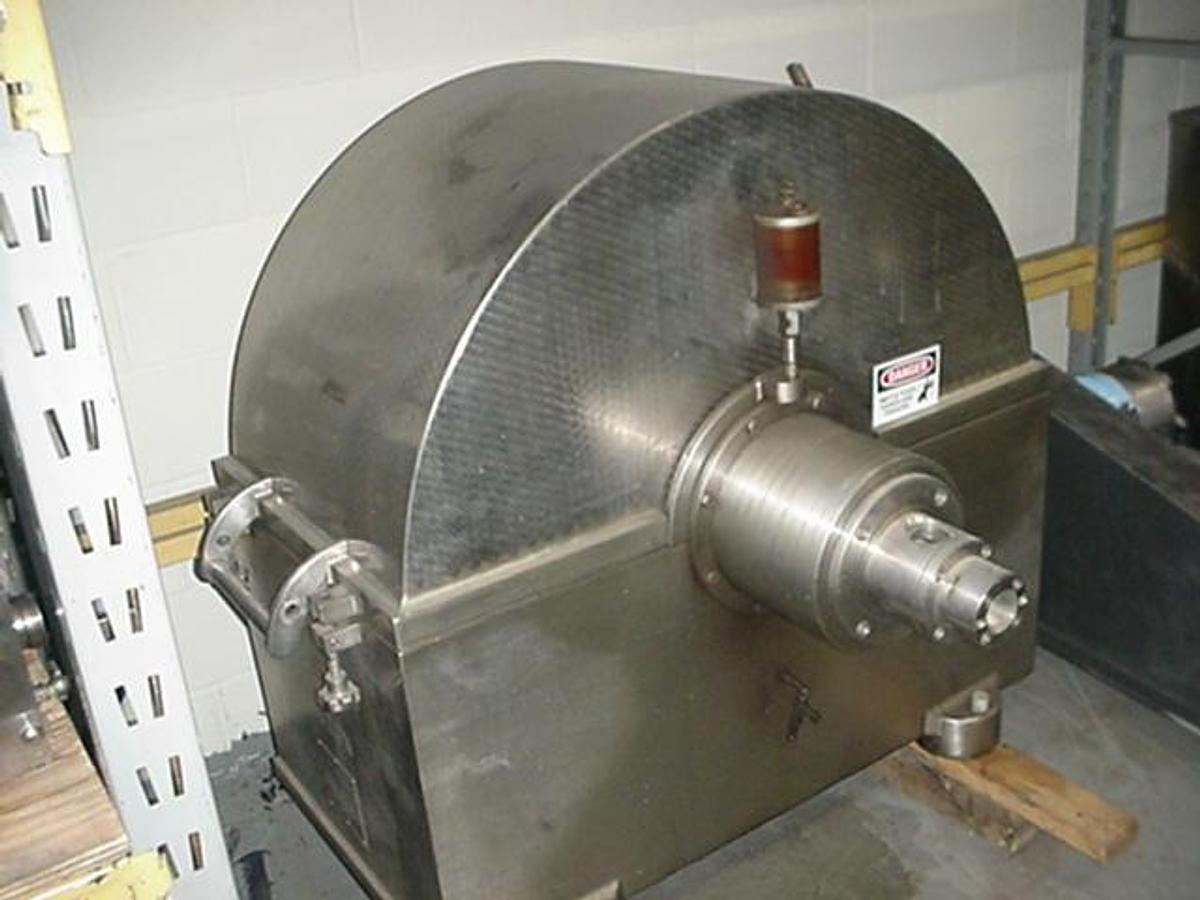
A Podbielniak extractor, often called a "Pod" in industrial settings, is a centrifugal liquid-liquid contactor that uses centrifugal force to bring two immiscible liquid phases into close contact for continuous extraction. Unlike conventional mixer-settler systems or packed columns, the Podbielniak accomplishes in a single compact unit what might otherwise require multiple stages of equipment. The rotor spins at high speeds, typically between 2,000 and 5,000 RPM, creating a centrifugal field that accelerates phase separation and drives the lighter and heavier liquids through a series of concentric channels where mass transfer occurs rapidly.
The technology was originally developed for antibiotic extraction, and pharmaceutical manufacturing remains one of its most prominent applications. Penicillin, erythromycin, and other fermentation-derived antibiotics are routinely processed using Podbielniak contactors because the equipment handles shear-sensitive materials gently while still achieving high extraction efficiency. Beyond pharmaceuticals, the equipment sees use in food processing, including dairy applications such as cheese and yogurt production, as well as in chemical processing, petroleum refining, and wastewater treatment. The compact footprint, continuous operation, and ability to handle liquids with small density differences make it a preferred choice in processes where conventional gravity-based extraction would be impractical or too slow.
What models of Podbielniak centrifugal extractors are commonly available on the used equipment market?
The used and surplus market carries a fairly wide range of Podbielniak models, though availability at any given time depends on what industrial facilities are decommissioning. Smaller laboratory and pilot-scale units such as the A-1 and B-10 appear periodically and are sought after by research operations or facilities running low-volume processes. Mid-range models like the D-36 and E-48 are common in pharmaceutical and specialty chemical plants and tend to move relatively quickly because they fit a broad range of production-scale applications. Larger industrial units, including the 9500 series and UPV series, represent significant throughput capacity and are typically sourced from major manufacturing or refining operations.
The model number often gives a rough indication of rotor volume or throughput class, so buyers researching a specific model should cross-reference the manufacturer's published specifications to confirm flow rate capacity and the number of theoretical equilibrium stages the unit provides. That last figure, the number of theoretical stages, is particularly important because it directly determines how much separation the machine can accomplish in a single pass. A unit listed simply by model number on the surplus market may or may not include documentation, so working with a dealer who can provide detailed specifications, photos, and inspection access is important when evaluating whether a particular unit suits the intended process.
What industries commonly use Podbielniak centrifugal contactors?
Pharmaceutical manufacturing has historically been the largest user of Podbielniak centrifugal contactors, primarily because the equipment excels at extracting antibiotics and other fermentation products from aqueous broths. The continuous, closed-system operation minimizes solvent losses and exposure, which matters greatly in GMP-regulated environments. The dairy industry also uses Podbielniak equipment, particularly in cheese and yogurt production, where the machines support separation and processing steps that benefit from controlled centrifugal contact between liquid phases.
Beyond those two sectors, Podbielniak extractors are used in specialty chemical manufacturing, petroleum and petrochemical refining, nuclear fuel reprocessing, and certain wastewater treatment applications where liquid-liquid extraction is needed to recover or remove specific compounds. The equipment's ability to handle liquids with small density differences, and to process emulsion-prone systems that would be difficult to separate by gravity, makes it valuable in any industry dealing with complex liquid phase chemistry. Buyers sourcing used Podbielniak equipment should consider whether the previous application involved corrosive or contaminating materials, since process history affects the condition of internal seals, rotor surfaces, and wetted parts.
What materials of construction are available for Podbielniak extractors, and why does it matter?
Podbielniak extractors have been manufactured in several materials of construction to accommodate the wide range of chemical environments they encounter. Stainless steel, particularly 316L, is the most common and suits the majority of pharmaceutical, food-grade, and general chemical applications. For more aggressive chemical environments, units constructed from Hastelloy C offer substantially better resistance to chlorides, oxidizing acids, and other corrosive media. Titanium variants also exist for applications involving halogenated solvents or highly oxidizing conditions where even Hastelloy may be marginal.
For buyers sourcing used equipment, material of construction is one of the most critical factors to verify before purchase. A stainless steel unit that processed a mildly corrosive solvent for years may show internal pitting or surface degradation that is not visible in external photos. Conversely, a Hastelloy unit may be significantly overbuilt for a non-corrosive application but could command a premium price on the used market due to its material value alone. Buyers should request documentation or at minimum detailed photos of the rotor, housing interior, and any seals or gaskets, and should factor in the cost of replacing wear components when evaluating the total acquisition cost of a used unit.
What flow rate capacities do different Podbielniak models offer?
Flow rate capacity in Podbielniak extractors varies considerably across the model range, which is one reason model selection is so application-specific. Smaller units intended for pilot or limited production use may handle combined phase flow rates of just a few liters per minute, while large industrial models in the 9500 and UPV series can process hundreds of liters per minute of combined aqueous and organic phase. The ratio of the two phases, called the phase ratio, also affects practical throughput, since the equipment must handle both streams simultaneously within its design envelope.
It is worth noting that published flow rate figures from the manufacturer represent design capacity under specific conditions, including fluid viscosities, density differences, and interfacial tension values. In practice, a used unit being redeployed into a different process may perform differently than the nameplate suggests if the new application involves fluids with substantially different physical properties. Buyers should consult with a process engineer familiar with liquid-liquid extraction to confirm that a candidate unit's rotor size and speed range are appropriate for the specific flow rates and separation requirements of their process before committing to a purchase.
What should buyers inspect when evaluating a used Podbielniak extractor?
Evaluating a used Podbielniak extractor requires attention to several mechanical and process-related factors that are easy to overlook when reviewing only external photos or a basic equipment listing. The rotor is the heart of the machine and operates at high rotational speeds, so any sign of imbalance, corrosion, erosion, or mechanical damage is a serious concern. Seal integrity is equally important since the rotating assembly must maintain separation between the two liquid phases and prevent leakage of potentially hazardous or valuable solvents. The motor condition, bearing wear, and vibration isolation mounts should all be assessed, ideally during a live or video inspection.
Reputable used equipment dealers will typically accommodate in-person inspections or detailed video walkthroughs of the machine. Some units may still be installed and operating at the selling facility, which provides the best opportunity to observe the equipment running under load. Keep in mind that most equipment dealers do not have the permitting or infrastructure to run actual product through a machine at their facility, so functional testing in the dealer's possession is usually limited to confirming that the motor runs and the rotor turns freely. Buyers with specific process requirements should also consult with the manufacturer regarding parts availability and technical support for the model in question, since older or discontinued models may have limited spare parts availability.
How does a Podbielniak extractor differ from other liquid-liquid extraction methods?
Conventional liquid-liquid extraction methods, including mixer-settlers, pulsed columns, and rotating disc contactors, rely primarily on gravity to separate the two liquid phases after mixing. This works reasonably well when the density difference between the phases is significant, but it becomes slow or impractical when the phases have similar densities, when one phase tends to emulsify, or when the process requires a very small physical footprint. The Podbielniak addresses these limitations by using centrifugal force, which can be hundreds of times stronger than gravity, to drive phase separation and mass transfer simultaneously within a compact rotating rotor.
The result is a continuous extraction process that can achieve multiple theoretical stages of separation in a single machine, with residence times measured in seconds rather than minutes. This speed is particularly valuable in pharmaceutical applications where the extracted compound may be unstable and prolonged contact with solvents or aqueous phases could cause degradation. The closed, continuous nature of the system also reduces solvent inventory and minimizes worker exposure compared to open batch extraction setups. On the downside, the mechanical complexity of a high-speed rotating assembly means maintenance requirements are more demanding than those of simpler gravity-based systems, which is an important consideration when evaluating used equipment.
What is the typical price range for used Podbielniak equipment?
Pricing for used Podbielniak extractors on the surplus market varies widely depending on model size, material of construction, age, condition, and current market supply. Small pilot-scale units can sell for a few thousand dollars when available, while mid-range production models in good condition typically fall in the range of tens of thousands of dollars. Large industrial units, particularly those in specialty alloys like Hastelloy or titanium, can command prices well into six figures depending on their condition and the demand for that specific configuration.
Because these machines are sold as used equipment, price alone is rarely a reliable indicator of value. A lower-priced unit that requires significant seal replacement, rotor reconditioning, or motor work may end up costing more in total than a higher-priced unit in better condition. Buyers should request detailed condition information and factor in the cost of any necessary refurbishment, spare parts, shipping, and rigging when calculating the true landed cost of the equipment. Dealers who specialize in process and separation equipment and have a long track record in the industry are generally better positioned to provide accurate condition assessments than general surplus liquidators.
What should buyers know about shipping and rigging a Podbielniak extractor?
Podbielniak extractors contain precision-machined rotating components that require careful handling during transit. The rotor assembly in particular is sensitive to shock and improper orientation, and damage during shipping can be costly to repair or may render a unit unusable. Proper packaging, which typically involves securing or removing the rotor assembly, draining all process fluids, and crating the unit to prevent movement, is essential. Smaller units may ship on a standard pallet with adequate bracing, while larger industrial models will require custom wooden crating or skidding to protect the housing, nozzles, and drive components.
Larger Podbielniak units can be substantial in weight and may require industrial rigging equipment for loading at the origin facility and unloading at the destination. Buyers should ask the selling dealer for specifics on how the unit will be packaged, what rigging will be required, and whether those costs are included in the quoted price or billed separately. Understanding the full landed cost, including freight, rigging, and any required crating, is important before finalizing a purchase. International shipments add additional considerations around customs documentation, export compliance, and the need for detailed packing lists that accurately describe the equipment and its components.
What are the key operational considerations for running a Podbielniak centrifugal extractor?
Operating a Podbielniak extractor safely and effectively requires attention to several factors that are specific to high-speed centrifugal equipment. The rotor must be properly balanced before operation, and any imbalance, whether from uneven liquid distribution, rotor wear, or improper reassembly after maintenance, can cause vibration that accelerates bearing wear and risks mechanical failure. Vibration isolation mounts should be in good condition, and facilities should have a procedure for monitoring vibration levels during operation. Seal condition is another ongoing concern, since the seals must maintain integrity at operating speeds while handling potentially aggressive process fluids.
From a process standpoint, operators need to maintain the correct phase ratio and flow rates to keep the liquid interface within the rotor at the intended location. If the interface migrates too far in either direction, one phase can break through into the other outlet stream, reducing extraction efficiency and potentially contaminating the product. Startup and shutdown procedures also matter, since the centrifugal field must be established before significant liquid flow is introduced to prevent flooding. Facilities acquiring used Podbielniak equipment should plan for a commissioning period that includes verifying all mechanical systems, confirming seal integrity under process conditions, and optimizing flow rates before relying on the unit for full production.