Category
Manufacturer
Model
FAQ:
What is a Phoenix drum dryer/flaker and what is it used for in industrial settings?
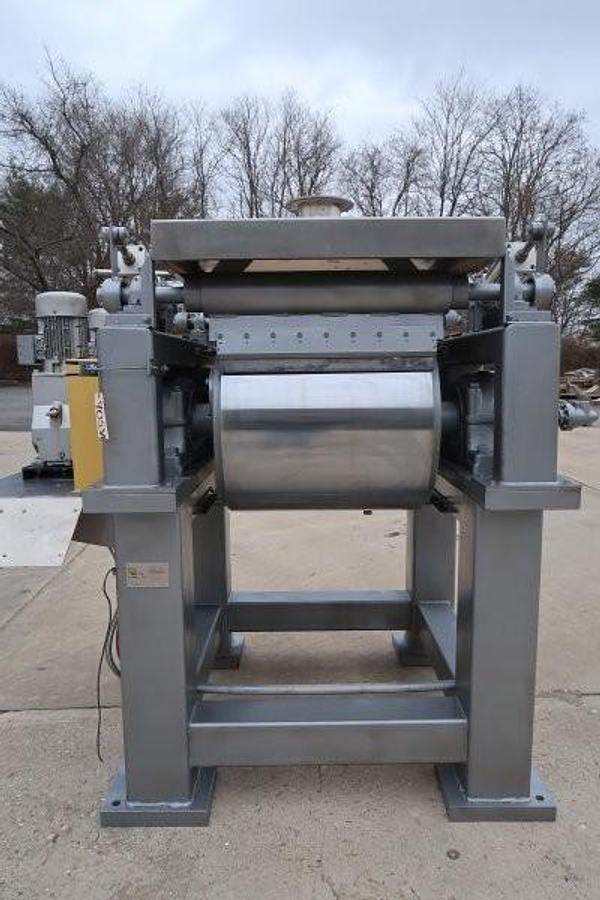
A Phoenix drum dryer/flaker is a type of industrial processing machine designed to dry or flake bulk materials by passing them over one or two heated rotating drums. The material is applied to the drum surface as a thin film, dried by conduction heat transfer, and then scraped off as a dried flake or sheet. These machines are widely used in food processing, chemical manufacturing, and pharmaceutical production for materials like starches, purees, adhesives, and various chemical compounds that need to be converted from a liquid or slurry state into a dry, flake form.
The double drum configuration, such as a 24 in. x 24 in. Phoenix unit, uses two drums rotating toward each other with a small adjustable gap between them. The material is fed into the nip between the drums, forms a thin film on each drum surface, and is dried before being scraped off by doctor blades. Double drum dryers tend to offer higher throughput than single drum designs and are valued for their ability to handle viscous or pasty materials that might not coat a single drum evenly. The drum dimensions directly affect production capacity, so a 24 in. x 24 in. machine is considered a mid-range unit suited to pilot-scale or moderate production runs.
What should buyers know about purchasing used Phoenix industrial equipment?
Used Phoenix industrial equipment, like any pre-owned processing machinery, is typically sold on an as-is basis. This means the seller is not responsible for the machine's future performance, and the full burden of evaluating condition falls on the buyer. That makes the reputation and specialization of the dealer a critical factor. Buyers should look for dealers with a long track record in the specific equipment category, whether that is drying, flaking, or related processing machinery, since specialized dealers are more likely to accurately represent the machine's condition and history.
Before committing to a purchase, buyers should request as much documentation as possible, including machine hours, service records, and any available maintenance logs. Asking about the equipment's most recent use and whether it was decommissioned or pulled from active production can provide useful context. It is also worth contacting the Phoenix Equipment Corporation or the machine's manufacturer directly to understand what parts and technical support are still available for the specific model and age of the unit, since older machines may have limited parts availability that affects long-term usability.
How does the inspection process work when buying used industrial equipment?
Used industrial equipment dealers typically offer buyers several inspection options: in-person visits to the dealer's facility, virtual walkthroughs conducted via video call, or recorded video captures of the machine that can be reviewed at the buyer's convenience. The right choice depends on the buyer's location, the value of the machine, and how much detail is needed to make a confident purchasing decision. For higher-value equipment like drum dryers and flakers, an in-person inspection is generally worth the travel cost, as it allows the buyer to check for wear on doctor blades, drum surface condition, bearing play, and the integrity of heating systems.
In some cases, equipment may still be installed at the facility where it was last used, particularly if a plant is in the process of liquidating surplus machinery. In those situations, the dealer can often arrange for the buyer to inspect the machine at the production site, and it may even be possible to observe the machine running under production conditions. However, buyers should understand that most equipment dealers do not have the permits or production infrastructure to run actual product through a machine at their own facility, so functional testing in a production sense is rarely an option at the dealer's location. The inspection is focused on mechanical condition rather than a full production trial.
What industries in Phoenix commonly buy and sell surplus industrial processing equipment?
Phoenix supports a diverse industrial economy that generates a steady flow of surplus and liquidated processing equipment. Key sectors include food and beverage manufacturing, chemical processing, pharmaceutical production, aerospace component manufacturing, and electronics fabrication. Each of these industries regularly upgrades, consolidates, or closes production lines, releasing equipment like drum dryers, mixers, conveyors, and heat exchangers back into the used equipment market. The region's growth over the past two decades has also brought in a significant number of distribution and logistics operations that periodically turn over material handling and warehouse equipment.
The Phoenix metro area's position along major freight corridors, including Interstate 10 and Interstate 17, makes it a practical hub for moving large industrial machinery both regionally and nationally. Equipment sourced in Phoenix can be shipped efficiently to buyers throughout the Southwest, California, Texas, and beyond. For buyers specifically looking for drying and flaking equipment used in food processing or chemical applications, the Phoenix market tends to have a reasonable supply due to the concentration of those industries in the region.
What are the typical payment terms when purchasing used industrial equipment from a dealer?
Most used industrial equipment dealers require full payment before the machine is released for shipping or pickup. This is standard practice across the industry and applies whether the buyer is purchasing a small benchtop unit or a large production machine. The reasoning is straightforward: used equipment dealers carry inventory risk and cannot hold machines indefinitely on partial payment, especially for specialty items that may have a limited pool of buyers. Wire transfer is the most common payment method for transactions of significant value, though some dealers also accept certified checks.
Some dealers will extend payment terms to established customers with a history of repeat purchases, but first-time buyers should expect to pay in full upfront. Buyers who need financing should explore third-party equipment financing companies, which can provide loans or lease structures for used industrial machinery. It is worth arranging financing before negotiating a purchase, since sellers are generally not in a position to hold equipment while a buyer secures funding. Clarifying payment expectations early in the conversation with the dealer avoids delays and misunderstandings once a price is agreed upon.
How is used industrial equipment typically shipped, and what costs should buyers anticipate?
Shipping costs for used industrial equipment vary considerably based on the size and weight of the machine, the distance to the buyer's facility, and the level of packaging or crating required to protect the equipment in transit. Smaller machines may ship on a standard pallet via LTL (less-than-truckload) freight, while larger or more complex equipment like drum dryers often requires custom crating or skidding to prevent damage. The cost of that packaging work is typically passed on to the buyer, so it is important to ask the dealer specifically what packaging is included in the quoted price and what will be billed separately.
For heavy machinery, rigging is an additional cost that buyers frequently overlook. Loading a large drum dryer or flaker onto a flatbed truck requires a forklift or crane, and unloading at the destination requires the same. If the buyer's facility does not have that equipment on-site, they will need to arrange and pay for a rigging crew. Buyers should ask the dealer for a fully itemized landed cost estimate that includes the machine price, packaging, rigging at the origin, freight, and any additional handling fees at the destination. Getting that full picture upfront prevents budget surprises and allows for accurate cost comparisons between different machines or sources.
What is the typical price range for used drum dryers and flakers?
Pricing for used drum dryers and flakers varies widely depending on drum size, configuration (single vs. double drum), age, condition, and the manufacturer. Smaller or older single drum units in fair condition can be found in the range of a few thousand dollars, while larger double drum systems from well-regarded manufacturers in good working condition can run anywhere from $20,000 to well over $100,000. Specialty configurations with stainless steel construction, sanitary design for food or pharmaceutical use, or larger drum dimensions command higher prices due to their more limited supply and higher demand from regulated industries.
The Phoenix brand specifically has a strong reputation in the drum drying industry, and used Phoenix units tend to hold their value reasonably well compared to lesser-known manufacturers. A 24 in. x 24 in. Phoenix double drum dryer/flaker is a mid-range size that appeals to food processors, starch manufacturers, and chemical producers running moderate volumes. Buyers should compare prices across multiple dealers and factor in the cost of any refurbishment, spare parts, or installation work needed before the machine is production-ready. The purchase price is rarely the total cost of getting a used machine into service.
What should buyers check when evaluating the condition of a used drum dryer or flaker?
The most critical components to evaluate on a used drum dryer or flaker are the drums themselves. Look closely at the drum surfaces for pitting, scoring, corrosion, or uneven wear, since any surface irregularities will affect film formation and product quality. Drums that have been re-ground or re-chromed may still have useful life remaining, but buyers should ask when that work was done and inspect the finish carefully. Doctor blades and their mounting assemblies are wear items that are relatively inexpensive to replace, but their condition can indicate how well the machine was maintained overall.
Beyond the drums, buyers should assess the condition of the drive system, including motors, gearboxes, and chain or gear drives, as well as the steam or hot water heating system if applicable. Check for evidence of leaks around rotary joints, inspect the frame for cracks or weld repairs, and verify that all safety guards and controls are present and functional. If the machine has been sitting idle for an extended period, bearings and seals may have deteriorated even without visible wear from use. Asking the dealer about the machine's storage conditions and how long it has been out of service is a reasonable part of due diligence before making an offer.
How does buying used industrial equipment from a specialized dealer differ from buying through a general auction or liquidation sale?
Specialized used equipment dealers generally offer a meaningfully different buying experience compared to general industrial auctions or liquidation sales. A dealer who focuses on processing equipment like drum dryers and flakers will have the technical knowledge to accurately describe the machine's specifications, condition, and suitability for a given application. They can answer detailed questions about drum dimensions, heating capacity, production rates, and compatibility with specific materials. That level of product knowledge is rarely available from a general auctioneer or liquidator, who may list a machine with nothing more than a model number and a few photographs.
Specialized dealers also tend to invest more in presenting their inventory accurately, since their reputation depends on repeat business and referrals within a relatively small industry community. Buyers at general auctions typically purchase with minimal recourse if the machine turns out to be different from what was described, while a reputable specialized dealer has a long-term incentive to be honest about condition and limitations. The tradeoff is that dealer prices are usually higher than auction prices for comparable equipment, but the reduced uncertainty and access to inspection support often justifies the premium, particularly for high-value or technically complex machines.
What parts and support availability should buyers consider before purchasing an older Phoenix drum dryer?
Before purchasing any used Phoenix drum dryer or flaker, it is worth reaching out directly to the manufacturer to understand what level of support they can provide for the specific model and age of the machine. Manufacturers vary in how long they support discontinued models, and the availability of spare parts, technical documentation, and service support can differ significantly depending on how old the unit is. Some manufacturers maintain comprehensive parts inventories for machines that are decades old, while others may have limited or no support for older models. Knowing this upfront helps buyers assess the true long-term cost of ownership.
Key parts to ask about include doctor blades and holders, rotary joints, drum bearings, drive components, and any proprietary control components. For machines used in food or pharmaceutical production, replacement parts may also need to meet specific material or sanitary standards, which can further limit sourcing options. Buyers who plan to run a used drum dryer in a regulated environment should also confirm that the machine can be brought into compliance with current safety and sanitary standards, since older equipment may require modifications. Factoring in parts availability and compliance costs alongside the purchase price gives a more accurate picture of the total investment required.