Category
Manufacturer
Model
Pharmapack
Pharmapack is a key player in the packaging industry, specializing in solutions for pharmaceuticals and healthcare products. They offer a variety of packaging machinery that ensures product safety and compliance. Their commitment to innovation helps manufacturers optimize their packaging processes.
FAQ:
What types of packaging machinery does Pharmapack manufacture?
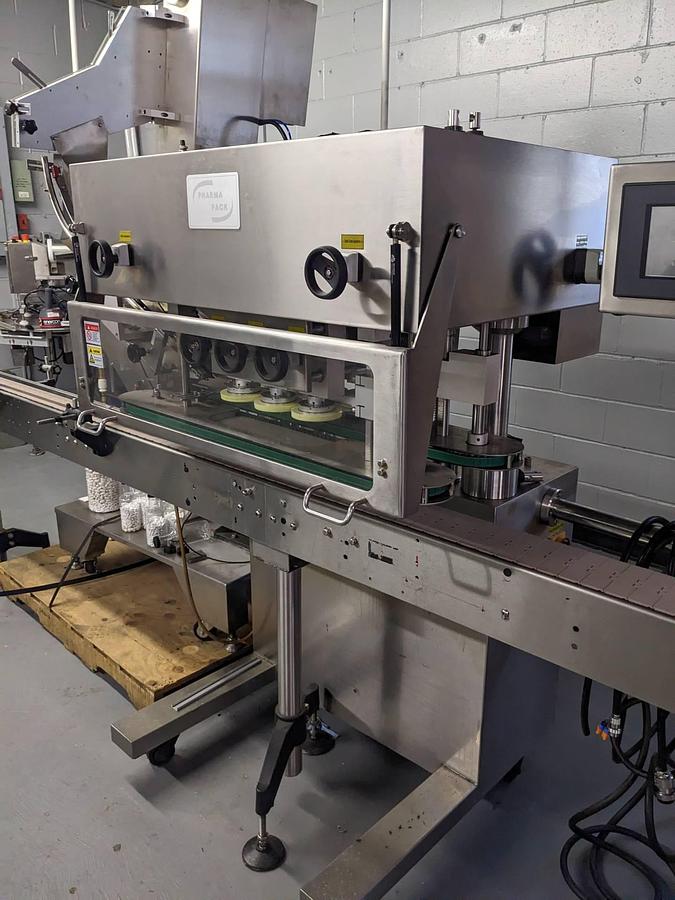
Pharmapack produces a broad range of automated packaging equipment aimed primarily at pharmaceutical, nutraceutical, food, and healthcare manufacturers. Their lineup covers counting machines, tablet and capsule filling machines, capping machines, labeling machines, cartoning machines, blister packaging machines, and integrated end-to-end packaging lines. The six-spindle auto screw capper with a waterfall cap elevator is one example of the kind of specialized equipment Pharmapack builds for high-throughput bottling operations.
Beyond individual machines, Pharmapack is known for offering complete line integration, meaning buyers can source multiple machine types that are designed to work together in sequence. This is particularly valuable for pharmaceutical manufacturers who need consistent throughput across filling, capping, labeling, and cartoning stages. Both semi-automatic and fully automatic configurations are available across many product categories, which allows facilities with different production volumes and budgets to find suitable equipment.
What compliance standards and certifications are Pharmapack machines built to meet?
Pharmapack machines are engineered to align with several internationally recognized standards, including GMP (Good Manufacturing Practice), CE marking requirements for equipment sold into European markets, and ISO quality management certifications. For pharmaceutical buyers in particular, GMP compliance is a non-negotiable requirement, since packaging equipment that contacts or handles drug products must meet strict standards for cleanability, material contact surfaces, and documentation. Pharmapack's focus on the pharmaceutical and healthcare sectors means their machines are designed with these regulatory expectations built in from the start.
Buyers purchasing used Pharmapack equipment should verify that a specific machine's configuration and condition still aligns with their facility's compliance requirements. Regulatory status can be affected by the machine's age, any modifications made by prior owners, and whether the equipment has been properly maintained and documented. It is advisable to consult with your quality assurance team and, where relevant, the machine's manufacturer to confirm what validation documentation or qualification work may be needed before putting a used machine into GMP-regulated production.
What should buyers know about purchasing used Pharmapack packaging equipment?
Used Pharmapack packaging machines offer a cost-effective path to acquiring well-engineered pharmaceutical-grade equipment without the price tag of buying directly from the manufacturer. Because Pharmapack specializes in pharmaceutical and healthcare packaging, their machines are built to stricter standards than general-purpose packaging equipment, which makes them attractive on the secondary market. However, buyers should approach any used machinery purchase with careful due diligence, since equipment is typically sold as-is and the condition can vary significantly depending on how the machine was used, maintained, and stored by the previous owner.
The most important step is a thorough inspection before committing to a purchase. Reputable used equipment dealers will accommodate in-person inspections, live video walkthroughs, or recorded video of the machine in its current state. Some machines may still be installed and running at a production facility, while others may be decommissioned and in storage. Keep in mind that most dealers are not set up to run actual product through a machine during inspection, since doing so would require production permitting they typically do not hold. Buyers should factor this into their evaluation and, where possible, review maintenance records, ask about the machine's production history, and consult with Pharmapack directly to understand what parts and technical support are available for the specific model and age of equipment they are considering.
How is used pharmaceutical packaging equipment typically priced?
Pricing for used pharmaceutical packaging machinery varies considerably based on machine type, complexity, age, condition, and how much demand exists for that particular model. A basic semi-automatic capper or labeler might sell for a few thousand dollars, while a fully automatic blister packaging line or high-speed counting and filling system from a manufacturer like Pharmapack could run well into the tens of thousands or higher. Machines that are younger, in verified working condition, and come with documentation tend to command stronger prices on the secondary market.
Beyond the listed price, buyers should account for the full landed cost of the equipment. This includes rigging and loading at the seller's location, freight or shipping charges, any crating or palletization needed to protect the machine in transit, and unloading or installation at the buyer's facility. For larger or heavier machines, specialized rigging equipment may be required at both ends of the shipment, which adds to the total cost. Getting a clear picture of all these charges upfront helps avoid surprises and makes it easier to compare options across different sellers.
What is a six-spindle auto screw capper, and what applications is it used for?
A six-spindle auto screw capper is a capping machine that uses six rotating spindle heads to apply and torque threaded caps onto bottles or containers as they move along a conveyor. The six-spindle design allows for precise, consistent torque application across a range of cap sizes and container types, making it well-suited for high-volume production lines where uniformity and speed are critical. The waterfall cap elevator, which is a common accessory on these machines, automatically orients and feeds caps down a chute into the capping station, eliminating the need for manual cap placement and significantly increasing throughput.
These machines are widely used in pharmaceutical, nutraceutical, personal care, and food and beverage manufacturing, anywhere that bottles with threaded closures need to be capped at production scale. In pharmaceutical settings specifically, consistent torque is important not only for line efficiency but also for product integrity and tamper evidence. A properly functioning screw capper ensures caps are applied to spec every time, reducing the risk of loose closures, contamination, or failed integrity checks downstream in the packaging process.
What industries use Pharmapack packaging machinery beyond pharmaceuticals?
While Pharmapack's roots are firmly in pharmaceutical packaging, the equipment they produce is well-suited to several adjacent industries that share similar requirements around product safety, dosing accuracy, and regulatory compliance. Nutraceutical and dietary supplement manufacturers are among the most common non-pharma users of Pharmapack equipment, since their products, vitamins, capsules, softgels, and powders, go through essentially the same counting, filling, capping, and labeling processes as prescription or over-the-counter drug products. Food manufacturers handling small, countable items like confections or specialty food products also make use of Pharmapack counting and filling technology.
Healthcare product manufacturers, including those producing medical devices packaged in blister or carton formats, represent another significant market for this type of equipment. The compliance-oriented design of Pharmapack machines, including cleanable surfaces, precise controls, and documentation-friendly features, translates well to any regulated or semi-regulated industry. Buyers from outside the pharmaceutical sector often find that Pharmapack equipment gives them capabilities that exceed their minimum requirements, which can be an advantage if they anticipate stricter regulatory scrutiny in the future or are looking to expand into pharmaceutical contract manufacturing.
How does the inspection process work when buying used packaging machinery?
Inspections are a standard part of any reputable used equipment transaction, and buyers should expect dealers to offer at least one of three options: an in-person visit to see the machine directly, a live video call walkthrough conducted remotely, or a recorded video showing the machine's current condition and any visible wear. Each approach has trade-offs. In-person inspections give the buyer the most complete picture, allowing them to check for physical damage, wear on contact parts, condition of electrical panels, and the overall state of the frame and guarding. Remote video inspections are more convenient but depend heavily on the quality of the footage and the seller's willingness to show every relevant detail.
It is worth understanding that most used equipment dealers are not able to run product through a machine during an inspection. Running actual pharmaceutical or food product requires production-level permitting and quality controls that a reseller's facility typically does not have. What dealers can usually do is demonstrate that the machine powers on, that mechanical components move as intended, and that there are no obvious defects. Buyers should come to any inspection with a checklist of specific things they want to see, including the drive systems, sensors, tooling condition, and any parts that are known wear items on that particular model. Asking the seller about the machine's history, including how long it was in service, what it was running, and why it was taken out of production, can also provide useful context.
What should buyers understand about shipping and logistics for used packaging equipment?
Shipping used packaging machinery is more involved than standard freight, and the costs can add up quickly if buyers do not plan for them in advance. The first consideration is packaging and crating. Machines need to be properly secured and protected before they leave the seller's facility, and the level of crating required depends on the machine's size, fragility, and the shipping method. A well-crated machine is far less likely to arrive damaged, but professional crating adds to the upfront cost. Buyers should ask the dealer specifically what packaging they provide and whether additional crating is available for an extra charge.
For larger or heavier machines, rigging is another line item to account for. Loading a multi-hundred-pound packaging machine onto a truck requires a forklift or crane at the origin, and unloading at the destination requires the same. If the buyer's facility does not have that equipment on site, they will need to arrange and pay for it separately. Freight costs themselves vary based on distance, machine weight and dimensions, and whether liftgate service is needed at delivery. The full landed cost of a used machine, meaning the purchase price plus all shipping, rigging, and handling charges, is the number that really matters when comparing options. Buyers should request a complete cost breakdown from the dealer before finalizing any purchase.
What payment terms are typical when purchasing used pharmaceutical packaging machinery?
Most used equipment dealers require full payment before a machine ships. This is standard practice in the industry and reflects the nature of used machinery transactions, where the seller needs to confirm funds are secured before releasing equipment that may have taken significant time and resources to source, inspect, and prepare for sale. Payment is commonly accepted by wire transfer, and some dealers may accept other forms depending on the transaction size and the buyer's relationship with the seller.
Buyers who have an established history with a particular dealer may occasionally be able to negotiate different terms, but first-time buyers should plan for full payment upfront. Because payment precedes shipment, the inspection process takes on added importance. Buyers should complete their due diligence, review all available documentation, and resolve any open questions about the machine's condition before sending funds. If there is any uncertainty about a machine's working order or suitability for a specific application, it is better to address those questions during negotiation than after payment has been made.
How can buyers assess whether a specific used Pharmapack model will still be supported with parts and service?
The availability of parts and technical support for a used machine depends heavily on its age and model. Pharmapack, like most manufacturers, tends to support current and recent models more fully than older discontinued equipment. Before purchasing a used Pharmapack machine, it is worth contacting the manufacturer directly to ask about parts availability, whether technical documentation like manuals and wiring diagrams can be provided, and what level of remote or on-site support they offer for that particular model. Manufacturers are often willing to provide this information even for equipment being sold on the secondary market, since it helps buyers make informed decisions and reflects well on the brand.
Buyers should also consider the machine's age relative to how long they expect to use it. A machine that is five years old and still actively supported is a very different proposition from one that is fifteen years old and for which the manufacturer no longer stocks wear parts. Identifying which components are most likely to need replacement during the machine's remaining service life, and confirming those parts are available either from the manufacturer or through third-party suppliers, is a practical step that experienced buyers take before finalizing a purchase. Choosing a used equipment dealer who specializes in pharmaceutical packaging machinery is also an advantage, since they are more likely to have relevant technical knowledge and connections to support buyers after the sale.