Category
Manufacturer
Model
FAQ:
What sizes and capacities are Pesch stainless steel mix tanks available in?
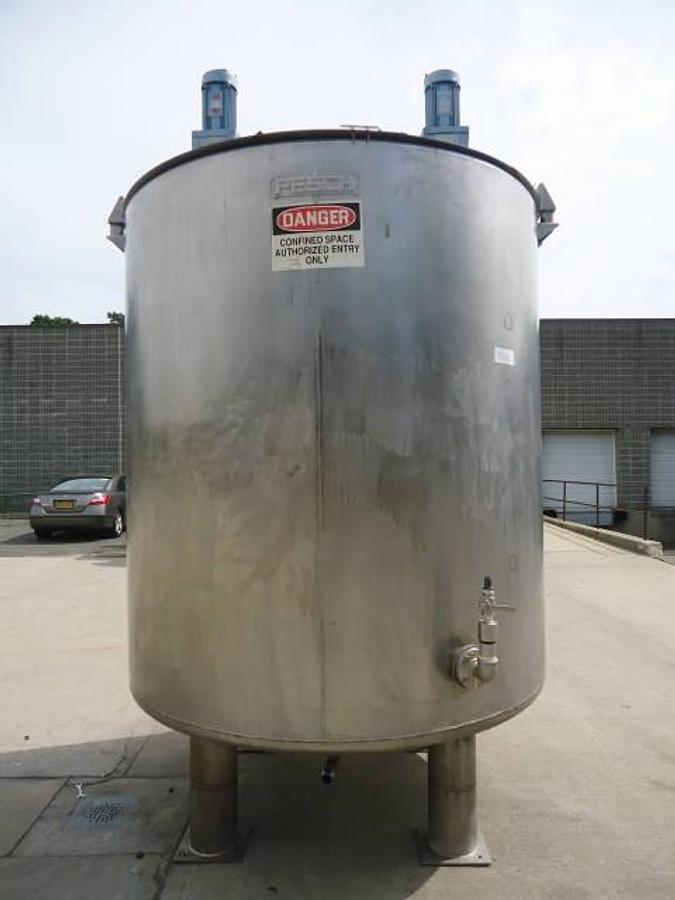
Pesch stainless steel mix tanks have been manufactured across a range of capacities to suit different production scales, from smaller batch processing operations to large-volume industrial applications. On the used equipment market, listings commonly appear in sizes such as 2,200 gallons, though other capacities exist depending on what becomes available through decommissioned facilities and equipment resellers. The specific capacity of any given tank will be listed in the machine specifications, so buyers should review those details carefully before inquiring.
When sourcing a used Pesch mix tank, it pays to be flexible on capacity if your process allows it. A tank that is slightly larger than your minimum requirement can often be adapted to your workflow, and used equipment pricing tends to make oversizing less cost-prohibitive than it would be with purpose-built machinery. Always verify the stated capacity against the physical dimensions and any stamped data plates on the tank itself during inspection.
What grade of stainless steel is used in Pesch mix tanks, and does it matter for my application?
Pesch mix tanks are constructed from stainless steel, and the specific alloy grade is an important factor depending on the substances being processed. The two most common grades found in industrial mix tanks are 304 stainless steel and 316 stainless steel. Grade 304 is widely used for general food processing, water, and non-corrosive chemical applications. Grade 316 contains added molybdenum, which significantly improves resistance to chlorides and other corrosive agents, making it the preferred choice for pharmaceutical manufacturing, specialty chemicals, and high-purity applications.
For any used tank purchase, buyers should confirm the alloy grade through the original documentation, data plates, or by requesting material test reports if available. The grade affects not only corrosion resistance but also compliance with industry standards such as 3-A Sanitary Standards and FDA regulations for food contact surfaces. If documentation is unavailable, a reputable used equipment dealer should be able to assist in identifying the material specification or facilitate an inspection where the tank can be examined directly.
Are used Pesch stainless steel mix tanks suitable for food and beverage production?
Stainless steel mix tanks from manufacturers like Pesch have historically been used across food processing, beverage production, dairy, and brewing applications, and a used unit can absolutely continue to serve in those environments provided it meets the sanitary requirements of your facility and regulatory jurisdiction. Key factors to evaluate include the interior surface finish, the condition of welds and seams, the integrity of any gaskets or seals, and whether the tank was previously used in a food-grade environment or in chemical processing that could have compromised the surface.
Buyers sourcing used tanks for food or beverage applications should pay particular attention to the interior finish during inspection. Electropolished or sanitary-finish interiors are preferred because they minimize surface porosity and are easier to clean and sanitize. A thorough inspection, either in person or via detailed video, should include the interior welds, any ports or fittings, and the condition of the bottom outlet. It is also worth consulting with your facility's sanitation team or a third-party inspector before committing to a purchase, especially if the tank will be used in a regulated production environment.
What types of agitators or mixing systems are typically compatible with Pesch stainless steel mix tanks?
Pesch stainless steel mix tanks are designed to accommodate various agitation systems depending on the application. Common configurations include top-mounted agitators with impeller styles such as paddle, anchor, turbine, or high-shear mixing heads. The choice of agitator depends heavily on the viscosity of the product being mixed, the required shear level, and whether the process involves blending, emulsifying, dissolving solids, or maintaining suspension of particles. Tanks used in food and beverage processing often feature sanitary-style agitators with polished shafts and clean-in-place compatible designs.
When purchasing a used Pesch mix tank, it is important to clarify whether an agitator is included with the tank or sold separately. Some listings include the full mixing assembly, while others are tank-only. If the tank comes with an agitator, request details on the motor horsepower, shaft length, impeller type, and drive configuration so you can assess compatibility with your process requirements. If the agitator is not included, the tank's top opening dimensions and drive mount specifications will determine what aftermarket or used agitation systems can be fitted.
Do Pesch mix tanks come with heating or cooling jacket options?
Many stainless steel mix tanks, including those manufactured by Pesch, are available in jacketed configurations that allow for temperature control during processing. A jacketed tank has a second outer shell surrounding part or all of the vessel, through which a heat transfer medium such as steam, hot water, glycol, or chilled water can be circulated. This makes the tank suitable for processes that require precise temperature management, including pasteurization, fermentation, chemical reactions, and product conditioning. Half-pipe jackets and full-shell jackets are both common configurations, each with different heat transfer characteristics.
On the used market, whether a specific Pesch tank is jacketed will be clearly noted in the equipment listing and specifications. If temperature control is a requirement for your process, this should be a primary filter in your search. For used jacketed tanks, buyers should inspect the jacket for any signs of corrosion, weld repairs, or pressure testing history, and verify that the jacket's rated pressure and temperature range align with your heating or cooling system. A dealer should be able to provide photos or video of the jacket connections and any associated fittings during the inspection process.
What does a dished bottom design mean on a stainless steel mix tank, and why does it matter?
A dished bottom, sometimes called a dished head or dish-end bottom, refers to a tank base that curves inward rather than being flat or cone-shaped. This geometry is commonly used in sanitary and industrial mixing applications because it promotes complete drainage of the vessel contents and eliminates flat surfaces where product can pool or stagnate. The curved profile also distributes mechanical stress more evenly across the bottom of the tank, which contributes to structural integrity under pressure or vacuum conditions. In food, beverage, and pharmaceutical processing, complete drainage is critical for both yield and cleanability.
From a practical standpoint, a dished bottom tank is generally easier to clean in place compared to flat-bottom designs, since liquid and cleaning solutions drain naturally toward the outlet without leaving residual pockets. When evaluating a used tank with a dished bottom, inspect the bottom outlet valve or nozzle for condition and compatibility with your piping, and check the interior surface of the dish for any pitting, discoloration, or weld repairs that could affect sanitation or structural integrity. The 2,200-gallon Pesch tank available on the used market features this dished bottom configuration, which makes it well-suited for applications where full drainage and cleanability are priorities.
Are used stainless steel mix tanks compliant with FDA or 3-A sanitary standards?
Compliance with FDA food contact regulations and 3-A Sanitary Standards is determined by the design, materials, and surface finish of the tank at the time of manufacture, as well as its current condition. Tanks built to 3-A standards use specific alloy grades, minimum surface finish requirements (typically a 150-grit or finer interior finish), and design criteria that eliminate crevices and dead zones where bacteria can harbor. FDA compliance for food contact surfaces similarly depends on the materials used being appropriate for contact with food or beverages.
For used tanks, compliance status should be verified rather than assumed. A tank that was originally built to 3-A or FDA standards may still meet those requirements if it has been properly maintained and shows no significant surface degradation, but buyers should request any available documentation such as original certifications, material test reports, or previous inspection records. If documentation is unavailable, an independent inspection by a sanitary equipment specialist can help assess whether the tank still meets the relevant standards for your intended application. Consulting with your facility's quality assurance team before purchase is strongly recommended for regulated industries.
What should buyers inspect when evaluating a used Pesch stainless steel mix tank?
A thorough inspection of a used stainless steel mix tank should cover both the structural and functional aspects of the vessel. On the exterior, look for signs of dents, weld repairs, corrosion around fittings, and the condition of any jacket connections or insulation. On the interior, the surface finish is critical: check for pitting, discoloration, rust staining (which can indicate cross-contamination from carbon steel tools or fittings), and the quality of interior welds. Ports, nozzles, and fittings should be examined for thread condition, gasket seating surfaces, and any signs of leakage history.
Used equipment dealers will typically accommodate in-person inspections, virtual walkthroughs, or detailed video captures of the machine. For a tank that is still installed at a production facility, an in-person visit can sometimes be arranged through the dealer so the buyer can see the equipment in context. Keep in mind that most dealers do not have the capability to run full production tests, so the inspection will focus on visual and mechanical condition rather than live processing. Buyers should also check the data plate for capacity, pressure rating, and material specification, and ask the dealer about the tank's previous application and cleaning history to assess suitability for their intended use.
What are typical shipping and logistics considerations for a large stainless steel mix tank?
Shipping a large stainless steel mix tank such as a 2,200-gallon vertical vessel involves logistics that go well beyond standard freight. The tank will need to be properly secured and protected before transport, which typically means custom crating or heavy-duty skidding to prevent movement and surface damage in transit. The level of packaging required will affect the total shipping cost, and buyers should ask the dealer for specifics on how the equipment will be prepared before it leaves the facility. For tall vertical tanks, height restrictions on transport routes may also be a consideration.
Loading and unloading a tank of this size requires appropriate rigging equipment such as a forklift with sufficient capacity or a crane, and rigging costs are typically separate from the base freight charge. Buyers should request a full breakdown of packaging, rigging, and freight costs from the dealer to understand the complete landed cost of the equipment before committing to a purchase. It is also worth confirming that your receiving facility has the equipment and clearances needed to unload and position the tank safely. Coordinating these logistics in advance avoids delays and unexpected expenses once the equipment is in transit.
What payment terms should buyers expect when purchasing used industrial mix tanks?
Most used equipment dealers require full payment prior to releasing a machine for shipment. This is standard practice in the industry and applies to the majority of transactions regardless of the equipment type or purchase price. The rationale is straightforward: once a machine ships, the dealer has limited recourse if payment issues arise, so payment in full before dispatch protects both parties and ensures a clean transfer of ownership. Accepted payment methods vary by dealer but commonly include wire transfer, ACH, and in some cases credit card for smaller purchases.
Some dealers may offer payment terms to established customers with a history of prior transactions, but this is the exception rather than the rule for first-time buyers. If financing is needed, buyers can explore third-party equipment financing options independently, as many lenders specialize in used industrial machinery. Before finalizing any purchase, buyers should also confirm that the total cost includes all applicable fees such as packaging, rigging, and freight, since these can add meaningfully to the base equipment price on a large tank.