Category
Manufacturer
Model
FAQ:
What is a Pardo stainless steel kettle used for in industrial settings?
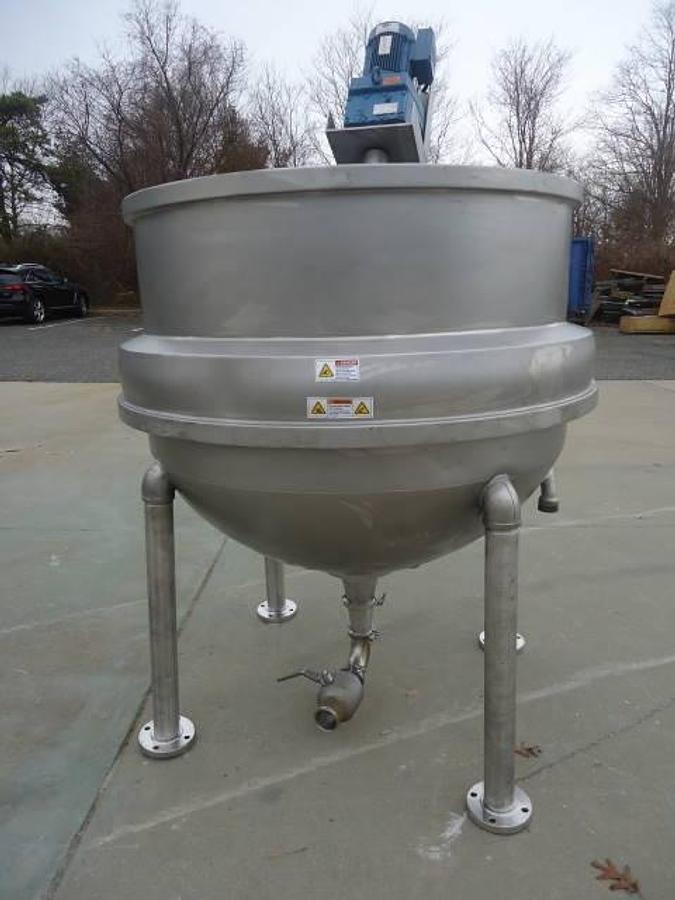
Pardo stainless steel kettles are industrial-grade processing vessels designed for heating, cooking, mixing, and holding liquid or semi-liquid products at scale. Unlike household kettles, these are large-capacity units built for food processing, pharmaceutical, chemical, and cosmetic manufacturing environments. A typical Pardo kettle features a jacketed design that circulates steam or hot water through the outer wall to heat the product inside evenly and without direct flame contact. Many models also include an agitator to keep contents moving, which prevents scorching and ensures consistent temperature throughout the batch.
The hemispherical or tilting configurations common in Pardo kettles make them practical for facilities that need to discharge product quickly and cleanly. The inclined or tilting design allows operators to pour contents out without manual scooping, which reduces labor and contamination risk. These kettles are standard equipment in facilities producing soups, sauces, confections, dairy products, and similar goods where precise temperature control and sanitary processing conditions are critical.
What does a jacketed kettle jacket pressure rating mean, and why does it matter?
The jacket on an industrial kettle is a sealed space surrounding the inner vessel through which a heating or cooling medium, typically steam, hot water, or glycol, is circulated. The jacket pressure rating, often expressed in PSI, tells you the maximum pressure the jacket can safely handle. A 100 PSI jacket rating, for example, means the jacket is built to withstand steam pressure up to that level, which corresponds to steam temperatures well above 300 degrees Fahrenheit. Higher jacket pressure ratings generally allow for faster heating and the ability to reach higher processing temperatures.
This rating matters because it directly affects what the kettle can be used for and how it must be maintained. Facilities using steam as a heat source need to match their boiler output to the kettle's rated capacity. Operating a kettle above its rated jacket pressure is a serious safety hazard and a code violation in most jurisdictions. When evaluating a used jacketed kettle, buyers should confirm the jacket integrity through pressure testing and review any available inspection history to ensure the vessel has not been compromised through corrosion, weld failures, or prior overpressure events.
What grade of stainless steel is used in Pardo industrial kettles, and is it food-safe?
Pardo industrial kettles are typically constructed from 316 stainless steel, which is a higher-grade alloy than the more common 304 stainless steel. The difference lies in the addition of molybdenum in 316, which significantly increases resistance to chlorides, acids, and corrosive cleaning agents. This makes 316 stainless steel the preferred material in food processing, dairy, pharmaceutical, and marine applications where exposure to salt, acidic products, or aggressive sanitizers is routine. Both 304 and 316 stainless steel are considered food-safe and are free from BPA and other harmful plasticizers since they contain no plastic components.
For buyers purchasing used equipment, the grade of stainless steel is an important specification to verify before purchase. 316 stainless commands a higher price than 304 and offers meaningfully better corrosion resistance over the long term, particularly in facilities that process acidic foods like tomato-based products, citrus, or vinegar. Inspecting a used kettle for surface pitting, rust staining, or weld discoloration can help assess whether the stainless steel has been properly maintained and whether the material integrity is still intact for food-contact use.
What should buyers inspect when purchasing a used Pardo stainless steel kettle?
Buying a used industrial kettle requires a more careful evaluation than purchasing new equipment, since the condition of the vessel directly affects both safety and performance. The most critical areas to inspect are the interior product contact surfaces, the jacket welds, the agitator shaft and seals, and any fittings or valves. Interior surfaces should be smooth and free of pitting, cracks, or corrosion, since surface defects can harbor bacteria and compromise sanitary processing. The jacket should be pressure-tested to confirm it holds rated pressure without leaks, and all valves should operate freely without signs of seizing or heavy mineral buildup.
Reputable used equipment dealers will typically accommodate in-person inspections at their facility or arrange video walkthroughs for remote buyers. In some cases, the equipment may still be installed at the facility where it was used, and an inspection can be coordinated there. Buyers should also consult the kettle manufacturer directly to understand parts availability and technical support for the specific model and age of the unit, since older models may have limited replacement parts. Getting a clear picture of the machine's history, including what products were processed and how frequently the kettle was cleaned and maintained, adds valuable context before committing to a purchase.
What capacity sizes are Pardo stainless steel kettles commonly available in on the used market?
Used Pardo stainless steel kettles appear on the market in a range of capacities suited to different production scales. Smaller units may be found in the 20 to 100 gallon range, which are appropriate for pilot production, specialty food operations, or smaller batch processing facilities. Mid-range units in the 150 to 300 gallon range are common in medium-scale food manufacturing, and larger units exceeding 300 gallons, such as 350-gallon models, are used in high-volume production environments where large batch sizes are processed continuously or in rapid succession.
Capacity selection depends on batch size requirements, available floor space, and the heating system capacity at the facility. A 350-gallon jacketed kettle, for instance, requires a steam supply system capable of delivering enough BTUs to heat that volume of product within an acceptable cycle time. Buyers should also factor in the physical dimensions of the unit, since larger kettles require adequate ceiling clearance, structural floor support, and utility connections. When browsing used inventory, confirming both the working capacity and the overall footprint of the kettle is an important step before arranging transport or installation.
What is the difference between a hemispherical kettle and a flat-bottom kettle?
The shape of a kettle's interior bowl affects how heat is distributed, how product flows during agitation, and how completely the vessel can be emptied. Hemispherical kettles have a rounded, dome-shaped bottom that maximizes the surface area in contact with the heating jacket relative to the volume of product. This geometry promotes more even heat distribution and reduces the likelihood of cold spots or hot spots during cooking or processing. The curved bottom also works naturally with agitators, since a curved surface minimizes dead zones where product can stagnate and burn.
Flat-bottom kettles are simpler in construction and can be easier to fabricate, but they are generally less efficient for jacketed heating because the flat base has less jacket contact area per unit of volume. Hemispherical designs are the preferred choice for most food and pharmaceutical applications where temperature uniformity and complete product discharge are priorities. Inclined or tilting hemispherical kettles take this a step further by allowing the entire vessel to tip forward, draining product through the open top rather than relying solely on a bottom outlet valve. This makes discharge faster and cleaning easier, which is a meaningful operational advantage in high-throughput production environments.
How does an agitated kettle differ from a standard jacketed kettle?
A standard jacketed kettle heats product through the vessel walls without any mechanical mixing. This works adequately for thin liquids that naturally circulate through convection, but it creates problems with thicker products, high-sugar formulations, or anything prone to settling or scorching. An agitated kettle adds a motorized mixing mechanism, typically a paddle, anchor, or scrape-surface agitator, that continuously moves the product during heating. This keeps the contents in motion, equalizes temperature throughout the batch, and prevents the product from sticking to the heated walls.
For food processors working with sauces, jams, confections, dairy products, or any viscous material, agitation is often not optional but essential to product quality and consistent output. The agitator design varies depending on the product viscosity and the required mixing intensity. Anchor agitators, which follow the contour of the kettle wall closely, are common in high-viscosity applications because they continuously wipe the heated surface and prevent buildup. When evaluating a used agitated kettle, inspecting the agitator blades for wear, checking the gearbox for smooth operation, and verifying that the shaft seal is intact are all important steps to assess whether the mixing system is in serviceable condition.
What are typical shipping and rigging considerations for a used industrial kettle?
Industrial kettles are heavy, often awkwardly shaped pieces of equipment that require careful handling from the point of removal to final installation. Smaller kettles may be moved with a standard forklift and shipped on a heavy-duty pallet, but larger units, particularly those in the 200-gallon-plus range, typically require professional rigging for loading and unloading. Rigging involves the use of cranes, spreader bars, and specialized lifting equipment to safely move the vessel without damaging the jacket, fittings, or agitator assembly. Buyers should ask the seller for the kettle's approximate shipping weight and dimensions so they can arrange appropriate receiving equipment on their end.
Shipping costs for used industrial kettles vary significantly based on the size and weight of the unit, the distance between origin and destination, and the level of packaging or crating required to protect the equipment in transit. Freight carriers handling heavy machinery typically charge based on weight and freight class, and additional fees apply for liftgate service, inside delivery, or residential delivery. Buyers should request a detailed breakdown of all shipping-related costs, including packaging, rigging, freight, and any required permits for oversized loads, to understand the full landed cost of the equipment before finalizing a purchase.
What payment terms should buyers expect when purchasing used industrial kettles?
Most used equipment dealers require full payment before the equipment is released for shipping. This is standard practice in the industry and reflects the nature of the transaction, since used machinery is typically sold as-is and the dealer needs to confirm cleared funds before arranging logistics. Payment is commonly accepted by wire transfer, and some dealers may accept credit cards for smaller purchases, though card transactions on high-value equipment are less common due to processing fees. Buyers should confirm accepted payment methods directly with the seller before proceeding.
Some dealers extend payment terms to repeat customers or established businesses with a demonstrated purchase history, but this is the exception rather than the rule for first-time buyers. If financing is needed, buyers may want to explore equipment financing through third-party lenders who specialize in used industrial machinery, as these arrangements are handled independently from the dealer. Regardless of payment method, buyers should ensure they receive a clear invoice detailing the equipment, serial number if available, agreed price, and any additional charges for packaging or rigging before funds are transferred.
How should buyers assess whether a used Pardo kettle is the right fit for their production process?
Matching a used kettle to a specific production process requires looking beyond the headline capacity number. Key factors include the jacket pressure rating and the heating medium it is designed for, the agitator type and motor horsepower, the material grade of the product contact surfaces, the discharge configuration, and the overall condition of the unit. A kettle that was used for a low-viscosity product may not have an agitator powerful enough for a thicker formulation, and a unit rated for steam heating may not be compatible with a facility that uses hot water or thermal oil as a heat source. Reviewing the full specifications sheet and comparing them against process requirements before inspecting the equipment saves time and prevents costly mismatches.
Buyers should also think about the practical aspects of installation, including the utility connections required, the available floor space, and whether the kettle will need any modifications to meet current sanitary standards or facility-specific requirements. Consulting with a process engineer or equipment specialist familiar with the product category is worthwhile for buyers who are less experienced with jacketed kettle systems. Reaching out to the kettle manufacturer with the model and approximate age of the unit can help clarify what level of technical support and parts availability to expect, which is a meaningful factor in the long-term serviceability of the equipment.