Category
Manufacturer
Model
FAQ:
What is an NJM/CLI labeler and what industries use it?
NJM/CLI is a well-established Canadian manufacturer of labeling, capping, and filling equipment that has built a strong reputation across pharmaceutical, food and beverage, cosmetic, and personal care industries. The company is now part of ProMach, one of the larger packaging machinery groups in North America, which speaks to the brand's standing in the industry. NJM/CLI machines are pressure-sensitive labelers designed to apply self-adhesive labels to containers with high accuracy and repeatability, making them a go-to choice for regulated industries where label placement consistency is critical.
The product line spans several labeling configurations, including wrap-around labelers, front-and-back labelers, and spot labelers, each built to handle different container geometries and production environments. Pharmaceutical manufacturers in particular have relied on NJM/CLI equipment because the machines are built to meet the precision requirements of that sector. Food and beverage producers and cosmetic companies also use these labelers extensively for round bottles, flat panels, and tapered containers across a wide range of production volumes.
What is the NJM/CLI Uni-300 labeler and what does it do?
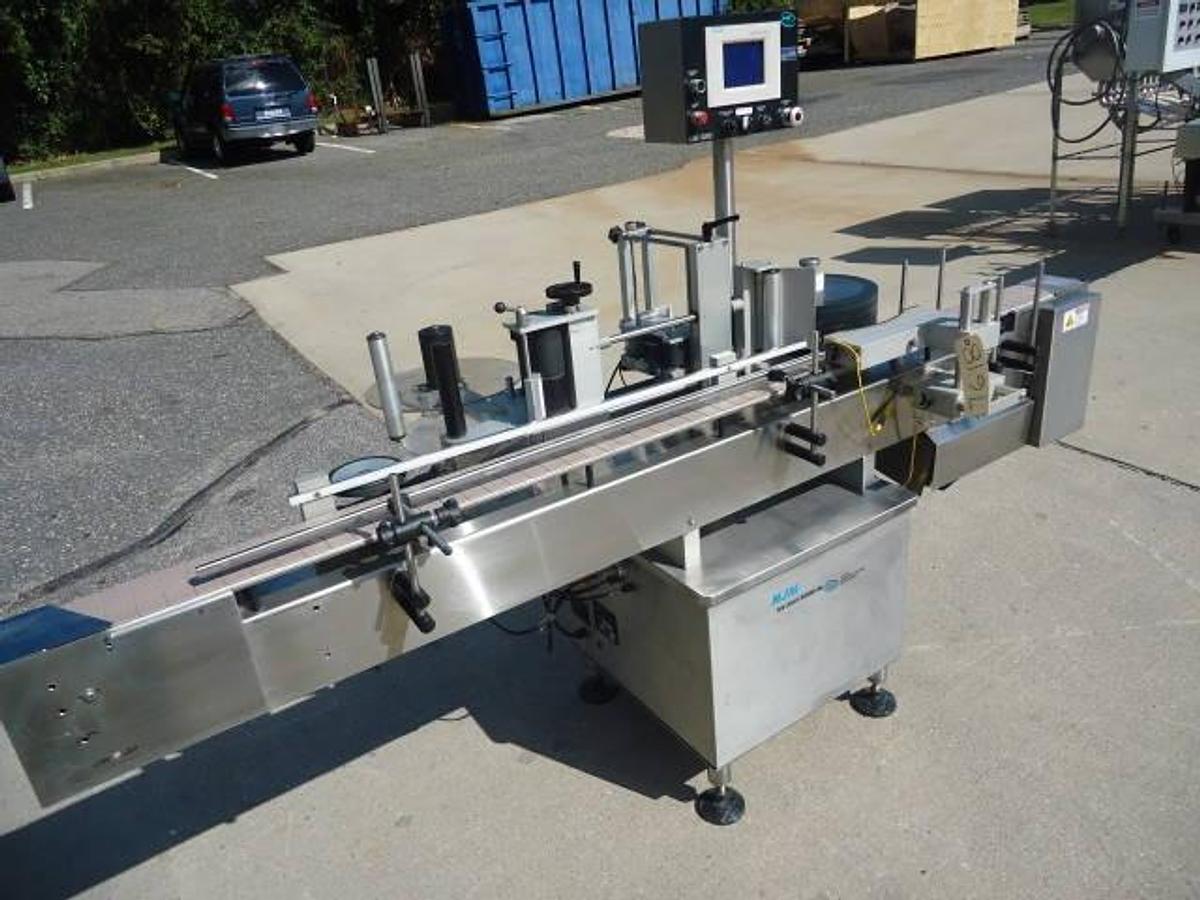
The NJM/CLI Uni-300 is a spot and wrap-around pressure-sensitive labeler, meaning it can apply a label that wraps partially or fully around a cylindrical container, or place a spot label on a flat or curved surface. It features a touch screen control panel, which makes setup, format changeovers, and speed adjustments considerably more straightforward than older machines with manual controls and mechanical stops. The touch screen interface typically allows operators to store multiple product recipes, reducing changeover time when switching between container formats.
The Uni-300 is a versatile machine well suited to mid-range production environments in pharmaceutical, nutraceutical, cosmetic, and food and beverage facilities. Its design accommodates a range of container diameters and label sizes, and the wrap-around capability makes it practical for round bottles that require full-coverage labeling. When evaluating a used Uni-300, buyers should confirm the included tooling and change parts, since the machine's compatibility with specific container sizes depends on the format parts that come with it.
What label sizes and container types are compatible with NJM/CLI labeling machines?
NJM/CLI labelers are built to handle pressure-sensitive labels across a broad range of dimensions, though the exact size range depends on the specific model and the format parts installed on the machine. Generally speaking, these machines accommodate label widths from roughly 0.5 inches up to several inches, and label lengths that can span from small spot labels to full wrap-around labels that circle an entire container. The label roll core size and outer diameter specifications matter as well, since the unwind and rewind stations are sized accordingly.
On the container side, NJM/CLI machines can typically handle round bottles, square and rectangular containers, tapered bottles, and flat panels depending on the labeler configuration. Wrap-around models are optimized for cylindrical containers, while front-and-back configurations are better suited to flat-sided packaging. Buyers purchasing a used NJM/CLI labeler should request a full list of the change parts included with the machine, and confirm which container diameter range and label size range those parts support. If the machine was previously running a specific product, that information can help determine how much additional tooling investment may be needed to run a different format.
What is the typical labeling speed of an NJM/CLI labeler?
NJM/CLI labelers are production-grade machines designed for industrial throughput, and labeling speeds vary by model and configuration. Many models in the NJM/CLI lineup are capable of applying labels at rates ranging from around 100 to over 400 containers per minute, depending on the label size, container geometry, and the specific machine model. The Uni-300 and similar mid-range models are generally positioned for moderate to high-speed production lines, making them practical for facilities that need consistent output without the footprint of the largest high-speed systems.
Actual throughput in a real production environment depends on several factors beyond the machine's rated speed, including label length, container handling characteristics, line integration, and the condition of the equipment. For used machines, it is worth asking the seller about the production speeds the machine was running at in its previous application, as this gives a practical reference point. Buyers should also factor in that a machine running at its top rated speed requires well-maintained components, so the condition of the drive system, applicator head, and sensors all play into achievable throughput.
What should buyers know about purchasing a used NJM/CLI labeler?
Buying a used NJM/CLI labeler requires more due diligence than a straightforward equipment purchase, because the condition, included tooling, and history of the machine can vary significantly from one unit to the next. The model number is the starting point, since NJM/CLI has produced a wide range of machines over the years with meaningful differences in speed, format capability, control systems, and parts availability. Confirming the exact model, serial number, and year of manufacture helps buyers understand what they are getting and what level of manufacturer support they can expect from ProMach, which now handles NJM/CLI's legacy product line.
Reputable used equipment dealers will typically offer in-person or video inspections so buyers can assess the machine's condition before committing. Since used machines are sold as-is, the inspection is the buyer's primary tool for evaluating the equipment. Buyers should look at the condition of the label applicator, the drive belts and rollers, the touch screen or control panel, and the overall frame and guarding. Asking for photos or video of the machine powered on, and ideally running through a cycle, provides meaningful insight into its current working order. Change parts, manuals, and any available service records are also worth requesting, as they add practical value to the purchase.
Are spare parts available for used NJM/CLI labeling machines?
Spare parts availability is a legitimate concern with any used packaging machine, and NJM/CLI equipment generally fares reasonably well in this regard. Since NJM/CLI is now part of ProMach, buyers can contact ProMach's parts and service division to inquire about parts availability for a specific model and serial number. For older models, some components may no longer be stocked by the manufacturer, but third-party suppliers and aftermarket parts vendors often carry wear items like belts, rollers, sensors, and applicator components for well-known labeler brands.
Before purchasing a used NJM/CLI labeler, it is worth reaching out directly to ProMach or a qualified service technician to get a realistic picture of what parts are readily available for that particular machine. Age and model generation matter, as newer models are more likely to have active parts support than equipment that has been out of production for many years. Buyers should also ask whether the selling dealer has any spare parts or change parts included with the machine, since having a small inventory of wear items on hand can reduce downtime risk after installation.
What is the typical price range for a used NJM/CLI labeler?
Used NJM/CLI labelers span a wide price range depending on the model, age, condition, included tooling, and the seller. Entry-level or older models in basic configurations can be found for a few thousand dollars, while more capable mid-range machines like the Uni-300 with touch screen controls and multiple format parts typically fall in the range of $10,000 to $40,000 or more. High-speed or highly configured systems from NJM/CLI's lineup can exceed that range depending on specifications and condition.
The price of the machine itself is only part of the total cost of acquisition. Buyers should factor in shipping and rigging costs, any change parts or tooling needed to run their specific containers, integration costs if the machine needs to be fitted into an existing line, and any service or reconditioning work required after delivery. Getting a clear picture of landed cost, meaning the machine price plus all associated costs to get it running in your facility, is the practical way to compare options across different sellers and machine conditions.
How does a wrap-around labeler differ from a front-and-back labeler?
A wrap-around labeler applies a single label that wraps around the circumference of a container, typically a round bottle or tube. The label is fed from a roll and applied by pressing it against the container as it rotates, which allows the label to adhere smoothly around the full or partial circumference. This configuration is common in pharmaceutical, beverage, and personal care applications where a single label needs to cover a significant portion of the container surface. The NJM/CLI Uni-300 is an example of a machine capable of spot and wrap-around labeling.
A front-and-back labeler, by contrast, applies two separate labels simultaneously to opposite flat faces of a container, which makes it better suited to square or rectangular bottles and jars. Each configuration requires different tooling, timing, and container handling setups. Buyers evaluating a used labeler should confirm which configuration the machine is set up for, and whether it can be converted to a different format, since some machines are more flexible than others. The change parts included with a used machine often determine which containers and label placements are immediately usable without additional investment.
What should buyers ask about inspecting a used NJM/CLI labeler before purchase?
Inspections are the most important step in buying any used packaging machine, and reputable dealers will offer in-person visits, live video calls, or recorded video walkthroughs of the equipment. For a used NJM/CLI labeler, buyers should ask to see the machine powered on and cycling, with the applicator head moving and the label web threaded through the system. This confirms that the drive system, sensors, and controls are functional. Paying attention to the condition of the applicator pad or roller, the label web path components, and the container handling belts gives a practical sense of how much wear the machine has seen.
Buyers should also ask specifically about the control panel or touch screen condition, since replacing a proprietary HMI on an older machine can be expensive. Asking about the machine's production history, including what products it ran, at what speeds, and for how long, provides useful context. Some machines may still be installed and running at a production facility, in which case an inspection can be arranged at the plant. Keep in mind that most used equipment dealers do not have the permitting or setup to run actual product through a machine, so the inspection will typically focus on mechanical and electrical function rather than a full production run-off.
What are the typical shipping and logistics considerations for a used NJM/CLI labeler?
Labeling machines like NJM/CLI models are precision equipment with sensitive components including applicator heads, sensors, and control panels that can be damaged if the machine is not properly secured and packaged for transit. Shipping costs and requirements depend on the size and weight of the specific model, the origin and destination, and the level of crating or palletization required to protect the machine. Smaller labelers may ship on a standard pallet with adequate blocking and bracing, while larger or heavier machines may require custom wooden crating to prevent movement and protect protruding components.
For larger NJM/CLI systems, professional rigging may be required for loading at the origin and unloading at the destination, which adds to the total logistics cost. Buyers should ask the selling dealer for a detailed breakdown of packaging, rigging, and freight costs before finalizing a purchase, since these charges can be meaningful relative to the machine price. It is also worth confirming whether the machine will be shipped via common carrier freight or dedicated trucking, as the handling differences between those options can affect the risk of transit damage. Understanding the full landed cost before committing to a purchase helps avoid surprises.