Category
Manufacturer
Model
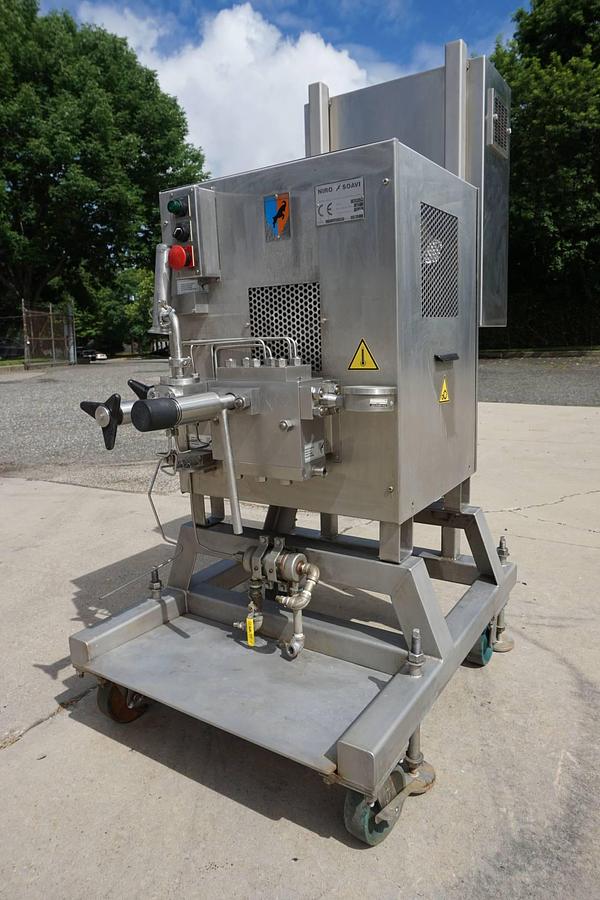
Niro Soavi
Niro Soavi is a leader in the field of spray drying technology, serving the food, dairy, and pharmaceutical industries. Their equipment is known for its efficiency and ability to produce high-quality powdered products.
FAQ:
What is a Niro Soavi homogenizer and what is it used for?
A Niro Soavi homogenizer is a high-pressure processing machine designed to reduce particle size, create stable emulsions, and improve the uniformity of liquid or semi-liquid products. The technology works by forcing a product through a specially engineered valve at extremely high pressure, which subjects it to intense shear, turbulence, and cavitation forces. This results in a finer, more consistent particle distribution that would be impossible to achieve through conventional mixing alone. Niro Soavi, an Italian brand now operating under the GEA Group, built its reputation by producing machines capable of handling everything from delicate dairy proteins to tough cell disruption applications in biotech.
In practical terms, these machines are used for tasks like homogenizing milk and cream to prevent fat separation, producing stable pharmaceutical emulsions and suspensions, processing fruit juices and beverages to improve texture and shelf life, and disrupting microbial cells in biotech research and production. The pressure ranges available across the product line, from around 100 bar for standard food applications up to 1,500 bar or more for specialized pharmaceutical and biotech work, make Niro Soavi equipment adaptable across a wide variety of processing challenges. Their stainless steel construction and hygienic design also make them compliant with food-grade and pharmaceutical sanitary standards, which is a significant factor in their widespread adoption.
What industries commonly use Niro Soavi homogenizers?
Niro Soavi homogenizers serve a broad range of industries, but they are most heavily used in food and dairy, beverage, pharmaceutical, and biotechnology. In the dairy sector, homogenization is a standard processing step for milk, cream, yogurt, and cheese products, where consistent fat globule size directly affects texture, mouthfeel, and shelf stability. Beverage producers use these machines to improve the consistency of fruit juices, plant-based drinks, and emulsified beverages. The pharmaceutical industry relies on high-pressure homogenization to produce liposomes, nanoemulsions, and drug suspensions where particle size uniformity is critical to product efficacy and regulatory compliance.
Beyond those core sectors, Niro Soavi equipment also finds application in cosmetics and personal care manufacturing, where stable emulsions are essential for creams, lotions, and serums. Biotech and research facilities use the higher-pressure models specifically for cell disruption, a process that breaks open microbial or plant cells to extract intracellular compounds like enzymes, proteins, and DNA. Chemical processing operations that require fine emulsification or dispersion also make use of these machines. The versatility across such different industries is one reason why used Niro Soavi homogenizers retain strong interest on the secondary market, as a machine previously used in a food plant may be perfectly suited for repurposing in a cosmetics or nutraceutical operation with appropriate cleaning and validation.
What are the main Niro Soavi homogenizer product lines, and how do they differ?
Niro Soavi produced several distinct product lines over the years, each aimed at different scales of production and pressure requirements. The Panda series is one of the most recognized, designed primarily for laboratory and pilot-scale work. These units are compact, capable of operating at very high pressures (some models reaching 1,500 bar), and are widely used in pharmaceutical and biotech research settings where small batch sizes and precise pressure control matter more than high throughput. The Panther series steps up to larger production capacities while maintaining the high-pressure capability that makes Niro Soavi equipment attractive for demanding applications.
The Ariete series covers industrial-scale production, targeting food, dairy, and beverage operations that require continuous high-volume processing. These machines are built for durability in around-the-clock production environments and are designed with hygienic construction to meet food safety standards. Pilot plant models, like the 2006H-A stainless steel unit available on the used market, bridge the gap between lab-scale development and full production, making them popular for process development work and smaller-scale commercial production. When evaluating any of these lines on the used market, the key variables to assess are the maximum operating pressure, the flow rate capacity, the condition of the homogenizing valve assembly, and whether spare parts for that specific model are still readily available through GEA or authorized suppliers.
What pressure ranges are available on Niro Soavi homogenizers?
Niro Soavi homogenizers span a wide pressure range, which is one of the primary reasons the brand is used across so many different industries. Entry-level and food-grade models typically operate in the range of 100 to 400 bar, which is sufficient for standard dairy homogenization, beverage processing, and basic emulsification tasks. Mid-range models extend up to around 600 to 800 bar and are used in more demanding food applications, cosmetics, and general pharmaceutical processing. High-pressure models, particularly those in the Panda series, can reach 1,500 bar or higher, enabling applications like nanoemulsion production and microbial cell disruption that require extreme force to achieve the desired particle size reduction.
When shopping for a used Niro Soavi homogenizer, the rated maximum pressure of the unit is one of the first specifications to confirm, because it directly determines what processes the machine can handle. A pilot plant unit rated at 5,800 PSI (roughly 400 bar), for example, is well suited for food, dairy, and standard pharmaceutical emulsification work but would not be appropriate for cell disruption applications that demand much higher pressures. Buyers should also ask about the actual operating pressure history of the machine, since equipment that has consistently run near its maximum rated pressure may show more wear on valve components and seals than a unit that operated well within its capacity range.
What should I inspect when buying a used Niro Soavi homogenizer?
Buying a used high-pressure homogenizer requires a more thorough evaluation than purchasing simpler processing equipment, because the internal components that do the actual work are subject to significant wear. The homogenizing valve and valve seat are the most critical parts to assess, as these are where the high-pressure processing actually occurs and where wear accumulates fastest. Seals, pistons, and the high-pressure pump components should also be examined carefully. Buyers should ask the seller about the machine's service history, how many operating hours it has logged, and what maintenance was performed during its working life. Any signs of pitting, scoring, or erosion on the valve assembly are worth noting, as these components can be expensive to replace.
Reputable used equipment dealers will typically accommodate in-person inspections or arrange video walkthroughs so buyers can get a clear picture of the machine's condition. Some equipment may still be installed at the facility where it was last used, which can allow for observation of the machine in a production context, though most dealers do not have the permitting or infrastructure to run actual product through the equipment during an inspection. Buyers should also consult with GEA or authorized Niro Soavi service providers before purchasing, particularly for older models, to confirm what level of technical support and parts availability they can expect. The age and specific model of the machine will directly affect whether replacement parts are readily sourced or require extended lead times.
Are used Niro Soavi homogenizers a reliable choice for food and pharmaceutical processing?
Used Niro Soavi homogenizers can be a very practical and cost-effective option, provided the buyer does their due diligence on the machine's condition and parts availability. Niro Soavi built its equipment to handle demanding, continuous production environments, and many units have operational lifespans that extend well beyond their first owner's use. The stainless steel construction and hygienic design that made these machines attractive for food and pharmaceutical applications in the first place also contribute to their durability on the secondary market. A well-maintained unit from a reputable seller can deliver years of reliable service, particularly for operations that don't require the machine to run at the upper limits of its pressure rating.
That said, buyers in regulated industries like pharmaceuticals or food production need to factor in the validation and qualification work required to put a used machine into a compliant production environment. IQ/OQ/PQ protocols, cleaning validation, and material traceability documentation may all need to be addressed before the machine can be used in a regulated process. Selecting a used equipment dealer who specializes in food and pharmaceutical processing machinery, and who can provide detailed documentation on the machine's history and condition, makes this process considerably smoother. It's also worth reaching out directly to GEA to understand what service support, spare parts, and technical documentation are available for the specific model being considered, since this varies by age and product line.
What spare parts are commonly needed for Niro Soavi homogenizers, and are they available?
The components that see the most wear in a high-pressure homogenizer are the homogenizing valve and valve seat, the plunger seals and packing, the pistons or plungers themselves, and the inlet and outlet check valves. These parts are subject to continuous high-pressure stress and abrasion from the product being processed, so they require periodic replacement as part of normal maintenance. For Niro Soavi equipment, GEA Group (the current parent company) is the primary source for genuine replacement parts, and they maintain support for many models through their authorized service network. However, the availability of specific components can vary significantly depending on how old the machine is and whether GEA has continued to stock parts for that particular model or series.
For buyers considering older Niro Soavi units, it's strongly advisable to contact GEA directly before completing a purchase to confirm parts availability and get a sense of lead times and costs. Some third-party manufacturers also produce compatible wear parts for common Niro Soavi models, which can be a practical alternative when OEM parts are on extended lead time or discontinued. Buyers should ask the seller whether any spare parts are included with the machine, as sellers sometimes have stockpiled consumables or replacement components that were on hand at the time the equipment was decommissioned. Having a supply of critical wear parts on hand at the time of purchase can significantly reduce downtime risk during the initial period of operation.
What capacity and throughput options should I consider when purchasing a Niro Soavi homogenizer?
Niro Soavi homogenizers are available across a wide range of throughput capacities, from small pilot-scale units processing just a few liters per hour up to large industrial machines capable of handling tens of thousands of liters per hour in continuous operation. Pilot plant models are typically used for process development, small-batch production, and scale-up trials, where the goal is to establish processing parameters that can later be transferred to a full production unit. These smaller machines are often found in R&D departments, universities, and contract manufacturing organizations that need flexibility across multiple product types rather than high-volume throughput.
For buyers evaluating used units, matching the machine's rated capacity to the actual production volume required is important both for efficiency and for equipment longevity. Running a machine consistently at or near its maximum rated flow rate accelerates wear on pump components and seals. Conversely, using a large industrial unit for small-batch work is often impractical from a cleaning, setup, and energy consumption standpoint. The 2006H-A pilot plant model, for example, is designed for smaller-scale processing and would suit operations that need reliable homogenization capability without the footprint and throughput of a full industrial unit. When reviewing listings for used Niro Soavi equipment, always confirm the rated flow rate in liters per hour alongside the pressure rating, as both specifications together define what the machine is actually capable of.
How does the shipping and logistics process work for purchasing a used Niro Soavi homogenizer?
Shipping a high-pressure homogenizer requires careful planning because these are precision machines with sensitive internal components that can be damaged by rough handling or inadequate packaging. The cost and complexity of shipping will depend on the size and weight of the specific unit, the distance involved, and the level of crating or palletization required to protect the machine in transit. Smaller pilot plant units can sometimes be crated and shipped via standard freight carriers, while larger industrial models may require specialized rigging equipment for loading and unloading, which adds to the total landed cost. Buyers should ask the seller for a detailed breakdown of packaging, rigging, and freight costs before finalizing a purchase, so there are no surprises when calculating the true cost of acquisition.
For international purchases, additional considerations include customs duties, import documentation, and compliance with any regulations governing the import of used industrial equipment in the destination country. Buyers should also confirm whether the seller will handle export documentation or whether the buyer is responsible for arranging their own freight forwarder. Most used equipment dealers require full payment prior to shipping, so understanding the complete logistics picture before committing to a purchase is important. If the machine is still installed at a production facility, the seller will typically coordinate with the facility to schedule decommissioning and rigging, which may affect the timeline between purchase and delivery.
What questions should I ask a seller before buying a used Niro Soavi homogenizer?
Before committing to a purchase, buyers should gather as much information as possible about the machine's history and current condition. Key questions include: What year was the machine manufactured, and what is the model number? How many operating hours does it have, and what was it last used to process? Has it been serviced regularly, and are there maintenance records available? What is the condition of the homogenizing valve, seals, and pump components? Are any spare parts included with the sale? Is the machine currently installed and operational, decommissioned in place, or already removed from its previous facility? Answers to these questions give a much clearer picture of what the buyer is actually getting and help identify any potential issues that would require attention before the machine can be put back into service.
Buyers should also ask about inspection options. Reputable dealers will offer in-person inspections, video walkthroughs, or detailed photo documentation of the machine, including close-up images of wear components and the nameplate showing model and serial number information. If the machine is still at a production facility, it may be possible to arrange an inspection while it is still installed, which provides the best opportunity to assess its condition. Additionally, contacting GEA directly with the model and serial number before purchase is a worthwhile step, as they can confirm what technical support, service documentation, and spare parts are available for that specific unit. This kind of pre-purchase research significantly reduces the risk of acquiring a machine that turns out to be difficult or expensive to support.