Category
Manufacturer
Model
Netzsch
Netzsch is a global leader in the field of machinery and instrumentation, particularly known for its grinding and dispersing equipment. They serve industries such as chemicals, food, and pharmaceuticals, providing solutions that enhance product quality and processing efficiency.
FAQ:
What types of Netzsch equipment are commonly available on the used market?
Netzsch produces a wide range of industrial machinery, and most product lines show up regularly in the used equipment market. The most frequently traded categories include wet grinding mills (such as the ALPHA, AHM, and LMZ series), dry grinding and pin mill systems, progressive cavity pumps from the NEMO series, and mixing and dispersing equipment. Each product line is engineered for specific processing applications, so buyers typically have a clear target in mind based on their production requirements.
Beyond those core categories, Netzsch also manufactures instrumentation and thermal analysis equipment, though grinding and dispersing machinery tends to dominate used listings. Pin mills, bead mills, and agitator bead mills are particularly common because they serve such a broad range of industries. Buyers sourcing used Netzsch equipment should identify the specific model series that matches their process parameters, including chamber volume, tip speed range, and material compatibility, before beginning their search.
Which industries use Netzsch grinding and dispersing equipment?
Netzsch has built its reputation across several demanding industries, and that breadth is one reason the brand holds its value so well on the secondary market. The primary industries served include pharmaceuticals, chemicals, food and beverage processing, cosmetics, coatings and inks, mining, and energy. In pharmaceuticals, Netzsch mills are used for particle size reduction of active ingredients and wet grinding of suspensions. In chemicals and coatings, dispersing and bead mill systems handle pigment grinding and emulsification tasks that require tight particle size distribution control.
Food processing operations use Netzsch equipment for applications like chocolate refining, nut paste production, and wet grinding of plant-based ingredients. Mining and mineral processing facilities rely on the high-throughput grinding systems for ore liberation and slurry processing. This cross-industry versatility means that a used Netzsch machine decommissioned from one sector can often be redeployed in another, provided the wetted parts and materials of construction are compatible with the new application. Buyers should verify material compatibility carefully before purchasing used equipment for a different process than its prior use.
What should I look for when evaluating a used Netzsch mill or disperser before buying?
Condition assessment on used Netzsch equipment should focus on the components that experience the most wear during normal operation. For bead mills and agitator bead mills, the agitator shaft, grinding discs or pins, and the grinding chamber liner are the parts most subject to abrasion. Buyers should request detailed photographs or video of these internal components, as wear patterns can reveal a great deal about how hard the machine was run and whether it was maintained properly. The mechanical seal and bearing assemblies are also worth scrutinizing, since replacement costs on these parts can be significant.
Beyond internal wear components, buyers should ask about the machine's operational history, including what materials were processed, the typical batch sizes or throughput rates, and how recently the machine was last serviced. Reputable used equipment dealers will generally accommodate in-person inspections or arrange video walkthroughs of the equipment. Keep in mind that most dealers do not have the permitting or production infrastructure to run actual product through a machine during an inspection, so the evaluation will focus on mechanical condition, visual inspection, and documentation rather than a live production test. Consulting the Netzsch manufacturer directly about parts availability for a specific model and serial number is also a practical step before committing to a purchase.
How does buying used Netzsch equipment compare to purchasing directly from the manufacturer?
The most immediate difference is cost. Used Netzsch equipment typically sells at a significant discount compared to manufacturer pricing for equivalent specifications, which makes the used market attractive for operations that need proven processing capability without the capital outlay of a brand-new machine. Netzsch equipment is engineered for long operational life, and many machines remain fully functional for decades with proper maintenance, which is why the secondary market for this brand stays active. Buyers can often acquire a well-maintained used Netzsch mill at 30 to 60 percent of the cost of a comparable current-production unit, depending on age, condition, and model.
The trade-off is that used equipment is sold as-is, without the manufacturer support structure that accompanies a new purchase. There are no factory warranties on used machines sold through third-party dealers, and the buyer takes on responsibility for verifying condition through inspection. Lead times are generally much shorter with used equipment since the machine already exists and is ready to ship, which can be a meaningful advantage for operations facing production bottlenecks. Buyers should factor in the potential cost of reconditioning, spare parts, and any required modifications when comparing the total landed cost of used equipment against manufacturer pricing.
Are spare parts and consumables available for used Netzsch equipment?
Parts availability is one of the more important due diligence items when purchasing used Netzsch equipment, and the answer varies depending on the model and its age. Netzsch maintains a broad parts network, and for models that are still in active production or were recently discontinued, spare parts are generally accessible through authorized distributors and service centers. Common wear parts such as mechanical seals, grinding discs, agitator pins, and pump stators are often stocked or available on reasonable lead times for widely used model series.
For older or discontinued models, parts availability can become more limited. Buyers should contact Netzsch directly with the machine's model number and serial number to get an honest assessment of what support they can expect. In some cases, aftermarket parts suppliers also manufacture compatible components for popular Netzsch mill and pump models, which can provide an alternative sourcing path. It is worth building a small inventory of critical wear parts at the time of purchase, particularly for machines that will be running in continuous production environments where downtime is costly. A reputable used equipment dealer can often advise on which parts are worth stocking based on the specific machine being purchased.
What is the typical price range for used Netzsch equipment?
Pricing on used Netzsch equipment spans a wide range because the product line itself is so diverse. A smaller laboratory-scale bead mill or pin mill might be available for a few thousand dollars, while a large production-scale agitator bead mill or a complete NEMO pump system can run into the tens of thousands. The specific model series, chamber or pump size, materials of construction, and overall condition all have a direct impact on asking price. Equipment that has been recently serviced or comes with documented maintenance history typically commands a premium over machines sold with no service records.
Market timing also plays a role. When a large chemical plant or pharmaceutical manufacturer decommissions a facility, multiple pieces of Netzsch equipment may enter the market simultaneously, which can create buying opportunities at lower prices. Conversely, high-demand models in good condition can hold their value stubbornly. Buyers should research recent comparable sales when evaluating whether an asking price is reasonable, and factor in shipping, rigging, and any reconditioning costs to arrive at a true total cost of acquisition. Getting multiple quotes on freight and crating before finalizing a purchase is a practical way to avoid surprises on the landed cost.
How is used Netzsch equipment typically shipped, and what should buyers expect for freight costs?
Shipping costs for used Netzsch equipment depend heavily on the size and weight of the machine, the origin and destination, and the level of packaging required to protect it in transit. Smaller benchtop units and laboratory mills can often be palletized and shipped via standard LTL freight at relatively modest cost. Larger production-scale mills, pump systems, or complete processing lines require more substantial crating and may need specialized rigging equipment for loading and unloading, both of which add to the total freight cost.
Buyers should ask the dealer for a detailed breakdown of packaging, rigging, and freight charges before finalizing a purchase, since these costs can vary considerably and affect the true landed price of the equipment. Heavier machines may require a forklift or crane at the receiving facility, so buyers should confirm they have the appropriate unloading equipment on-site before the shipment arrives. International shipments add customs clearance, import duties, and compliance documentation to the cost equation. Getting a clear picture of all freight-related expenses upfront is one of the most practical things a buyer can do to avoid budget surprises after the purchase is complete.
What payment terms should buyers expect when purchasing used Netzsch equipment from a dealer?
Most used equipment dealers require full payment before a machine is released for shipment. This is standard practice in the industry and applies regardless of the equipment brand or price point. The reasoning is straightforward: once a machine leaves the dealer's facility, verifying its condition and recovering payment becomes significantly more complicated. Buyers should plan for this requirement when budgeting for a purchase and ensure that funds can be transferred in a timely manner to avoid delays in shipping.
Some dealers will extend payment terms to buyers with an established purchasing history, but this is typically reserved for repeat customers with a demonstrated track record. For first-time buyers, wire transfer is the most common payment method, though some dealers accept other forms of verified payment. Buyers who need financing should explore equipment financing options through their bank or a third-party lender before approaching a dealer, since most used equipment dealers do not offer in-house financing programs. Having financing pre-arranged allows buyers to move quickly when the right piece of equipment becomes available, which matters in a market where desirable machines can sell quickly.
Can used Netzsch equipment be inspected before purchase?
Inspection options vary depending on where the equipment is located and whether it is still installed at a production facility or sitting in a dealer's warehouse. Reputable dealers generally accommodate in-person inspections, virtual walkthroughs, or detailed video captures of the machine so buyers can assess its condition before committing. For equipment that is still installed and operating at a plant, some dealers can arrange an inspection at the actual facility, where a buyer may be able to observe the machine running in production, though this depends on the cooperation of the equipment's current owner.
Buyers should treat the inspection as a critical step rather than a formality. The goal is to get as accurate a picture as possible of the machine's current mechanical condition, visible wear, and any obvious damage or missing components. It is worth preparing a specific list of what you want to see, including internal wear parts, control panels, motor condition, and any ancillary components that are included in the sale. Because most dealers do not have production facilities, they typically cannot run actual product through the machine during an inspection. The evaluation will be mechanical and visual rather than a full performance test, which makes thorough preparation and the right questions all the more important.
What is a Netzsch pin mill, and what applications is it used for?
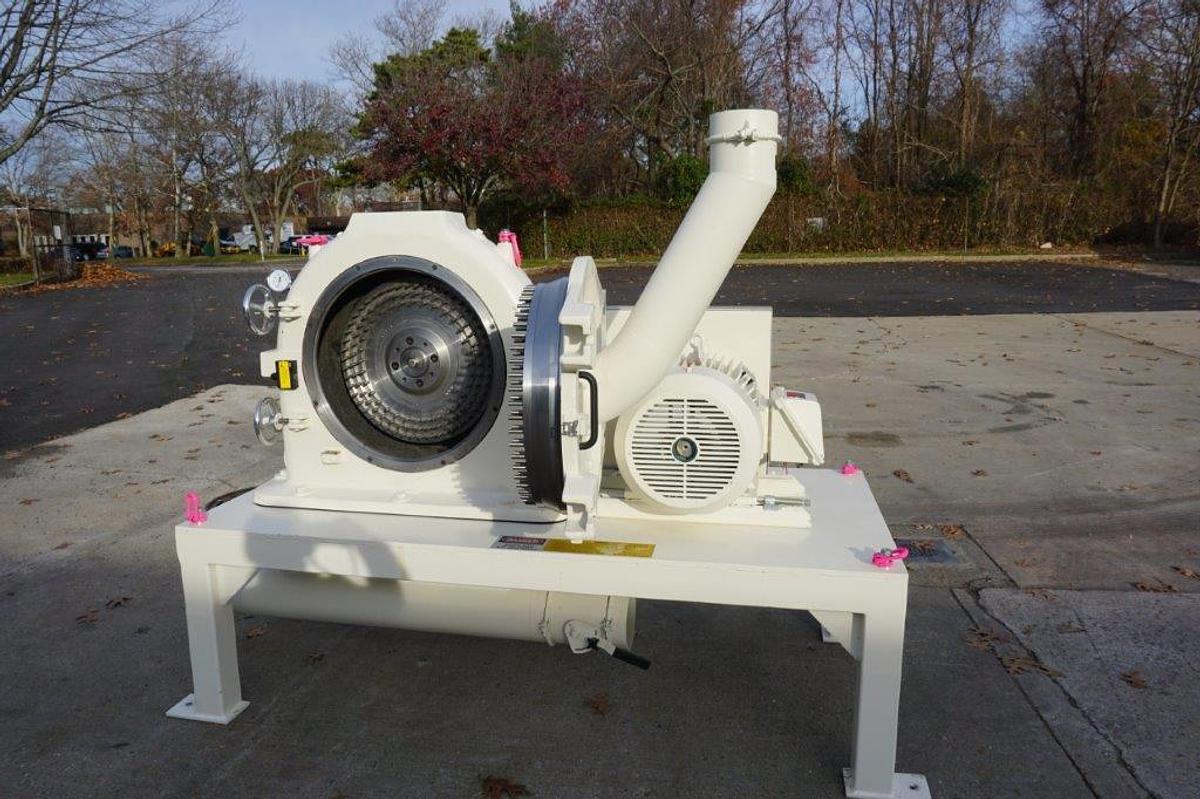
A Netzsch pin mill is a type of impact grinding machine that uses interlocking rows of pins mounted on rotating and stationary discs to reduce particle size through repeated impact and shear. The material is fed into the center of the disc assembly and is accelerated outward through the pin rows, where it is broken down progressively until it exits at the periphery. Pin mills are capable of producing fine to medium particle sizes and are well suited for materials that are friable, heat-sensitive, or require a relatively narrow particle size distribution. Typical feed materials include spices, sugar, chemicals, pigments, and certain pharmaceutical powders.
One of the practical advantages of a pin mill is its relatively simple mechanical design, which makes it easier to clean and maintain compared to some other mill types. This is particularly relevant in food and pharmaceutical processing, where cross-contamination between batches is a serious concern and equipment must be cleaned thoroughly between production runs. Used Netzsch pin mills appear on the secondary market periodically and can represent good value for operations that need reliable size reduction capacity without the cost of a current-production machine. Buyers should verify that the pin disc geometry and materials of construction are compatible with their intended application, and inspect the pins and discs carefully for wear before purchasing.