Category
Manufacturer
Model
Neslab
Neslab is recognized for its high-performance chillers and temperature control systems, serving industries such as biotechnology and pharmaceuticals. Their equipment ensures precise thermal management in critical manufacturing processes.
FAQ:
What are Neslab chillers and what are they used for?
Neslab chillers are precision temperature control systems designed to maintain exact thermal conditions in demanding laboratory, industrial, and manufacturing environments. The brand has built a strong reputation for high-performance cooling across a wide range of applications, including biotechnology research, pharmaceutical manufacturing, semiconductor fabrication, laser cooling systems, and general industrial process cooling. Their equipment is particularly valued in settings where even minor temperature fluctuations can compromise product quality or experimental results.
The core function of a Neslab chiller is to circulate temperature-controlled fluid through a process or piece of equipment, absorbing heat and maintaining a stable setpoint. Depending on the model series, these units can handle everything from bench-scale laboratory instruments to larger production-scale cooling loads. The HX, RTE, CFT, ThermoFlex, and Merlin series each target different temperature ranges and capacity requirements, giving buyers a wide selection to match their specific application. Some models are capable of reaching temperatures as low as -90 degrees Celsius, while others are optimized for ambient-range process cooling at higher flow rates.
What Neslab chiller models are most commonly available on the used market?
The used market for Neslab chillers tends to be fairly active because these machines are built to last, and many units remain functional long after their original owners upgrade or decommission them. The models that appear most frequently include the RTE series (recirculating temperature baths and chillers), the HX series (designed for higher-capacity process cooling), the CFT series (portable chillers suited for single-phase power applications), the ThermoFlex series (compact recirculating chillers popular in laser and analytical instrument cooling), and the Merlin series (often found in laboratory and light industrial settings).
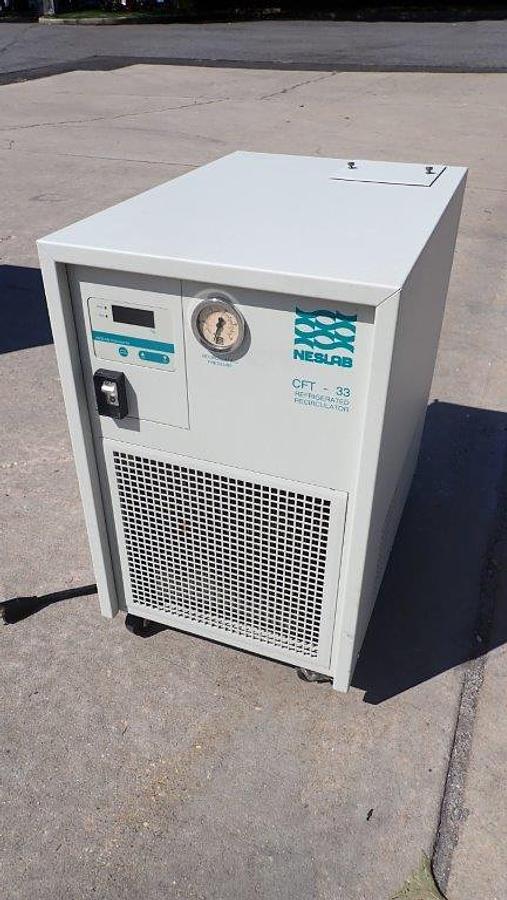
Among portable options, the CFT-33 is a good example of the type of single-phase unit that shows up regularly in used equipment inventories. It appeals to labs and smaller operations that need reliable cooling without the infrastructure demands of a three-phase system. When searching for a specific model, it helps to know your required temperature range, cooling capacity in watts or kilowatts, fluid compatibility, and available power supply, since these factors will narrow the field considerably and help you avoid purchasing a unit that is over- or under-sized for your process.
Are used Neslab chillers reliable enough for laboratory and pharmaceutical use?
Neslab chillers have a well-established reputation for durability, which is a big part of why the used market for them remains active and well-stocked. Many units continue to perform accurately for years or even decades past their initial installation, provided they have been maintained properly. In laboratory and pharmaceutical environments, where precise thermal management is critical to process integrity, a well-maintained used Neslab chiller can be a cost-effective alternative to purchasing a brand-new unit from a different manufacturer.
That said, the reliability of any used chiller depends heavily on its maintenance history, operating conditions, and the care taken by the seller to accurately represent the machine's current condition. Buyers should request as much documentation as possible, including any service records, and take advantage of inspection opportunities before committing to a purchase. Reputable used equipment dealers will typically offer in-person or video inspections so buyers can assess the machine's physical condition and, where possible, observe it in operation. Consulting with the manufacturer about parts availability and technical support for a specific model and age is also a smart step, since older units may have more limited support resources.
What cooling capacity options are available for used Neslab chillers?
Neslab chillers span a broad range of cooling capacities, which is one reason they appear across so many different industries and applications. At the lower end, compact recirculating models in the ThermoFlex and RTE series typically deliver cooling capacities in the range of a few hundred watts, making them well-suited for small analytical instruments, lasers, and benchtop laboratory equipment. Mid-range models step up to one to several kilowatts of cooling, covering a wider array of process equipment and pilot-scale manufacturing applications.
Larger HX-series and process-grade units can deliver significantly higher capacities, sometimes reaching into the tens of kilowatts range, which is appropriate for production-scale pharmaceutical manufacturing, semiconductor fabrication tools, or multi-instrument cooling loops. When evaluating a used Neslab chiller, it is important to match the unit's rated cooling capacity at your target setpoint temperature to your actual process heat load. Cooling capacity ratings are temperature-dependent, meaning a chiller rated at a certain wattage at 20 degrees Celsius will deliver less cooling at lower setpoints. Reviewing the original specification sheets for the model in question will give a clearer picture of real-world performance across the temperature range.
What temperature ranges do Neslab chillers cover?
The temperature range available across the Neslab product lineup is one of the broadest in the laboratory and process chiller category. Entry-level recirculating units in the RTE series typically operate from just below ambient down to around -20 or -30 degrees Celsius, which covers the majority of common laboratory cooling needs. Mid-range models extend further into sub-ambient territory, and some specialized units in the Neslab lineup are rated for operation as low as -90 degrees Celsius, making them suitable for cryogenic-adjacent research and low-temperature process chemistry.
On the upper end, many Neslab models also support heating as well as cooling, functioning as recirculating temperature baths that can hold setpoints well above ambient for applications like viscosity testing, elevated-temperature reactions, or thermal cycling protocols. This dual heating and cooling capability adds flexibility and is worth noting when comparing models. Buyers should confirm the exact temperature range of any specific used unit they are considering, since temperature control performance can be affected by the age of refrigerant components, the condition of the compressor, and whether the unit has been serviced recently.
What is the typical price range for used Neslab chillers?
Pricing for used Neslab chillers varies considerably depending on the model series, cooling capacity, age, and overall condition of the unit. Compact, single-phase portable models like the CFT series or smaller RTE units tend to be the most affordable entry point, often available in the low hundreds to low thousands of dollars range. Mid-capacity models with more sophisticated temperature control or higher flow rates typically fall in the several-thousand-dollar range, while larger HX-series or high-capacity process chillers can command prices well into the five-figure range depending on specifications and condition.
Because these are used machines, pricing also reflects the seller's knowledge of the equipment's history and the level of inspection or testing that has been performed. A unit sold with documented service records and a thorough inspection will generally be priced higher than one sold with limited information, and that premium is often worth it for buyers who need reliable performance. It is also worth factoring in shipping, rigging, and any reconditioning costs when calculating the total landed cost of a used chiller, since these expenses can add meaningfully to the purchase price depending on the size of the unit and the distance involved.
How do I evaluate the condition of a used Neslab chiller before buying?
Evaluating a used chiller before purchase requires looking at both the mechanical and operational condition of the unit. On the mechanical side, key things to inspect include the condition of the compressor, the state of the refrigerant circuit (look for signs of leaks or low refrigerant charge), the condition of pump seals and fluid lines, the cleanliness of the condenser coils, and the general state of the electrical components and control panel. Corrosion, scale buildup in fluid passages, and worn seals are common issues in older units that have not been regularly serviced.
Reputable used equipment dealers will typically accommodate in-person inspections at their facility, or can provide detailed video walkthroughs of the machine if travel is not practical. Some equipment may still be installed and operating at the facility where it was decommissioned, in which case the dealer may be able to arrange an inspection at that location. Keep in mind that most used equipment dealers do not have the permitting or infrastructure to run full production tests, so inspection is generally limited to visual assessment and, where possible, powering the unit on to verify basic operation. Buyers should also contact the manufacturer directly to check on parts availability and technical support for the specific model, since the age of the unit can affect how much after-sale support is realistically available.
What is the difference between Neslab and Thermo Scientific chillers?
Neslab was an independent manufacturer of laboratory and process chillers and temperature control equipment for several decades before being acquired by Thermo Electron, which later became Thermo Fisher Scientific. After the acquisition, Neslab products were gradually rebranded under the Thermo Scientific label, and newer units sold under that brand are essentially the continuation of the Neslab product line with updated designs and controls. For buyers in the used equipment market, this means that older units will carry the Neslab name and branding, while more recent production units from the same product family may be labeled Thermo Scientific.
From a practical standpoint, the core engineering and performance characteristics of the two brands overlap significantly, particularly for models that were produced during the transition period. Buyers searching specifically for used Neslab chillers are often looking at units that predate the full rebrand, which means they are dealing with machines that may be older but are also proven in the field over a longer track record. Parts and service support for older Neslab-branded units can vary, so it is worth checking with Thermo Fisher Scientific directly to understand what level of support is available for a specific model number and production year before making a purchase decision.
What should buyers know about shipping a used Neslab chiller?
Shipping a used chiller requires more planning than most standard freight shipments because these machines contain refrigerant circuits, precision pumps, and sensitive electronic controls that can be damaged by improper handling or inadequate packaging. Smaller portable units like the CFT-33 can typically be palletized and shipped via standard freight carriers with appropriate blocking and bracing, but larger process chillers may require custom crating to prevent damage in transit. The cost of packaging varies based on the level of protection required, and buyers should ask the seller specifically what packaging method will be used before agreeing to a purchase price.
Larger or heavier chillers may also require specialized rigging equipment for loading at the origin and unloading at the destination, which adds to the overall cost. Buyers should get a clear breakdown of all shipping-related charges, including palletization or crating, freight, and any rigging fees, so they understand the full landed cost of the equipment before committing. It is also worth confirming whether the receiving facility has a loading dock or forklift access, since delivery to a location without appropriate unloading equipment can create complications and added expense.
What payment terms are typical when buying used Neslab chillers from a dealer?
Payment practices in the used industrial equipment market are fairly standardized. Most dealers require full payment before the equipment is shipped or released, which reflects the nature of selling used machinery where the seller has no practical way to recover the equipment once it has left the facility. This is a normal and expected condition of sale, not a red flag, and buyers should plan accordingly when budgeting for a purchase. Wire transfers are the most common payment method for transactions of this size, though some dealers also accept credit cards or other forms of payment depending on the transaction amount.
Some dealers may offer extended payment terms or net terms to buyers with whom they have an established purchasing history, but this is generally the exception rather than the rule for first-time transactions. Buyers who need financing should explore equipment financing options through third-party lenders before approaching a dealer, since many used equipment transactions can be financed through specialized lenders who understand the residual value of industrial machinery. Having financing pre-arranged also puts a buyer in a stronger negotiating position and speeds up the transaction once a suitable unit is found.