Category
Manufacturer
Model
Myers
Myers provides a range of material handling and processing equipment, primarily for the food and beverage sectors. Their solutions are designed to enhance efficiency and safety in production environments.
FAQ:
What types of Myers mixing equipment are available on the used market?
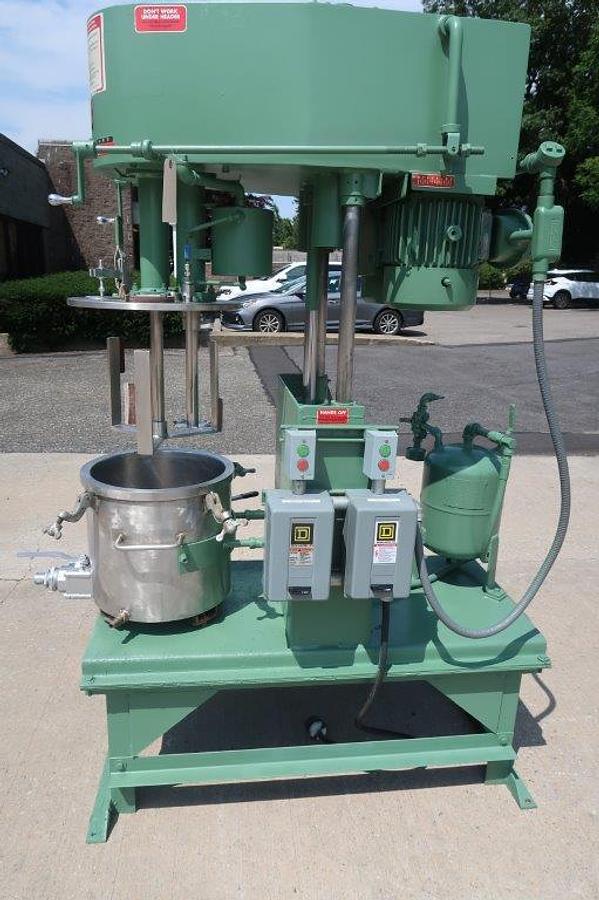
Myers has built its reputation around high-speed dispersers and industrial mixing equipment, and those product lines tend to dominate the used market as well. Common equipment types that surface for resale include high-speed production dispersers, laboratory dispersers, multi-shaft mixers, planetary mixers, and dual-shaft jacketed vacuum mixers. The dual-shaft jacketed vacuum mixer is a particularly specialized piece of equipment, combining two independent agitation systems with a jacketed vessel for temperature control and a vacuum-capable design for processes that require air removal or controlled atmosphere mixing.
Beyond dispersers, buyers searching the used market may also find Myers equipment configured for specific viscosity ranges, from low-viscosity fluid mixing to high-viscosity paste processing. Stainless steel construction is common across many Myers models, which makes them well-suited for sanitary applications in food, beverage, and pharmaceutical production. When browsing used listings, it helps to note the vessel capacity, motor configuration, shaft type, and any special features like explosion-proof (XP) motors or jacketed vessels, since these details significantly affect the machine's suitability for a given application.
What industries commonly use Myers mixing equipment?
Myers mixing equipment has historically served a broad range of process industries, with particularly strong roots in coatings, inks, adhesives, and chemical processing. High-speed dispersers from Myers are well-regarded in these sectors because of their ability to break down agglomerates and achieve fine, uniform particle distribution in liquid formulations. Paint manufacturers, ink producers, and adhesive formulators have relied on Myers dispersers for decades, which is one reason used Myers equipment appears regularly on the resale market after facilities upgrade or consolidate production.
Beyond those traditional industries, Myers equipment also finds application in food and beverage production, where stainless steel construction and sanitary design standards are priorities. Pharmaceutical and personal care product manufacturers similarly look for Myers mixers when sourcing used processing equipment, particularly models with jacketed vessels and vacuum capability that support temperature-sensitive or air-sensitive formulations. The brand's reputation for heavy-duty construction and durability makes used Myers equipment attractive across all of these sectors, since a well-maintained machine can continue delivering reliable performance long after its initial production run.
What should buyers look for when inspecting used Myers mixing equipment?
Inspecting used mixing equipment thoroughly before purchase is one of the most important steps a buyer can take, and Myers machines are no exception. Key areas to evaluate include the condition of the shaft and blade or impeller assembly, the integrity of the vessel (particularly looking for pitting, corrosion, or weld repairs in stainless steel models), the motor's operating condition, and the functionality of any variable speed controls. For jacketed models, buyers should verify that the jacket is intact and that connections for heating or cooling media are in good condition. On vacuum mixer models, the sealing surfaces and vacuum system components deserve close attention.
Reputable used equipment dealers will typically accommodate in-person inspections or provide detailed video walkthroughs of the machine. Some equipment may still be installed and running at a production facility, where an inspection can be arranged directly at the plant. It is worth noting that most equipment dealers do not have the permitting or infrastructure to run full production tests with actual product, so inspections focus on mechanical condition and operational verification rather than formulation-specific performance. Buyers should also consult with Myers directly regarding parts availability and technical support for a specific model, since the age and configuration of the machine can influence what level of manufacturer support remains available.
How do high-speed dispersers differ from other types of industrial mixers?
A high-speed disperser, sometimes called a high-speed dissolver or HSD, uses a rotating toothed disc (called a Cowles blade or dispersion blade) spinning at high peripheral speeds to create intense hydraulic shear within a batch. This shear action is specifically designed to break apart agglomerates, wet out pigment particles, and distribute solids uniformly throughout a liquid medium. The process is fundamentally different from simple blending, where the goal is just to combine ingredients. Dispersers are optimized for particle size reduction and deagglomeration, which is why they are the workhorse equipment in coatings, ink, and pigment dispersion applications.
Other mixer types serve different functions. Planetary mixers use a revolving agitator that orbits around the vessel while rotating on its own axis, which is effective for high-viscosity materials like pastes, doughs, and thick compounds that a high-speed disperser cannot efficiently process. Multi-shaft mixers combine a high-speed disperser shaft with one or more low-speed anchor or helical agitators in the same vessel, giving operators the ability to handle a wider viscosity range within a single batch. Understanding these distinctions helps buyers select the right used Myers equipment for their specific process requirements rather than simply purchasing based on brand or price alone.
What does a dual-shaft jacketed vacuum mixer do, and what processes is it used for?
A dual-shaft jacketed vacuum mixer combines several process capabilities into one piece of equipment. The dual-shaft design means the machine has two independent mixing elements operating simultaneously, typically a high-speed disperser shaft for shear and particle dispersion paired with a low-speed anchor or sweep agitator that keeps material moving across the vessel walls and prevents dead zones. This combination allows processors to handle materials across a wide viscosity range within a single batch, which is particularly valuable when a formulation changes viscosity significantly during processing.
The jacketed vessel adds the ability to heat or cool the batch by circulating a temperature-controlled fluid (water, oil, or steam) through the jacket surrounding the mixing chamber. This is critical for processes where temperature must be controlled to manage viscosity, prevent ingredient degradation, or facilitate reactions. The vacuum capability allows air to be drawn out of the vessel during mixing, which is important for products where entrapped air causes quality problems, such as certain sealants, adhesives, pharmaceutical ointments, cosmetic creams, and food products. Used dual-shaft jacketed vacuum mixers in stainless steel construction are sought after in food, personal care, pharmaceutical, and specialty chemical production for exactly these reasons.
What are explosion-proof (XP) motors on mixing equipment, and when are they required?
Explosion-proof motors are specially constructed electric motors designed to contain any ignition that occurs inside the motor housing, preventing sparks or heat from escaping and igniting flammable vapors or dusts in the surrounding environment. They are built and certified to meet specific electrical safety classifications defined by standards organizations, and their use is typically required by safety regulations when mixing equipment operates in environments where flammable solvents, vapors, or combustible dust may be present. In mixing applications, this is common when processing solvent-based coatings, inks, adhesives, or chemical formulations that release flammable vapors during agitation.
For buyers evaluating used Myers mixing equipment, the presence of an XP-rated motor is a meaningful specification that directly affects where the machine can be legally and safely deployed. A used mixer with an XP motor commands a premium on the resale market because it expands the range of facilities and processes it can serve. Buyers should verify the motor's classification rating and confirm it meets the requirements for their specific facility hazard classification. It is also worth having an electrician or safety professional review the full electrical configuration of a used machine before putting it into service in a classified area, since other electrical components beyond the motor may also need to meet explosion-proof standards.
How is used Myers mixing equipment typically priced compared to buying new?
Used industrial mixing equipment is generally priced at a significant discount compared to purchasing equivalent equipment through a manufacturer or authorized distributor. The actual discount varies based on the age of the machine, its condition, the complexity of the design (a basic single-shaft disperser versus a dual-shaft jacketed vacuum mixer with XP motors, for example), and current market demand for that type of equipment. Well-maintained used Myers dispersers and mixers in good working order can represent substantial savings, which is why many small and mid-sized manufacturers, contract processors, and R&D facilities actively source used equipment rather than buying new.
Buyers should factor in more than just the listed price when calculating the total cost of acquisition. Shipping costs for industrial mixing equipment can be substantial, particularly for larger machines that require rigging, crating, or specialized freight handling. Inspections, any refurbishment or parts replacement needed after purchase, installation, and any modifications required to integrate the machine into an existing production line all add to the landed cost. Getting a clear picture of these additional expenses before committing to a purchase helps avoid surprises and allows for an accurate comparison between used equipment options.
What should buyers understand about shipping and rigging costs for used industrial mixers?
Shipping industrial mixing equipment is not the same as shipping standard freight, and the costs can be meaningfully higher than buyers anticipate if they only focus on the listed equipment price. Mixers and dispersers are heavy, often awkwardly shaped machines that require proper palletization or custom crating to prevent damage in transit. The level of packaging required depends on the size and configuration of the machine, and these packaging costs are typically passed on to the buyer. Smaller bench-top or laboratory-scale units may ship on standard pallets, while larger production dispersers or multi-shaft mixers may need custom wooden crating or even specialized rigging frames.
For larger machines, the loading and unloading process itself requires heavy-duty rigging equipment such as forklifts or cranes, and the cost of rigging services at both the origin and destination facilities is an added expense that buyers need to account for. Buyers should ask the selling dealer for a detailed breakdown of packaging, rigging, and freight costs before finalizing a purchase so they understand the full landed cost of the equipment. It also helps to confirm in advance what unloading equipment is available at the receiving facility, since arriving with a machine that requires a crane when only a forklift is available creates delays and additional expense.
What payment terms should buyers expect when purchasing used mixing equipment from a dealer?
Most used industrial equipment dealers require full payment before the equipment is released for shipping. This is standard practice in the industry and applies to the majority of transactions, particularly for buyers who have not previously purchased from that dealer. The reasoning is straightforward: used equipment is a finite, specific asset, and dealers need payment security before committing to hold a machine and prepare it for shipment. Accepted payment methods vary by dealer but commonly include wire transfer, ACH, and in some cases credit card for smaller purchases.
Some dealers extend payment terms to established customers with a history of repeat purchases, but this is the exception rather than the rule and is typically negotiated on a case-by-case basis. Buyers who are new to a dealer should plan for full prepayment as the default expectation. It is a good idea to confirm payment terms, accepted methods, and any deposit requirements early in the conversation with a dealer, before spending significant time on inspections or logistics planning. Understanding the payment structure upfront avoids delays once both parties are ready to finalize a transaction.
How can buyers assess the reputation and reliability of a used mixing equipment dealer?
The used industrial equipment market has reputable, long-established dealers alongside less experienced resellers, and the difference matters significantly when buying specialized processing equipment. A dealer's track record is one of the most reliable indicators of reliability. Dealers who have been operating for many years and who specialize in process and mixing equipment (rather than selling a broad mix of unrelated machinery) are generally better positioned to accurately describe the equipment they sell, answer technical questions, and facilitate a smooth transaction. Specialization matters because a dealer familiar with mixing equipment understands what specifications are meaningful and what condition issues are worth flagging.
Buyers should look for dealers who are transparent about the condition of their equipment, willing to provide detailed photos, video walkthroughs, or in-person inspection access, and responsive to technical questions. A dealer who is evasive about condition details or reluctant to accommodate reasonable inspection requests is a red flag. It also helps to ask about the source of the equipment, since machines coming directly out of production facilities often have a clearer maintenance history than machines that have passed through multiple hands. Checking for any available references or reviews from past customers, and confirming that the dealer can provide clear documentation of the sale, are additional steps that protect buyers in the used equipment market.