Category
Manufacturer
Model
Munson
Munson is recognized for its heavy-duty mixing and size reduction equipment, primarily serving the food and chemical industries. Their machines are engineered for reliability and performance in demanding applications.
FAQ:
What types of mixing equipment does Munson Machinery manufacture?
Munson Machinery has been building industrial mixing and blending equipment since 1905, and their product line covers a fairly wide range of mixer types. The core lineup includes rotary batch mixers, ribbon blenders, fluidized bed mixers, and continuous mixers, along with size reduction equipment. Each design addresses a different set of processing requirements, so buyers working with fragile granules, dense powders, or cohesive blends will typically find a Munson configuration suited to their material.
The rotary batch mixer is arguably the machine Munson is best known for. It tumbles material in a rotating drum with internal flights, producing thorough blending with minimal mechanical stress on the product. This makes it a go-to choice for friable or fragile materials where a ribbon blender's agitator might cause breakage. Ribbon blenders, by contrast, use a double-helical agitator inside a horizontal trough and are well suited for bulk powder blending at higher throughput. Understanding which mixer type fits a specific application is the first step before evaluating any used Munson equipment on the market.
What industries commonly use Munson industrial mixers?
Munson equipment turns up across a broad range of processing industries, which is part of why used machines hold their value and remain in demand on the secondary market. Food processing is one of the heaviest use cases, covering dry spice blends, baking mixes, snack seasonings, and powdered nutritional products. Chemical manufacturers rely on Munson mixers for pigments, fertilizers, detergents, and specialty compounds. Pharmaceutical and nutraceutical producers use them for blending active ingredients with excipients, often in sanitary stainless steel configurations that meet FDA and GMP standards. Plastics compounders, mineral processors, and agricultural feed producers are also consistent users of this equipment.
The breadth of industries served is worth keeping in mind when shopping for a used Munson machine, because a mixer that came out of a food plant will have different construction and surface finish requirements than one that processed abrasive minerals. Reviewing the machine's history, materials of construction, and any documentation about prior use helps buyers confirm that a specific unit is appropriate for their intended application. Reputable used equipment dealers who specialize in process and mixing machinery are generally the best source for this kind of background information.
What materials of construction are available on used Munson mixers, and why does it matter?
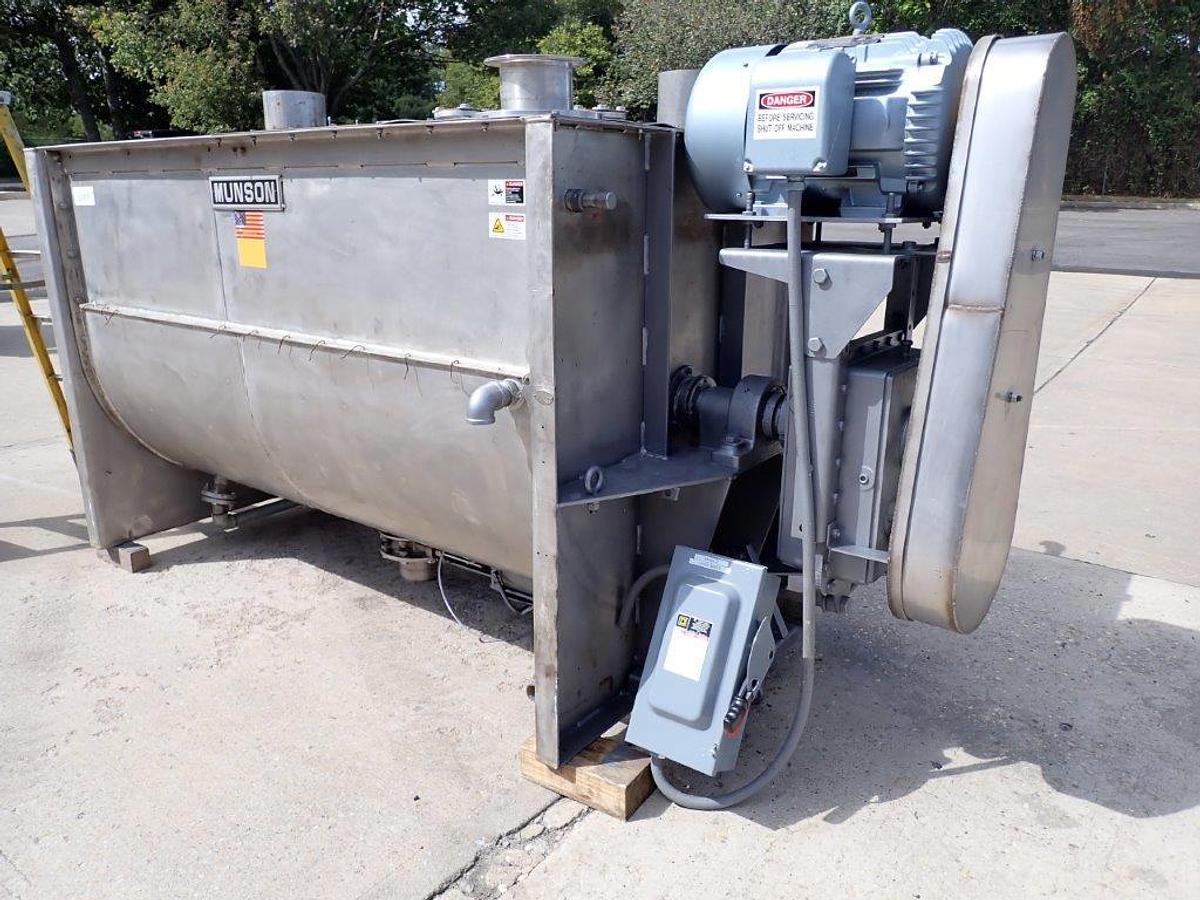
Munson builds its equipment in both carbon steel and stainless steel, with sanitary stainless steel configurations available for food-grade, pharmaceutical, and other regulated applications. Stainless steel units, particularly those built to 304 or 316 stainless specifications, resist corrosion from acidic or moisture-laden materials and are far easier to clean to the standards required in food and pharmaceutical processing. Jacketed versions, like the 65 cubic foot stainless steel double ribbon blender with a jacket, add the ability to heat or cool the product during blending, which is critical for temperature-sensitive formulations or materials that need to be processed at a controlled temperature.
For buyers sourcing used Munson equipment, material of construction is one of the most important specs to verify before purchase. A carbon steel mixer that processed dry minerals may not be suitable for a food application without significant refurbishment. Conversely, a sanitary stainless unit with polished interior surfaces and clean-in-place fittings may carry a price premium on the used market that is well justified for a regulated production environment. Asking the dealer for photos of the interior welds, surface finish, and any existing certifications or documentation from the previous owner gives buyers the clearest picture of what they are actually purchasing.
What mixing capacities are typically available when buying used Munson equipment?
Munson manufactures ribbon blenders and rotary batch mixers across a wide capacity range, from small pilot-scale units holding just a few cubic feet up to large production machines exceeding 100 cubic feet. Mid-range units in the 20 to 65 cubic foot range are among the most commonly traded on the used market because they fit the production volumes of a large number of food, chemical, and pharmaceutical operations. The 65 cubic foot double ribbon blender is a good example of a capacity that serves both mid-size batch production and larger facilities running shorter batch cycles.
Capacity selection on the used market requires some practical math. A ribbon blender is typically loaded to around 50 to 60 percent of its rated volume to allow proper agitator action and blend quality. So a 65 cubic foot blender handles working batches closer to 35 to 40 cubic feet of material. Buyers should also factor in bulk density: a low-density powder like a spice blend will behave very differently than a dense mineral at the same cubic foot fill level. Discussing these details with a knowledgeable used equipment dealer before purchase helps ensure the machine selected will actually meet production requirements.
What is the Munson Rotary Batch Mixer, and what makes it different from a ribbon blender?
The Munson Rotary Batch Mixer is a drum-style blender where the entire vessel rotates on a horizontal axis. Material inside the drum is lifted and cascaded by internal flights and baffles rather than by a fixed agitator moving through the batch. This tumbling action is inherently gentle, which makes the machine well suited for blending fragile granules, coated particles, or any material where breakage or attrition during mixing would degrade product quality or alter particle size distribution. The absence of a central agitator shaft also means there are no mechanical seals in contact with the product stream, which simplifies cleaning and reduces contamination risk.
A ribbon blender, by comparison, uses a double-helical ribbon agitator mounted on a shaft inside a horizontal U-trough. The ribbons move material in opposing directions simultaneously, creating a fast, thorough mix. Ribbon blenders are generally faster at homogenizing large batches of free-flowing powders, but the mechanical action is more aggressive. For applications involving fragile materials, high-value ingredients where yield loss from breakage matters, or blends requiring very short mix times with minimal shear, the rotary batch design often wins out. Both types appear regularly on the used equipment market, and the right choice depends heavily on the specific material and process requirements.
What should buyers inspect when evaluating used Munson mixing equipment?
A thorough inspection of any used Munson mixer should cover several areas: the condition of the agitator or ribbon, the integrity of the trough or drum, the state of seals and bearings, the gearbox and drive system, and the control panel or electrical components. Ribbon agitators in particular can show wear or bending at the tips if the machine was overloaded or run with improperly sized batches. Interior welds and surface finish are especially important for stainless steel units going into food or pharmaceutical service, since pitting or rough welds can harbor contamination. Any jacketed units should be checked for leaks or scale buildup in the jacket passages.
Most reputable used equipment dealers will accommodate in-person inspections at their facility or, in cases where the machine is still at the selling plant, can arrange access for the buyer or their representative. Video inspections and detailed photo documentation are also commonly offered when travel is not practical. Keep in mind that most equipment dealers are not set up to run production trials, so testing the machine with actual product is generally not possible through the dealer. Buyers who need process validation before committing to a purchase should factor in the cost of having the equipment inspected by a qualified millwright or process engineer who can assess mechanical condition independently.
Are replacement parts and manufacturer support available for used Munson machinery?
Munson Machinery has been in continuous operation since 1905, which is a meaningful factor when evaluating long-term support for used equipment. A manufacturer with that kind of history is far more likely to have parts documentation, drawings, and service knowledge for older machines than a company that has changed ownership multiple times or exited certain product lines. That said, the availability of specific parts for any used machine depends on the model, age, and whether the design has been updated or discontinued over time. Buyers should contact Munson directly before purchasing a used unit to ask about parts availability for that specific model and serial number.
For wear items like seals, bearings, and drive components, many parts can be sourced through industrial supply channels regardless of the manufacturer's support level, since these are often standard mechanical components. The more manufacturer-specific items, such as replacement ribbon agitators, drum flights, or proprietary control components, are the ones worth verifying in advance. A used equipment dealer who specializes in mixing and blending machinery can often provide guidance on parts sourcing based on their experience with similar machines, and some dealers maintain a stock of common wear parts for the equipment they sell.
What should buyers understand about shipping and rigging costs for used Munson mixers?
Industrial mixing equipment is heavy, and larger Munson ribbon blenders or rotary batch mixers can weigh several thousand pounds. Shipping costs are rarely straightforward and depend on the size and weight of the machine, the origin and destination, and the level of packaging or crating required to protect the equipment in transit. A machine that ships on an open pallet carries different freight costs than one requiring a custom-built wooden crate with internal blocking and bracing. Buyers should ask the dealer specifically what packaging is included in the quoted price and what additional crating or skidding charges might apply.
For larger machines, rigging at both the origin and destination is a real cost that buyers sometimes overlook. Loading a multi-ton blender onto a flatbed truck requires a forklift or crane, and unloading at the buyer's facility requires the same. If the buyer's plant does not have the lifting equipment to handle a large machine, hiring a rigging contractor adds to the landed cost. Getting a complete picture of freight, rigging, and crating costs before finalizing a purchase prevents surprises and allows for a fair comparison between machines priced at different locations.
What are typical payment terms when purchasing used Munson equipment from a dealer?
Used industrial equipment dealers generally require payment in full before a machine is released for shipping. This is standard practice in the industry and reflects the nature of used equipment transactions, where the dealer needs to confirm funds before coordinating logistics. Wire transfer is the most common payment method for larger purchases, though some dealers accept other forms of payment depending on the transaction size and the buyer's relationship with the seller. Buyers who are working with a dealer for the first time should expect to pay in full upfront.
For buyers with an established purchasing history with a particular dealer, some flexibility on payment terms may be available, but this is handled case by case rather than as a standard policy. It is worth asking the dealer directly about any available options if payment timing is a consideration. Regardless of payment terms, buyers should make sure the purchase agreement clearly documents the machine description, serial number, condition as represented, and any agreed-upon inclusions like manuals, spare parts, or accessories before funds are transferred.
How do buyers verify the condition of a used Munson mixer before committing to a purchase?
The standard approach is to request an inspection, either in person at the dealer's facility or through a detailed video walkthrough. A good video inspection should show the machine running under power if possible, with close-up views of the agitator, seals, interior surfaces, drive components, and control panel. For machines that are still installed and operating at a customer's facility, some dealers can arrange access for a buyer's representative to observe the equipment in actual production, which provides the most accurate picture of its working condition. For decommissioned machines, a thorough visual and mechanical inspection is the practical alternative.
Buyers should come to an inspection with a checklist of specific things to verify based on the machine type. For a ribbon blender, that means checking ribbon tip clearance, shaft seal condition, trough surface finish, and gearbox operation. For a rotary batch mixer, the drum, trunnion bearings, and loading/discharge seals are the key areas. Buyers who are not familiar with the mechanical details of mixing equipment can hire an independent equipment appraiser or process engineer to conduct the inspection on their behalf. The cost of a professional inspection is almost always justified relative to the purchase price of a large industrial mixer.