Category
Manufacturer
Model
FAQ:
What types of industrial mixers does Morton manufacture?
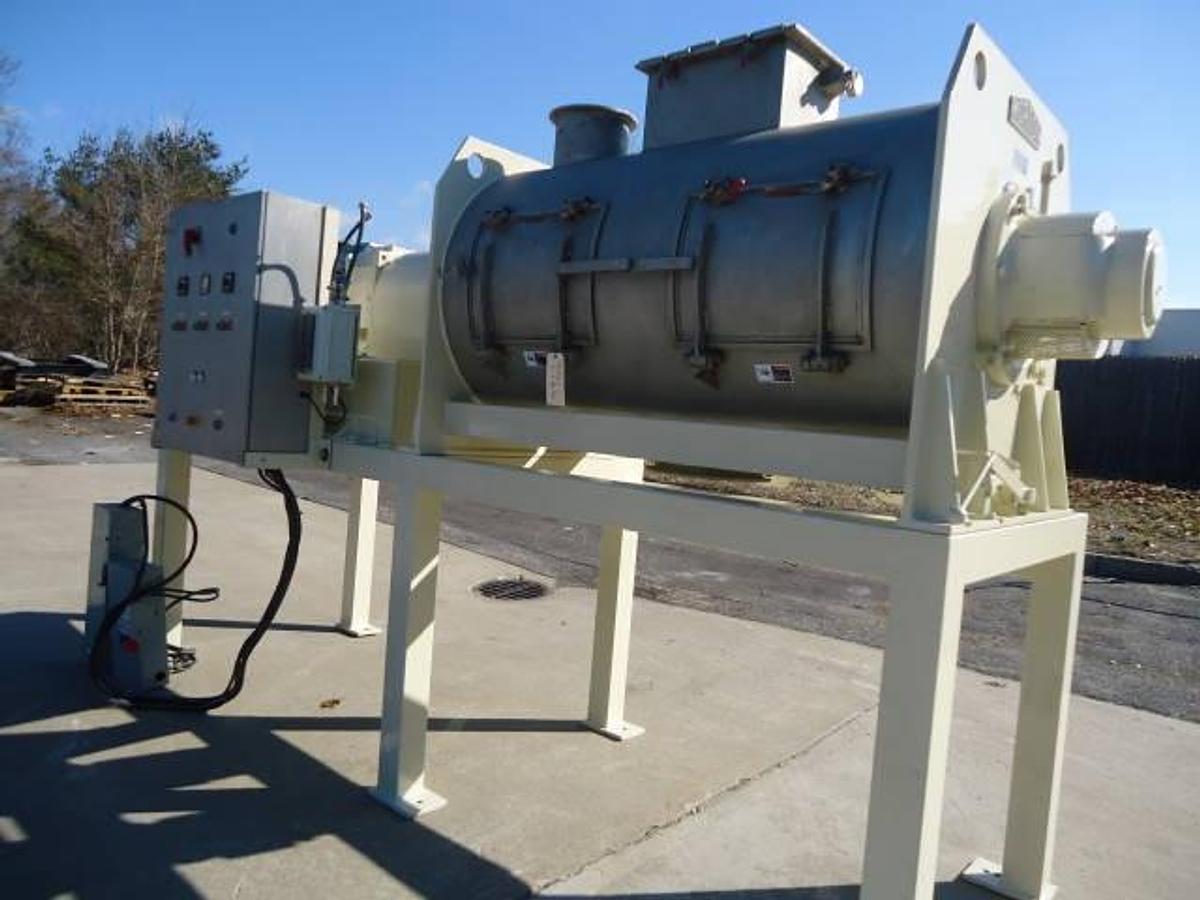
Morton produces a range of industrial mixing equipment designed for heavy-duty batch processing applications. Their product line includes plow mixers, which use a horizontal shaft with plow-shaped mixing tools to agitate and blend materials, as well as variants equipped with high-speed choppers. The choppers are mounted on the mixer body and run independently of the main shaft, breaking up agglomerates and improving the uniformity of the mix. A well-known example of this configuration is the Morton FKM-1200D, a stainless steel plow mixer with choppers designed for demanding processing environments.
Beyond plow-style machines, Morton has historically been associated with internal batch mixers used in rubber and plastics compounding. These machines are built for applications where shear force, heat generation, and material consistency are critical process variables. Buyers evaluating Morton equipment should pay close attention to the mixer type, the material of construction (carbon steel vs. stainless steel), and whether the unit includes auxiliary components like choppers, heating or cooling jackets, and discharge valves, since these features significantly affect what the machine can do in production.
What industries commonly use Morton industrial mixers?
Morton industrial mixers are used across several process-intensive industries where consistent, high-shear blending of dense or viscous materials is required. Rubber compounding is one of the most historically prominent applications, where internal batch mixers are used to incorporate carbon black, plasticizers, and curatives into rubber stocks. Adhesives and sealant manufacturing also rely on this type of equipment, as do plastics compounding operations that need to blend polymer pellets with additives, colorants, or fillers.
Beyond polymer processing, Morton-style plow mixers see use in food processing, chemical manufacturing, and pharmaceutical production, particularly when the application calls for gentle folding combined with high-speed chopping to achieve particle size reduction or coating. Plant managers and process engineers evaluating used Morton equipment should match the mixer's material of construction and surface finish to their specific application. Stainless steel units, for example, are typically required in food-grade and pharmaceutical environments, while carbon steel machines are more common in rubber and chemical processing.
What should buyers look for when purchasing a used Morton industrial mixer?
Buying used industrial mixing equipment requires a more deliberate evaluation process than purchasing capital equipment through a standard procurement channel. The most important factors to assess are the condition of the mixing chamber, the wear on the plow blades or mixing tools, the integrity of seals and shaft bearings, and the operational status of any auxiliary components like choppers, heating jackets, or discharge valves. Asking for detailed photographs, video walkthroughs, or arranging an in-person inspection are all reasonable steps before committing to a purchase.
Buyers should also consider the age and model of the machine and reach out directly to Morton or their current service network to understand what level of parts availability and technical support they can expect. Older machines may have limited parts availability, which affects long-term maintenance costs. Selecting a used equipment dealer with a demonstrated track record in industrial mixing or related process equipment is important, since specialists in this category are better positioned to accurately represent the machine's condition and application history. Used mixers are typically sold as-is, so the quality of the inspection process directly determines the risk the buyer takes on.
What mixing capacities are available in used Morton industrial mixers?
Morton industrial mixers have been manufactured across a wide range of batch capacities, from smaller laboratory or pilot-scale units to large production machines capable of processing several thousand liters per batch. Capacity is typically expressed in liters or gallons for plow mixers, and in terms of working volume for internal batch mixers. The FKM series, for example, references capacity in the model number, with the FKM-1200D indicating a 1,200-liter working capacity. Buyers should confirm whether a listed capacity refers to total vessel volume or the actual recommended working volume, since these figures are not always the same.
When selecting a capacity, process engineers should account for bulk density of the materials being mixed, the required batch size to meet production targets, and any future scaling needs. Oversizing a mixer can lead to poor mixing dynamics at partial fill, while undersizing creates bottlenecks. Used equipment markets will have varying availability at any given time, so buyers with specific capacity requirements may need to be flexible or patient in their search. Consulting with a dealer who specializes in industrial mixing equipment can help identify machines that meet the technical specifications without requiring costly modifications.
What is the typical price range for used Morton industrial mixers?
Pricing for used Morton industrial mixers varies considerably based on the mixer type, capacity, configuration, age, and overall condition of the machine. Smaller or older units in fair condition can sometimes be found in the range of $20,000 to $60,000, while larger, more recent machines in good working order, particularly those with stainless steel construction and auxiliary features like choppers or jacketed vessels, can command prices well above $100,000. Internal batch mixers designed for rubber compounding tend to sit at the higher end of the price spectrum given their mechanical complexity.
Buyers should treat the listed price as a starting point and factor in additional costs before calculating the true landed cost of the equipment. Rigging, freight, crating or palletization, and any reconditioning work needed after delivery all add to the total investment. Some dealers can assist with sourcing freight quotes or arranging rigging services, which helps buyers compare total cost of ownership across different machines and sellers. Given the capital-intensive nature of this equipment, taking the time to get a complete picture of all-in costs before committing is a standard part of the procurement process.
How does a plow mixer with choppers work, and what advantages does it offer?
A plow mixer operates on a horizontal axis, with a series of plow-shaped mixing tools mounted to a central shaft. As the shaft rotates, the plows move material in a three-dimensional pattern, lifting and folding it across the full length of the mixing chamber. This action creates a thorough blend without generating excessive heat, which makes plow mixers well-suited for materials that are heat-sensitive or that require gentle handling. The mixing action is efficient at both high and low fill levels, which gives operators some flexibility in batch size.
The addition of high-speed choppers changes the mixing profile significantly. Choppers are independently driven blades mounted through the side or top of the mixer body, and they spin at much higher RPMs than the main plow shaft. When active, they break apart lumps, agglomerates, or clumps that the plows alone cannot fully disperse. This is particularly useful in applications involving powders with strong cohesive tendencies, granulation processes, or coating operations where a uniform particle size distribution is critical. The combination of gentle bulk movement from the plows and high-shear action from the choppers gives this mixer type a broad application range across food, chemical, and polymer processing industries.
What power requirements should buyers expect for Morton industrial mixers?
Power requirements for Morton industrial mixers depend heavily on the size of the machine, the viscosity and bulk density of the materials being processed, and the configuration of the drive system. Smaller plow mixers may operate on motors in the 10 to 30 horsepower range, while large-capacity machines or internal batch mixers designed for rubber compounding can require 100 horsepower or more to generate the torque needed for dense, viscous materials. Choppers add a separate motor requirement on top of the main drive, typically in the 5 to 20 horsepower range depending on the application.
Buyers should verify the electrical specifications of any used mixer before purchase, including voltage, phase, and frequency requirements, and confirm that their facility's electrical infrastructure can accommodate the machine. In North America, most industrial equipment operates on 460V three-phase power, but older machines or units imported from other markets may have different requirements. If the existing electrical setup does not match, the cost of a transformer or rewiring should be included in the total acquisition budget. Requesting the original equipment documentation or nameplate data from the dealer is a straightforward way to confirm these specifications before committing to a purchase.
What does the inspection process look like for a used industrial mixer before purchase?
Inspections for used industrial mixing equipment generally take one of three forms: in-person visits to the dealer's facility or the plant where the machine is currently located, live video walkthroughs conducted remotely, or recorded video documentation provided by the dealer. Each approach has trade-offs. In-person inspections allow a buyer or their technician to physically examine wear surfaces, check for cracks or corrosion, operate the machine if possible, and assess the overall condition firsthand. Remote inspections are more convenient but depend on the quality of the video and the thoroughness of the dealer in capturing relevant details.
It is worth noting that most used equipment dealers do not have the permitting or production infrastructure to run actual product through a machine during an inspection. What a buyer can typically observe is whether the machine powers on, whether the drive components operate smoothly, and the visual condition of the mixing chamber, seals, and blades. Some machines may still be installed and running at the selling plant, in which case the dealer can sometimes arrange for an inspection at that location. Buyers should come prepared with a checklist of specific components they want to see and ask targeted questions about the machine's service history, any recent repairs, and the reason for decommissioning.
What are the shipping and logistics considerations when buying a used Morton industrial mixer?
Industrial mixers are heavy, often irregularly shaped pieces of equipment that require specialized handling from the moment they leave the selling facility to the moment they arrive at the buyer's plant. Rigging is typically required to load the machine onto a flatbed or enclosed trailer, and the cost of rigging varies based on the weight and configuration of the equipment. Buyers should ask the dealer for details on how the machine will be prepared for transit, including whether it will be crated, palletized, or shipped loose, since the level of packaging directly affects the risk of damage during transport.
Freight costs for large industrial mixers can be significant, and buyers should obtain quotes that reflect the actual dimensions and weight of the machine, including any skids or crating. Oversized loads may require permits or specialized carriers. On the receiving end, buyers need to confirm that their facility has adequate rigging equipment or that they have arranged for a rigger to unload and position the machine. Getting a clear breakdown of all shipping-related costs before finalizing the purchase is the best way to avoid surprises and accurately compare the total landed cost of machines from different sellers or locations.
What payment terms are typical when purchasing used industrial mixing equipment?
Most used equipment dealers require full payment before a machine is released for shipping. This is standard practice in the industry and reflects the nature of used capital equipment transactions, where the seller needs to confirm funds before incurring the cost of rigging, packaging, and freight coordination. Payment is typically made by wire transfer, though some dealers accept other forms depending on the transaction size and the buyer's relationship with the seller.
For buyers who have an established history with a particular dealer, some flexibility on payment terms may be available, but this is the exception rather than the rule for first-time transactions. Buyers financing the purchase through a third-party lender or equipment leasing company should factor in the time required to complete the financing process, since dealers will generally not hold a machine indefinitely without a deposit or confirmed payment timeline. Clarifying payment expectations early in the negotiation process helps avoid delays once both parties have agreed on price.