Category
Manufacturer
Model
Midwestern Industries
Midwestern Industries provides manufacturing equipment primarily for the aggregate and mining sectors. They are known for their screening and separation equipment that helps optimize material processing.
FAQ:
What types of screening equipment does Midwestern Industries manufacture?
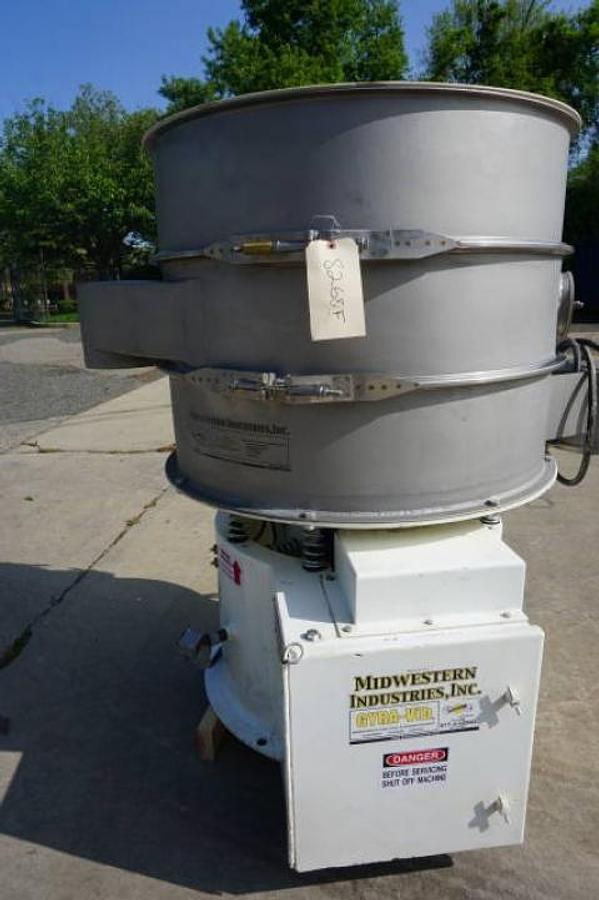
Midwestern Industries produces a range of vibratory screening and separation equipment designed to handle diverse material processing needs. Their product line includes round vibratory separators (commonly called sifters), rectangular screeners, and tumbler screeners. Each machine type is suited to different throughput volumes, material characteristics, and space constraints on a production floor. Round separators are particularly popular for fine particle separation and scalping, while rectangular screeners tend to handle higher-capacity, coarser material applications.
The company builds equipment in various deck configurations, meaning a single machine can sort material into multiple fractions simultaneously. A two-deck screener, for example, separates material into three distinct size ranges in a single pass. Stainless steel construction is available across much of their product line, which makes their equipment practical for food processing, pharmaceutical, and other sanitary applications where hygiene standards are strict. This combination of machine types and construction options has made Midwestern Industries equipment a common sight in aggregate, mining, food processing, chemical, plastics, and recycling operations.
What industries use Midwestern Industries screening equipment?
Midwestern Industries screening equipment is used across a surprisingly wide range of industries, given that the core function of separating and classifying materials by particle size applies almost universally in manufacturing and processing. The aggregate and mining sectors are among the most prominent users, relying on these machines to classify crushed stone, sand, gravel, and mineral ores by size. Chemical and plastics producers use them to remove fines, scalp oversized particles, and ensure product consistency before packaging or further processing.
Food and pharmaceutical manufacturers depend heavily on Midwestern Industries sifters and separators because the stainless steel construction meets sanitary standards and the equipment handles delicate or fine powders without degradation. Recycling operations use the machines to sort shredded materials by size fraction, improving the purity of recovered streams. Across all of these sectors, the underlying value proposition is the same: consistent, high-throughput separation that reduces manual sorting labor and improves end-product quality. This broad applicability is one reason used Midwestern Industries machines remain in strong demand on the secondary equipment market.
What should buyers look for when evaluating used Midwestern Industries screening equipment?
Condition assessment is the most critical step when purchasing used screening equipment of any brand. For Midwestern Industries machines specifically, buyers should examine the screen decks and mesh panels closely, since screen media wears faster than the structural components and will likely need replacement. The vibratory motor or drive mechanism deserves equal attention, as worn bearings or an imbalanced counterweight assembly can cause inconsistent screening performance and accelerated structural fatigue. Checking the frame welds, clamps, and gaskets for cracks or deterioration is also worthwhile, particularly on older machines.
Reputable used equipment dealers will typically accommodate in-person inspections or provide detailed video walkthroughs of a machine before purchase. Some machines may still be installed and running at a facility, which allows a buyer to observe actual operation. Keep in mind that most dealers do not run production at their locations, so live product testing is rarely possible, but a thorough visual and mechanical inspection can reveal a great deal about a machine's condition. Buyers should also contact Midwestern Industries directly to determine what level of parts and technical support is available for a specific model and year, since older or discontinued models may have more limited support options.
What screen sizes and mesh configurations are available for Midwestern Industries equipment?
Midwestern Industries produces equipment in a range of diameters and frame sizes to accommodate different production capacities and installation footprints. Round vibratory separators are available in multiple diameters, with common sizes ranging from smaller bench-top units up to 60-inch diameter machines for high-volume applications. Rectangular screeners follow a similar pattern, with width and length combinations scaled to match the throughput requirements of a given process. A 36-inch diameter stainless steel two-deck sifter, for instance, is a mid-range machine well suited to moderate-volume powder or granule processing.
Screen media options include woven wire mesh in a broad range of openings, polyurethane panels for abrasive or wet materials, and specialty fabrics for fine or sticky products. The mesh size selection depends entirely on the particle size cut points a process requires, and multiple decks allow for simultaneous separation at different size thresholds. When purchasing used equipment, buyers should confirm which screen frames and tensioning hardware are included with the machine, since replacement screen panels are a recurring operating cost. Midwestern Industries replacement screens are generally available through the manufacturer and authorized distributors, though availability for older models should be verified before purchase.
How does a vibratory round separator work, and why is it used for fine particle separation?
A vibratory round separator uses a vertically oriented motor with eccentric weights mounted on the shaft to generate a three-dimensional vibratory motion across the screen surface. This motion causes material fed onto the top deck to travel in a controlled spiral path from the center of the screen toward the outer edge, where oversized particles discharge. Undersized particles pass through the mesh and either discharge from the machine or fall onto a second deck for further classification. The combination of circular motion and vertical vibration keeps material moving continuously and prevents blinding of fine mesh openings.
This design is particularly effective for fine powders and granules because the gentle, controlled motion minimizes particle degradation while maintaining high throughput relative to the machine's footprint. The round geometry also eliminates corners where material could accumulate and stagnate, which matters in food-grade and pharmaceutical applications where residue buildup creates contamination risks. Multiple deck configurations allow a single machine to produce several sized fractions simultaneously, reducing the need for multiple pieces of equipment in a processing line. These performance characteristics explain why round vibratory separators from manufacturers like Midwestern Industries have remained a standard piece of equipment in powder-handling industries for decades.
Are replacement parts and screen media readily available for used Midwestern Industries machines?
Parts availability is a practical consideration that often determines the long-term value of a used screening machine. Midwestern Industries has been producing vibratory screening equipment for many years, and for current and recent-generation models, replacement screen panels, clamp rings, gaskets, motor components, and drive weights are generally available through the manufacturer and their authorized service network. Buyers of used equipment should verify the specific model and approximate age of a machine and then contact Midwestern Industries directly to confirm what support and parts supply they can expect.
For older or discontinued models, parts availability can be more limited, which is a meaningful risk factor in a purchasing decision. In some cases, third-party screen fabricators can produce replacement mesh panels to fit older frames, which extends the useful life of machines that the manufacturer no longer actively supports. Before finalizing a purchase, it is worth asking the selling dealer whether any spare parts, extra screens, or documentation such as manuals or wiring diagrams are included with the machine. Having that baseline of documentation and spare components on hand reduces downtime risk when a machine eventually needs maintenance.
What is the typical price range for used Midwestern Industries screening equipment?
Pricing for used Midwestern Industries screening equipment varies considerably based on machine type, size, age, condition, and included accessories. Smaller round separators in the 18-to-24-inch diameter range tend to be the most affordable, often available in the low thousands of dollars for machines in serviceable condition. Mid-range machines such as 36-inch diameter sifters, particularly those built in stainless steel for food or pharmaceutical use, typically command higher prices reflecting both the material cost and the broader demand for sanitary-grade equipment. Large-diameter separators and high-capacity rectangular screeners represent the upper end of the price spectrum.
Condition plays a significant role in pricing. A machine that has been recently serviced, has current screen media installed, and comes with documentation will typically be priced higher than one sold strictly as-is with visible wear. Buyers should factor in the cost of replacement screens, any needed mechanical service, shipping, and rigging when calculating the true landed cost of a used machine. Getting a clear picture of those additional costs upfront, before committing to a purchase, helps avoid surprises and allows for an accurate comparison between machines at different price points.
What does the inspection process look like when buying used screening equipment?
Inspections are a standard part of buying used industrial machinery, and reputable dealers will accommodate them in several forms. In-person inspections allow a buyer or their representative to physically examine a machine, check welds and structural components, assess motor condition, review the screen media, and look for signs of wear or prior repairs. This is the most thorough option and is particularly worthwhile for higher-value machines or those with complex drive systems. Some machines are still installed at operating facilities, in which case the dealer can often arrange access for an inspection at the actual plant, where the equipment may even be running in production.
For buyers who cannot travel, video inspections have become a practical alternative. A dealer can walk through the machine on camera, focusing on areas of specific concern, and provide close-up footage of key components. Still photography of all sides, decks, drive assemblies, and any visible wear points is another common option. The goal in all cases is to give the buyer an accurate, honest picture of the machine's current condition before money changes hands. Buyers should prepare a specific list of what they want to see and communicate that clearly to the dealer before the inspection takes place, ensuring nothing important gets overlooked.
What are the typical shipping and logistics considerations for purchasing used screening equipment?
Shipping used screening equipment involves more planning than standard freight because these machines are heavy, sometimes awkwardly shaped, and sensitive to damage from improper handling. Smaller round separators may ship on standard pallets with adequate blocking and bracing, while larger machines typically require custom crating to protect the screen frames, motor assembly, and drive components during transit. The level of packaging required directly affects shipping costs, and buyers should ask dealers for specifics on how a machine will be prepared before it leaves the facility.
Larger or heavier machines will require rigging equipment for loading at the origin and unloading at the destination, and those costs are typically separate from the freight charges themselves. Buyers should request a fully itemized breakdown of packaging, rigging, and freight costs to understand the complete landed cost of the equipment before committing to a purchase. Freight carriers experienced in industrial machinery are preferable to standard LTL carriers for anything beyond small, well-crated units. Coordinating the receiving end in advance, including having appropriate forklift capacity or crane access available at the delivery location, prevents delays and potential damage at the point of delivery.
What payment terms should buyers expect when purchasing used industrial screening equipment?
Payment practices in the used industrial equipment market are fairly consistent across dealers. The standard expectation is full payment prior to shipment, which protects the seller and ensures the transaction is complete before a machine leaves their facility. This is the norm rather than the exception, and buyers should plan their purchasing process accordingly, particularly if internal purchase order or wire transfer approval processes take time. Wiring funds or arranging payment through a verified method before a scheduled ship date is the typical workflow.
Some dealers extend payment terms to established customers with a history of prior transactions, but this is generally not available to first-time buyers. Buyers who need financing should explore equipment financing options through third-party lenders before beginning their search, so that funding is ready when the right machine becomes available. Understanding the payment expectations upfront, and confirming them with the dealer early in the conversation, avoids delays that could result in a machine being sold to another buyer while financing is being arranged.