Category
Manufacturer
Model
Mgs
Mgs specializes in providing manufacturing equipment for the packaging industry, particularly in the food and beverage sectors. Their machines are known for their reliability and efficiency in high-speed production environments.
FAQ:
What types of packaging equipment does MGS manufacture?
MGS Machine Corporation specializes in secondary packaging equipment, with a product line that covers horizontal form-fill-seal machines, cartoners, multi-pack bundlers, and pouch packaging systems. Their horizontal continuous motion cartoners, such as the HCM-750, are particularly well-regarded in production environments where speed and consistency are critical. The equipment is designed to handle a wide range of product formats and SKU variations, which makes a single MGS machine capable of covering duties that might otherwise require multiple dedicated pieces of equipment.
Beyond cartoning, MGS builds machines suited for bundling, wrapping, and secondary containment across a variety of product types. Their engineering focus on flexibility means the equipment can often be reconfigured or adjusted for different pack sizes without a full changeover overhaul. This adaptability is one reason MGS machines retain strong demand on the used equipment market, since buyers can often repurpose them for product lines that differ from the machine's original application.
What industries use MGS packaging equipment?
MGS packaging equipment is used across several industries, with the strongest concentration in pharmaceutical, nutraceutical, food and beverage, and consumer goods manufacturing. Pharmaceutical and nutraceutical producers rely on MGS cartoners and bundlers for compliance-sensitive packaging operations where precision and repeatability are non-negotiable. Food and beverage manufacturers use MGS equipment for high-speed secondary packaging of products like pouches, bottles, cans, and cartons, where throughput rates directly affect line profitability.
Consumer goods companies also deploy MGS machines for retail-ready packaging, including multi-packs and club-store bundles. The equipment's ability to handle multiple product formats without requiring entirely separate machines makes it attractive to contract packagers and co-manufacturers who run a diverse mix of SKUs. Because MGS machines are built for mid-to-high volume production environments, they tend to appear in facilities where uptime and cycle speed carry significant operational weight.
What should buyers know about purchasing used MGS packaging equipment?
Buying used MGS equipment differs meaningfully from purchasing directly from a manufacturer. Used machines are sold as-is, which shifts the responsibility of evaluating condition squarely onto the buyer. This makes the reputation and specialization of the equipment dealer a critical factor in the decision. A dealer with a long track record in packaging machinery and specific experience with MGS equipment will be far better positioned to accurately represent a machine's current condition, available configurations, and any known service history than a general industrial surplus seller.
Buyers should also consult MGS directly before committing to a purchase, particularly for older models. The manufacturer can provide guidance on parts availability, the level of technical support the machine is likely to receive, and whether the specific model is still supported by their service network. Age and model generation can significantly affect how easy and affordable it will be to maintain the machine over time, so getting that information upfront helps buyers make a realistic assessment of total cost of ownership rather than focusing solely on the purchase price.
How should buyers inspect a used MGS machine before purchasing?
Inspections are a standard part of buying used packaging equipment, and reputable dealers will accommodate them in multiple formats. In-person inspections are the most thorough option and allow a buyer or their technician to physically examine the machine's mechanical condition, check for wear on key components, review the control system, and assess the overall state of the frame and tooling. Some machines are still installed and running in production at the facility where they were used, and in those cases the dealer can often coordinate a live inspection at the plant, which gives buyers the added benefit of seeing the equipment in operation.
For buyers who cannot travel, virtual inspections and detailed video walkthroughs are widely available alternatives. A good video inspection should cover the drive systems, infeed and outfeed sections, gluing or sealing components, and the HMI or control panel. One important caveat: most used equipment dealers do not hold production permits, so running actual product through a machine during inspection is generally not possible. The goal of any inspection, whether in person or remote, is to get an accurate picture of the machine's mechanical condition and operational readiness so there are no surprises after delivery.
What is the MGS HCM-750 and what is it used for?
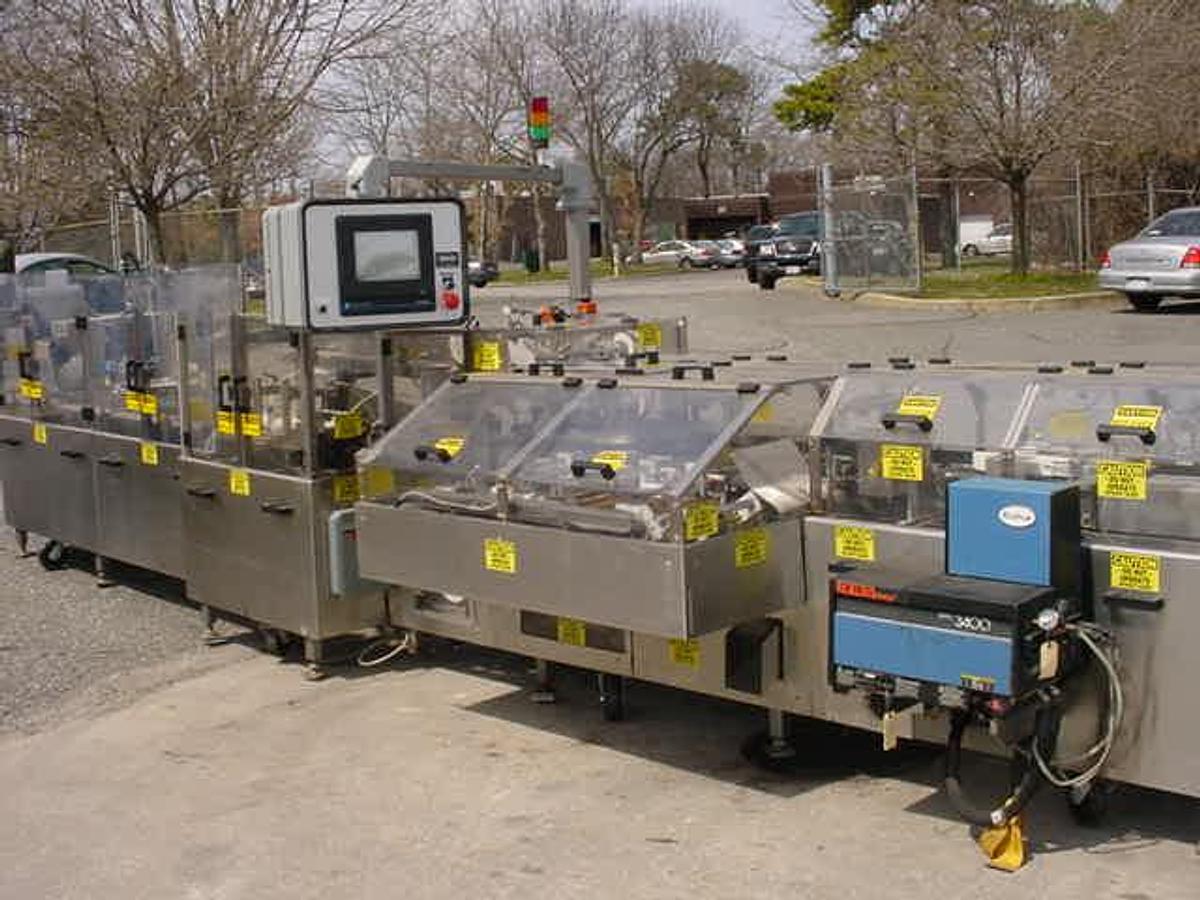
The MGS HCM-750 is a horizontal continuous motion cartoner, a type of secondary packaging machine designed to erect, fill, and close cartons in a continuous flow rather than stopping and starting for each cycle. Continuous motion cartoners operate at significantly higher speeds than intermittent motion machines, making the HCM-750 well-suited for production lines where throughput is a priority. The machine is commonly configured with integrated gluing systems, such as Nordson hot melt units, which apply adhesive to carton flaps for a clean, secure closure.
Applications for the HCM-750 span pharmaceutical, nutraceutical, and consumer goods packaging, anywhere that folding cartons are used as the primary retail or secondary container. The machine can typically handle a range of carton sizes with the appropriate tooling and format parts, which contributes to its versatility across different product lines. On the used equipment market, horizontal continuous motion cartoners from MGS tend to attract buyers who are scaling up production capacity or replacing older intermittent motion equipment with a faster, more efficient alternative.
What is the typical price range for used MGS packaging equipment?
Pricing for used MGS packaging equipment varies considerably based on the machine type, model generation, condition, and included accessories or tooling. Entry-level or older MGS machines with basic configurations can be found at price points that represent a fraction of the cost of comparable current-production equipment. More sophisticated systems like horizontal continuous motion cartoners with integrated gluing and full format sets will command higher prices, often ranging from tens of thousands into the low six figures depending on condition and completeness.
Beyond the purchase price, buyers should factor in the full landed cost of the equipment. Shipping, rigging, crating, and any reconditioning or spare parts procurement can add meaningfully to the total investment. Getting a clear breakdown of these costs from the dealer before committing to a purchase is a practical step that prevents budget surprises. In many cases, even with these additional costs, a well-maintained used MGS machine represents a substantially lower capital outlay than sourcing equivalent capacity through other means.
How does shipping and delivery work for used MGS packaging equipment?
Shipping used packaging machinery requires more planning than standard freight because of the size, weight, and mechanical complexity of the equipment. Dealers will typically arrange for the machine to be properly palletized or crated before shipment, and the level of packaging required directly affects the freight cost. Smaller MGS machines may ship on standard pallets with protective wrapping, while larger cartoners and bundlers often require custom wooden crates to prevent damage in transit. Buyers should ask the dealer specifically what packaging method will be used and whether that cost is included in the quoted price or billed separately.
For larger or heavier machines, professional rigging is required for both loading at the dealer's facility and unloading at the buyer's location. Rigging involves specialized equipment and labor to safely move heavy machinery, and this is typically an additional cost that the buyer needs to plan for on their end. The total landed cost of a used machine, which includes the purchase price, crating, freight, and destination rigging, can differ significantly from the sticker price, so getting a complete cost picture upfront is an important part of evaluating any used equipment purchase.
What are the payment terms for used packaging equipment purchases?
Payment practices in the used packaging equipment industry are fairly consistent across reputable dealers. In most cases, full payment is required before the machine is released for shipping. This is standard practice because used equipment transactions involve machines that may have been inspected and held specifically for a buyer, and dealers need assurance of payment before committing to the logistics of packaging and shipping large industrial machinery.
For buyers with an established relationship with a particular dealer, some flexibility on payment terms may be available, though this is typically extended only to repeat customers with a proven track record. Buyers who are purchasing from a dealer for the first time should expect to pay in full prior to shipment. It is worth clarifying the accepted payment methods, any deposit requirements to hold a machine during the inspection or due diligence period, and the timeline between payment confirmation and shipment scheduling before finalizing a purchase.
What makes MGS packaging equipment a strong choice for high-speed production lines?
MGS machines are engineered specifically for mid-to-high volume production environments, which means the mechanical design prioritizes speed, repeatability, and uptime over simplicity. Their horizontal continuous motion cartoners, for example, are built to run continuously rather than cycling through stop-start sequences, which allows them to achieve significantly higher output rates than intermittent motion alternatives. This architecture is particularly valuable in pharmaceutical and food manufacturing, where line efficiency has a direct impact on cost per unit.
Another factor that contributes to their appeal in demanding production environments is format flexibility. MGS equipment is designed to accommodate multiple product sizes and packaging configurations through changeover tooling rather than requiring entirely separate machines for each SKU. For facilities running diverse product mixes, this reduces capital equipment requirements and floor space. On the used market, this combination of speed capability and flexibility means MGS machines tend to hold their value well and attract buyers who are looking to add serious production capacity without the lead time or cost associated with sourcing current-production equipment.
How does buying used MGS equipment compare to purchasing current-production machinery?
The most immediate difference is cost. Used MGS equipment is available at a fraction of the price of comparable current-production machinery, which makes it an attractive option for manufacturers who need to add packaging capacity without a large capital outlay. Lead times are another significant factor. Current-production packaging equipment often involves lengthy manufacturing and delivery schedules, sometimes stretching six months to over a year for custom-configured machines. A used machine that is already available can be inspected, purchased, and installed in a matter of weeks, which matters considerably when production timelines are pressing.
The trade-offs are real and worth understanding clearly. Used machines come without the support structure that accompanies a purchase directly from a manufacturer, including training programs, installation supervision, and formal service agreements. Parts availability can also be a consideration for older models, which is why consulting with MGS about support levels for a specific machine before purchasing is a practical step. For buyers who do their due diligence on condition, parts, and dealer reputation, used MGS equipment frequently delivers strong value, particularly when the alternative is waiting months for new capacity or paying a significant premium for it.