Category
Manufacturer
Model
FAQ:
What is a flexible screw feeder and how does it work?
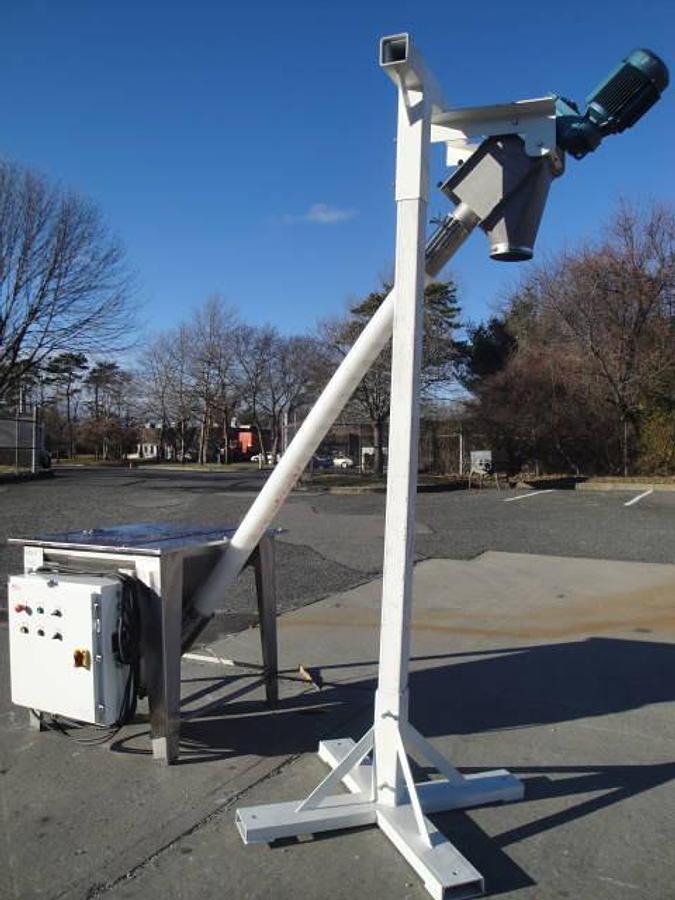
A flexible screw feeder is a type of bulk material conveying equipment that uses a rotating helical screw inside a flexible tube to move powders, granules, pellets, and other bulk solids from one point to another. The screw itself is driven by a motor at one end, and as it rotates, the helical flights push material along the tube toward a discharge point. Because the tube is flexible rather than rigid, the conveyor can be routed at angles, around obstacles, or in configurations that a rigid auger conveyor simply could not accommodate. This makes flexible screw feeders particularly practical in facilities where space is limited or where the feed path needs to change direction.
The design is intentionally simple, which is one of the main reasons these machines have remained popular across so many industries. There are very few moving parts, the tube and screw can typically be removed for cleaning without specialized tools, and the overall footprint is compact compared to pneumatic conveying systems or bucket elevators. Flexible screw feeders are used across food processing, pharmaceuticals, chemicals, plastics compounding, and agriculture, handling everything from fine powders to coarse granules. The 2008-era machines built to this design are mechanically straightforward, which means sourcing replacement parts and finding technicians familiar with the design is generally not difficult.
What materials can a flexible screw feeder handle?
Flexible screw feeders are capable of handling a wide range of bulk solid materials, including free-flowing powders, granules, pellets, flakes, and fibrous materials. Common examples include flour, sugar, salt, spices, coffee, plastic pellets, chemical powders, pigments, pharmaceutical excipients, and agricultural seeds. The screw profile and pitch can be matched to the material characteristics, so a feeder designed for fine powder will typically have a different screw geometry than one intended for coarse pellets or flakes. When evaluating a used flexible screw feeder, it is worth confirming what material the machine was originally used with, since residual contamination or wear patterns on the screw and tube can give insight into its service history.
One area where flexible screw feeders do require careful consideration is sticky, cohesive, or hygroscopic materials. These materials can clump inside the tube, pack around the screw, or cause bridging at the inlet hopper. Some machines are better suited to these applications than others, depending on screw design, tube diameter, and motor torque. The AMS unit listed as 3.5 inches in diameter and 115 inches in length offers a meaningful tube diameter and conveying length, which generally supports a broader range of material types compared to smaller-diameter units. Buyers with challenging materials should consult with the seller and, if possible, review the machine's original specifications or the manufacturer's material compatibility documentation.
What does the 3.5-inch diameter and 115-inch length mean for a flexible screw feeder's performance?
The tube diameter and length of a flexible screw feeder are two of the most important specifications for determining how the machine will perform in a given application. A 3.5-inch (approximately 89mm) tube diameter is considered a mid-to-large size for flexible screw feeders, which means it is capable of handling higher throughput volumes and can accommodate larger particle sizes or bulkier materials without bridging or blockage. Smaller-diameter units in the 1.5 to 2.5-inch range are typically used for fine powders in lower-volume applications, while a 3.5-inch unit is better suited to production-scale operations where feed rate and material volume are higher priorities.
At 115 inches (just under 10 feet), this unit has a substantial conveying length, which allows it to move material from floor level up to elevated hoppers, mixers, or packaging equipment without requiring an intermediate transfer point. Longer flexible screw feeders do introduce more friction on the screw and can affect feed rate consistency at the discharge end, so motor sizing and screw design become more critical at this length. Buyers should verify that the drive motor on a used unit of this size is appropriately matched to the intended material and feed rate, and should ask the seller about the machine's operational history to understand whether it was regularly run at or near its capacity limits.
Is a flexible screw feeder from 2008 still a viable option for food-grade applications?
Stainless steel flexible screw feeders built to food-grade standards can remain serviceable for many years when properly maintained, and a 2008-manufactured unit is not automatically disqualified from food-grade use. The AMS unit described here is constructed in stainless steel, which is the standard material of construction for food-contact applications because it resists corrosion, does not absorb odors or flavors, and can withstand the cleaning and sanitizing protocols required in food processing environments. The key factors to evaluate are the condition of the tube, screw, and contact surfaces, whether any wear or pitting has developed that could harbor bacteria, and whether all seals and gaskets are intact and food-safe.
Buyers considering this machine for food-grade use should arrange a thorough inspection, either in person or via detailed video, to assess the condition of all product-contact surfaces. It is also worth consulting with the manufacturer, AMS, to confirm whether replacement tubes, screws, and seals are still available for this model and whether the design meets current food safety standards such as those outlined by 3-A Sanitary Standards. Used equipment can absolutely serve food-grade applications, but due diligence on surface condition and parts availability is more important here than in non-food industries. A reputable used equipment dealer will be able to provide inspection access and documentation to support this evaluation.
Does a flexible screw feeder offer variable speed control, and why does it matter?
Variable speed control is one of the most practically valuable features on a flexible screw feeder, and many units are equipped with a variable frequency drive (VFD) that allows the operator to adjust screw rotation speed and, by extension, the feed rate. This matters because most production processes do not require a single fixed throughput rate. Batching operations need to slow down as they approach a target weight to avoid overshoot. Continuous blending processes may need to match the feed rate of a flexible screw feeder to the speed of a downstream mixer or filling machine. Without variable speed, operators are limited to mechanical adjustments or manual interventions to change output.
For a used machine like this 2008-manufactured unit, buyers should confirm whether a VFD is included with the machine or whether the drive system is fixed-speed. If the unit does not include a VFD, one can typically be added externally, though this adds cost and requires matching the drive specifications to the existing motor. When inspecting the machine, it is worth checking the condition of any existing drive components, including the motor, controller, and any speed adjustment mechanisms, since these components can wear or degrade over time. A seller familiar with the machine's history should be able to clarify what speed control capabilities are currently in place and whether the motor has been replaced or serviced during the machine's operational life.
How easy is it to clean and maintain a flexible screw feeder?
One of the reasons flexible screw feeders are favored in food, pharmaceutical, and chemical processing is that they are generally straightforward to disassemble and clean. The tube and screw assembly can typically be removed from the drive housing without specialized tools, allowing operators to clean the product-contact surfaces thoroughly between material changeovers or at the end of a production run. In stainless steel units like the AMS machine described here, the surfaces can be wiped down, rinsed, or sanitized depending on the material being processed and the cleanliness standards required. This ease of cleaning is a significant advantage over enclosed screw conveyors or pneumatic systems, which can be more complex to disassemble.
For a used machine, maintenance readiness also means checking the condition of the flexible tube itself. Over time, flexible tubes can develop wear points, particularly where the screw contacts the tube wall during operation. Cracks, abrasion marks, or thinning of the tube wall are signs that replacement may be needed before the machine is returned to service. Buyers should ask the seller about the current condition of the tube and screw, and should check with the manufacturer, AMS, on the availability of replacement tubes and screws for this model year. Routine maintenance on these machines is otherwise minimal, typically limited to motor lubrication and periodic inspection of the drive coupling and inlet hopper for wear.
What should a buyer inspect on a used flexible screw feeder before purchasing?
Buying used processing equipment requires a more hands-on evaluation than purchasing new machinery, and flexible screw feeders have a handful of specific wear points that deserve close attention. The flexible tube is the most common wear item on these machines. Inspect it carefully for abrasion, thinning, cracks, or any deformation along its length, particularly near the inlet and discharge ends where stress concentrates. The screw itself should be checked for wear on the helical flights, any bending or deformation, and signs of corrosion or pitting, especially if the machine was used with corrosive or abrasive materials. The drive motor and any associated speed control components should be tested if at all possible to confirm they operate correctly.
Beyond the mechanical components, buyers should ask the seller about the machine's service history, including what materials it processed, how frequently it was cleaned, and whether any repairs or part replacements were made during its operational life. Reputable used equipment dealers will typically accommodate in-person inspections or detailed video walkthroughs of the machine. Some machines may still be installed at the facility where they were used, which can allow for a live demonstration. Keep in mind that most dealers are not set up to run production tests with actual product, so the inspection will focus on mechanical condition rather than throughput verification. Consulting with the manufacturer, AMS, about parts availability and any known service considerations for this model year is also a practical step before committing to a purchase.
What power requirements should be expected for a flexible screw feeder of this size?
The power requirements for a flexible screw feeder depend on the tube diameter, conveying length, screw design, and the bulk density and flow characteristics of the material being conveyed. For a unit with a 3.5-inch tube diameter and a conveying length of 115 inches, the drive motor is typically in the range of 0.5 to 2 horsepower for most standard bulk solid applications, though heavier or more abrasive materials may require a more powerful motor. The motor on this 2008-manufactured AMS unit should be confirmed with the seller, along with the voltage and phase requirements, since industrial equipment of this era may be configured for 230V or 460V three-phase power, which needs to match the available electrical supply at the buyer's facility.
Buyers should also check whether the existing motor and drive components are in good working condition and whether any modifications were made to the electrical system during the machine's service life. If the unit includes a VFD, the drive's compatibility with the facility's power supply and control systems should be verified before installation. Electrical components on machines from 2008 are generally still supportable, but it is worth confirming that replacement parts for the motor and drive are available from the manufacturer or third-party suppliers. If the motor needs to be replaced, this is a relatively straightforward upgrade that does not require modifying the mechanical components of the feeder itself.
How does shipping and logistics work when purchasing a used flexible screw feeder?
Shipping a used flexible screw feeder involves several practical considerations that buyers should clarify with the seller before finalizing a purchase. The machine needs to be properly packaged to prevent damage in transit, which typically means palletizing the unit and securing it with appropriate blocking and bracing. For a unit of this size, with a tube length of 115 inches, the packaging requirements may call for a custom crate or an oversized pallet to ensure the tube and drive assembly are protected. The level of packaging affects freight cost, and buyers should ask the seller for a detailed breakdown of palletization or crating charges in addition to the base freight rate.
For larger or heavier machines, rigging may be required for loading at the seller's facility and unloading at the buyer's location. Rigging costs are typically separate from freight charges and should be factored into the total landed cost of the equipment. Buyers should confirm whether the seller handles rigging and loading, or whether the buyer needs to arrange this independently. It is also worth discussing freight carrier options, transit times, and insurance coverage for the shipment. Understanding the full landed cost, including the machine price, packaging, rigging, freight, and any applicable taxes or duties, is important for accurately comparing the value of used equipment against other sourcing options.
What are the typical payment terms for purchasing used processing equipment like this?
Most used equipment dealers require full payment before a machine is released for shipment. This is standard practice in the industry and reflects the fact that used equipment transactions involve unique, one-of-a-kind items that cannot simply be restocked if a buyer defaults. Payment is typically made by wire transfer, though some dealers may accept credit cards for smaller purchases. Buyers who have an established relationship with a dealer may be able to negotiate payment terms, but for first-time transactions, full payment upfront should be expected. It is reasonable to ask the seller about their payment process and any documentation they provide, such as a bill of sale or invoice, to confirm the transaction.
Buyers should also factor in the timing of payment relative to inspection. A common and prudent approach is to complete any inspection, whether in person or via video, before submitting payment. This gives the buyer confidence in the machine's condition before funds are transferred. If an in-person inspection is not practical, requesting a detailed video walkthrough of the machine, including the tube, screw, motor, and any control components, is a reasonable alternative. Selecting a used equipment dealer with a verifiable track record and experience in processing equipment is one of the most reliable ways to reduce risk in these transactions, since reputation and repeat business give established dealers a strong incentive to represent their equipment accurately.