Category
Manufacturer
Model
FAQ:
What is a Meissner bowl chopper used for?
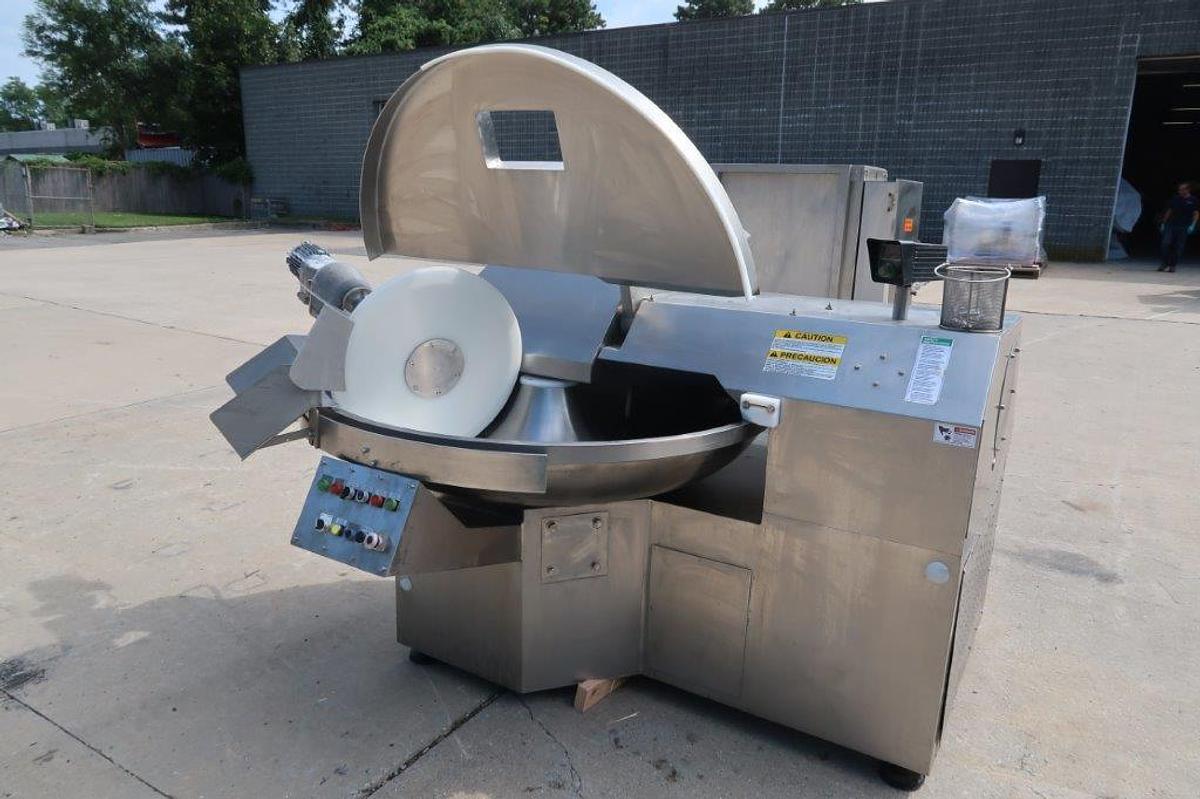
Meissner bowl choppers are industrial food processing machines designed primarily for meat processing, sausage production, deli operations, and large-scale food manufacturing. The machine works by rotating a stainless steel bowl past a set of high-speed rotating blades, which chop, emulsify, and blend the product in a continuous cycle. This process is essential for producing fine-textured meat emulsions used in frankfurters, bologna, pâtés, and similar products. The precision of the cut and the speed of the blade rotation directly affect the final texture and quality of the finished product, which is why the engineering of the machine matters so much in a production environment.
Beyond meat processing, bowl choppers can also be used for processing fish, poultry, and certain plant-based proteins, as well as for mixing and emulsifying non-meat ingredients like cheese spreads and specialty dips. Meissner, as a European manufacturer with a long history in food processing equipment, built these machines to handle high-volume, continuous production demands. Their construction reflects the hygienic design standards required in commercial food facilities, including smooth internal surfaces that resist bacterial buildup and are compatible with standard sanitation protocols. Used Meissner bowl choppers remain a popular choice for processors looking for proven, durable equipment without the cost of purchasing a machine directly from a manufacturer.
What bowl capacities are available for Meissner bowl choppers?
Meissner bowl choppers were manufactured across a range of bowl sizes to serve different production scales. Smaller commercial models typically start around 20 to 30 liters, which are suited for deli counters, specialty butcher shops, or smaller batch production operations. Mid-range models commonly fall in the 60 to 130 liter range and are well-suited for regional processors or facilities running multiple production shifts. At the high end, industrial Meissner models can exceed 200 liters in bowl capacity, designed for large-scale continuous production environments where throughput is a primary concern. The RSM-325, for example, represents one of the larger-capacity models in the Meissner lineup and is built for demanding industrial applications.
When shopping for a used Meissner bowl chopper, bowl capacity is one of the first specifications to match against your production requirements. Undersizing a bowl chopper relative to batch size forces processors into multiple smaller runs, which cuts into efficiency and increases labor costs. Oversizing can create issues with product quality if the bowl is not adequately loaded during operation. It is worth consulting with your production manager or a food processing equipment specialist to calculate the right bowl size based on your batch weights, production cycles per shift, and the types of products you plan to process. Used equipment listings typically specify the bowl capacity in liters, so that figure should be one of the first things to verify before inquiring about a specific machine.
What should buyers know about purchasing a used Meissner bowl chopper?
Buying a used Meissner bowl chopper requires a different level of due diligence than purchasing new equipment through a distributor. Since used machines are sold as-is, the condition of the bowl, blades, blade housing, and drive components varies significantly from one unit to the next depending on how the machine was maintained and how many hours it logged in production. Buyers should prioritize working with reputable used equipment dealers who specialize in food processing machinery and have a verifiable track record. A dealer with deep industry experience will be better positioned to accurately represent the condition of the machine and help you understand what, if anything, may need attention before the unit goes back into production.
Before committing to a purchase, request an inspection. Most reputable dealers will accommodate in-person visits, video walkthroughs, or recorded video inspections of the machine. If the equipment is still installed at a production facility, some dealers can arrange access to view it on-site, where you may even be able to see it running. Pay close attention to the condition of the bowl surface, the blade assembly, the bowl rotation mechanism, and the control panel. It is also worth contacting the manufacturer directly to ask about parts availability and technical support for the specific model you are considering, since older models may have limited support. Getting a clear picture of the machine's current state before purchase is the most important step in protecting your investment.
What are the blade and bowl materials used in Meissner bowl choppers?
Meissner bowl choppers are built with stainless steel bowls, which is the industry standard for food processing equipment that must withstand repeated washdowns, acidic ingredients, and strict sanitation requirements. Stainless steel resists corrosion, does not absorb odors or bacteria, and maintains a smooth surface finish that is easy to clean and inspect. The bowl is precision-formed to maintain tight tolerances with the blade assembly, which is critical for achieving consistent particle size and emulsification quality across batches. Any pitting, scoring, or surface damage to the bowl interior can create sanitation risks and affect product quality, which is why bowl condition is one of the key things to evaluate on a used machine.
The blades in a Meissner bowl chopper are typically manufactured from high-carbon steel, which allows them to hold a sharp edge under the stress of high-speed chopping. Sharp blades are essential not just for product quality but for food safety, since dull blades generate heat through friction, which can partially cook the meat emulsion and compromise texture and safety. Blade sharpness degrades over time with use, so replacement and resharpening are routine maintenance tasks in any production environment. When sourcing blades for a used Meissner, using manufacturer-specification blades is strongly preferred over aftermarket alternatives, since blade geometry affects how the product interacts with the bowl and the quality of the final emulsion. Confirming blade availability for the specific model you are purchasing is a practical step to take before finalizing any used equipment transaction.
What are the power and electrical requirements for a Meissner bowl chopper?
Meissner bowl choppers are industrial machines that require three-phase electrical power, which is standard in commercial food processing and manufacturing facilities but is not typically available in residential settings or smaller commercial kitchens without an electrical upgrade. The specific voltage and amperage requirements vary by model and bowl capacity. Smaller units may operate on 208 to 240 volt three-phase service, while larger industrial models often require 380 to 480 volt three-phase power depending on the motor configuration and the country of manufacture. Since Meissner is a European brand, machines built for European markets are typically configured for 50Hz electrical systems, while North American facilities operate on 60Hz. This difference matters and should be verified before purchasing a used unit, as running a motor at the wrong frequency affects its speed and can cause premature wear or damage.
Buyers should confirm the electrical specifications of any used Meissner bowl chopper before purchase and have a qualified electrician assess whether their facility's electrical infrastructure can support the machine as-is or whether a transformer or other electrical work will be needed. The cost of electrical modifications can add meaningfully to the total landed cost of the equipment, so factoring this in early prevents surprises after delivery. The machine's nameplate, which is typically located on the motor housing or control panel, will list the voltage, phase, frequency, and amperage draw. If the nameplate is missing or illegible on a unit you are considering, ask the dealer to confirm these specifications from documentation or direct measurement before you proceed.
How is a Meissner bowl chopper different from a food processor or grinder?
A bowl chopper is a fundamentally different type of machine from a standard food processor or meat grinder, even though all three are used in food production. A grinder forces meat through a die plate using an auger, which produces a coarsely ground product. A standard food processor uses a fixed blade in a stationary bowl and is designed for smaller batch work. A bowl chopper like those made by Meissner uses a rotating stainless steel bowl that continuously feeds product past a set of high-speed rotating blades mounted above the bowl. This combination of bowl rotation and blade speed allows the machine to chop product progressively finer with each pass, eventually producing a smooth, homogeneous emulsion that cannot be achieved with a grinder or a standard processor.
This emulsification capability is what makes bowl choppers essential in sausage and deli meat production. Products like hot dogs, mortadella, and liver sausage depend on a fine, stable emulsion of meat protein, fat, and water. The bowl chopper creates this emulsion by mechanically breaking down muscle fibers and fat cells while incorporating ice or water to control temperature. The process requires precise blade speed control and timing, which is why industrial bowl choppers like those from Meissner include variable speed drives and programmable controls on more advanced models. For a facility that needs to produce emulsified products at scale, a bowl chopper is not interchangeable with a grinder or a mixer. They serve different steps in the production process, and many facilities use all three in sequence.
What maintenance does a Meissner bowl chopper require to stay in good working order?
Blade maintenance is the most frequent and critical maintenance task on any bowl chopper. The blades must be kept sharp to produce consistent emulsification quality and to avoid the heat buildup that comes with dull cutting edges. In active production environments, blades may need resharpening or replacement every few weeks depending on the volume and type of product being processed. High-carbon steel blades can be resharpened by a qualified blade service, but they have a finite number of resharpening cycles before they need to be replaced entirely. Keeping a set of spare blades on hand is a common practice in production facilities to avoid downtime during blade service intervals.
Beyond blades, the bowl chopper requires regular lubrication of the drive components, inspection of the bowl rotation mechanism, and checks on the belt or gear drive system that powers the blade shaft. The bowl itself should be inspected periodically for surface damage, and all seals and gaskets in contact with product should be checked for wear. Electrical components, including the motor and control panel, benefit from periodic inspection by a qualified technician. On a used machine, it is especially important to establish a baseline maintenance check when the machine first arrives at your facility, since its prior maintenance history may be unknown. Consulting the machine's service manual and, where possible, reaching out to the manufacturer for model-specific maintenance guidance are both practical steps when bringing a used Meissner bowl chopper into service.
What is the typical price range for a used Meissner bowl chopper?
Pricing for used Meissner bowl choppers varies considerably based on bowl capacity, model, age, and overall condition. Smaller used units in the 20 to 60 liter range can be found in the range of a few thousand to roughly fifteen thousand dollars depending on condition and how recently the machine was serviced. Mid-size models in the 80 to 130 liter capacity range typically command higher prices, often falling somewhere between fifteen thousand and forty thousand dollars for units in good working condition. Larger industrial models with bowl capacities above 150 liters can run significantly higher, sometimes exceeding sixty to eighty thousand dollars for well-maintained units, though prices fluctuate based on market availability and the specific configuration of the machine.
It is worth noting that the purchase price is only part of the total cost of acquiring a used bowl chopper. Shipping, rigging, and any required electrical modifications all add to the final landed cost and should be factored into your budget before making a purchasing decision. A machine priced attractively may require significant freight costs if it is located across the country, or it may need electrical conversion work if it was originally configured for a different voltage or frequency. Asking the dealer for a detailed breakdown of packaging, rigging, and freight costs upfront will give you a realistic picture of what the machine will actually cost to get into production at your facility. Prices in the used equipment market also shift based on supply, so what a comparable unit sold for a year ago may not reflect current market conditions.
How should a used Meissner bowl chopper be inspected before purchase?
A thorough inspection of a used bowl chopper should cover both the mechanical and sanitary condition of the machine. On the mechanical side, the key areas to examine include the blade assembly and blade condition, the bowl surface for scoring or pitting, the smoothness of the bowl rotation, the drive system (whether belt, gear, or direct drive), and the condition of the motor and control panel. If the machine is still installed and operational at a production facility, watching it run under load gives the best indication of its actual working condition. If it has been decommissioned, a visual and manual inspection of all moving parts, combined with a power-on test where possible, is the next best option.
Most reputable used equipment dealers will accommodate in-person inspections at their facility or, if the machine is located at a third-party plant, can often arrange access for a buyer or their representative to view it on-site. For buyers who cannot travel, video inspections and recorded walkthroughs are a practical alternative and are commonly offered by established dealers. Keep in mind that dealers typically do not have the permitting or infrastructure to run actual food production, so testing the machine with live product is generally not possible outside of a licensed production facility. What you are looking for in an inspection is an accurate picture of the machine's current mechanical condition and any visible wear or damage. Bringing a qualified food equipment technician along for an in-person inspection, or having one review inspection footage, adds an extra layer of confidence before committing to a purchase.
Are replacement parts and blades available for used Meissner bowl choppers?
Parts availability for Meissner bowl choppers depends largely on the age and model of the machine. For models that were produced more recently or that are still represented in the manufacturer's active parts catalog, sourcing replacement blades, seals, belts, and other wear components is generally manageable through the manufacturer or through specialized food equipment parts suppliers. For older or discontinued models, parts availability can become more challenging, and buyers may need to work with machining shops to fabricate certain components or source parts through secondary markets. This is a practical reality with any used industrial equipment, and it makes the age and model of the specific machine an important factor in the purchasing decision.
Before finalizing the purchase of any used Meissner bowl chopper, it is worth contacting the manufacturer directly to ask about parts and technical support for that specific model. The manufacturer can tell you whether blades, drive components, and other critical parts are still stocked or can be ordered, and whether technical documentation is available. This step takes relatively little time but can save significant headaches down the road if a critical part fails and you discover it is no longer available. Dealers who specialize in food processing equipment are also often a useful resource for parts sourcing, since they develop supplier relationships over years of handling similar machinery. Prioritizing OEM-specification blades over aftermarket alternatives is strongly recommended, as blade geometry directly affects emulsification quality and food safety outcomes.