Category
Manufacturer
Model
Matthews
Matthews specializes in coding and marking solutions for the manufacturing sector. Their equipment ensures that products are accurately labeled for compliance and traceability, particularly in food and beverage industries.
FAQ:
What types of Matthews coding and marking equipment are available on the used market?
Matthews Marking Systems produces a broad range of industrial coding and marking equipment, and many of these machine types regularly appear on the used market. The main categories include continuous inkjet (CIJ) printers, thermal inkjet printers, laser marking systems, and label print-and-apply systems. Each category serves a different production need. CIJ printers like the Matthews CX16F are workhorses in high-speed packaging lines, capable of printing on the fly without stopping the conveyor. Laser systems are preferred where permanent, ink-free marking is required. Thermal inkjet units tend to be compact and well-suited for lower-speed applications or secondary packaging.
Within each category, Matthews has produced numerous models over the years, so buyers searching the used market will encounter machines with varying feature sets, print resolutions, and connectivity options. Some older models are simpler to operate and maintain, while later-generation units often include touchscreen interfaces and more advanced software. Buyers should identify which product type fits their substrate, line speed, and print content requirements before narrowing down to a specific model, as the right machine type matters more than brand generation alone.
What industries commonly use Matthews coding and marking equipment?
Matthews coding and marking equipment is designed for industrial production environments and is used across a wide range of sectors. Food and beverage manufacturing is one of the heaviest-use industries, where accurate date coding, lot coding, and traceability information are regulatory requirements. Pharmaceutical and nutraceutical manufacturers rely on Matthews systems for serialization, expiration dates, and compliance with track-and-trace regulations. Automotive parts manufacturers use marking equipment for part identification and quality control. Consumer goods, cosmetics, and chemical packaging operations also commonly run Matthews coders on their lines.
The equipment's ability to handle high line speeds and variable data printing makes it practical for any production environment where products need to be labeled consistently and accurately. Because Matthews machines are built for demanding manufacturing conditions, they tend to hold up well in environments with dust, temperature variation, and continuous multi-shift operation. This industrial-grade construction is one reason used Matthews equipment remains sought after, as buyers in these industries know the machines were built to perform in conditions similar to their own facilities.
What surfaces and substrates can Matthews marking equipment print on?
Matthews coding equipment is engineered to print on a wide variety of substrates, which is one reason it is popular across so many industries. Continuous inkjet printers in the Matthews lineup can mark on porous and non-porous surfaces including cardboard, corrugated boxes, glass, plastic bottles, metal cans, foil packaging, and coated papers. The key variable is ink selection. Different ink formulations are required for different surfaces, and Matthews has historically offered inks designed for adhesion on difficult substrates like HDPE plastics, treated films, and wet or greasy surfaces common in food processing environments.
Laser marking systems in the Matthews range are typically used on materials where a permanent, high-contrast mark is needed without ink, such as certain plastics, metals, and coated packaging. Label print-and-apply systems apply pre-printed or on-demand printed labels to virtually any surface where a label will adhere. When evaluating a used Matthews machine, buyers should confirm which ink types the specific model supports and verify that those inks are still available for that system, as ink compatibility is tied to the printhead design and can vary significantly between older and newer models.
Does Matthews coding equipment support variable data printing like barcodes, QR codes, and expiration dates?
Variable data printing is a core function of Matthews coding and marking systems. These machines are built specifically to print content that changes from product to product or batch to batch, including expiration dates, best-by dates, lot codes, serial numbers, linear barcodes, 2D barcodes like QR codes and Data Matrix codes, and GS1-compliant data strings. This capability is what makes them valuable in regulated industries where static pre-printed labels are not sufficient for traceability and compliance requirements.
The degree of flexibility in variable data handling depends on the specific model and its software. Later-generation Matthews systems often include more intuitive template-based software that allows operators to set up and switch between print jobs quickly. Older models may require more manual configuration but are still fully capable of variable data output. Buyers purchasing used Matthews equipment should ask about the software version included with the machine and whether it supports the specific data formats and communication protocols their production system uses, such as database connectivity or ERP integration.
What is the Matthews CX16F Continuous Inkjet Printer, and what is it used for?
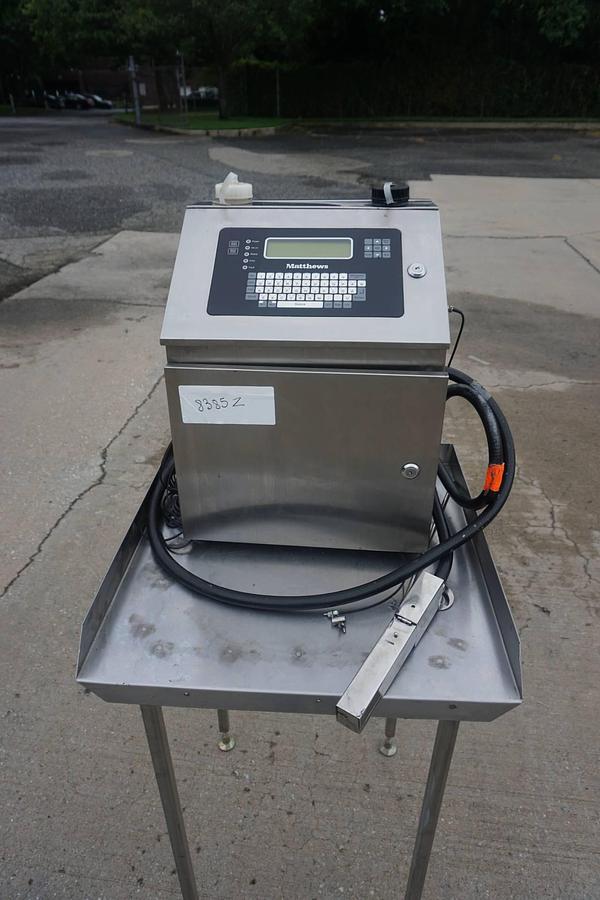
The Matthews CX16F is a continuous inkjet (CIJ) printer designed for inline product coding on manufacturing and packaging lines. CIJ technology works by generating a continuous stream of ink droplets, deflecting selected droplets onto the substrate as it passes the printhead, which allows marking at high line speeds without any contact between the printer and the product. The CX16F is built with a stainless steel construction, making it suitable for food and beverage environments where washdown conditions and hygiene standards are a concern.
In practical terms, the CX16F is used to apply date codes, lot numbers, barcodes, and other variable information directly onto product packaging, bottles, cans, or cartons as they move along a conveyor. The stainless steel housing is a meaningful feature for buyers in food processing or pharmaceutical applications, as it allows the equipment to withstand cleaning procedures that would damage standard enclosures. When shopping for a used CX16F, buyers should pay attention to the condition of the printhead and ink system, as these are the components most affected by wear and the quality of maintenance during the machine's prior service life.
What should buyers inspect when purchasing used Matthews coding equipment?
Buying used coding and marking equipment requires a focused inspection because the components that wear most are also the ones most critical to print quality. For continuous inkjet printers, the printhead, ink pump, and ink system are the primary areas of concern. Inkjet systems that were not properly maintained or that sat idle without being flushed can have dried ink residue in the ink circuit, which affects reliability. Buyers should ask whether the machine was in active production up until it was decommissioned, and request a demonstration or video showing the machine printing if possible.
For any Matthews coder, it is worth asking about the availability of spare parts and consumables for that specific model, since older machines may have components that are harder to source. Reputable used equipment dealers will typically accommodate in-person or video inspections so buyers can assess the machine's physical condition, check for corrosion or damage, and review any available maintenance records. Buyers should also consult with Matthews directly to understand what level of technical support and parts availability they can expect for the model they are considering, as this varies by age and product generation.
What ink types and consumables are required for Matthews continuous inkjet coders?
Matthews continuous inkjet printers require specific inks, make-up fluid (solvent), and cleaning solutions that are matched to the printhead design and the substrate being marked. CIJ inks come in a range of formulations including solvent-based inks for non-porous surfaces like plastics and metals, pigmented inks for high-contrast marking on dark substrates, and specialty inks for food-contact packaging or UV-fluorescent applications. Make-up fluid is used to maintain the correct ink viscosity as solvent evaporates during operation, and cleaning solution is needed for printhead maintenance and shutdown procedures.
For buyers purchasing used Matthews CIJ equipment, confirming ink availability for the specific model is an important step before completing the purchase. Some older Matthews models used proprietary ink formulations that may be difficult to source, while others accept third-party compatible inks. Running an incompatible ink can damage the printhead or void any support relationship with the manufacturer, so this is worth verifying carefully. The ongoing cost of inks and make-up fluid should also factor into the total cost of ownership calculation, as consumable expenses over time can be significant depending on production volume and shift hours.
How does the print resolution and speed of Matthews marking equipment compare across different machine types?
Print resolution and speed vary considerably across the Matthews product range depending on the technology type. Continuous inkjet printers typically operate at resolutions in the range of 150 to 300 dpi and are capable of printing at line speeds of several hundred meters per minute, making them well-suited for high-throughput packaging lines. The trade-off is that CIJ print quality, while adequate for date codes and simple barcodes, is generally not as sharp as thermal inkjet or laser marking for fine text or high-density 2D codes.
Thermal inkjet printers in the Matthews lineup deliver higher resolution, often in the 300 to 600 dpi range, which makes them better suited for printing readable small text, high-quality logos, or dense barcodes. However, they typically operate at lower line speeds than CIJ systems and are more commonly used on secondary packaging or lower-speed applications. Laser marking systems offer effectively unlimited resolution since they ablate or react with the substrate surface rather than depositing ink, and they are capable of very fine detail. Buyers should match the technology type to their specific resolution requirements and line speed before selecting a model, as no single technology is best for every application.
How is used Matthews coding equipment typically shipped, and what should buyers expect for costs?
Shipping used coding and marking equipment involves more logistics planning than standard freight because these machines contain sensitive ink systems, electronic components, and precision-aligned printheads that can be damaged if not properly secured. Smaller bench-top units like thermal inkjet printers are generally easier to package and can ship on a standard pallet with adequate foam and strapping. Larger inline CIJ systems or print-and-apply systems may require custom crating to protect protruding components and prevent movement during transit. The level of packaging required directly affects the shipping cost, so buyers should ask the seller for a detailed breakdown of palletization or crating charges before agreeing to a purchase.
For heavier or larger machines, loading and unloading may require a forklift or other rigging equipment, which adds to the landed cost. Buyers should ask whether the seller's facility has loading dock access and what equipment is available for loading, and similarly confirm what unloading capabilities exist at the destination. Most used equipment dealers require full payment before a machine ships. The total landed cost of a used Matthews coder includes the machine price, any crating or rigging fees, freight charges, and any applicable import duties if shipping across borders, so getting a complete quote before committing is the right approach.
Is used Matthews coding equipment compatible with existing production lines?
Compatibility depends on several factors including the machine's physical mounting requirements, communication interfaces, and the ink system's suitability for the substrate being marked. Matthews CIJ printers are generally designed to integrate into existing conveyor lines using standard mounting brackets and can be positioned to mark products from the side, top, or bottom depending on the application. Most models include standard electrical connections and can be configured to trigger printing from a product sensor or encoder signal that is already present on many production lines.
Buyers should gather specific technical details about any used Matthews machine they are considering, including the required power supply voltage and phase, the communication ports available (such as serial, Ethernet, or USB), and the printhead standoff distance required for the intended substrate. Older Matthews models may use communication protocols or software interfaces that require additional configuration to connect with modern PLC systems or production management software. Consulting with a technician familiar with the specific model before purchase, and reviewing any available documentation, will help identify potential integration issues before the machine arrives on the production floor.