Category
Manufacturer
Model
Marburg
Marburg specializes in manufacturing equipment for the pharmaceutical and food industries. They are particularly noted for their filling machines that cater to a variety of container types, ensuring precision and reliability.
FAQ:
What industries are Marburg filling machines designed for?
Marburg filling machines are built primarily for the pharmaceutical and food industries, where precision, repeatability, and hygienic design are non-negotiable. The brand has built its reputation around equipment that meets the demanding standards of these sectors, including strict fill accuracy requirements and compatibility with a range of container formats.
Beyond pharmaceuticals and food production, Marburg equipment is also used in cosmetic and personal care manufacturing, where similar standards around contamination control and fill consistency apply. Buyers from these industries tend to prioritize machines that can handle varying viscosities and container types without significant downtime between changeovers, and Marburg's product line has historically addressed those needs.
What types of containers can Marburg filling machines handle?
Marburg filling machines are noted for their ability to accommodate a variety of container types, which is one of the key reasons they appeal to manufacturers across multiple sectors. Depending on the specific model, compatible containers can include bottles, vials, tubes, ampoules, and pouches. This flexibility makes a single machine useful across different product lines, reducing the need for multiple pieces of dedicated equipment.
Container compatibility is one of the first things buyers should verify when evaluating a specific used Marburg model, since not every machine in the product line covers every container format. Requesting detailed specifications from the seller, including any tooling or change parts that come with the machine, will help clarify exactly what container sizes and types a particular unit can run.
What fill volume ranges do Marburg filling machines typically support?
Fill volume range varies considerably across different Marburg models, so there is no single answer that applies to the entire product line. Machines designed for pharmaceutical vials and ampoules typically operate in small-volume ranges, sometimes as low as a fraction of a milliliter up to around 100 mL, while equipment built for food or cosmetic bottles may handle much larger volumes. The specific fill range of any given unit is tied to its pump type, nozzle configuration, and the change parts included.
For buyers purchasing used equipment, it is worth asking the seller for the original equipment documentation or spec sheet if available, since this will list the designed fill range and accuracy tolerances. Fill accuracy on precision filling machines in this category is generally expected to fall within plus or minus 0.5 to 1 percent, though actual performance on a used machine should be assessed during inspection rather than assumed.
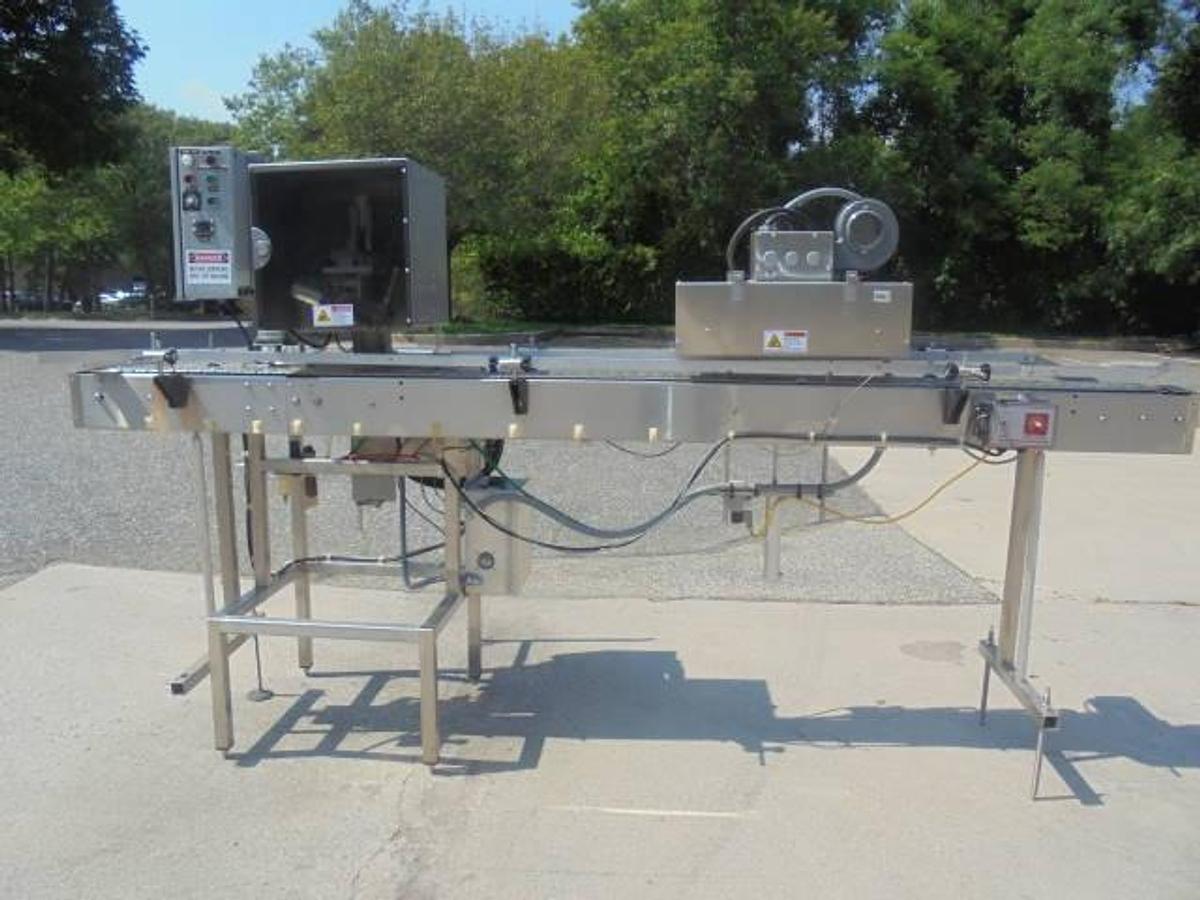
What is a Marburg Conveyorized Neck Bander with Shrink Tunnel, and what is it used for?
A conveyorized neck bander with shrink tunnel is a packaging line machine that applies a tamper-evident band or sleeve around the neck or cap of a container, then passes the container through a heat shrink tunnel to shrink the band tightly into place. This process is standard in pharmaceutical and food packaging where tamper evidence is a regulatory or consumer safety requirement. The variable speed feature on Marburg's version of this machine allows operators to adjust line speed to match upstream and downstream equipment, which is important for maintaining consistent throughput without creating bottlenecks.
This type of equipment is typically positioned downstream from a filling and capping station in a production line. It is used across a wide range of products including bottled supplements, over-the-counter medications, sauces, condiments, and personal care items. When evaluating a used unit, buyers should check the condition of the conveyor belts, the heating elements in the shrink tunnel, and the banding mechanism, since these are the components most subject to wear in normal production use.
What types of products can Marburg filling machines handle in terms of product consistency?
Marburg filling machines are associated with handling a range of product types, including free-flowing liquids, viscous liquids, pastes, and in some configurations, powders or granules. The ability to handle a specific product consistency depends heavily on the pump or dosing mechanism built into a particular model. Piston pumps, for example, are well suited to thick creams and pastes, while peristaltic or gravity-fed systems work better for thin, free-flowing liquids.
Buyers purchasing used Marburg equipment should confirm the pump type and any included tooling before committing to a purchase, particularly if they are filling a product with an unusual viscosity or particulate content. A machine that was previously used for thin pharmaceutical liquids may require modification or different nozzles to run a thick cosmetic paste effectively. Asking the seller about the machine's production history can provide useful context about what it was actually running in its previous application.
Are Marburg filling machines suitable for small businesses or only large-scale production?
Marburg's product line has historically included both semi-automatic and fully automatic models, which means the brand is not exclusively associated with high-volume industrial production. Semi-automatic filling machines require an operator to position containers manually or trigger each fill cycle, making them practical for smaller batch sizes and lower production volumes. These models typically carry lower price points on the used market, which makes them accessible to small and mid-sized businesses that cannot justify the capital cost of a fully automated line.
Fully automatic Marburg models, by contrast, are designed for continuous high-throughput production and are better suited to larger manufacturers with consistent, high-volume demand. The right choice depends on production volume, budget, and the level of operator involvement a business can support. Buying used rather than purchasing new equipment from a manufacturer can significantly reduce the entry cost for either category, making precision pharmaceutical and food-grade filling technology more accessible to smaller operations.
How do Marburg filling machines perform against GMP, FDA, or CE compliance requirements?
Marburg filling machines built for pharmaceutical and food applications are generally designed with regulatory compliance in mind, since those industries demand it. CE marking, GMP (Good Manufacturing Practice) compliance, and FDA-compatible construction, typically involving food-grade or pharmaceutical-grade contact materials such as 316L stainless steel and certain approved elastomers, are common design considerations for equipment in this category. Whether a specific used machine meets current regulatory standards in a buyer's jurisdiction is a separate question that requires careful evaluation.
Buyers operating in regulated industries should review the machine's documentation, material certifications, and design specifications before purchase, and may want to consult with their quality or regulatory team as part of the evaluation process. It is also worth contacting the manufacturer directly to understand what validation documentation, if any, was produced for a particular model, and whether the manufacturer still supports that model with parts or technical information. Age and model generation can affect what compliance documentation exists and what level of manufacturer support remains available.
What should buyers inspect when evaluating a used Marburg filling machine?
A thorough inspection of a used filling machine should cover both mechanical condition and documentation. On the mechanical side, key areas include the condition of all product-contact components such as nozzles, pumps, seals, and tubing, since these are subject to wear and chemical exposure. The drive system, electrical controls, and any sensors or servo mechanisms should also be checked for proper function. Visible corrosion, worn seals, or damaged nozzles are common findings on used equipment and can affect both performance and compliance.
Reputable used equipment dealers will typically accommodate in-person inspections at their facility, or can arrange video inspections and provide detailed photo documentation for remote buyers. In some cases, a machine may still be installed and running at the original production facility, which can allow for an inspection under actual operating conditions. Keep in mind that most equipment dealers are not set up to run product through a machine during inspection, since that would require production permitting they do not hold. Buyers should factor inspection findings into their total cost assessment, including any reconditioning or replacement parts that may be needed before the machine goes back into production.
What are the typical shipping and logistics considerations for purchasing a used Marburg filling machine?
Filling machines vary considerably in size and weight, and the logistics involved in moving them safely from a seller's location to a buyer's facility require careful planning. Smaller semi-automatic units may ship on a standard pallet with appropriate blocking and bracing, while larger fully automatic machines often require custom crating or skidding to prevent damage in transit. Rigging costs for loading and unloading heavier equipment can be significant, particularly if a forklift or crane is needed at either end of the shipment.
Buyers should request a detailed breakdown of packaging, rigging, and freight costs from the seller before finalizing a purchase, since these charges can meaningfully affect the total landed cost of the equipment. Freight rates vary based on origin, destination, weight, and dimensional size, and international shipments introduce additional considerations around customs, duties, and import documentation. Asking the seller specifically how the machine will be prepared for transit and what carrier or freight service they use will help buyers understand what to expect and avoid surprises at delivery.
What are the typical payment terms when buying a used Marburg filling machine from a dealer?
Most used equipment dealers require full payment before a machine ships. This is standard practice in the industry and reflects the fact that used machinery transactions do not typically involve the same financing infrastructure as new equipment purchases from a manufacturer. Buyers should be prepared to wire funds or arrange another agreed-upon payment method prior to the machine leaving the seller's facility. Some dealers extend payment terms to repeat customers with whom they have an established relationship, but this is at the dealer's discretion rather than a standard offering.
For buyers making a significant capital purchase, it may be worth exploring third-party equipment financing options independently, since some lenders specialize in used machinery loans and can provide financing that the dealer itself does not offer. Before finalizing any transaction, buyers should confirm exactly what is included in the purchase price, including any tooling, change parts, manuals, or documentation that will accompany the machine, so there are no misunderstandings about what transfers with the equipment.