Category
Manufacturer
Model
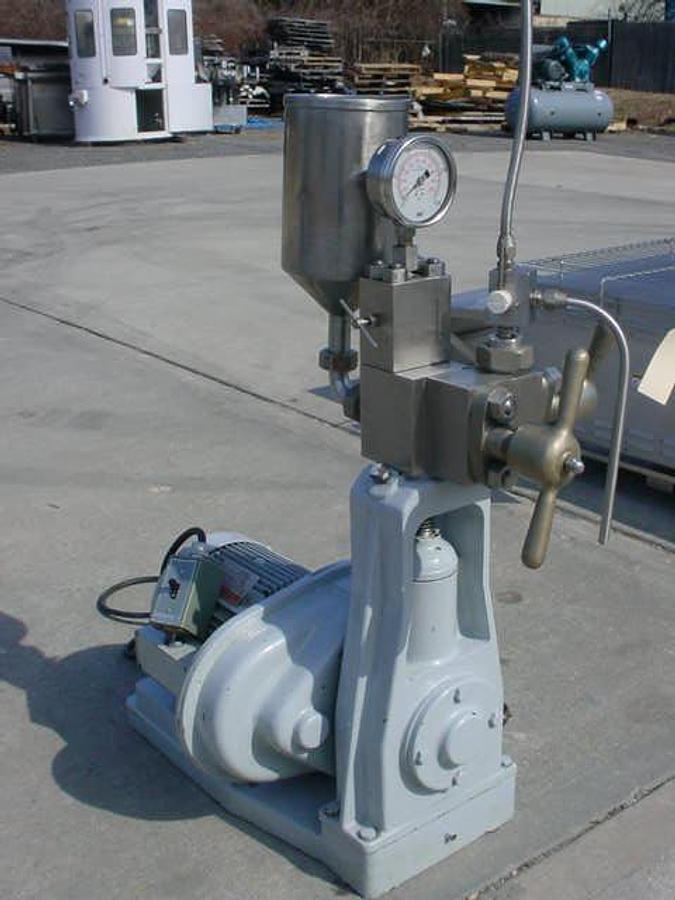
Manton Gaulin
Manton Gaulin is a leader in homogenization technology, supplying equipment primarily to the dairy and food industries. Their homogenizers are critical for achieving desired product textures and consistencies in milk and cream.
FAQ:
What industries are Manton Gaulin homogenizers best suited for?
Manton Gaulin homogenizers have a long history of use in the dairy and food processing industries, where achieving consistent product texture and particle size is critical. Milk, cream, and other fluid dairy products are among the most common applications, as homogenization prevents fat separation and creates the smooth, uniform consistency consumers expect. Beyond dairy, these machines are used in beverage production, infant formula manufacturing, pharmaceutical emulsion processing, and cosmetics, anywhere that a stable emulsion or tight particle size distribution is required.
The brand's reputation in these industries is tied directly to the reliability of its high-pressure valve design, which delivers repeatable results across large production volumes. Pharmaceutical and nutraceutical processors in particular value two-stage Manton Gaulin units for applications like injectable emulsions or sensitive nutritional products where particle size control is tightly regulated. Because these machines were built to industrial-grade standards, used units still in good mechanical condition can serve demanding production environments effectively.
What is the difference between a single-stage and two-stage Manton Gaulin homogenizer?
A single-stage Manton Gaulin homogenizer passes product through one homogenizing valve under high pressure, which breaks down fat globules or particles and creates a more uniform mixture. This configuration works well for many standard dairy and food applications where a general reduction in particle size is sufficient. Single-stage units tend to be simpler mechanically and are often found in applications like fluid milk processing or basic beverage emulsification.
A two-stage homogenizer adds a second valve operating at lower pressure immediately after the first. This second stage disrupts any particle clusters or aggregates that form right after the initial high-pressure pass, producing a significantly tighter and more consistent particle size distribution. For products like infant formula, pharmaceutical emulsions, or high-fat cream products where uniformity is critical, two-stage homogenization is generally the preferred approach. When evaluating used Manton Gaulin equipment on the secondary market, confirming whether a unit is single-stage or two-stage is one of the most important specification checks a buyer should make.
What pressure ranges do Manton Gaulin homogenizers typically operate at?
Manton Gaulin homogenizers are high-pressure machines, with operating pressures that typically range from around 500 psi on the lower end for gentle applications up to 8,000 psi or more for demanding pharmaceutical or fine-emulsion work. Standard dairy applications such as fluid milk homogenization generally run in the 2,000 to 3,500 psi range for the first stage, with the second stage operating at a fraction of that pressure. The exact pressure required depends on the viscosity of the product, the target particle size, and the specific formulation being processed.
The high-pressure piston pump design that Manton Gaulin units are built around is what distinguishes them from lower-grade mixing or blending equipment. The mechanical force generated through the homogenizing valve is what drives particle size reduction and emulsion stability, not shear from a rotating blade or agitator. Buyers sourcing used units should verify that the pump components, seals, and valves are in serviceable condition, since wear in these parts directly affects the machine's ability to maintain target operating pressures consistently.
What sizes and capacities are available for used Manton Gaulin homogenizers?
Used Manton Gaulin homogenizers appear on the secondary market across a wide range of sizes, from small laboratory and pilot-scale units up to large industrial machines capable of processing thousands of gallons per hour. Common models found through used equipment dealers include the M-3, M-6, and M-15 for smaller-scale or pilot applications, and the M-60 and larger industrial units for full production environments. Lab-scale models like the 15M-8TBA two-stage unit are particularly useful for R&D, process development, or smaller specialty production runs.
Capacity is typically expressed in gallons per hour (GPH) or liters per hour, and the right size depends on the production volume and product type. Buyers scaling up from pilot to production should pay close attention to how pressure ratings and valve configurations compare across models, since a larger machine is not always a direct scale-up of a smaller one. Because the used market offers a range of vintages and configurations, it is worth consulting with a knowledgeable equipment dealer who specializes in food and dairy processing machinery to identify which model fits the specific application.
What is the typical price range for a used Manton Gaulin homogenizer?
Pricing for used Manton Gaulin homogenizers varies considerably based on model size, condition, age, and configuration. Small pilot-scale or laboratory units can be found in the range of a few thousand dollars, while mid-size production units in good working condition typically fall somewhere between $10,000 and $50,000. Larger industrial-scale machines with higher flow rates and pressure capabilities can run significantly more, particularly if they have been recently serviced or include documentation of their operating history.
Beyond the purchase price, buyers should factor in additional costs such as rigging, crating, freight, and any reconditioning or parts replacement needed after delivery. These landed costs can add meaningfully to the total investment, especially for heavier industrial units that require specialized loading equipment. Requesting a full cost breakdown from the dealer before committing, including packaging, shipping, and any known mechanical issues, is the most reliable way to understand the true cost of acquiring a used unit.
Are replacement parts still available for older Manton Gaulin homogenizer models?
Manton Gaulin was acquired by APV, which is now part of SPX Flow, so technical support and OEM replacement parts for Manton Gaulin equipment generally route through SPX Flow or its authorized distributors. For many of the more common models, wear parts such as pistons, seals, homogenizing valves, and valve seats are still accessible through these channels, though availability can vary depending on the specific model and its age. Buyers considering older or less common units should contact SPX Flow directly before purchasing to confirm what level of parts and technical support they can realistically expect.
In addition to the OEM supply chain, there is an active aftermarket for Manton Gaulin components, with third-party manufacturers producing compatible wear parts for many of the most widely used models. Specialty used equipment dealers with experience in dairy and food processing machinery are often a good resource for locating hard-to-find components or identifying compatible alternatives. Checking parts availability before finalizing a purchase, not after, is a practical step that experienced buyers consistently recommend.
How does a Manton Gaulin homogenizer differ from a standard high-pressure pump?
A standard high-pressure pump is designed primarily to move fluid from one point to another at elevated pressure, without any specific mechanism for particle size reduction or emulsion formation. A Manton Gaulin homogenizer, by contrast, uses that high-pressure flow to force product through a precisely engineered homogenizing valve, where the combination of pressure drop, turbulence, and cavitation does the actual work of breaking down fat globules, reducing particle size, and stabilizing emulsions. The homogenizing valve assembly is the defining component that separates a true homogenizer from a pump.
This distinction matters practically because substituting a high-pressure pump for a homogenizer will not produce the same product outcome. The valve geometry, gap width, and operating pressure of a Manton Gaulin unit are calibrated to achieve specific particle size targets that cannot be replicated by pressure alone. For food, dairy, and pharmaceutical processors where product consistency is a quality requirement, the homogenizing valve is not an optional feature. It is the mechanism that makes the machine functionally different from other high-pressure equipment.
What should buyers look for when evaluating a used Manton Gaulin homogenizer?
The most important areas to assess on a used Manton Gaulin homogenizer are the condition of the high-pressure pump components and the homogenizing valve assembly. Pistons, plungers, seals, and valve seats are wear items that directly affect pressure performance and product quality. Scoring, pitting, or excessive wear in these areas can indicate a machine that will need significant reconditioning before it is production-ready. Asking the dealer for photos or video of these components, or arranging a direct inspection, is a reasonable and standard part of the buying process.
Buyers should also verify the machine's configuration, specifically whether it is single-stage or two-stage, its rated flow capacity, and its maximum operating pressure, to confirm it matches the intended application. Checking the age and model against parts availability through SPX Flow or aftermarket suppliers is another practical step before committing. Reputable used equipment dealers who specialize in food and dairy processing machinery will typically accommodate in-person or video inspections and can provide documentation on the machine's known history. Some units may still be installed at the facility where they were last used, making it possible to observe the equipment in a decommissioned or even operating state before purchase.
Do used Manton Gaulin homogenizers come with a warranty?
Warranties on used industrial equipment are handled very differently than on equipment purchased directly from a manufacturer. Used equipment dealers typically sell machinery on an as-is basis, which means the responsibility for evaluating the machine's condition falls on the buyer before the sale is finalized. This makes the inspection process particularly important. Buyers should take advantage of any opportunity to inspect the equipment in person, via video, or through detailed photo documentation provided by the dealer, and should ask specific questions about known mechanical issues or recent service history.
Before purchasing, it is also worth contacting SPX Flow, the current parent of the Manton Gaulin brand, to understand what level of technical support is available for the specific model and age of the unit being considered. The age of the machine and whether it is a commonly supported model can significantly affect how much help is available after the sale. Choosing a dealer with a long track record in food and dairy processing equipment, rather than a generalist reseller, tends to reduce risk because such dealers are more likely to have accurately represented the machine's condition and to have experience identifying potential issues before listing a unit for sale.
What should buyers know about shipping and delivery of a used Manton Gaulin homogenizer?
Manton Gaulin homogenizers are heavy industrial machines, and shipping costs can vary significantly depending on the size of the unit, the distance involved, and the level of packaging required to protect the equipment in transit. Smaller lab-scale units may ship on a standard pallet, while larger industrial models typically require custom crating or skidding to prevent damage during transport. Some machines are heavy enough to require professional rigging equipment for loading and unloading, which adds to the overall cost and logistics complexity.
Buyers should request a detailed breakdown of all freight-related costs from the dealer before finalizing a purchase, including packaging, rigging, and carrier charges, to get an accurate picture of the total landed cost. For large machines, the difference between a basic pallet and a fully engineered crate can be substantial, and the cost of freight damage to an unprotected machine can easily exceed any savings from cutting corners on packaging. Confirming these details upfront, rather than treating shipping as an afterthought, is standard practice for experienced industrial equipment buyers.