Category
Manufacturer
Model
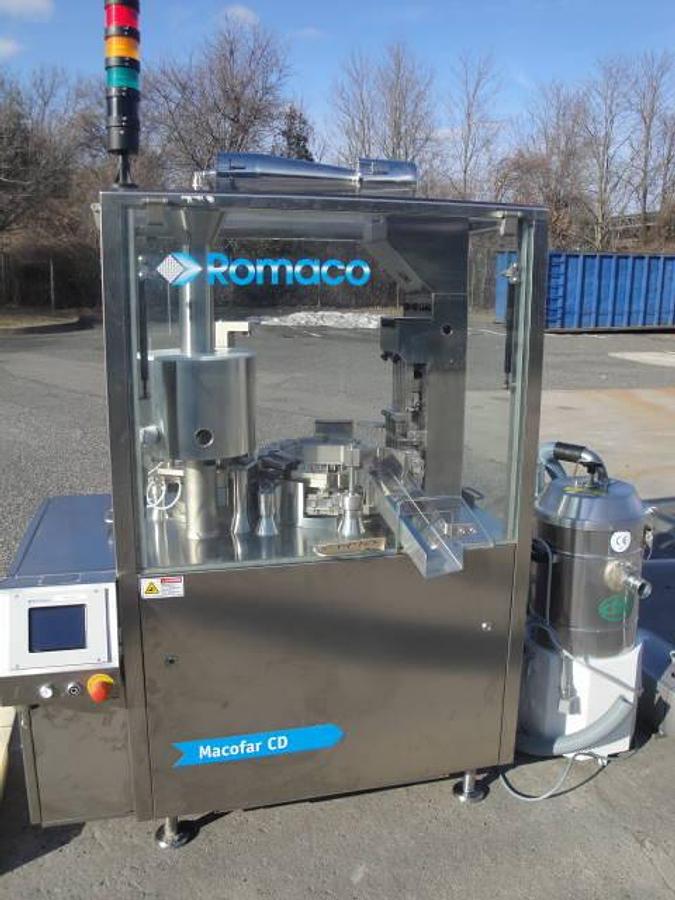
Macofar
Macofar is recognized for its advanced pharmaceutical packaging solutions, particularly in the production of filling and sealing machines for vials and syringes. Their equipment is widely used in the pharmaceutical and biotechnology sectors, ensuring high standards of quality and efficiency.
FAQ:
What types of Macofar pharmaceutical equipment are available on the used market?
Macofar has built its reputation primarily around capsule filling machines, powder filling systems, and packaging equipment for vials and syringes. On the secondary market, the most commonly traded models include the MT 13, MT 40, and CD 40 series. The CD 40, for example, is a stainless steel encapsulator well-suited for pharmaceutical production environments that require precision dosing and hygienic construction. Beyond capsule fillers, Macofar's catalog has historically included filling and sealing machines designed for vials and syringes, making their equipment particularly relevant to pharmaceutical and biotechnology manufacturers.
The range of used Macofar equipment available at any given time will vary depending on what facilities are decommissioning or upgrading their production lines. Buyers looking for a specific model should work with dealers who specialize in pharmaceutical machinery, as they tend to have deeper access to inventory and can source machines that may not be publicly listed. It's worth being specific about your production requirements, including output capacity, fill format, and regulatory environment, so the dealer can match you with the right machine.
Is used Macofar equipment reliable for active pharmaceutical production?
Macofar has a long-standing reputation in the pharmaceutical equipment industry for building machines with solid construction, precise dosing mechanisms, and long service lives. These qualities are a big reason why used Macofar machines continue to trade actively on the secondary market decades after manufacture. Many facilities have successfully integrated used Macofar capsule fillers and packaging machines into validated production lines, provided the equipment has been properly maintained and documented throughout its service history.
That said, reliability depends heavily on the condition of the specific machine being purchased, not the brand alone. Buyers should request maintenance logs, service records, and any available validation documentation before committing to a purchase. A thorough inspection, either in person or via video, is strongly recommended to assess the machine's current mechanical condition. Dealers who specialize in pharmaceutical equipment can typically arrange these inspections and provide an honest assessment of what refurbishment or calibration work may be needed before the machine returns to production.
What is the typical price range for used Macofar capsule filling machines?
Pricing for used Macofar capsule filling machines varies considerably depending on the model, production capacity, age, condition, and what documentation accompanies the sale. Entry-level or older models with higher hours of use may be priced in the range of tens of thousands of dollars, while larger, higher-capacity machines in better condition with full documentation packages can command significantly more. The MT and CD series machines, being among the most sought-after on the secondary market, tend to hold their value reasonably well given the brand's reputation.
Beyond the sticker price, buyers should factor in the full landed cost of the equipment. This includes rigging and loading at the seller's facility, freight and shipping, any crating or palletization required for safe transport, and the cost of any refurbishment, spare parts, or revalidation work needed at the buyer's facility. Getting a clear picture of all these costs upfront helps avoid surprises and makes it easier to compare machines across different dealers.
What is the difference between the Macofar MT series and CD series machines?
The Macofar MT series and CD series represent different generations and design approaches within the company's capsule filling lineup. The MT series machines, including the widely known MT 13 and MT 40, are intermittent-motion capsule fillers that have been workhorses in pharmaceutical plants for many years. They are valued for their mechanical simplicity, ease of maintenance, and ability to handle a variety of fill materials including powders, pellets, and liquids. The MT designation generally refers to the machine's mechanical transport system, and these models are found in a broad range of production scales.
The CD series, such as the CD 40, represents a later design with refinements aimed at improving output consistency and hygienic construction, often featuring stainless steel contact parts suited to GMP environments. While both series are capable machines, the right choice depends on your specific production volume, the type of formulation being filled, and the regulatory requirements of your facility. When evaluating used machines from either series, the condition of the dosing components, capsule transport mechanisms, and control systems should be carefully inspected, as these are the areas most subject to wear over time.
Does used Macofar equipment comply with GMP and FDA regulatory standards?
Macofar machines were designed and built to meet the pharmaceutical industry's quality and hygiene standards, and many models carry CE certification and were manufactured with GMP-compliant materials and construction. However, when purchasing a used machine, compliance is not automatic. The machine's current condition, any modifications made during its service life, and the availability of supporting documentation all play a role in determining whether it can be brought into compliance at a new facility.
Buyers should request any existing IQ/OQ/PQ validation records, CE documentation, and maintenance history from the seller. Even if full documentation is not available, a well-maintained machine can often be revalidated by the buyer's engineering or quality team, though this adds time and cost to the project. It's advisable to consult with your regulatory affairs team before purchase to understand what documentation will be required for your specific application, and to confirm with the dealer what records are available for the machine in question.
What production capacity can be expected from Macofar filling machines?
Production capacity for Macofar capsule filling machines varies significantly across models. The MT 13 is designed for smaller-scale production and is often used in clinical or development settings, while the MT 40 and CD 40 are higher-output machines suited to commercial manufacturing. Output rates for the larger models can reach tens of thousands of capsules per hour under optimal conditions, though actual throughput will depend on the capsule size, fill material characteristics, and the condition of the machine's dosing and transport components.
For used machines specifically, rated capacity should be treated as a reference point rather than a guarantee. Wear on dosing discs, tamping pins, and capsule transport segments can affect output rates and fill weight consistency over time. During any inspection, it's worth asking the seller about the machine's recent production history and whether it has been running at or near its rated capacity. If the machine has been decommissioned for an extended period, factor in the time and cost of bringing it back to optimal operating condition before projecting production output.
Are spare parts available for older Macofar models?
Parts availability is one of the most important practical considerations when purchasing used Macofar equipment, particularly for older models. Macofar has gone through ownership changes over the years, and the level of support available from the manufacturer or its successors can vary depending on the specific model and its age. For some widely used models like the MT series, there is an established aftermarket for spare parts, including dosing discs, tamping pins, capsule segment sets, and seals. Third-party manufacturers also produce compatible components for certain Macofar models.
Before finalizing a purchase, buyers are strongly advised to contact the current manufacturer or authorized service agents to confirm what parts are available for the specific model under consideration, and at what lead times and cost. Some dealers will negotiate an initial spare parts package as part of the sale, which can be a practical way to ensure you have critical consumables and wear items on hand from day one. Consulting with a qualified Macofar service technician during the inspection phase can also help identify which components are nearing end of life and should be sourced before the machine goes into production.
How should buyers inspect used Macofar equipment before purchasing?
A thorough inspection is one of the most important steps in purchasing any used pharmaceutical machine, and Macofar equipment is no exception. Reputable dealers will typically offer buyers the option of an in-person inspection at the machine's current location, a live video walkthrough, or a recorded video showing the machine's condition and, where possible, its operation. For machines that are still installed at a production facility, it may be possible to observe the equipment running under actual production conditions, which gives the most accurate picture of its mechanical state.
During an inspection, focus on the condition of the dosing components, the capsule transport system, the drive mechanisms, and the control panel. Ask about the age of tooling and whether it has been replaced recently. Review any available maintenance records to understand the service history. Keep in mind that most equipment dealers do not have the permitting or facilities to run actual pharmaceutical product through a machine, so functional testing is typically limited to dry runs or mechanical operation checks. Engaging a qualified Macofar technician or a pharmaceutical equipment specialist to participate in the inspection, either in person or remotely, can provide an expert second opinion on the machine's condition.
Can used Macofar equipment be validated for pharmaceutical use at a new facility?
Yes, used Macofar equipment can be validated for pharmaceutical production at a new facility, but the process requires planning and documentation. Validation typically involves Installation Qualification (IQ), Operational Qualification (OQ), and Performance Qualification (PQ), collectively known as IQ/OQ/PQ. If the previous owner has existing validation documentation for the machine, that paperwork can sometimes be used as a starting point, though most regulatory bodies will require the new owner to conduct at minimum an OQ and PQ in the new facility environment to confirm the machine performs to specification under current conditions.
The amount of validation work required will depend on your regulatory environment, the intended product, and the condition and history of the machine. Buyers should loop in their quality and regulatory teams early in the purchasing process to understand the validation roadmap and associated costs. Some dealers who specialize in pharmaceutical equipment can provide guidance on what documentation is available for a specific machine and may be able to connect buyers with qualified validation contractors who have experience with Macofar equipment.
What should buyers know about shipping and logistics for used Macofar machines?
Macofar capsule filling and packaging machines range from relatively compact benchtop units to large, heavy production machines that require specialized handling. Shipping costs and logistics complexity scale accordingly. For larger machines, professional rigging is typically needed for loading at the origin facility and unloading at the destination, which adds to the total cost. Smaller machines may be palletized and shipped via standard freight, but proper crating is still important to prevent damage to precision components during transit.
Buyers should ask the dealer for a detailed breakdown of all costs associated with getting the machine to their facility, including palletization or crating, rigging, freight, and any customs or import duties if the machine is crossing international borders. Understanding the full landed cost before committing to a purchase prevents budget surprises and allows for a proper cost comparison across different machines or sellers. It's also worth confirming who is responsible for the machine once it leaves the seller's facility, and how any transit damage would be handled.