Category
Manufacturer
Model
Lodige
Lodige provides mixing and granulation equipment for the pharmaceutical and chemical industries. Their advanced systems are designed for high efficiency and precision, ensuring consistent product quality in manufacturing processes.
FAQ:
What is a Lödige plow mixer and how does it work?
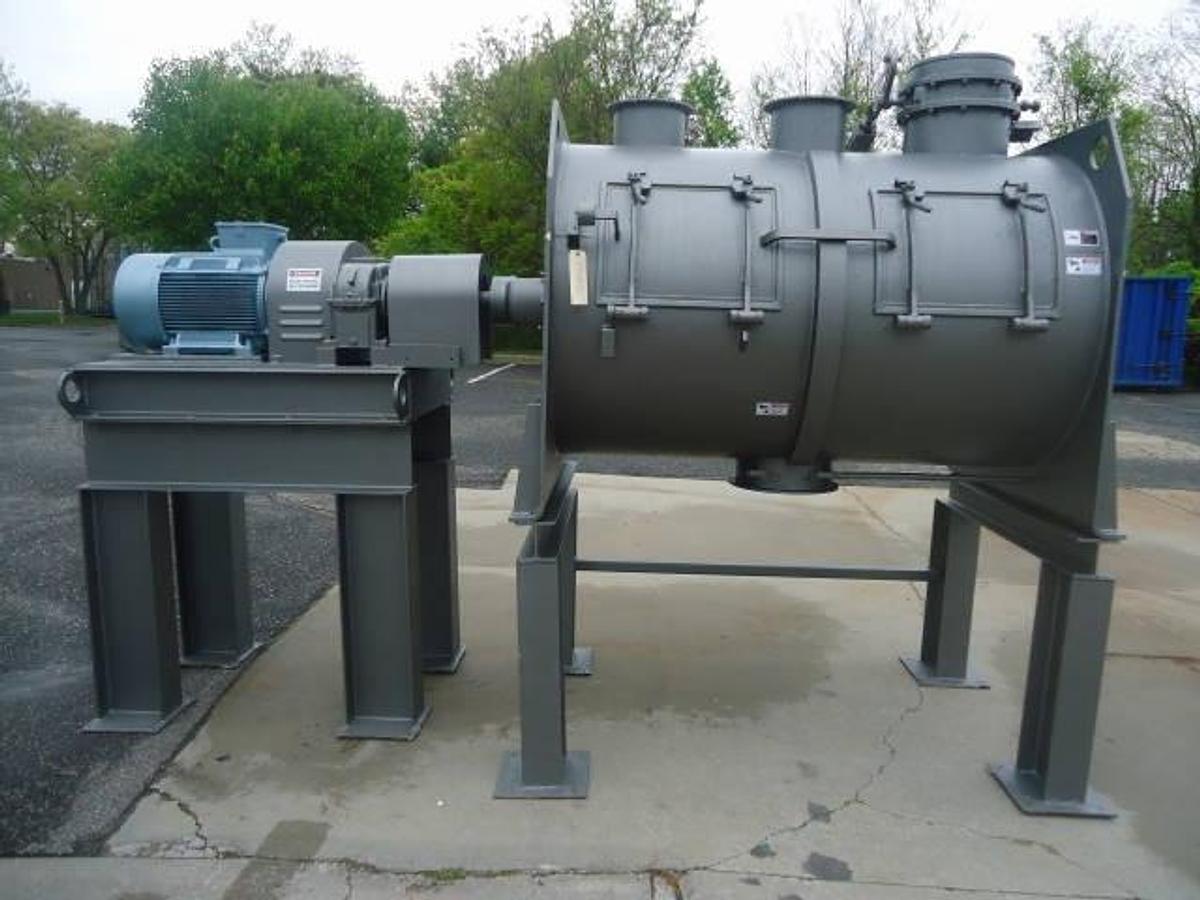
A Lödige plow mixer is a horizontal batch mixing machine that uses plow-shaped mixing tools mounted on a central shaft to move material in a three-dimensional pattern inside a cylindrical drum. As the shaft rotates, the plows lift and throw material outward and inward simultaneously, creating what is often called a fluidized mechanical zone. This action produces extremely fast and thorough blending without relying on gravity alone, which is why these machines are so effective for materials that would segregate or clump in a gentler mixer.
One of the defining features of the Lödige design is the optional integration of choppers or high-speed dispersers mounted on the vessel wall. These secondary tools spin at much higher speeds than the main shaft and break apart agglomerates as they form, which is critical when processing sticky, lumpy, or cohesive materials. The combination of plow action and chopper action allows the machine to achieve batch uniformity in as little as one to three minutes in many applications, making it one of the faster mixing technologies available for powder and granule processing.
What industries use Lödige plow mixers?
Lödige plow mixers are used across a broad range of process industries, which is one of the reasons they retain strong resale value on the used equipment market. Pharmaceutical manufacturing is among the most common applications, where the machines are used for dry blending of active ingredients and excipients, wet granulation, and coating processes. The stainless steel construction and hygienic design of many models make them well-suited to the strict cleanliness and documentation requirements of pharmaceutical production.
Beyond pharmaceuticals, these mixers are widely used in food processing, specialty chemicals, building materials such as dry-mix mortars and adhesives, and plastics compounding. The ability to handle powders, granules, pastes, and slurries within the same basic machine design gives the Lödige plow mixer a versatility that appeals to manufacturers across very different sectors. A used Lödige plow mixer purchased for a chemical application, for example, may have originally been installed in a food plant, so buyers should review the machine's history and construction materials carefully to confirm suitability for their specific process.
What sizes and capacities are available for used Lödige plow mixers?
Lödige plow mixers have been manufactured across an exceptionally wide capacity range, from small laboratory-scale units under 10 liters all the way up to large production vessels exceeding 40,000 liters. This scalability is one of the brand's most recognized attributes, and it means that buyers searching the used equipment market can often find a unit sized appropriately for their process without having to compromise on design. Common production-scale sizes seen in the used market include units in the 300-liter, 600-liter, 1,200-liter, and 1,600-liter range, though availability at any given time depends entirely on what has been decommissioned and listed for sale.
The model designations used by Lödige typically indicate the working volume of the vessel, which helps buyers quickly identify whether a particular unit falls within their required batch size. For example, the FM300 designation refers to a 300-liter unit, while the FKM-1600D refers to a 1,600-liter vessel. Buyers should clarify whether the listed capacity refers to total vessel volume or working volume, as these figures differ and the distinction matters for process calculations. Reputable used equipment dealers who specialize in process and mixing equipment can help clarify these specifications.
What is the typical price range for a used Lödige plow mixer?
Pricing for used Lödige plow mixers varies considerably depending on vessel size, configuration, condition, and age. Smaller units in the 100 to 300-liter range typically trade in a lower price tier, while larger production-scale machines with jacketed vessels, choppers, and full instrumentation can command significantly higher prices. Because Lödige equipment is known for its build quality and longevity, well-maintained used units often hold their value better than comparable machines from less established manufacturers, which is reflected in asking prices on the secondary market.
Beyond the purchase price itself, buyers should factor in additional costs that affect the total landed price of the equipment. These include rigging and loading at the seller's facility, freight and transportation, any crating or packaging required to protect the machine in transit, and installation and commissioning at the buyer's site. Larger machines with heavy steel construction may require crane or specialized rigging equipment for loading and unloading, which adds to the overall cost. Getting a clear picture of all these costs before committing to a purchase is important for accurate budget planning.
What should buyers look for when inspecting a used Lödige plow mixer?
A thorough inspection of a used Lödige plow mixer should cover several key areas. The condition of the vessel interior is one of the most important things to assess, particularly the wear on the plow blades and the condition of the vessel lining or stainless steel surface. Plow tips and wear liners are subject to abrasion over time, and replacement can be costly. Buyers should also examine the shaft seals, the condition of the drive components including the gearbox and motor, and the integrity of any jacket welds if the unit is a jacketed model designed for heating or cooling.
Reputable used equipment dealers will typically offer inspection options to help buyers assess the machine before purchase. These can include in-person visits to the dealer's facility, video walkthroughs, or in some cases access to the machine at the facility where it was last in production. Keep in mind that most used equipment dealers are not set up to run actual production trials, so functional testing is generally limited to confirming that the machine powers on, the shaft rotates correctly, and the choppers operate as expected. Buyers with specific process requirements may want to consult with a process engineer or the original manufacturer to evaluate whether a particular used unit is suitable for their application.
Do used Lödige plow mixers come with a warranty?
Used industrial equipment, including Lödige plow mixers, is typically sold on an as-is basis by used equipment dealers. This is standard practice across the industry and reflects the reality that dealers generally cannot verify the full operating history of a machine or guarantee its performance in a new production environment. The responsibility for confirming the condition and suitability of the equipment rests with the buyer, which is why thorough pre-purchase inspection is so important.
Because there is no dealer warranty to fall back on, buyers should take several practical steps to protect themselves. Choosing a dealer with a long track record in process and mixing equipment is a good starting point, as established dealers have reputations to protect and are more likely to represent equipment accurately. Buyers should also contact Lödige directly to understand what level of manufacturer support is available for the specific model and serial number they are considering, since parts availability and technical support can vary based on the age and configuration of the machine. Older or discontinued models may have limited manufacturer support, which is worth knowing before purchase.
What does a jacketed Lödige plow mixer do, and when is it needed?
A jacketed Lödige plow mixer has an outer shell surrounding the main vessel that allows a heating or cooling medium, typically hot water, steam, or chilled water, to circulate around the product zone. This design gives the operator control over the temperature inside the vessel during mixing, which is critical for processes where heat must be added or removed to achieve the desired result. Wet granulation in pharmaceutical manufacturing, for example, often requires controlled drying or temperature management during the process, and a jacketed vessel makes this possible without a separate piece of equipment.
In chemical and food applications, jacketed mixers are used for processes like reaction mixing, where an exothermic reaction needs to be controlled, or for conditioning materials that must be held at a specific temperature to achieve the right viscosity or flow characteristics. When evaluating a used jacketed Lödige plow mixer, buyers should pay particular attention to the condition of the jacket welds and connections, as leaks or corrosion in the jacket can be expensive to repair and may affect the machine's suitability for temperature-sensitive processes. Pressure ratings for the jacket should also be confirmed and matched against the buyer's process requirements.
What are the installation and commissioning requirements for a Lödige plow mixer?
Installing a Lödige plow mixer requires adequate floor space and load-bearing capacity, since these machines are built with heavy steel construction and can be substantial in weight even at mid-range capacities. Larger units may require reinforced flooring or a dedicated equipment pad. Electrical connections must match the machine's motor specifications, which on used equipment imported from Europe may require transformer or phase conversion work to adapt to local power supply standards. Buyers should obtain the machine's electrical drawings and specifications before purchase to understand what site preparation will be needed.
Commissioning a used plow mixer typically involves verifying that all mechanical components operate correctly, checking and replacing worn seals or gaskets, confirming that the control system functions as expected, and performing test runs before introducing product. If the machine has been in storage for an extended period, lubrication points, gearbox oil, and drive components should all be inspected and serviced as part of the startup process. Engaging a qualified millwright or process equipment technician for installation and commissioning is advisable, particularly for larger or more complex units with choppers, jackets, or integrated process controls.
Are spare parts available for used Lödige plow mixers?
Parts availability for Lödige plow mixers depends significantly on the age and model of the specific machine. Lödige Process Technology is an active manufacturer with a long history, and for many production models, wear parts such as plow tips, seals, bearings, and chopper blades are still available directly from the manufacturer or through authorized distributors. Buyers should contact Lödige with the machine's model number and serial number before purchase to get a realistic picture of what parts are available and at what lead times, since this can vary considerably between current-generation and older discontinued models.
For machines where manufacturer parts support is limited, the used equipment and aftermarket parts ecosystem can sometimes fill the gap. Fabricated wear parts, replacement seals, and drive components sourced from third-party suppliers are an option for some applications, though buyers should verify compatibility carefully. Keeping a small inventory of critical wear parts on hand after purchase is a common practice for operators running Lödige mixers in production environments, as it reduces downtime risk if a component needs replacement unexpectedly. Discussing parts strategy with the equipment dealer at the time of purchase is a reasonable step that experienced dealers should be able to help with.
How is a used Lödige plow mixer typically shipped, and what should buyers expect for freight costs?
Shipping a used Lödige plow mixer involves more logistics than most standard equipment purchases because of the machines' size and weight. Smaller units may be palletized and shipped via freight carrier, but mid-size and larger machines typically require flatbed trucking, and very large units may need specialized heavy-haul transport. The machine must be properly secured and protected before loading, which may involve custom crating or blocking and bracing to prevent movement and damage in transit. The level of packaging required affects the total shipping cost, and buyers should ask the dealer specifically what packaging will be provided.
Loading at the origin facility and unloading at the destination are additional cost items that buyers often underestimate. Larger plow mixers require crane or forklift rigging for loading and unloading, and if the buyer's facility does not have the necessary equipment on-site, arranging for a rigging contractor adds to the cost. International shipments introduce additional considerations including customs documentation, import duties, and potentially longer transit times. Getting a detailed freight quote that covers all of these elements, including rigging at both ends, is the best way to understand the true landed cost of the machine before committing to a purchase.