Category
Manufacturer
Model
FAQ:
What is a Lehmann three roll mill and what is it used for?
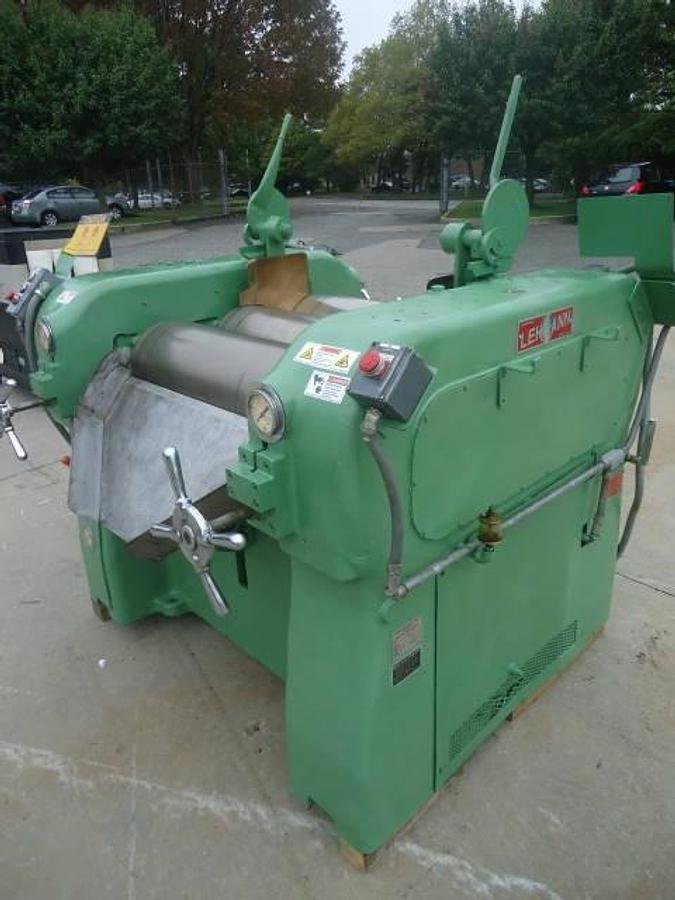
A Lehmann three roll mill is a precision dispersion and milling machine manufactured by Lehmann Mills, a brand with Swiss engineering roots and a long-standing reputation in the processing equipment industry. The machine uses three horizontally positioned rollers that rotate in alternating directions, generating intense shear force in the gaps between them. This shear force breaks down agglomerates and disperses particles to an extremely fine level, often reaching sub-micron fineness, which is difficult to achieve with most other mixing technologies.
These mills are used across a wide range of industries wherever high-viscosity materials need to be uniformly mixed or refined. Common applications include printing inks, industrial coatings, adhesives, sealants, cosmetics, pharmaceutical ointments, electronic pastes, and ceramic slurries. The ability to handle thick, paste-like materials without introducing air makes the three roll mill particularly valuable in formulations where product consistency and particle size are critical to performance. Lehmann units are well regarded for their build quality and the precision of their roller gap adjustment systems, which directly control the fineness of the final dispersion.
What roller sizes are available for Lehmann three roll mills?
Lehmann three roll mills are produced in a range of roller sizes to suit different production scales, from small R&D batches to full industrial output. Laboratory-scale units typically feature roller diameters starting around 50mm, while production-scale machines can have rollers significantly larger in both diameter and face width. A commonly encountered used production model is the 13-inch by 32-inch configuration, which refers to the roller diameter and face length respectively, giving a substantial milling surface area for higher-volume throughput.
The roller dimensions directly affect both the capacity of the mill and the shear intensity it can generate. Larger rollers allow for more material to pass through per cycle and can accommodate higher-viscosity formulations, while smaller laboratory units offer precise control for small-batch development work. When evaluating a used Lehmann mill, the roller face width and diameter should be matched to the intended production volume and the viscosity range of the materials being processed. Roller surface condition is equally important, as scoring, pitting, or uneven wear on a used unit can affect dispersion quality and may require regrinding before the machine returns to optimal performance.
What materials can be processed using a Lehmann three roll mill?
Lehmann three roll mills are designed to handle high-viscosity, paste-like materials that require fine particle dispersion or thorough blending of components that resist mixing by conventional agitation. The most common materials processed include printing and lithographic inks, UV-curable coatings, solvent-based and water-based paints, epoxy and silicone adhesives, cosmetic creams and ointments, pharmaceutical topical preparations, and specialty electronic pastes such as conductive silver or dielectric materials used in circuit board manufacturing.
The three roll mill is also used in food processing for products like chocolate and confectionery pastes, as well as in ceramics for grinding and dispersing ceramic slurries. The key requirement is that the material must have enough viscosity to be picked up and carried by the rollers rather than flowing off the apron. Very low-viscosity liquids are generally not suitable for this type of mill. When purchasing a used Lehmann unit, it is worth confirming whether the rollers are made from hardened steel, granite, or another material, as roller composition affects compatibility with certain chemistries and influences the level of contamination risk for sensitive formulations.
What is the price range for a used Lehmann three roll mill?
Pricing for used Lehmann three roll mills varies considerably depending on roller size, model, age, overall condition, and included accessories. Smaller laboratory-scale units in good working condition typically sell in the range of a few thousand dollars, while larger production-scale machines with wider roller faces and more sophisticated gap control systems can reach tens of thousands of dollars. The 13-inch by 32-inch production models, for example, represent a significant capital investment even on the used market given their capacity and the precision engineering involved in their construction.
Condition is the single biggest driver of price variation in the used market. A machine that has been well maintained, has rollers in good surface condition, and comes with functioning gap adjustment and scraper blade assemblies will command a higher price than one requiring immediate refurbishment. Buyers should factor in potential reconditioning costs, including roller regrinding if needed, replacement of apron and scraper blades, and any electrical updates required to meet local power standards. Requesting a detailed inspection before purchase, either in person or via video, is the most reliable way to assess whether the asking price reflects the machine's actual condition and remaining service life.
What should I inspect when buying a used Lehmann three roll mill?
Buying a used three roll mill requires a methodical assessment of several key components that directly affect milling performance. The roller surfaces are the most critical area to examine. Look for scoring, pitting, flat spots, or uneven wear across the face, as any surface irregularities will translate directly into inconsistent gap spacing and uneven dispersion quality. Roller parallelism should also be verified, since rollers that are not perfectly aligned cannot maintain a uniform gap and will produce variable results across the width of the milled product.
Beyond the rollers, inspect the gap adjustment mechanism for accuracy and smooth operation, since worn or damaged adjustment hardware makes it difficult to achieve repeatable fineness settings. Check the condition of the apron (the trough that collects material between rollers) and the scraper blade, as these wear parts are replaced periodically and their condition indicates how well the machine was maintained. Bearing condition is another important factor, as rough or noisy bearings suggest the machine has seen heavy use. Drive components, including the motor, gearbox, and belts or chains, should be examined for wear. Reputable used equipment dealers will typically accommodate in-person inspections or provide detailed video walkthroughs so buyers can evaluate these components before committing to a purchase.
What does the Sight-O-Matic control on a Lehmann three roll mill do?
The Sight-O-Matic is a gap adjustment and control system found on certain Lehmann three roll mill models, including the 13-inch by 32-inch production unit. It provides the operator with a visual reference for the roller gap setting, allowing repeatable and precise adjustments to the clearance between rollers. This is important in production environments where the same fineness specification must be achieved batch after batch, since even small variations in roller gap can result in meaningful differences in particle size and dispersion quality.
The ability to set and return to specific gap positions without relying purely on operator feel or manual measurement is one of the features that distinguishes better-engineered production mills from simpler designs. On a used machine, the Sight-O-Matic mechanism should be inspected to confirm that the adjustment hardware moves smoothly, that the indicator reads consistently, and that the rollers actually respond accurately to the set position. Worn threads, loose linkages, or a damaged indicator can undermine the value of this feature. When evaluating a used Lehmann mill with this control system, asking the seller to demonstrate the gap adjustment during an inspection is a reasonable and worthwhile request.
Is a used Lehmann three roll mill suitable for laboratory or small-batch work?
Lehmann three roll mills are produced in configurations suited to both laboratory-scale development and full production volumes, so suitability depends entirely on the specific model being considered. Smaller units with roller diameters in the 50mm to 100mm range are well suited to R&D work, formulation development, and small-batch production where material quantities are limited and flexibility between different formulations is a priority. These compact units take up minimal floor space and are easier to clean between batches, which matters when working with multiple product types.
Larger production models, such as the 13-inch by 32-inch configuration, are designed for sustained output at scale and are generally not the most practical choice for occasional small-batch use, both because of the material quantities needed to properly load the rollers and because cleaning and changeover take more time. That said, some manufacturers and contract processors do run larger mills for development batches when they need to validate that a formulation will behave consistently at production scale. When purchasing a used unit for lab use, confirm that the roller size and minimum batch capacity align with typical batch volumes, and verify that the machine can be cleaned to the standard required between formulation changes.
What are the power and electrical requirements for a Lehmann three roll mill?
Lehmann three roll mills are industrial machines and typically require three-phase electrical power. The specific voltage, phase, and frequency requirements vary by model, roller size, and the country where the machine was originally installed. Production-scale units with larger rollers and more powerful drive motors may require 380V, 460V, or 480V three-phase power depending on the configuration, while smaller laboratory units may run on lower amperage circuits. The motor horsepower also scales with roller size, as wider and larger-diameter rollers require more torque to maintain consistent roller speed under load.
When purchasing a used Lehmann mill, particularly one that was manufactured for or previously operated in a different country, it is important to verify the electrical specifications against the available power supply at the installation site. Transformers or phase converters may be needed if the machine's original electrical configuration does not match local utility standards. This should be factored into the total cost of acquisition. Sellers and used equipment dealers can typically provide the motor nameplate data and electrical schematics from the machine, which should be reviewed by a qualified electrician before installation to confirm compatibility and identify any required modifications.
How is a used three roll mill typically shipped, and what should buyers expect for costs?
Shipping a used three roll mill involves more logistical complexity than standard freight because of the machine's weight, the precision of its roller components, and the need to prevent damage in transit. Smaller laboratory units may be palletized and shipped via standard freight carriers, while larger production-scale machines typically require custom wooden crating to protect the rollers and frame. The rollers in particular are sensitive to impact and vibration, and inadequate packaging can result in surface damage that affects milling performance. Rigging costs for loading and unloading larger machines are an additional expense that buyers should account for when calculating the total landed cost.
Most used equipment dealers require full payment before a machine is released for shipping. Shipping charges vary based on the size and weight of the machine, the distance between origin and destination, and the level of packaging required. International shipments add customs clearance, import duties, and potentially additional crating requirements to meet export standards. Buyers should request a detailed breakdown of packaging, rigging, and freight costs from the seller before finalizing the purchase, since these figures can be substantial for a large production mill and can meaningfully affect the economics of the acquisition compared to sourcing a machine closer to the installation site.
Do used Lehmann three roll mills come with a warranty?
Warranties on used industrial equipment work very differently from what buyers might expect when purchasing a machine directly from a manufacturer. Used equipment dealers generally sell machinery on an as-is basis, meaning the machine is sold in its current condition without a performance guarantee attached. This places the responsibility for assessing condition squarely on the buyer, which is why thorough pre-purchase inspection is so important. The age and model of a Lehmann mill can also affect the availability of manufacturer support, spare parts, and technical documentation, so it is worth contacting Lehmann Mills directly to understand what level of support is available for a specific unit before purchasing.
The practical alternative to a warranty is due diligence. Buyers should work with used equipment dealers who have a long track record in processing and milling equipment specifically, since industry-focused dealers are better positioned to accurately represent a machine's condition and history. Requesting an in-person inspection, a video walkthrough, or detailed photographs of all critical components, including rollers, bearings, gap adjustment hardware, and drive components, gives buyers the information needed to make a confident decision. Some machines may still be in active production at the selling facility, which can allow for a live demonstration of the mill running under load, providing the most direct evidence of its current operating condition.