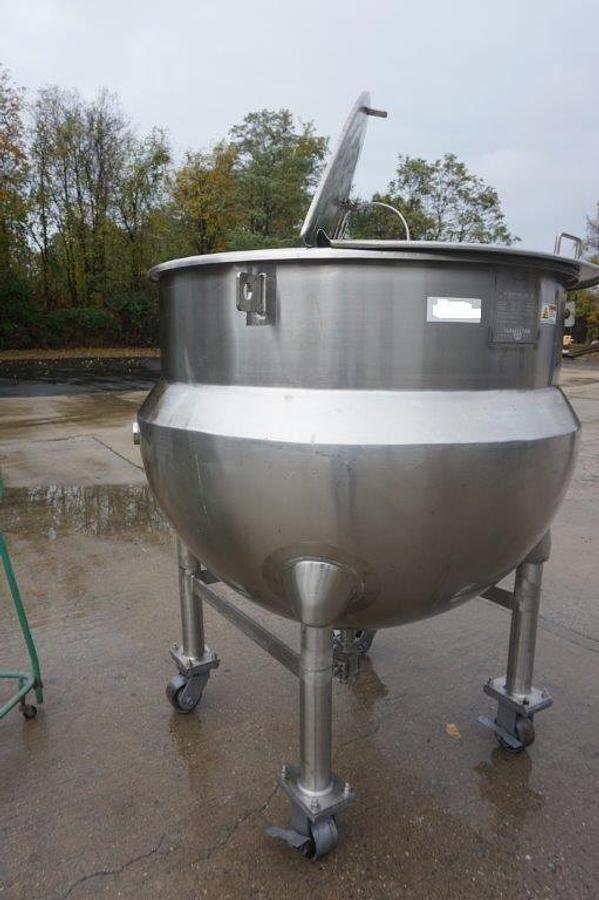
Category
Manufacturer
Model
Lee And Groen
Lee And Groen is known for its advanced processing equipment for the dairy industry. They manufacture a range of machines, including pasteurizers and homogenizers, ensuring high standards of quality and safety in dairy production. Lee And Groen’s technology helps dairy producers meet regulatory requirements.
FAQ:
What sizes do Lee And Groen jacketed kettles typically come in?
Lee And Groen jacketed kettles are manufactured across a wide range of capacities to suit different production scales. Common sizes include 100-gallon, 125-gallon, and 200-gallon units, and the brand also produces smaller countertop models as well as very large floor-mounted kettles for high-volume industrial operations. The size selection depends heavily on batch volume requirements, the type of product being processed, and available floor space in the facility.
When buying used Lee And Groen kettles, it is worth noting that availability at any given time depends on what has come off the market from decommissioned food processing or institutional cooking facilities. Used equipment dealers who specialize in food processing machinery tend to carry a rotating inventory of these kettles in multiple sizes, so buyers looking for a specific capacity should check current stock and inquire about upcoming availability if their preferred size is not listed.
How does a jacketed kettle work, and what makes the double-wall jacket design effective?
A jacketed kettle uses a double-wall construction where the inner cooking vessel is surrounded by an outer shell, creating a sealed cavity between the two walls. Steam, hot water, or another heat transfer medium is circulated through this jacket space, which heats the inner cooking surface evenly from all sides rather than applying direct flame or heat to the bottom only. This indirect heating method prevents scorching, reduces hot spots, and gives operators far more consistent temperature control across the entire batch.
The practical advantage of this design is significant in food production environments. Products like soups, sauces, dairy-based items, confections, and pharmaceutical compounds require precise temperature management throughout the cook cycle. Because the heat is distributed uniformly across the vessel walls rather than concentrated at a single point, the risk of product degradation or burning is substantially reduced. This is one of the main reasons jacketed kettles from manufacturers like Lee And Groen have been a standard piece of equipment in commercial kitchens, food processing plants, and institutional cooking facilities for decades.
What industries commonly use Lee And Groen jacketed kettles?
Lee And Groen jacketed kettles are used across a broad range of industries wherever controlled, large-batch heating or cooking is required. Food processing operations are the most common application, covering soups, sauces, gravies, jams, confections, dairy products, and ready-to-eat meal production. Institutional foodservice operations such as hospitals, correctional facilities, school cafeterias, and large catering operations also rely heavily on jacketed kettles because of the high volumes they need to produce consistently and safely.
Beyond food and foodservice, jacketed kettles see use in pharmaceutical manufacturing for mixing and heating compounds, in chemical processing for reactions that require controlled temperature environments, and in cosmetic production. The stainless steel construction and precise heat control that make Lee And Groen kettles attractive in food applications translate well to these other regulated industries. This cross-industry demand is part of why used Lee And Groen kettles tend to hold their value and remain in circulation long after their initial installation.
What materials are Lee And Groen jacketed kettles made from?
Lee And Groen jacketed kettles are typically constructed from high-grade stainless steel, most commonly 304 or 316 stainless steel for the product-contact surfaces. Type 304 stainless is the standard choice for most food and dairy applications because of its strong corrosion resistance, ease of cleaning, and durability under repeated thermal cycling. Type 316 stainless, which contains molybdenum, offers even greater resistance to chlorides and acidic compounds, making it the preferred material for more aggressive processing environments such as certain pharmaceutical or chemical applications.
The stainless steel construction is critical not just for food safety and regulatory compliance but also for the long service life these kettles are known for. A well-maintained stainless steel kettle can remain in service for many years, which is why used Lee And Groen kettles are still actively sought after in the secondary market. When evaluating a used unit, buyers should inspect the interior cooking surface and jacket welds carefully for pitting, corrosion, or signs of heavy abrasive cleaning that could compromise the surface integrity over time.
What is the difference between a direct steam and indirect steam jacketed kettle?
In a direct steam jacketed kettle, steam is injected directly into the jacket cavity and condenses against the inner vessel wall to transfer heat. The condensate is then drained away. This is a straightforward and efficient heating method that delivers consistent temperatures and is widely used in food processing plants that have an existing steam supply. Direct steam systems tend to heat up quickly and are well-suited for high-throughput production environments.
An indirect steam system, sometimes called a pressurized water or heat transfer fluid system, uses a closed-loop arrangement where a heat transfer medium such as hot water or a thermal oil is heated separately and then circulated through the jacket. This approach gives operators finer control over temperature and is often used in applications where very precise temperature management is needed, or where a direct steam supply is not available. Some kettles are also designed to use electric heating elements or direct gas-fired systems to heat the jacket fluid. When purchasing a used jacketed kettle, buyers should confirm the heating configuration of the specific unit and verify that it is compatible with the utilities available at their facility.
Do Lee And Groen jacketed kettles come with a tilting mechanism, and what are the benefits?
Many Lee And Groen jacketed kettles are manufactured with a tilting mechanism that allows the entire vessel to tip forward for pouring or emptying. These tilting models are typically available in manual tilt, gear-driven, or motor-assisted configurations depending on the kettle size and the weight of the load being handled. Smaller kettles may use a simple hand-wheel or lever, while larger units handling 100 gallons or more generally require a motorized tilt drive to safely manage the weight involved.
The operational benefits of a tilting kettle are substantial in any high-volume cooking environment. Emptying a stationary kettle requires pumping or ladling product out, which is time-consuming and increases the risk of burns or spills. A tilting design allows operators to pour product directly into transport containers, tilt pans, or processing lines quickly and safely, reducing labor time and improving ergonomics. When evaluating a used tilting kettle, it is worth inspecting the tilt mechanism, trunnion bearings, and any associated gearbox or motor for wear, since these components see significant mechanical stress over the life of the machine.
Are Lee And Groen jacketed kettles compliant with food safety standards?
Lee And Groen has a long history of manufacturing processing equipment for the food and dairy industries, and their kettles are generally designed and built to meet the hygiene and safety standards required in commercial food production. Many of their units are constructed to NSF (National Sanitation Foundation) standards or 3-A Sanitary Standards, which are the benchmarks for food contact surfaces, cleanability, and sanitary design in the food processing industry. These standards govern things like surface finish, crevice-free construction, and the ability to clean and sanitize equipment effectively.
When purchasing a used Lee And Groen kettle, buyers should verify the specific certifications that applied to the unit at the time of manufacture, as standards and certification requirements have evolved over the years. It is also worth consulting with the relevant regulatory bodies or your facility's food safety team to confirm that the used equipment meets current requirements for your specific application and jurisdiction. Age and condition can affect whether a used machine will pass a facility audit, so a thorough inspection before purchase is an important step in the evaluation process.
What should buyers inspect when evaluating a used jacketed kettle?
A thorough inspection of a used jacketed kettle should cover several areas. The interior cooking surface is the most critical, and buyers should look for pitting, cracks, heavy scratching, or discoloration that could indicate corrosion or surface degradation. The jacket itself should be inspected for any evidence of leaks, weld repairs, or scale buildup from years of steam or water circulation. If the kettle has an agitator, the shaft seals, bearings, and blade condition should all be checked, since these components wear over time and can be costly to replace.
Beyond the vessel itself, buyers should evaluate the heating system components, including any valves, gauges, and steam traps, as well as the tilt mechanism if the unit is a tilting model. Dealers who specialize in food processing equipment will typically accommodate in-person inspections or provide detailed video walkthroughs of the machine. Some units may still be installed and operating at a production facility, which offers the best opportunity to see the kettle running under real conditions. Keep in mind that most equipment dealers do not have production capabilities, so testing with actual product is generally not possible in a dealer's facility, but a visual and mechanical inspection can still reveal a great deal about the condition of the machine.
What are the typical shipping and delivery considerations for a large jacketed kettle?
Jacketed kettles, particularly floor-mounted units in the 100 to 200-gallon range, are heavy pieces of industrial equipment that require careful handling throughout the shipping process. Proper palletization or custom crating is typically necessary to protect the vessel, fittings, and any attached components during transit. The level of packaging required will affect the overall shipping cost, and buyers should ask the seller for specifics on how the equipment will be prepared before it leaves the facility.
Loading and unloading a large kettle also requires appropriate rigging equipment such as a forklift or crane, and this is often an added cost that buyers need to factor into the total landed price of the equipment. Freight charges will vary based on the weight of the unit, the distance involved, and whether liftgate service or inside delivery is needed at the destination. Before finalizing a purchase, buyers should get a clear breakdown of all associated costs including packaging, rigging, freight, and any destination handling fees so there are no surprises when the equipment arrives.
What payment terms do used equipment dealers typically offer for jacketed kettles?
Most used equipment dealers require full payment before a machine is released for shipping. This is standard practice in the secondary machinery market and applies to jacketed kettles and most other types of industrial processing equipment. The rationale is straightforward: used equipment is typically sold as-is, and dealers need to ensure payment is secured before incurring the costs of preparing, rigging, and shipping a large piece of machinery.
Some dealers may extend payment terms to buyers with whom they have an established purchasing history, but this is not the norm for first-time transactions. Buyers should clarify the accepted payment methods and any deposit requirements early in the negotiation process. Wire transfer is the most common payment method for used industrial equipment purchases of this scale. If financing is needed, buyers typically arrange that independently through equipment financing companies or their own banking relationships, as most used equipment dealers do not offer in-house financing programs.