Category
Manufacturer
Model
Label-Aire
Label-Aire specializes in labeling solutions for various industries, including food, beverage, and pharmaceuticals. Their machines are known for their speed and accuracy, designed to meet the high demands of production lines. Label-Aire’s technology helps companies enhance their packaging efficiency while maintaining compliance with labeling regulations.
FAQ:
What types of Label-Aire label applicators are available on the used equipment market?
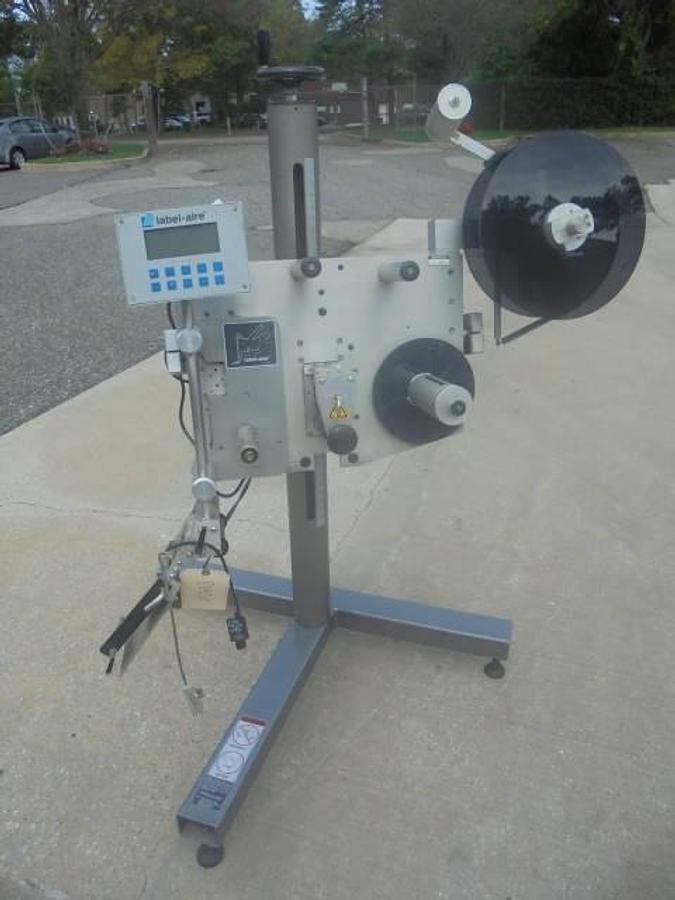
Label-Aire produces a range of pressure sensitive label applicators designed for different production environments and application requirements. The most commonly found models on the secondary market include the Label-Aire 3115, 3138, and 3111, each built for specific line speeds, label sizes, and mounting configurations. These machines support multiple application methods, including wipe-on, tamp, tamp-blow, and blow-on, which makes them adaptable to a wide variety of product shapes and packaging formats. Wipe-on application works well for flat, consistent surfaces moving at high speed, while tamp and tamp-blow methods handle recessed surfaces or products that require a more deliberate label placement.
Buyers shopping the used market will typically find single-phase and three-phase models, with varying levels of automation and control sophistication depending on the age and configuration of the machine. Some units are stripped-down applicator heads designed to integrate with existing conveyors and print systems, while others come as more complete assemblies. When evaluating used Label-Aire equipment, it helps to confirm the specific model number and any included accessories, since configurations can vary considerably even within the same model line.
What industries use Label-Aire label applicators?
Label-Aire applicators have a strong presence across several industries where accurate, high-speed labeling is a production requirement rather than an option. Food and beverage manufacturers rely on them for applying product labels, nutritional information panels, and date codes to bottles, cans, pouches, and cartons. Pharmaceutical and nutraceutical producers use Label-Aire equipment because of its precision, which is critical for compliance labeling where placement accuracy and readability directly affect regulatory requirements. Cosmetics, personal care, and household products companies also use these machines heavily, given the high volumes and aesthetic standards involved in consumer packaging.
Beyond consumer goods, Label-Aire applicators appear in logistics and distribution operations for applying shipping labels and barcodes to cases and pallets. General manufacturing and industrial packaging operations use them wherever consistent, automated label placement is needed to reduce labor costs and minimize errors. This broad industry adoption is one reason used Label-Aire machines hold their value reasonably well on the secondary market. A machine that served a food plant for several years may be entirely suitable for a logistics or manufacturing application, making used units an attractive option for buyers in adjacent industries.
Are used Label-Aire label applicators a reliable option for production use?
Label-Aire has built a reputation for producing durable, well-engineered equipment, and that durability is a significant reason why used units remain in demand. The machines are built with modular designs that simplify maintenance and component replacement, and many units have long service lives when properly maintained. A used Label-Aire applicator that has been well cared for in a production environment can deliver years of additional service, particularly in applications where line speeds and label complexity fall within the machine's rated specifications. The brand's widespread use across food, beverage, pharmaceutical, and industrial sectors means there is a large installed base, which supports parts availability and technical knowledge in the field.
That said, buying used industrial equipment always carries some degree of uncertainty, and Label-Aire machines are no exception. Since used equipment is typically sold as-is, buyers carry the responsibility of thoroughly inspecting any machine before purchase. Reputable used equipment dealers will generally accommodate in-person or video inspections so buyers can assess the machine's current condition. It also makes sense to contact Label-Aire directly to understand what level of technical support and parts availability exists for the specific model and age of machine being considered, since older models may have more limited support than more recent ones.
What should a buyer inspect on a used Label-Aire applicator before purchasing?
A thorough inspection of a used Label-Aire applicator should cover both mechanical and electrical components. On the mechanical side, buyers should examine the applicator head for wear, check the label feed path for damage or excessive wear on rollers and guides, and look at the tamp pad or blow tube if applicable. The condition of the drive motor, the label sensor, and any pneumatic components should also be assessed, since these are areas where wear tends to accumulate in high-cycle applications. Any signs of crash damage, bent frames, or improvised repairs are worth flagging and discussing with the seller before committing to a purchase.
On the electrical and controls side, buyers should confirm that the machine powers up and that the control interface is functional. Many used Label-Aire machines will still be running when taken out of service, and some dealers can arrange for an inspection at the facility where the machine is still in production, which provides a clearer picture of actual operating condition. Keep in mind that most used equipment dealers do not have the permits or production infrastructure to run actual product through a machine during a dealer-site inspection, so functional testing is typically limited to powered operation rather than full production simulation. Asking the seller for any available service records or maintenance history is also a practical step.
What application methods do Label-Aire machines use, and how do they differ?
Label-Aire applicators are built around four primary application methods, each suited to different product types and line configurations. Wipe-on application is the simplest and fastest method, where the label is dispensed and pressed onto the product surface as it passes by the applicator head. This works best for flat, consistent surfaces moving at relatively high and uniform speeds. Tamp application uses a pneumatic pad that extends to press the label onto the product, which allows for more precise placement and works on surfaces where wipe-on contact is not practical. Tamp-blow combines the tamp mechanism with an air assist to improve label conformance on slightly irregular surfaces.
Blow-on application, sometimes called air-blow, uses a directed air stream to transfer the label from the applicator to the product surface without physical contact. This method is useful for delicate products, fragile packaging, or situations where the applicator head cannot be positioned close to the product. The choice of application method has a direct impact on line speed, label placement accuracy, and the types of products that can be handled, so understanding which method a specific used machine uses is an important part of the buying decision. Buyers should match the application method of any used machine they are considering to the specific requirements of their production line.
What label sizes and materials are compatible with Label-Aire applicators?
Label-Aire applicators are designed to handle pressure sensitive labels, which covers a broad range of face stock materials including paper, polypropylene, polyester, and various specialty films. The specific label size range a machine can handle depends on the model and how the applicator head is configured, but most Label-Aire units can accommodate a fairly wide range of label widths and lengths. Label roll core size and outside diameter are also factors, since the machine's unwind spindle and feed path are sized for specific roll dimensions. Buyers should verify these specifications against their label supplier's roll format before finalizing a purchase.
One practical consideration with used machines is that the existing setup may be optimized for the label dimensions used by the previous owner. Changeover to a different label size typically involves adjusting guides, sensors, and in some cases the applicator head position. Label-Aire's modular design generally makes these adjustments manageable, but buyers should factor in setup and changeover time when evaluating a used unit for a new application. If the machine will be running labels with unusual materials, such as very thin films or heavily textured stock, it is worth consulting with a Label-Aire technician to confirm compatibility with the specific model being considered.
How fast are Label-Aire label applicators, and what throughput can they support?
Label-Aire applicators are built for industrial production environments, and their speed capabilities reflect that. Depending on the model and application method, Label-Aire machines can typically apply labels at rates ranging from several hundred to well over a thousand labels per minute in wipe-on configurations under optimal conditions. Tamp and blow-on methods operate at somewhat lower cycle rates due to the mechanical or pneumatic action involved, but they still support high-volume production requirements in most packaging environments. The Label-Aire 3115, one of the more commonly traded models on the used market, is a pressure sensitive applicator designed to handle demanding production line speeds.
Actual throughput in a given installation depends on several factors beyond the machine's rated speed, including label size, product spacing on the conveyor, the consistency of product presentation, and the condition of the machine. Used machines that have been well maintained should perform close to their rated specifications, but buyers should account for the possibility of some performance degradation due to wear. Getting a clear picture of the machine's operating history and any recent maintenance or repairs helps set realistic expectations. For applications where throughput is critical, confirming the machine's rated speed for the specific application method and label size is an important step before purchase.
How difficult is it to integrate a used Label-Aire applicator into an existing production line?
Label-Aire applicators are designed as modular units that mount to standard conveyor systems, which makes integration relatively straightforward compared to more complex packaging machinery. Most models use adjustable mounting brackets that allow the applicator head to be positioned for the correct label placement height and angle relative to the product. The machine typically requires a connection to the facility's compressed air supply for pneumatic models, along with a power connection matched to the unit's voltage and phase requirements. Integration with line speed signals or product sensors is usually handled through the machine's control interface, which on most Label-Aire models is accessible and well documented.
For buyers adding a used Label-Aire applicator to an existing line, the main variables are confirming that the machine's mounting configuration fits the available space, that the electrical supply matches the machine's requirements, and that the control system can communicate with any upstream or downstream equipment. Label-Aire's widespread use in industry means that many maintenance technicians and system integrators are already familiar with the platform, which reduces the learning curve. Buyers who are less familiar with the equipment may want to budget for a service call from a technician experienced with Label-Aire machines to assist with the initial setup and calibration, particularly if the machine is being reconfigured from its previous application.
Are replacement parts and technical support available for used Label-Aire applicators?
Parts availability is one of the practical advantages of buying used Label-Aire equipment. The brand has a large installed base across North American and international manufacturing facilities, which has supported a robust supply of replacement components over the years. Common wear items such as tamp pads, label sensors, drive belts, and feed rollers are generally available through Label-Aire's service network as well as third-party industrial parts suppliers. For older models, availability can vary, so buyers should check with the manufacturer directly to understand what support exists for the specific model and production year they are considering.
Label-Aire as a manufacturer has historically provided technical documentation and support for their equipment, though the level of support available for any specific machine depends on its age and whether the model is still within the manufacturer's active support window. Buyers of used Label-Aire equipment are well advised to contact the manufacturer before purchasing to confirm parts availability and to understand what service resources exist. Selecting a used equipment dealer that specializes in packaging machinery is also valuable, since these dealers often have practical knowledge of the machines they sell and can provide guidance on common maintenance needs and known issues for specific models.
What should buyers know about shipping and payment when purchasing a used Label-Aire applicator?
Shipping costs for used Label-Aire applicators vary based on the size of the machine, its weight, and the level of packaging required to protect it in transit. Smaller applicator heads may ship on a standard pallet, while larger or more complete assemblies may require custom crating to prevent damage. Buyers should ask the seller specifically about how the machine will be packaged, what rigging or loading costs apply if the machine needs to be moved from a plant floor, and what the estimated freight costs are to their location. Getting a clear picture of the total landed cost, including packaging, rigging, and freight, before agreeing to a purchase prevents unexpected expenses.
On payment, most used equipment dealers require full payment before a machine ships. Some dealers may extend terms to established customers with a purchase history, but buyers should not assume this is available. Payment terms and conditions should be confirmed in writing before the transaction is finalized. Since used equipment is typically sold as-is, buyers carry the responsibility of inspecting the machine to their satisfaction prior to payment. Most reputable dealers will accommodate in-person inspections at their facility or, if the machine is still located at a production facility, can arrange for a video or virtual inspection so the buyer can assess the machine's condition before committing funds.