Category
Manufacturer
Model
Kombi & Lees
FAQ:
What is a Kombi & Lees filter press and what is it used for?
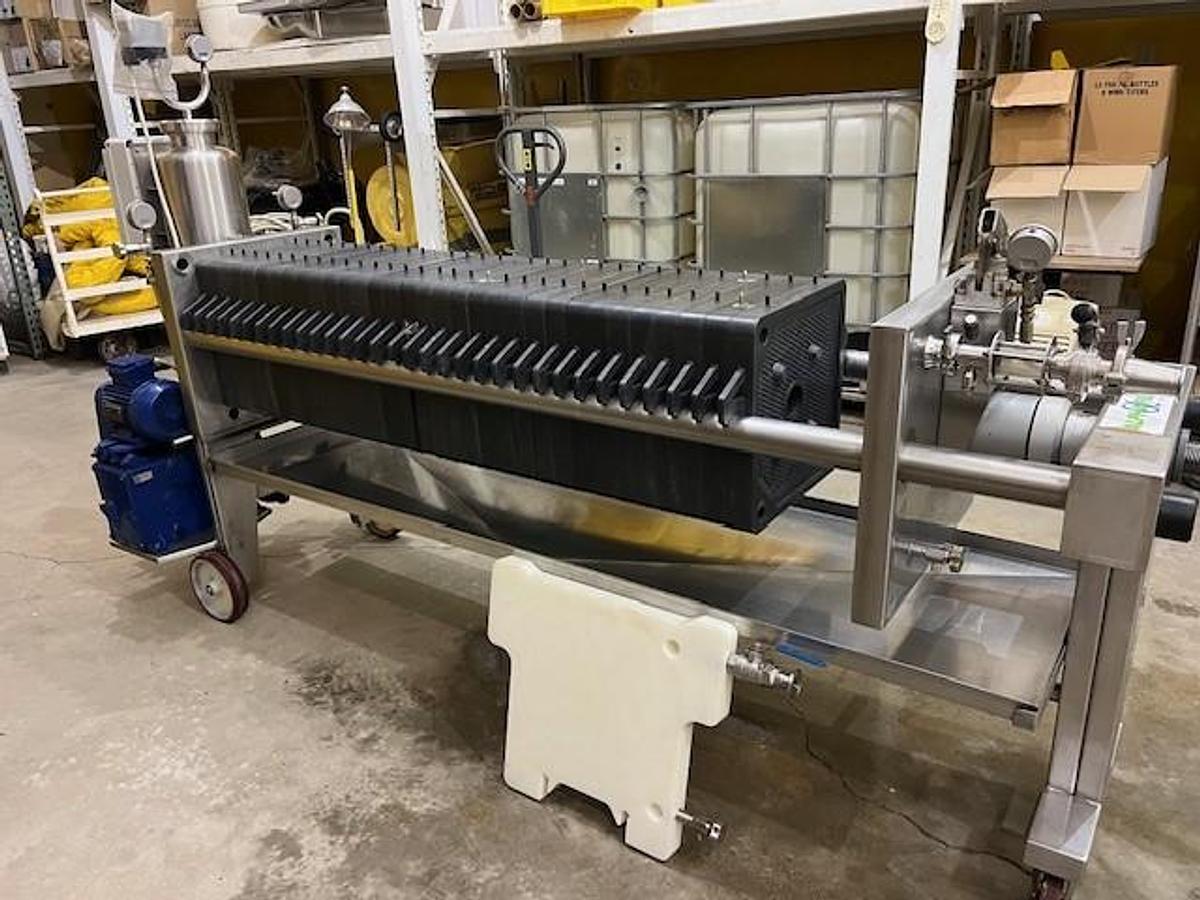
A Kombi & Lees filter press is a specialized plate-and-frame filtration unit designed primarily for the wine and beverage processing industry. Its core function is to separate solids from liquids, making it especially effective for filtering wine lees, grape juice, cider, and other fruit-based beverages. The 'Kombi' designation refers to a combination-style design that allows the press to handle both standard filtration and lees recovery in a single unit, which reduces the need for multiple pieces of equipment and improves overall production efficiency.
In a winery setting, lees are the sediment left behind after fermentation, consisting of dead yeast cells, grape solids, and other particulates. Recovering usable liquid from lees has historically been a challenge, and the Kombi & Lees press was engineered specifically to address that problem. The press forces liquid through filter media held between a series of plates and frames, capturing solids while allowing clarified liquid to pass through. This makes it a practical tool for wineries looking to maximize yield from each batch while maintaining product clarity and quality.
How does a plate and frame filter press differ from other wine filtration methods?
A plate and frame filter press works by stacking alternating plates and frames together to create a series of chambers. Filter media, typically sheets or pads, are placed between the plates. When the press is closed and liquid is pumped through, solids accumulate in the chambers while clarified liquid exits through outlets on the plates. This method gives the operator direct control over filtration intensity by selecting filter media of different porosity levels, ranging from coarse to sterile-grade filtration.
Compared to crossflow filtration or rotary vacuum drum filtration, a plate and frame press is generally simpler to operate, easier to clean manually, and more cost-effective to maintain, particularly for small to mid-sized production facilities. Crossflow systems are better suited for very high-volume continuous operations, while plate and frame presses excel at batch processing and lees recovery where solid content is high. For wineries that need flexibility across different filtration tasks without investing in multiple systems, a combination press like the Kombi & Lees design offers a practical middle ground.
What sizes and capacities are typically available for Kombi & Lees filter presses?
Kombi & Lees filter presses are produced in a range of sizes to accommodate different production volumes, from small boutique wineries to larger commercial operations. The capacity of a plate and frame press is primarily determined by two factors: the dimensions of the individual plates and frames, and the total number of plates in the stack. A press with more plates and larger frame dimensions will hold a greater volume of solids and process more liquid per cycle.
Plate sizes for wine filter presses in this category commonly range from around 400mm x 400mm up to 800mm x 800mm or larger, with plate counts varying from as few as 10 to well over 40 depending on the model. When evaluating a used Kombi & Lees press, buyers should confirm the plate count, frame depth, and overall throughput capacity to ensure the machine matches their production requirements. Throughput is typically measured in hectoliters per hour, and the actual output will also depend on the viscosity of the liquid, the solids load, and the type of filter media being used.
What materials are the filter plates made from in a Kombi & Lees filter press?
The plates and frames in a Kombi & Lees filter press are constructed from stainless steel, which is the standard material for food-grade and beverage processing equipment. Stainless steel provides resistance to the acids naturally present in wine and fruit juices, prevents contamination from corrosion, and allows for thorough sanitation between production runs. The food-contact surfaces comply with hygiene standards expected in winery and beverage facility environments.
Some components, such as seals, gaskets, and filtration sheet holders, may incorporate food-grade rubber or polymer materials. When purchasing a used press, it is worth inspecting these components carefully, as gaskets and seals are wear items that may need replacement depending on the age and prior usage of the machine. Stainless steel structural components tend to hold up well over many years of use, which is one reason these presses retain their practical value on the used equipment market.
What filtration media are compatible with a Kombi & Lees filter press?
Kombi & Lees filter presses are compatible with standard cellulose-based filter sheets and pads, which are the most widely used filtration media in the wine industry. These sheets are available in a range of grades, from coarse pads designed for rough filtration of high-solids liquids like lees, to medium grades for general clarification, to fine and sterile-grade pads used for polishing wine before bottling. The appropriate grade depends on the clarity goal and the solids content of the liquid being processed.
Filter sheets for plate and frame presses are sized to match the plate dimensions of the specific press model, so buyers should confirm plate dimensions before sourcing media. Suppliers of winery consumables stock sheets in the most common sizes. Some operators also use diatomaceous earth as a pre-coat on filter sheets to extend media life and improve filtration performance when processing particularly heavy lees loads. Compatibility with standard industry media is one of the practical advantages of the plate and frame design, as replacement sheets are widely available from multiple suppliers.
Are Kombi & Lees filter presses suitable for small wineries and boutique producers?
Yes, Kombi & Lees filter presses are well-suited to small and boutique wineries, particularly because they are available in compact configurations with lower plate counts that match lower production volumes. For a small winery processing a few hundred hectoliters per vintage, a press with 10 to 20 plates can handle both general wine filtration and lees recovery without requiring the capital investment of larger industrial filtration systems. The manual or semi-manual operation of most models in this range also means less reliance on automated controls, which simplifies training and day-to-day use.
For boutique producers, one of the more compelling reasons to consider a used Kombi & Lees press is cost. Purchasing used equipment rather than a comparable unit from a manufacturer at full price can significantly reduce the capital required to add filtration capacity. The stainless steel construction means a well-maintained press retains its functionality for many years, and the plate-and-frame design is straightforward enough that experienced winery staff can operate and clean the machine without specialized technical support.
What should I inspect when buying a used Kombi & Lees filter press?
When evaluating a used Kombi & Lees filter press, the most important areas to inspect are the condition of the stainless steel plates and frames, the integrity of the gaskets and seals, the hydraulic or mechanical closing mechanism, and the inlet and outlet fittings. Plates should be checked for warping, pitting, or corrosion, as damaged plates can compromise the seal between chambers and reduce filtration efficiency. Gaskets and seals are wear items and are likely to need replacement on older machines, but they are generally inexpensive and straightforward to source.
Reputable used equipment dealers will typically accommodate in-person inspections at their facility, or provide video walkthroughs and detailed photographs if an in-person visit is not practical. Some machines may still be installed at the production facility where they were last used, in which case an inspection can sometimes be arranged on-site. Keep in mind that most used equipment dealers do not have the permits or infrastructure to run actual production trials, so functional testing with wine or juice is generally not possible through the dealer. Buyers should factor this into their due diligence and, where possible, consult with the press manufacturer regarding parts availability and technical support for the specific model and age of the machine they are considering.
What is the typical price range for a used Kombi & Lees filter press?
Pricing for used Kombi & Lees filter presses varies considerably based on the size of the press, the number of plates, the overall condition, and the age of the machine. Smaller presses with fewer plates and lower throughput capacity tend to be priced lower, while larger commercial-scale units with high plate counts command higher prices. As a general reference point, used plate and frame wine filter presses in good working condition can range from a few thousand dollars for compact units to tens of thousands of dollars for larger, well-maintained commercial models.
Beyond the purchase price, buyers should account for the full landed cost of the equipment, which includes shipping, any crating or rigging required for loading and transport, and any refurbishment or parts replacement needed after delivery. Shipping costs for a machine of this type can be significant depending on the distance and the size of the unit, so it is worth requesting a detailed quote from the dealer that breaks out all of these costs before committing to a purchase. Payment terms for used equipment purchases typically require full payment prior to shipment, though some dealers may offer alternative arrangements for established customers.
How do you clean and maintain a Kombi & Lees filter press?
Cleaning a plate and frame filter press after each use is straightforward but requires attention to detail to prevent contamination between batches. After filtration is complete, the press is opened by separating the plates, and the spent filter sheets or pads are removed and discarded. The plates and frames are then rinsed with clean water to remove residual solids, followed by a wash with an appropriate food-grade cleaning solution. For winery use, caustic-based cleaners are commonly used for removing organic residues, followed by an acid rinse to neutralize and remove mineral deposits. All contact surfaces should be thoroughly rinsed with clean water before the press is reassembled for the next use.
Routine maintenance involves inspecting gaskets and seals for wear or cracking, checking the closing mechanism for proper function, and ensuring that all inlet and outlet connections are free of blockages. Gaskets are the most common wear component and should be replaced when they show signs of deterioration to maintain a proper seal between plates. The stainless steel construction of the Kombi & Lees press makes it resistant to the harsh cleaning chemicals used in food and beverage facilities, and with consistent maintenance, these machines can remain in reliable service for many years.
What does 'as-is' mean when buying used filtration equipment, and how should buyers protect themselves?
Used equipment is sold 'as-is' by dealers, meaning the machine is offered in its current condition without the warranty coverage that manufacturers provide on new equipment. This places the responsibility for evaluating the condition and suitability of the machine squarely on the buyer. It is not a reason to avoid the used equipment market, but it does mean that careful pre-purchase inspection is essential. Buyers should take advantage of any inspection options offered by the dealer, whether that is an in-person visit, a live video walkthrough, or a detailed set of photographs and condition notes.
Selecting a dealer with a long track record in the food and beverage equipment industry, and one that specializes in the type of machinery being purchased, significantly reduces risk. Experienced dealers are more likely to accurately represent the condition of equipment and provide useful context about a machine's history and maintenance. Buyers should also contact the press manufacturer directly to understand what parts and technical support are available for the specific model and age of the machine, since older models may have limited parts availability. Taking these steps before purchase gives buyers a much clearer picture of what they are acquiring and what ongoing support they can expect.