Category
Manufacturer
Model
Key Industries
Key Industries manufactures a variety of equipment for the food processing sector, particularly known for their mixing and blending machines. Their products are designed to improve efficiency and consistency in production.
FAQ:
What is a capsule polisher and what does it do?
A capsule polisher is a piece of post-filling equipment used in pharmaceutical and nutraceutical production lines to clean the exterior surface of filled capsules before they move on to inspection, sorting, or packaging. After a capsule filling machine closes and ejects capsules, fine powder dust, residual debris, and static charge are often present on the outer shell. Left uncleaned, this contamination can cause capsules to stick together, interfere with automated counting and packaging equipment, and create an unprofessional finished product.
Most capsule polishers accomplish this cleaning through a combination of soft rotating brushes and a vacuum or blower system. The brushes gently agitate the capsule surface to dislodge clinging powder, while the vacuum draws away the loosened dust and prevents it from resettling. The process is designed to be thorough enough to produce a clean, shiny capsule exterior without applying enough force to crack, dent, or otherwise damage the capsule shell. In a properly configured finishing line, capsules move continuously from the filler through the polisher and on to downstream equipment, keeping production flowing without manual intervention.
What capsule sizes are compatible with Key Industries capsule polishing equipment?
Key Industries capsule polishers are designed to handle a broad range of standard capsule sizes, which is one of the practical advantages of their equipment for contract manufacturers and facilities running multiple product lines. Pharmaceutical capsule sizing follows a standardized scale, and most industrial polishers in this category are built to accommodate capsules ranging from the large size 000 down through size 5, covering the vast majority of hard gelatin and HPMC capsule formats used in commercial production.
Buyers shopping for a used Key Industries capsule polisher should confirm the specific size range of the unit they are evaluating, since some models may be configured or optimized for a particular size range. When inspecting a machine, it is worth asking whether any size-change parts, brushes, or adjustment settings are included with the unit, as these components can affect compatibility with smaller or larger capsule formats. Consulting Key Industries directly about a specific model number can also help clarify which capsule sizes were supported at the time of manufacture and whether replacement parts for size changeovers are still available.
How does a Key Industries capsule polisher remove dust and static from capsule surfaces?
Key Industries capsule polishers use a mechanical and pneumatic cleaning approach that addresses both the physical dust on the capsule surface and the electrostatic charge that causes powder to cling. Capsules are fed into the machine and travel along a brushing section where soft bristle brushes rotate against the capsule exterior. This gentle scrubbing action dislodges powder that has adhered to the shell during the filling and closing process. The design of the brush mechanism is calibrated to apply enough contact pressure to clean effectively without cracking or deforming the capsule.
Simultaneously, a vacuum or blower system draws the loosened dust away from the capsule stream and deposits it into a collection area, preventing recontamination. Some configurations also incorporate ionization or other static-reduction elements, though the primary static mitigation in brush-and-vacuum systems comes from the physical removal of the charged powder itself. The result is a capsule that exits the polisher with a clean, smooth exterior that is ready for visual inspection, metal detection, or direct packaging. For facilities running high-volume production, this continuous inline process is far more efficient than any manual cleaning alternative.
What is the production throughput of Key Industries capsule polishers like the CP-300 and CP150?
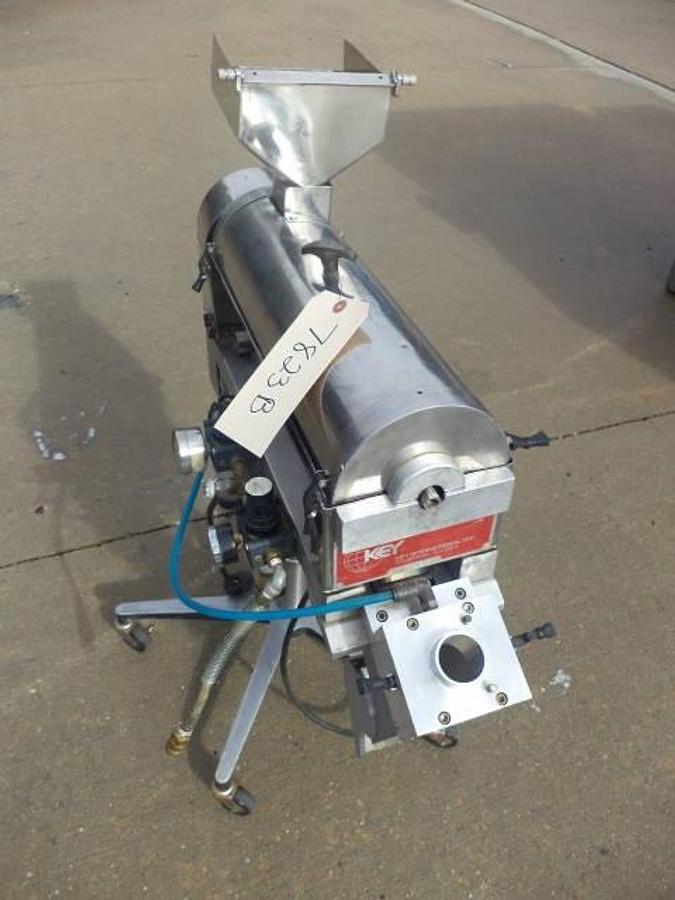
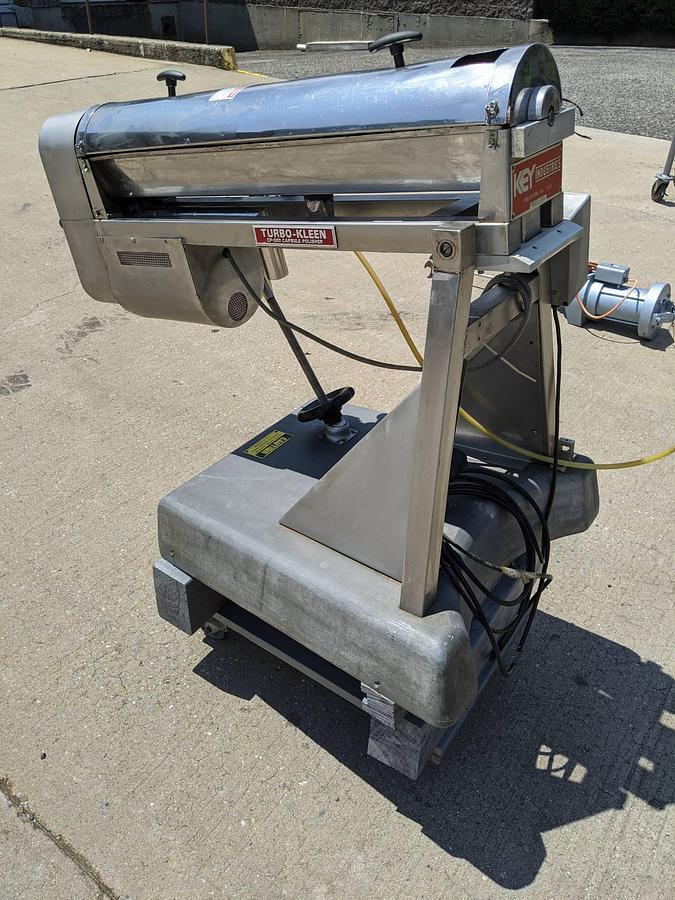
Throughput on capsule polishing equipment varies by model, capsule size, and how the machine is integrated into the broader production line. The Key Industries CP-300 "Turbo-Kleen" and the CP150 are two distinct models that represent different capacity tiers. Generally speaking, smaller or portable models like the CP150 are suited to lower-volume or pilot-scale production environments, while larger models are designed to keep pace with high-speed capsule filling machines producing hundreds of thousands of capsules per hour.
When evaluating a used capsule polisher, buyers should request the manufacturer's rated throughput for the specific model and then consider how that figure aligns with the output of their filling equipment. A polisher that cannot keep up with the filler creates a bottleneck, while an oversized polisher running well below capacity is an inefficient use of floor space and capital. It is also worth noting that actual throughput on a used machine may differ from published specifications depending on the machine's condition, wear on brushes or rollers, and whether the vacuum system is functioning at full capacity. A thorough inspection before purchase helps establish realistic performance expectations.
Is a used Key Industries capsule polisher compatible with existing capsule filling equipment?
Capsule polishers are generally designed as standalone inline units that connect to a capsule filling machine via a discharge chute or transfer conveyor. Key Industries polishers are built to integrate into standard pharmaceutical finishing lines, and in most cases they can be positioned downstream of capsule fillers from a variety of manufacturers. The key compatibility factors are the discharge height and orientation of the filler, the feed inlet dimensions of the polisher, and the capsule size range being run.
For used equipment specifically, buyers should take careful measurements of the inlet and outlet dimensions and compare them against their existing line configuration. Some facilities fabricate simple transfer chutes or adapters to bridge minor height or angle differences between machines from different manufacturers. It is also worth confirming that the electrical requirements of the polisher match the available power supply at the facility, since voltage and phase specifications can vary between older and more recent equipment. Reaching out to Key Industries with the model number of the polisher can help clarify what integration accessories were originally available and whether technical documentation is still on hand.
What materials are used in the construction of Key Industries capsule polishing equipment?
Pharmaceutical and nutraceutical production equipment is expected to meet strict material standards to prevent contamination and support sanitary cleaning procedures. Key Industries capsule polishers are built with stainless steel as the primary contact and structural material, which is standard practice for equipment used in GMP-regulated environments. Stainless steel resists corrosion, does not absorb product residue, and can withstand the cleaning agents and sanitizing solutions used in pharmaceutical facilities without degrading.
Brush components, seals, and other parts that contact capsules directly are typically made from materials selected for their softness and non-reactivity, since harsh or abrasive contact surfaces would damage capsule shells. When purchasing a used machine, buyers should inspect these contact parts carefully, as brushes and seals are wear items that may need replacement depending on the machine's prior use history. Confirming the grade of stainless steel used in the construction (typically 304 or 316 series) is also relevant for facilities with specific material documentation requirements under their quality systems.
Do Key Industries capsule polishers meet GMP and FDA compliance standards?
Key Industries designs its capsule polishing equipment for use in pharmaceutical and nutraceutical manufacturing environments, where GMP (Good Manufacturing Practice) compliance is a baseline expectation. GMP-compliant equipment is characterized by smooth, cleanable surfaces, stainless steel construction in product contact areas, minimal dead zones where product can accumulate, and documentation support for qualification activities such as IQ, OQ, and PQ. Key Industries equipment is generally built with these principles in mind, which is why it is commonly found in regulated production facilities.
However, buyers of used equipment should understand that GMP compliance is ultimately a facility-level responsibility, not just an equipment characteristic. A used machine that was compliant in its previous installation may require cleaning verification, recalibration, or minor refurbishment before it can be qualified in a new facility. It is advisable to request any available documentation that accompanied the machine, including maintenance records, cleaning validation data, or prior qualification records, as these can significantly reduce the time and cost of requalifying the equipment. Consulting with a quality assurance professional familiar with pharmaceutical equipment qualification is a practical step before putting any used machine into regulated production.
How easy is it to clean and maintain a Key Industries capsule polisher?
Capsule polishers used in pharmaceutical environments need to be cleaned between product changeovers, and the ease of that process depends heavily on how the machine is designed for disassembly. Key Industries polishers are built for production environments where cleaning is a routine requirement, and most components that contact capsules or powder are accessible without specialized tools. Brush assemblies, collection trays, and dust collection components can typically be removed, cleaned, and reinstalled as part of a standard changeover procedure.
For a used machine, the practical ease of cleaning also depends on the condition of seals, gaskets, and surface finishes after years of prior use. Worn seals can create crevices where product accumulates, and pitted or scratched stainless steel surfaces are harder to clean thoroughly than smooth ones. Before purchasing a used Key Industries capsule polisher, a close inspection of these areas during an in-person or video review can reveal whether any refurbishment is needed to restore the machine to a cleanable condition. Routine maintenance on these machines generally includes brush inspection and replacement, vacuum filter changes, and lubrication of any moving mechanical components according to the manufacturer's service guidelines.
What should buyers inspect when purchasing a used Key Industries capsule polisher?
Buying used pharmaceutical equipment requires a more thorough evaluation than purchasing a commodity item, because the machine's condition directly affects production quality and regulatory compliance. For a used Key Industries capsule polisher, the most important areas to inspect are the brush assembly (checking for wear, deformation, or missing bristles), the vacuum or blower system (confirming suction is functioning and filters are present), the stainless steel contact surfaces (looking for pitting, scratches, or corrosion), and the electrical controls (verifying that the motor, switches, and any speed controls operate correctly).
Reputable used equipment dealers will typically accommodate in-person inspections at their facility or, when the machine is still located at the original production site, can arrange access through the selling facility. Video inspections and video captures of the machine running are also commonly offered. Keep in mind that most dealers do not have pharmaceutical production permits, so they cannot run actual capsule product through the machine during an inspection, but they can demonstrate that the motor runs, the brushes rotate, and the vacuum system draws air. Buyers should also ask about the machine's history, including what product it was used for, how many shifts it ran, and when it was last serviced, since this context helps estimate remaining service life and likely refurbishment needs.
What are the typical shipping and payment considerations when buying a used Key Industries capsule polisher?
Used capsule polishing equipment varies in size and weight depending on the model. Smaller portable units like the CP150 may ship on a standard pallet with proper blocking and bracing, while larger models such as the CP-300 may require a custom crate or skid to prevent damage in transit. Shipping costs depend on the packaging method, the origin and destination, the carrier selected, and whether any special handling or liftgate service is needed at the receiving facility. Buyers should ask the dealer for a detailed breakdown of packaging, freight, and any rigging charges so they understand the full landed cost before committing to a purchase.
On payment terms, used equipment dealers typically require full payment before a machine ships. Some dealers extend terms to repeat customers or established accounts, but this is not standard practice for first-time transactions. Wire transfer is the most common payment method for used industrial equipment purchases. Buyers should factor lead time for payment processing into their project timelines, especially if the machine needs to be inspected, purchased, and delivered within a specific window for a production startup or line expansion.