Category
Manufacturer
Model
FAQ:
What is a three roll mill and how does it work?
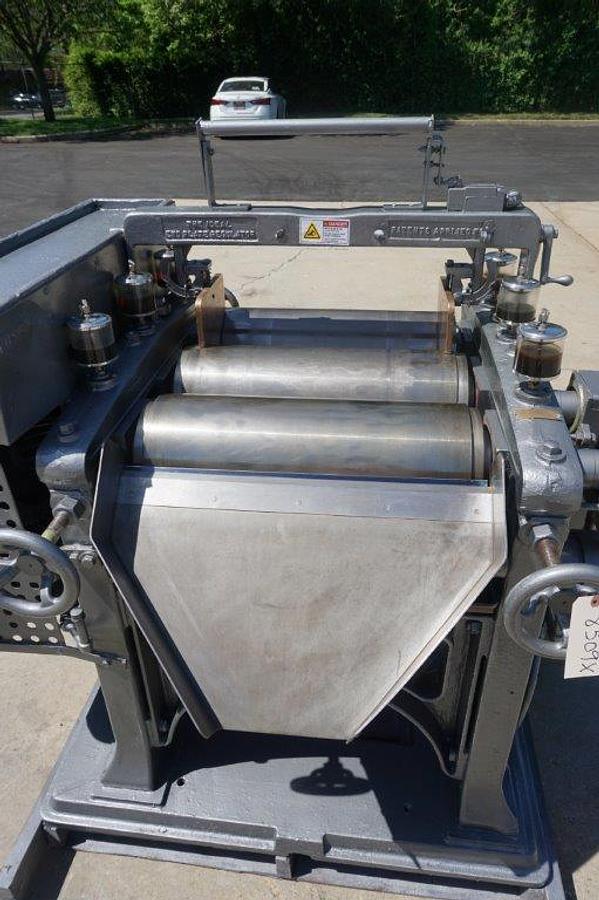
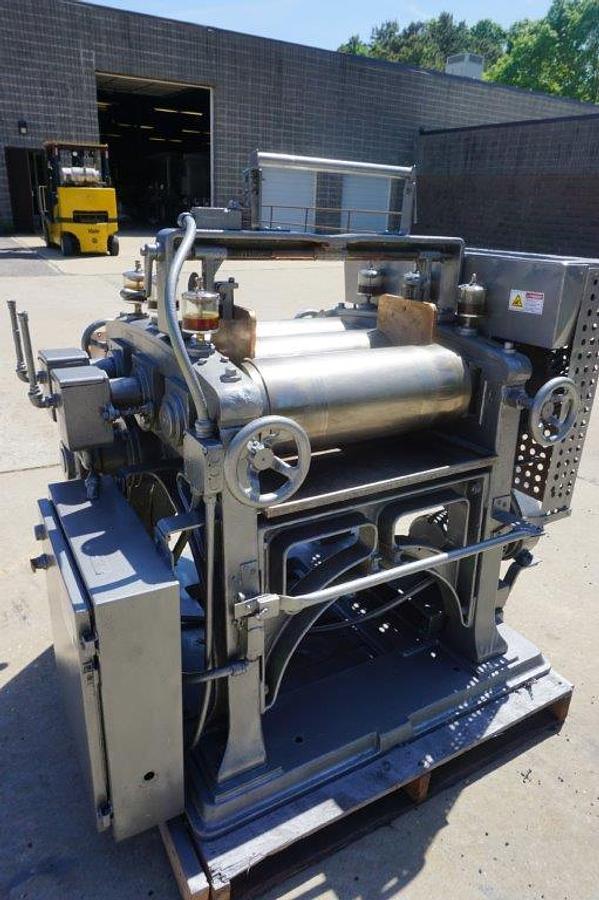
A three roll mill is a machine used to mix, disperse, refine, or homogenize viscous materials by passing them through the gaps between three horizontally positioned rollers. The rollers rotate in alternating directions, which creates intense shear force as material is pulled through each nip point. This shearing action breaks down agglomerates and produces a finely dispersed, uniform paste or compound that would be difficult to achieve with other mixing equipment.
The process is well suited to materials that are too thick or too sensitive for high-speed dispersers or ball mills. Operators feed material into the first nip between the feed and center rollers, and the material transfers to the apron roller and is collected with a scraper blade. Gap settings between the rollers control the degree of shear and the fineness of the final product, and multiple passes can be made to reach tighter particle size targets.
What materials and pastes can be processed with a Kent three roll mill?
Kent three roll mills are used across a wide range of industries because the shear-based processing method works on almost any viscous or paste-like material. Common applications include cosmetic formulations such as lipstick, foundation, and sunscreen; pharmaceutical ointments and creams; electronic conductive pastes and solder pastes; printing inks; coatings and varnishes; adhesives and sealants; ceramic pastes; and certain food products like chocolate or nut butters.
The key requirement is that the material must have enough viscosity to stay in the nip zone and transfer between rollers rather than splashing or flowing away. Very low-viscosity liquids are not well suited to roll milling. Materials containing abrasive particles, pigments, or fillers are handled effectively because the roller surfaces are hardened and designed to withstand repeated contact with solid particles suspended in a paste matrix.
What roller diameter and length specifications are available for Kent three roll mills?
Kent three roll mills are produced in multiple sizes to match different production volumes and space constraints. The size designation typically refers to roller diameter by roller length, and one commonly available used configuration is the 8-inch diameter by 24-inch length roller format. This mid-range size is practical for pilot-scale production and smaller manufacturing runs, offering meaningful throughput without requiring the floor space or infrastructure of a full production-scale machine.
When evaluating a used Kent three roll mill, the roller dimensions directly affect throughput capacity and the width of the material ribbon that can be processed in a single pass. Larger roller lengths increase output per pass, while roller diameter influences the contact area and the mechanical advantage available for generating shear. Buyers sourcing used equipment should confirm the exact roller dimensions from the listing specifications rather than assuming a standard size, since multiple configurations exist across the Kent product line.
What is the maximum grinding fineness achievable with a Kent three roll mill?
Three roll mills in general, including Kent models, are capable of achieving particle sizes down to approximately 1 to 5 microns under optimal conditions, though the practical fineness depends on several factors including roller material, gap adjustment precision, the number of passes, and the rheological properties of the material being processed. For demanding applications such as electronic conductive pastes or high-quality cosmetic pigment dispersions, multiple passes at progressively tighter gap settings are typically required to reach sub-5-micron fineness.
It is worth understanding that fineness targets are highly application-specific. A pharmaceutical ointment may require a different fineness standard than a ceramic paste or a printing ink. When purchasing a used Kent three roll mill, buyers should assess whether the roller surfaces show wear or scoring, since surface condition directly affects the minimum achievable gap and therefore the finest grind the machine can produce. Consulting with the seller about the machine's history and prior applications can help set realistic expectations for performance.
Are Kent three roll mills suitable for laboratory use, or are they only for large-scale production?
Kent three roll mills span both laboratory and production environments depending on the model and roller size. Smaller configurations with shorter roller lengths are practical for lab-scale work, formulation development, and small batch processing where material quantities are limited and frequent product changeovers are expected. These smaller machines allow formulators to develop and refine a paste recipe before committing to a full production run, and they occupy much less floor space than production-scale equipment.
Larger Kent models with longer rollers and higher motor power ratings are designed for continuous or semi-continuous production environments where throughput is the priority. A used 8-inch by 24-inch Kent three roll mill sits in a practical middle range that can serve both pilot production and modest-volume manufacturing. Buyers should match the roller length and motor specifications to their actual batch size requirements, keeping in mind that running a large machine at very low throughput is generally less efficient than selecting a size appropriate to the application.
What roller materials are used in Kent three roll mills, and how does this affect material compatibility?
Three roll mills, including those made by Kent, are typically built with rollers in hardened steel, chrome steel, or alumina ceramic. Hardened and chrome steel rollers are durable and cost-effective for general-purpose applications involving inks, adhesives, and coatings where trace metal contamination is not a concern. Chrome steel rollers offer good corrosion resistance and a smooth surface finish that aids material transfer and cleanup.
Alumina ceramic rollers are the preferred choice for applications that cannot tolerate metallic contamination, such as pharmaceutical compounds, certain electronic pastes, and food-grade formulations. Ceramic rollers are also more chemically inert, making them better suited for processing materials that contain acids, solvents, or other chemically aggressive components. When evaluating a used Kent three roll mill, buyers should confirm the roller material from the equipment listing or through direct inspection, and assess the condition of the roller surfaces for chips, cracks, or wear patterns that could affect performance or contamination control.
How is the roller gap adjusted on a three roll mill, and does Kent offer automated gap control?
Roller gap adjustment on a three roll mill controls the amount of shear applied to the material and directly determines grinding fineness. On most three roll mills, gap adjustment is accomplished through mechanical handwheels or screw mechanisms that move the feed and apron rollers relative to the fixed center roller. Some models incorporate digital micrometers or graduated scales so operators can set and repeat gap positions with reasonable accuracy across production runs.
More advanced three roll mill configurations include hydraulic or motorized gap control systems that allow adjustments under load, which is useful for maintaining consistent fineness as material viscosity changes during processing. Whether a specific used Kent three roll mill has manual or automated gap control depends on the model and the options it was built with. Buyers should ask the seller for details on the gap adjustment mechanism and, if possible, observe it during an inspection to confirm it operates smoothly and holds position without drift, since worn adjustment mechanisms can make repeatable gap settings difficult to achieve.
Do Kent three roll mills offer water-cooled rollers, and why does roller cooling matter?
Water-cooled rollers are an important feature on three roll mills intended for processing heat-sensitive materials. The shear forces generated during milling produce friction and heat at the nip points, which can degrade temperature-sensitive formulations such as waxes, low-melt adhesives, certain pharmaceutical actives, and some cosmetic ingredients. Water-cooled rollers circulate coolant through the interior of each roller, maintaining surface temperatures within a range that protects the material being processed.
Kent three roll mills are available in configurations with water-cooled rollers, and this feature is a key consideration when selecting a used machine for heat-sensitive applications. When evaluating a used Kent mill, buyers should inspect or inquire about the condition of the internal cooling channels and the rotary unions that connect the coolant supply to the spinning rollers, as these components can develop leaks or scaling over time. Confirming that the cooling system is functional and free of blockages is an important part of the pre-purchase inspection process.
What should buyers look for when inspecting a used Kent three roll mill before purchasing?
A thorough inspection of a used Kent three roll mill should cover several key areas. Roller surface condition is the most critical point, since scratches, pitting, chips, or uneven wear directly affect grinding performance and the minimum achievable gap. The gap adjustment mechanism should move freely and hold its set position without slipping. Bearings should be checked for noise or play, and the drive system including the motor, gearbox, and belt or gear train should show no signs of excessive wear or oil leaks. If the machine has water-cooled rollers, the cooling system and rotary unions should be inspected for leaks and confirmed to be clear of scale or blockage.
Reputable used equipment dealers will typically accommodate in-person inspections at their facility, or provide detailed video walkthroughs and photographs of the machine. Some used Kent mills may still be installed at an active production facility, in which case an inspection can sometimes be arranged at the plant with the cooperation of the selling dealer and the equipment owner. Keep in mind that most used equipment dealers are not set up for product testing, since running actual production requires different permitting and facilities. The goal of the inspection is to get an accurate picture of the machine's mechanical condition and current state of maintenance.
What are the typical shipping and payment considerations when buying a used Kent three roll mill?
Used three roll mills are heavy industrial machines, and shipping costs depend on the roller size, overall machine weight, and the packaging required to protect the equipment in transit. Smaller Kent models may ship on a standard pallet, while larger machines typically require custom wooden crating to prevent damage during handling. Heavy machines may also require professional rigging equipment for loading at the seller's facility and unloading at the buyer's location, which adds to the total landed cost. Buyers should request a detailed breakdown of packaging, rigging, and freight charges from the seller before finalizing a purchase so there are no surprises.
Payment terms for used industrial equipment generally require full payment before the machine ships. Some dealers extend terms to established repeat customers, but this is not standard practice for first-time buyers. Most transactions are completed by wire transfer or other secure payment methods. Buyers should factor in the full landed cost including freight, rigging, and any required installation work when comparing the price of a used Kent three roll mill against other available options.