Category
Manufacturer
Model
FAQ:
What is a Kady Mill and what is it used for?
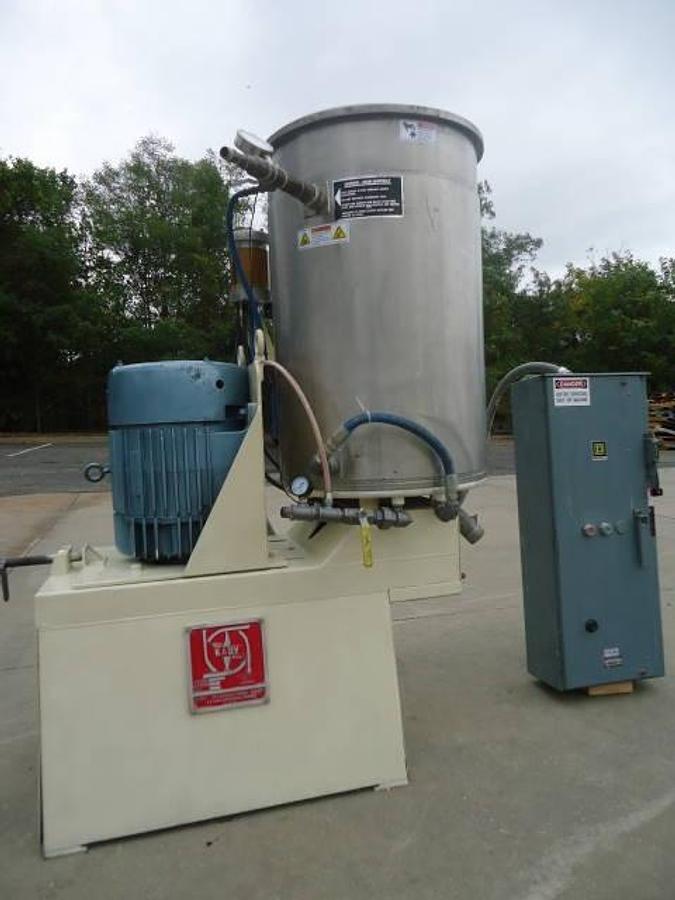
A Kady Mill is a high-shear batch mixer and disperser that uses a rotor-stator mechanism to achieve intense hydraulic shear within a closed vessel. The rotor spins at high speed inside a closely toleranced stator, creating powerful shear forces that break down agglomerates, reduce particle size, and produce fine, uniform dispersions. Unlike many mixing technologies, the Kady Mill operates as a closed system, which helps contain volatile materials and minimizes contamination during processing.
Kady Mills are widely used across a broad range of industries, including paints and coatings, printing inks, adhesives, cosmetics, pharmaceuticals, food processing, and specialty chemical manufacturing. They are particularly valued in applications where consistent particle size reduction and thorough dispersion are critical to product quality. Because the process does not rely on grinding media such as beads or balls, there is significantly less risk of media contamination in the finished product, which makes the Kady Mill a preferred choice in industries with strict purity requirements.
What industries commonly use Kady Mills?
Kady Mills are found in a wide variety of manufacturing environments where controlled dispersion and particle size reduction are essential. The paints and coatings industry has historically been one of the heaviest users, relying on Kady Mills to disperse pigments and fillers into liquid vehicles efficiently. Printing ink manufacturers use them for similar reasons, as achieving fine, consistent pigment dispersion directly affects print quality and color accuracy.
Beyond coatings and inks, Kady Mills are also common in adhesive production, cosmetics manufacturing, pharmaceutical processing, and food-grade applications. In pharmaceuticals and cosmetics, the closed-vessel design and media-free operation are especially attractive because they reduce contamination risk and support cleaner processing environments. Chemical manufacturers processing slurries, emulsions, or suspensions also rely on Kady Mills for their ability to handle high-viscosity materials and produce repeatable results batch after batch.
What is the difference between a Kady Mill and a conventional ball mill or sand mill?
The most fundamental difference is that a Kady Mill achieves particle size reduction and dispersion through hydraulic shear generated by its rotor-stator assembly, while ball mills and sand mills rely on grinding media (steel balls, ceramic beads, or sand) to physically abrade and break apart particles. This distinction has significant practical consequences. In a ball mill or sand mill, media wear introduces trace contamination into the product over time, which can be a serious problem in pharmaceuticals, food processing, or high-purity chemical applications. The Kady Mill eliminates that concern entirely.
From an operational standpoint, Kady Mills also tend to offer faster batch processing times compared to conventional ball mills for many dispersion tasks, and the closed-vessel design makes them easier to clean and more suitable for processing volatile or hazardous materials. Ball mills, on the other hand, can achieve extremely fine particle sizes and may still be preferred in applications requiring very aggressive grinding of hard solids. Sand mills and bead mills are often favored for continuous processing of lower-viscosity products. The right choice depends heavily on the specific material being processed, the required particle size, and production volume.
What sizes and capacities are available when looking for a Kady Mill for sale?
Kady Mills have been manufactured across a wide range of sizes, from small laboratory-scale units with roughly 1-gallon capacity up to large production models capable of handling several hundred gallons per batch. Mid-range production units, such as 60-gallon capacity models, are among the more commonly encountered sizes on the used equipment market and are well suited to pilot-scale or moderate-volume production environments. Larger units are typically found in high-volume manufacturing facilities and are less frequently available secondhand.
When searching for a used Kady Mill, buyers will also encounter variations in construction beyond just tank capacity. Stainless steel vessels are common in food, pharmaceutical, and cosmetic applications due to sanitary requirements, while carbon steel construction is more typical in industrial coating or ink applications. Jacketed models, which allow for temperature control through heating or cooling of the vessel wall, are available and important for processing temperature-sensitive materials. Horsepower ratings on the drive motor vary considerably across sizes and can range from a few horsepower on lab units to 30 HP or more on larger production machines.
What materials can a Kady Mill process?
Kady Mills are designed to handle a broad range of liquid and semi-liquid materials, particularly those involving solids suspended or dispersed in a liquid carrier. Common applications include pigment dispersions, resin-based coatings, adhesive compounds, cosmetic emulsions, pharmaceutical suspensions, food-grade slurries, and various chemical formulations. The rotor-stator mechanism is especially effective at breaking down soft to moderately hard agglomerates and achieving fine, uniform particle distribution within a liquid medium.
Material compatibility depends significantly on the construction of the specific mill. Stainless steel vessels and wetted parts are appropriate for food, pharmaceutical, and cosmetic products where hygiene and corrosion resistance are priorities. For more aggressive chemical applications, the wetted surfaces and seals should be reviewed carefully to confirm compatibility with the specific solvents or reactive materials being processed. High-viscosity materials can generally be handled, though the rheology of the product affects mixing efficiency and may influence the choice of rotor-stator configuration. Buyers evaluating a used Kady Mill should confirm that the materials of construction match the intended application before purchasing.
What should I inspect when buying a used Kady Mill?
Buying a used Kady Mill requires a careful, methodical inspection to understand the true condition of the equipment before committing to a purchase. The rotor and stator are the most critical components to evaluate, since they are subject to wear and are central to the machine's performance. Inspect the gap between rotor and stator for signs of excessive wear, scoring, or damage. Check the condition of the shaft seals, as worn seals can lead to leaks and contamination issues. The vessel itself should be examined for pitting, corrosion, dents, or weld repairs, especially if it is a stainless steel unit intended for sanitary applications.
Reputable used equipment dealers will typically accommodate in-person inspections or provide detailed video walkthroughs of the machine so buyers can assess its condition remotely. Some equipment may still be installed and operational at a production facility, which can allow for a more thorough evaluation of its working state, though most dealers are not set up to run actual production tests with customer materials. Buyers should also check the motor, drive components, and any ancillary equipment such as jacketing connections or control panels. Consulting the machine's manufacturer about parts availability and support for the specific model and age is a smart step, as older models may have limited parts support.
How much does a used Kady Mill cost?
Pricing for used Kady Mills varies considerably depending on capacity, condition, configuration, and the specific model. Smaller laboratory-scale units can be found for a few thousand dollars, while mid-range production models in good working condition typically fall somewhere in the range of $10,000 to $30,000. Larger, higher-horsepower units or those with specialized features such as jacketed stainless steel vessels, explosion-proof motors, or custom configurations can command prices above $50,000 on the secondary market.
Beyond the purchase price itself, buyers should factor in the full landed cost of the equipment. Shipping charges depend on the size and weight of the machine and the level of crating or palletization required to protect it in transit. Larger mills may require specialized rigging for loading and unloading, which adds to the overall cost. In most cases, used equipment dealers require full payment prior to shipping. Getting a clear picture of all associated costs before finalizing a purchase helps avoid surprises and allows for accurate budgeting.
Are replacement parts and service support available for used Kady Mills?
Parts availability for used Kady Mills depends on the age and model of the specific machine. Kady International, the manufacturer, has historically supported its equipment line, but older or discontinued models may have limited parts availability. Before purchasing a used Kady Mill, it is worth contacting the manufacturer directly to ask about parts support, lead times, and whether technical documentation such as manuals or parts lists can be obtained for the specific model being considered. This due diligence can save significant time and expense down the road.
For commonly worn components such as rotor-stator assemblies, shaft seals, and bearings, aftermarket or third-party replacement options may also be available depending on the machine's specifications. Some industrial service shops with experience in high-shear mixing equipment can fabricate or source compatible wear parts even when manufacturer support is limited. Buyers should treat parts availability as a key factor in their purchasing decision, particularly for machines that will be running in continuous or high-volume production environments where downtime is costly.
How long does a Kady Mill typically last?
Kady Mills are built as heavy-duty industrial equipment, and well-maintained units have been known to remain in productive service for several decades. The longevity of any individual machine depends heavily on how it was used, how consistently it was maintained, and whether wear components such as rotor-stator assemblies and seals were replaced on schedule. Machines that processed abrasive materials or were run at maximum capacity continuously will show more wear than those used in lighter-duty applications.
On the used equipment market, it is not unusual to find Kady Mills that are 20 or 30 years old and still mechanically sound, though buyers should always verify condition through a thorough inspection rather than assuming age alone tells the full story. Key indicators of remaining service life include the condition of the rotor and stator, the state of the seals and bearings, and whether the vessel shows signs of significant corrosion or structural wear. A machine that has been properly maintained and stored, even if it is older, can often provide many more years of reliable service with only routine maintenance and periodic wear-part replacement.
What are the shipping and payment considerations when buying a used Kady Mill?
Used Kady Mills are heavy industrial machines, and shipping logistics require careful planning. Smaller units may be palletized and shipped via freight carrier, while larger production models often require custom crating and heavy-duty rigging for safe loading and unloading. The cost of packaging, rigging, and freight can add meaningfully to the total purchase price, so buyers should request a detailed breakdown of all shipping-related charges from the dealer before finalizing the transaction. Understanding the full landed cost of the equipment is essential to accurate budgeting.
On the payment side, most used equipment dealers require full payment prior to releasing equipment for shipment. This is standard practice in the industry and reflects the nature of used machinery transactions. Buyers who have an established relationship with a dealer may occasionally have access to different terms, but first-time buyers should expect to pay in full upfront. Wire transfer is the most common payment method for transactions of this size. Confirming all shipping, rigging, and payment details in writing before the sale is completed helps protect both parties and ensures a smooth transaction.