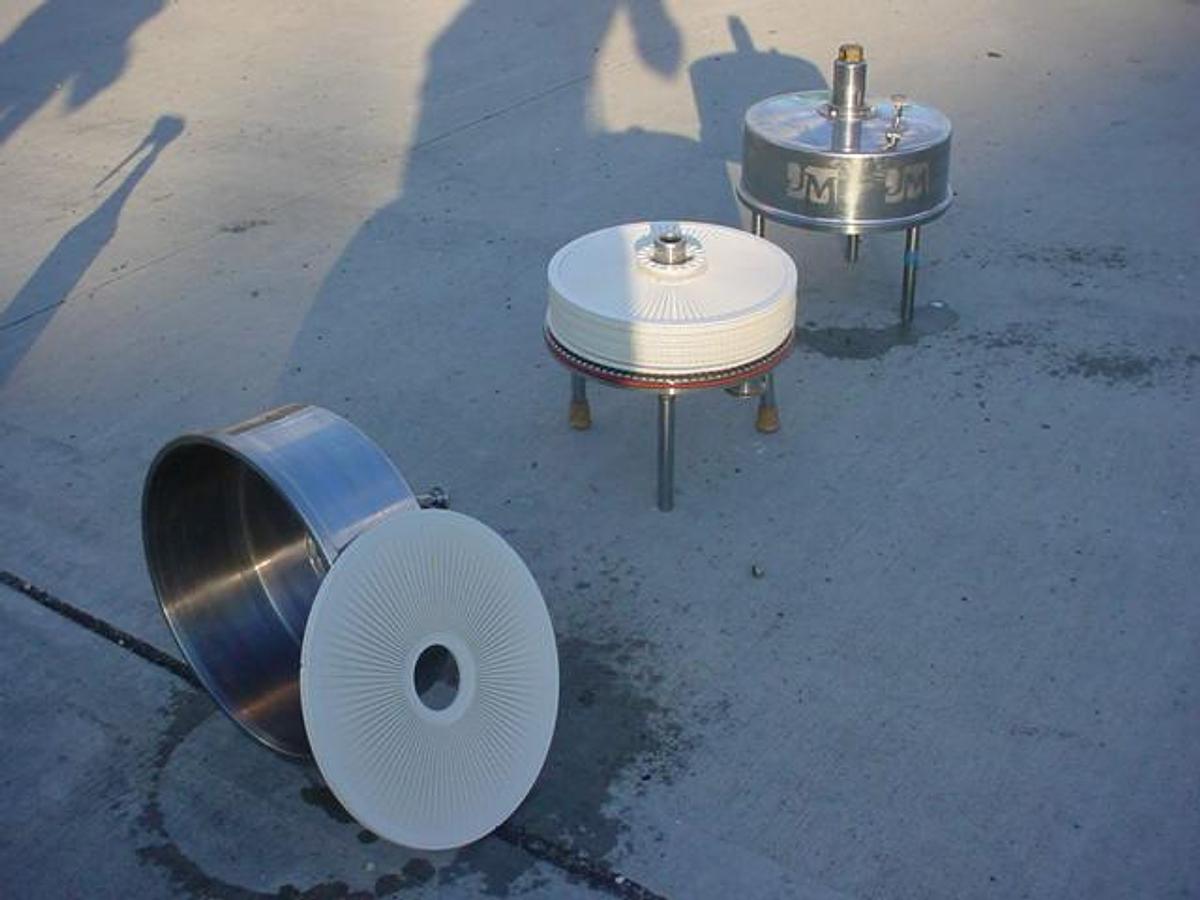
Category
Manufacturer
Model
Johns-Manville
Johns-Manville is a manufacturer of insulation and roofing materials, serving the construction industry. They are known for their innovative solutions in thermal insulation, particularly their fiberglass and mineral wool products.
FAQ:
What is a membrane disc filter and how does it work?
A membrane disc filter is a flat, circular filtration medium used in pressure or vacuum filtration assemblies across a wide range of industrial and laboratory applications. The disc sits inside a filter housing, and fluid is forced through the membrane under pressure or drawn through by vacuum. The membrane itself contains a precise network of pores that physically block particles, microorganisms, or contaminants above a certain size while allowing the filtered fluid to pass through. Because the filtration mechanism is purely physical rather than chemical, membrane disc filters can be used across a broad range of chemically aggressive or sensitive process streams.
These filters are classified by three primary specifications: disc diameter, membrane material, and pore size (expressed in microns). The combination of these three factors determines compatibility with a given filter housing and suitability for a particular application. Common membrane materials include cellulose acetate, nylon, PTFE, polyvinylidene fluoride (PVDF), and polycarbonate, each offering different chemical resistance and flow characteristics. Membrane disc filters are widely used in pharmaceutical manufacturing, chemical processing, water treatment, food and beverage production, and laboratory research settings where consistent, repeatable particle retention is essential.
What industries and applications are Johns-Manville membrane disc filters designed for?
Johns-Manville membrane disc filters were designed for use across several demanding industrial and laboratory environments where precise particle retention is critical. Historically, these filters found application in pharmaceutical and biotech manufacturing, where sterile filtration and consistent pore-size performance are regulatory requirements. Chemical processing operations also relied on membrane disc filters for clarification, sterilization, and the removal of fine particulates from process streams. Water treatment facilities used them for microfiltration steps, and laboratory settings employed them for sample preparation, analytical filtration, and quality control testing.
Buyers sourcing used Johns-Manville membrane disc filters today are often doing so to maintain or extend the service life of legacy filtration systems that were originally specified with this brand. In those cases, the application requirements remain the same as when the equipment was first installed. It is worth verifying that any used filter unit being considered matches the original specifications for the process in question, including flow rate capacity, pressure rating, and chemical compatibility with the fluids being filtered. Consulting the original equipment documentation or a filtration specialist can help confirm whether a used unit is appropriate for a given application.
What sizes and micron ratings are typically available for membrane disc filters?
Membrane disc filters are manufactured in a range of standard disc diameters, commonly from 13mm on the small end for laboratory syringe filter applications up to 293mm or larger for high-throughput industrial housings. The most frequently encountered sizes in industrial and laboratory settings are 47mm, 90mm, 142mm, and 293mm, though proprietary housing designs from specific manufacturers sometimes call for non-standard diameters. Buyers must match the disc diameter precisely to their filter holder or housing, as even a small mismatch will compromise the seal and allow unfiltered fluid to bypass the membrane.
Pore size ratings for membrane disc filters typically range from about 0.1 microns for sterilizing-grade applications up to 10 microns or more for coarser prefiltration steps. The most common ratings encountered in pharmaceutical and laboratory work are 0.2 microns (used for bacterial removal) and 0.45 microns (used for general clarification and particle removal). For any used membrane disc filter unit, buyers should confirm the pore size rating from available documentation or equipment markings, since pore size directly determines what the filter will and will not retain in service.
Are Johns-Manville membrane disc filters still being manufactured, or are they considered legacy products?
Johns-Manville has undergone significant corporate changes over the decades, including restructuring related to asbestos litigation, which affected the continuity of various product lines. The brand today is primarily associated with insulation and roofing materials for the construction industry rather than filtration products. As a result, Johns-Manville branded membrane disc filters are generally considered legacy or discontinued products, and sourcing them through used equipment channels is often the most practical path for buyers who need them for existing systems.
Because genuine Johns-Manville branded filters may have limited availability, buyers maintaining older filtration equipment should also investigate cross-reference compatibility with current production equivalents from manufacturers such as Pall, MilliporeSigma (formerly Millipore), Sartorius, or Parker Hannifin. Many modern membrane disc filters from these suppliers are available in specifications that match or exceed the performance of older branded units. That said, for buyers who specifically need used Johns-Manville units, working with a reputable used equipment dealer who specializes in industrial filtration is the most reliable way to locate authentic units in known condition.
What should buyers check when evaluating used membrane disc filter equipment?
Buying used membrane disc filter equipment requires more due diligence than purchasing commodity consumables, because the condition of the housing, seals, and associated hardware directly affects filtration performance. Buyers should request documentation on the unit's service history if available, including what fluids were processed and at what pressures. Physical inspection should cover the condition of the filter housing body, the integrity of gaskets and O-rings, the condition of any inlet and outlet connections, and whether the clamping or closure mechanism operates properly. Corrosion, chemical staining, or deformation of any wetted surfaces are red flags that warrant careful consideration.
Reputable used equipment dealers will typically accommodate in-person inspections or provide detailed video walkthroughs of the equipment so buyers can assess condition before committing to a purchase. Keep in mind that most used equipment dealers do not have the permitting or production infrastructure to perform live filtration tests with actual process fluids, so the inspection will focus on mechanical condition rather than functional performance testing. Buyers should ask specifically about the age of the unit, what replacement parts may be needed, and whether the manufacturer still supports the model with spare parts. Getting a clear picture of the full landed cost, including any refurbishment needed after purchase, helps avoid surprises.
Can membrane disc filters be cleaned and reused, or are they single-use items?
Whether a membrane disc filter can be cleaned and reused depends on the membrane material, the application, and the nature of the contaminants being removed. Some membrane types, particularly PTFE and certain nylon membranes, are physically durable enough to withstand cleaning protocols such as back-flushing, chemical sanitization, or autoclaving, and manufacturers sometimes publish validated cleaning procedures for their products. In laboratory settings, some disc filters are cleaned and reused for non-critical analytical work. However, repeated use introduces the risk of membrane integrity degradation, pore blockage that is not fully reversed by cleaning, or contamination carryover between batches.
In regulated industries such as pharmaceutical manufacturing, membrane disc filters used for sterile filtration are almost always treated as single-use items. Regulatory guidance from bodies like the FDA and EMA generally requires validated filter integrity testing before and after each filtration run, and reuse of sterilizing-grade membranes is difficult to validate to the required standard. For industrial or non-regulated applications, reuse may be practical and economical, but buyers should assess the cost of integrity testing and cleaning against the cost of replacement before committing to a reuse protocol. When sourcing used filter housings and assemblies, the reusability question applies to the hardware rather than the membrane itself, since the membrane element is typically replaced as a consumable.
What flow rates and pressure ratings do membrane disc filters typically support?
Flow rate capacity for membrane disc filters scales primarily with disc diameter and pore size. Larger diameter discs offer more active filtration area, which translates directly to higher throughput at a given pressure differential. As a rough reference, a 47mm disc filter is suitable for laboratory-scale flows measured in milliliters per minute, while a 293mm disc can handle industrial flows measured in liters per minute. Pore size also affects flow rate because smaller pores create more resistance; a 0.2-micron membrane will have lower throughput than a 1-micron membrane of the same diameter under identical pressure conditions.
Pressure ratings vary by housing design and membrane material rather than being a fixed property of the disc itself. Most laboratory filter holders are rated for relatively modest pressures, often in the range of 50 to 100 psi, while industrial housings can be rated considerably higher. PTFE membranes and stainless steel housings tend to support the highest operating pressures and temperatures. Buyers evaluating used membrane disc filter assemblies should confirm the pressure rating of the housing from its documentation or nameplate, and verify that the rating is appropriate for their intended process conditions. Operating a filter housing beyond its rated pressure is a safety risk and can compromise filtration integrity.
How do buyers confirm that a replacement membrane disc filter is compatible with their existing filter housing?
Compatibility between a membrane disc filter and an existing housing comes down to three factors: disc diameter, membrane thickness, and the gasket or seal configuration. Disc diameter must match the housing's filter support surface precisely. A disc that is even a few millimeters undersized will not seal properly against the housing gasket, allowing fluid to bypass the membrane entirely. Buyers should measure the existing filter support screen or consult the housing manufacturer's documentation to confirm the required disc diameter before sourcing replacement filters.
Membrane thickness and edge configuration also matter, particularly in housings that use a specific gasket design or edge seal to hold the disc in place. Some housings are designed for membranes with a specific thickness tolerance, and using an out-of-spec membrane can result in leakage or difficulty closing the housing. For legacy equipment like older Johns-Manville systems, buyers may find that cross-referencing the original specification with current-production equivalents from Pall, Sartorius, or MilliporeSigma yields a compatible replacement. Contacting the housing manufacturer or a filtration specialist with the original model number is the most reliable way to confirm compatibility before purchasing used or replacement filter media.
What should buyers understand about shipping and logistics for used membrane disc filter equipment?
Used membrane disc filter equipment varies considerably in size and fragility, from compact laboratory filter holders that can ship in a small parcel to large industrial housings that require freight shipping and specialized rigging. For any used filtration unit, buyers should ask the seller for specifics on how the equipment will be packaged, since improper packaging is one of the most common causes of damage in transit. Smaller units may be palletized, while larger assemblies may require custom crating to protect connections, valves, and pressure vessels during handling. The level of packaging required will affect shipping costs, and buyers should request a detailed quote that accounts for all packaging, freight, and any rigging needed for loading and unloading at the destination.
Larger industrial filter housings may require a forklift or crane for unloading, which is an additional cost that buyers need to plan for before the shipment arrives. It is worth confirming with the seller whether the equipment is currently installed and in production at a facility, decommissioned and in storage, or already at the dealer's warehouse, since each situation affects logistics differently. Getting a clear picture of the full landed cost, including freight, rigging, and any site preparation needed to receive the equipment, helps buyers make an accurate cost comparison and avoid unexpected expenses after the purchase is committed.
What payment terms do used industrial equipment dealers typically require for membrane disc filter purchases?
Most used industrial equipment dealers require payment in full before a piece of equipment is released for shipping. This is standard practice in the used machinery industry and reflects the fact that dealers typically do not hold inventory on consignment or extend credit to first-time buyers. Accepted payment methods vary by dealer but commonly include wire transfer, ACH, and in some cases credit card for smaller purchases. Buyers should confirm accepted payment methods and any associated fees before finalizing a purchase, since wire transfer fees and currency conversion costs can add up on international transactions.
Some dealers may offer payment terms to established repeat customers with whom they have an existing business relationship, but this is not the norm for first-time transactions. Buyers who are unfamiliar with a particular dealer should take the time to verify the dealer's track record and reputation in the industry before sending payment. Checking how long the dealer has been in business, whether they specialize in filtration or industrial processing equipment, and whether they can provide references from past customers are all reasonable steps to take. A dealer with a long history of selling filtration equipment is better positioned to accurately represent the condition and specifications of a used membrane disc filter unit than a general surplus dealer with limited technical knowledge of the product.