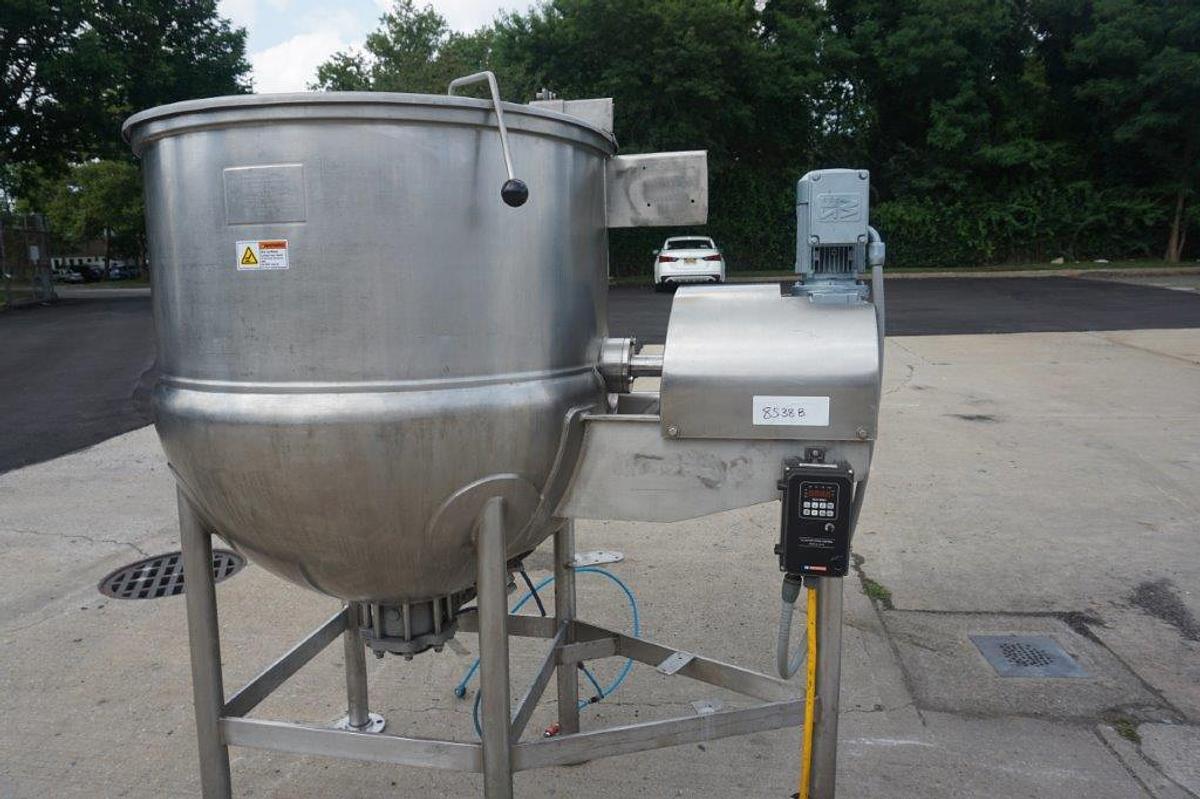
Category
Manufacturer
Model
FAQ:
What is a jacketed kettle and how does it work?
A jacketed kettle is a double-walled vessel where the space between the inner and outer walls forms a jacket. Steam, hot water, or a cooling medium circulates through this jacket to heat or cool the contents of the kettle indirectly. Because the heat transfer happens through the vessel walls rather than direct flame or immersion heating, the process is far more controlled and uniform. This makes jacketed kettles especially well-suited for temperature-sensitive products where scorching, hot spots, or uneven cooking would compromise quality.
The indirect heating method also makes it straightforward to switch between heating and cooling cycles simply by changing the medium flowing through the jacket. In food processing, this is particularly valuable for products like sauces, jams, dairy items, and confections that require precise temperature management at different stages of production. Industrial and pharmaceutical applications follow the same basic principle, using the jacketed design to maintain tight process control throughout a batch.
What sizes do J.C. Pardo And Sons jacketed kettles typically come in?
J.C. Pardo And Sons jacketed kettles are manufactured across a wide range of capacities to accommodate different production scales. Smaller units suited for pilot batches or specialty production can start at just a few gallons, while larger commercial and industrial models can reach several hundred gallons. A commonly encountered size on the used equipment market is the 150-gallon configuration, which represents a practical mid-range capacity for many food processing and industrial operations.
Capacity selection depends heavily on batch size requirements, available floor space, and the viscosity of the product being processed. A 150-gallon kettle, for example, offers enough volume for meaningful commercial production runs while still being manageable in terms of installation footprint and utility connections. Buyers sourcing used J.C. Pardo kettles should confirm the exact working capacity versus total vessel volume, as these figures can differ depending on agitator configuration and fill level restrictions.
What materials are used in the construction of J.C. Pardo And Sons jacketed kettles?
J.C. Pardo And Sons jacketed kettles are typically fabricated from stainless steel, with Type 304 and Type 316 being the most common grades used. Type 316 stainless steel is particularly favored for food, pharmaceutical, and chemical applications because of its enhanced corrosion resistance, especially against chlorides and acidic compounds. The 150-gallon unit commonly found on the used equipment market is constructed from Type 316 stainless steel, which reflects the manufacturer's focus on sanitary and chemically demanding environments.
Beyond the grade of stainless steel, the quality of welds, interior surface finish, and the integrity of the jacket itself are all critical factors when evaluating a used kettle. Sanitary applications typically require a smooth interior finish to prevent product buildup and allow for thorough cleaning. Buyers inspecting a used J.C. Pardo kettle should pay close attention to weld seams, any signs of pitting or corrosion on the interior walls, and the condition of fittings and ports, as these details directly affect both food safety compliance and long-term serviceability.
What agitation or mixing options are available on J.C. Pardo And Sons jacketed kettles?
J.C. Pardo And Sons jacketed kettles can be equipped with various agitation systems depending on the intended application. Common configurations include sweep agitators, anchor agitators, and horizontal scraper systems. The scraper agitator design is particularly useful for viscous products or anything prone to sticking or burning on the kettle walls, as the scraper blades maintain continuous contact with the heated surface and prevent product buildup. The 150-gallon model available on the used market features horizontal scraper agitation, making it well-suited for thick sauces, confections, or similar high-viscosity products.
The choice of agitation system has a direct impact on heat transfer efficiency and product consistency. A scraper agitator constantly moves product away from the hot jacket wall and into the center of the batch, which results in more uniform heating and reduces the risk of scorching. Buyers evaluating used kettles should assess the condition of agitator blades or scraper elements, the drive motor, and any gearbox components, as these parts experience significant wear over time and may require servicing or replacement depending on the machine's history.
What industries use J.C. Pardo And Sons jacketed kettles?
J.C. Pardo And Sons jacketed kettles are used across a broad range of industries where controlled heating, cooking, or processing of batched materials is required. The food and beverage industry represents the largest user base, with applications spanning sauce production, soup manufacturing, jam and jelly cooking, confectionery, dairy processing, and prepared meal production. The pharmaceutical and nutraceutical industries also rely on jacketed kettles for mixing and heating active ingredients and formulations where contamination control and precise temperature management are essential.
Chemical and personal care product manufacturers use jacketed kettles for similar reasons, particularly when processing materials that are heat-sensitive or reactive. The stainless steel construction and indirect heating design make these kettles adaptable across all of these sectors. For buyers sourcing used equipment, understanding the prior industry application of a specific kettle can be helpful context, though a thorough inspection and appropriate cleaning validation will be necessary before introducing the vessel into a regulated production environment regardless of its previous use.
Are J.C. Pardo And Sons jacketed kettles suitable for both heating and cooling applications?
Yes, jacketed kettles from J.C. Pardo And Sons can be used for both heating and cooling processes. The jacket surrounding the inner vessel is designed to circulate a temperature-controlled medium, which can be steam or hot water for heating, or chilled water and glycol solutions for cooling. This dual-function capability is one of the primary advantages of the jacketed kettle design, allowing a single piece of equipment to handle multiple stages of a production process without transferring product to a separate vessel.
In practice, many food processing operations use this feature to cook a product to a target temperature and then rapidly cool it before packaging, all within the same kettle. The efficiency gain from avoiding product transfers reduces contamination risk and speeds up cycle times. When evaluating a used jacketed kettle, buyers should confirm that the jacket connections, valves, and any associated fittings are rated for the pressure and temperature ranges required by their specific heating and cooling application, and that there are no signs of jacket leaks or compromised welds from prior use.
What should buyers know about inspecting a used J.C. Pardo And Sons jacketed kettle before purchasing?
Buying a used jacketed kettle requires a more thorough evaluation than purchasing standard fabricated tanks or simpler vessels, because the jacketed design introduces additional points of potential failure. The jacket itself can develop leaks at welds or fittings over time, which may not be visible from the exterior. Inspectors should look for any signs of staining, mineral deposits, or corrosion around jacket ports, as these can indicate past leaks or improper maintenance. The interior surface condition is equally important, particularly for sanitary applications, where pitting or deep scratches can harbor bacteria and complicate cleaning validation.
Reputable used equipment dealers will typically accommodate in-person inspections, virtual walkthroughs, or detailed video captures of the machine to give buyers an accurate picture of its current condition. Some kettles may still be installed at an active production facility, in which case the dealer can often coordinate a viewing at the plant. Keep in mind that most used equipment dealers do not have the production permits or facilities to run actual product through the machine during an inspection, so functional testing is generally limited to confirming mechanical operation of the agitator drive, motor, and associated components. Buyers should also consult with J.C. Pardo And Sons directly to understand parts availability and support for the specific model and age of the unit they are considering.
What is the typical operating pressure for the jacket on a J.C. Pardo And Sons jacketed kettle?
The jacket pressure rating on a J.C. Pardo And Sons jacketed kettle varies depending on the model, vessel size, and the intended heating medium. Steam-heated jacketed kettles commonly operate at jacket pressures in the range of 15 to 100 PSI, with many food processing models designed for steam pressures around 15 to 50 PSI. Higher pressure ratings allow for the use of higher-temperature steam, which increases heat transfer rates and reduces cook times, but also places greater demands on the jacket construction and associated safety equipment.
For used kettles, the rated jacket pressure should be documented on the vessel's data plate or in any available documentation that accompanies the equipment. Buyers should verify that the jacket pressure rating aligns with their facility's steam supply specifications and that all pressure relief devices are present and in serviceable condition. If documentation is missing or incomplete, a pressure vessel inspection by a qualified engineer is advisable before putting the kettle into service, as operating a vessel beyond its rated pressure is a serious safety risk.
What are the shipping and logistics considerations when buying a used jacketed kettle?
Jacketed kettles are heavy, often irregularly shaped pieces of equipment that require careful handling during transport. Smaller units in the 50 to 150-gallon range can typically be moved with standard pallet jacks and secured on heavy-duty pallets with appropriate blocking and bracing, but larger kettles may require custom crating to protect fittings, agitator components, and the vessel itself from transit damage. The cost of packaging will vary based on the size and configuration of the kettle and the level of protection required for the specific shipping method being used.
For larger or heavier kettles, professional rigging services are often necessary for both loading at the seller's location and unloading at the buyer's facility. Rigging adds to the total landed cost of the equipment and should be factored into budget planning from the start. Buyers should ask the dealer for a detailed breakdown of packaging, rigging, and freight costs before committing to a purchase so there are no surprises. Freight carriers experienced in industrial equipment are generally preferable to standard LTL carriers for this type of machinery, as they are better equipped to handle the weight and dimensions involved.
What payment terms should buyers expect when purchasing a used J.C. Pardo And Sons jacketed kettle from a dealer?
Used equipment dealers selling industrial machinery like jacketed kettles typically require full payment before the equipment is released for shipping. This is standard practice across the used machinery industry and reflects the logistical realities of moving large equipment across the country or internationally. Unlike retail transactions, used industrial equipment sales involve significant freight coordination, and dealers generally do not begin that process until funds have cleared. Payment is most commonly accepted via wire transfer, though some dealers may accept other forms of business payment depending on the transaction size.
Repeat customers with an established relationship with a dealer may occasionally be offered extended payment arrangements, but first-time buyers should plan for full payment upfront. Before sending any funds, buyers are strongly encouraged to complete their inspection process, confirm all equipment details, and clarify the full scope of what is included in the sale, such as any ancillary components, documentation, or spare parts. Understanding the total cost including equipment price, packaging, rigging, and freight before finalizing payment helps avoid unexpected expenses after the purchase is committed.