Category
Manufacturer
Model
Intelligent Packaging
Intelligent Packaging offers advanced packaging solutions that incorporate technology to enhance product safety and tracking. Their systems are widely used in the food and pharmaceutical industries.
FAQ:
What is an intelligent packaging machine and how does it differ from a standard packaging machine?
An intelligent packaging machine incorporates technologies like machine vision, IoT sensors, AI-driven controls, and real-time data processing directly into the packaging process. Where a conventional machine simply performs a mechanical task, an intelligent machine monitors its own performance, detects errors, adjusts parameters on the fly, and generates production data that operators and plant managers can act on. Common capabilities include automatic defect detection, label verification, fill-level checking, seal integrity inspection, and predictive maintenance alerts, all running at full production speeds without slowing the line.
The practical difference for a manufacturer is significant. A standard machine requires human inspection at various checkpoints to catch problems like underfills, misaligned labels, or compromised seals. An intelligent machine flags or rejects those issues automatically, reducing waste, lowering the risk of costly recalls, and providing the traceability data that regulated industries like food and pharmaceuticals increasingly require. These systems are also designed to communicate with broader plant software, including MES and ERP platforms, so production data flows into the systems managers already use rather than living in isolation on the machine floor.
What types of products are intelligent packaging machines designed to handle?
Intelligent packaging machines are used across a wide range of industries and product types, though they are most heavily concentrated in food and pharmaceutical manufacturing. In food applications, they handle snacks, frozen products, fresh produce, powders, granules, liquids, and confectionery. Pharmaceutical applications include tablets, capsules, sachets, and liquid medications where dosing accuracy and tamper evidence are critical. The machines are also found in personal care, nutraceuticals, pet food, and industrial goods where traceability or precise fill weights matter.
The specific product a machine can handle depends on its configuration. A vertical form, fill, and seal machine with a volumetric head, for example, is well suited to free-flowing products like granules, seeds, coffee, or snack mixes that can be measured by volume. Other configurations use weigh-scale heads for products requiring precise weight-based portioning, or specialized filling systems for liquids and semi-liquids. Buyers should match the machine's filling mechanism, bag style capability, and speed rating to their specific product characteristics and packaging format requirements before purchasing.
How much do used intelligent packaging machines typically cost?
Pricing for used intelligent packaging machines varies considerably depending on the machine type, age, brand, condition, and level of automation. Entry-level semi-automatic models can be found in the $15,000 to $50,000 range, while mid-range fully automatic systems commonly fall between $50,000 and $200,000. High-throughput, fully integrated lines with advanced vision systems and multi-head weighers can exceed $500,000 even on the used market, though buyers are typically getting significantly more capability per dollar compared to purchasing the equivalent machine at manufacturer pricing.
Beyond the machine price itself, buyers should account for the full landed cost of the equipment. Rigging, crating, freight, installation, and any refurbishment or parts needed to bring the machine to operating condition are all real costs that should be factored into the budget before committing to a purchase. Requesting a detailed quote from the dealer that breaks out shipping, packaging, and any known service needs gives a much clearer picture of total acquisition cost than the list price alone.
What should buyers inspect before purchasing a used intelligent packaging machine?
Because used packaging machines are sold as-is, the inspection process is one of the most important steps in a purchase decision. Buyers should request a thorough inspection of the machine's mechanical components, including the sealing jaws, drive systems, film path, and any conveyor or transfer mechanisms. For intelligent machines specifically, the condition of sensors, cameras, control boards, and the HMI (human-machine interface) touchscreen deserves close attention, since electronic components can be expensive to replace and may be difficult to source for older models.
Reputable dealers typically offer in-person inspections, video walkthroughs, or recorded video captures of the machine so buyers can evaluate its current state before committing. Some machines may still be installed in an active production facility, where an in-person inspection can be arranged between the dealer and the facility owner. Keep in mind that most dealers are not set up to run full production tests with actual product, as that requires different permitting and operational infrastructure. Buyers should also contact the machine manufacturer directly to understand what technical support, software updates, and spare parts are still available for the specific model and production year they are considering, since age can meaningfully affect long-term supportability.
Can a used intelligent packaging machine integrate with an existing production line or ERP system?
Integration capability is one of the more nuanced aspects of buying a used intelligent packaging machine. Many machines from established manufacturers were built with standard communication protocols such as OPC-UA, Ethernet/IP, or Modbus, which allows them to connect with plant-level systems including MES platforms and ERP software like SAP or Oracle. Whether a specific used machine supports these integrations depends heavily on its control system architecture, firmware version, and the era in which it was built. Machines from the last ten to fifteen years are generally more likely to have modern connectivity options than older equipment.
Buyers planning to integrate a used machine into a connected production environment should document their existing system requirements before shopping and verify compatibility with the dealer before purchase. In some cases, third-party integration hardware or software middleware can bridge gaps between an older machine's control system and a modern plant network. It is worth consulting with a controls engineer or the machine manufacturer's technical team early in the process to understand what integration is feasible and what it will cost, rather than discovering limitations after the machine has been shipped and installed.
What is a vertical form, fill, and seal machine and what is it used for?
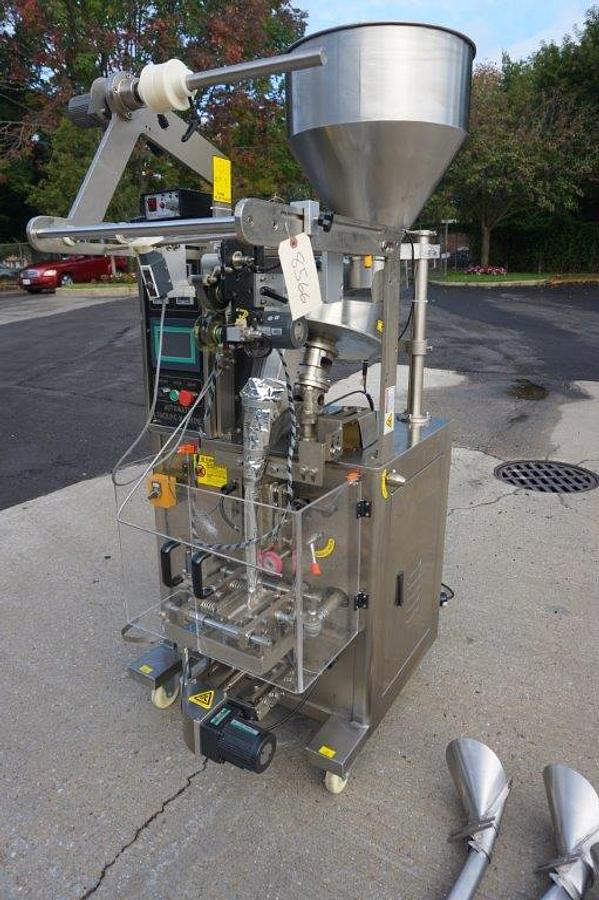
A vertical form, fill, and seal machine, commonly abbreviated as VFFS, is a type of packaging equipment that takes flat film from a roll and forms it into a bag, fills the bag with product, and seals it closed, all in a continuous vertical operation. The process happens in a single machine pass: the film is shaped around a forming tube, a bottom seal is made, product is dispensed into the open bag from above, and then a top seal closes the package. The result is a finished, filled bag ready for distribution or secondary packaging.
VFFS machines are among the most widely used packaging formats in food manufacturing because they are efficient, flexible, and compatible with a broad range of bag styles including pillow bags, gusseted bags, and quad-seal bags. When paired with a volumetric head, the machine measures product by volume, making it a practical choice for free-flowing items like coffee, grains, seeds, frozen vegetables, and snack foods. Intelligent VFFS machines add layers of process control on top of the basic forming and sealing operation, such as automatic film tension adjustment, seal temperature monitoring, and rejection of packages that fall outside specified parameters.
What does a volumetric head do on a packaging machine?
A volumetric head is a filling device that measures product by volume rather than by weight. It typically uses a cup or auger mechanism to dispense a consistent, pre-set volume of product into each package. The operator sets the desired fill volume, and the head cycles through that measurement repeatedly as the machine runs. Volumetric heads are a cost-effective filling solution for products where volume is an acceptable proxy for the desired fill quantity, and where product density is consistent enough that volume and weight track closely together.
Common applications include dry granular products like rice, beans, coffee, candy, and pet food, as well as some powders and flakes. The main advantage of a volumetric head is mechanical simplicity and speed. The trade-off compared to a weigh-scale system is that volumetric filling is less precise when product density varies, which can lead to fill weight inconsistencies across a production run. Buyers sourcing a used VFFS machine with a volumetric head should verify that the head is in good working condition and that the cup sizes or auger configuration match their intended product and fill quantity.
What level of technical expertise is needed to operate an intelligent packaging machine?
Day-to-day operation of an intelligent packaging machine is generally manageable for operators with basic mechanical aptitude and some familiarity with industrial equipment. Most machines from established manufacturers use a touchscreen HMI that guides operators through product changeovers, parameter adjustments, and routine maintenance prompts. Operators typically need to understand how to load film rolls, clear jams, adjust seal temperatures, and interpret the machine's status indicators and alarm codes. Formal machine-specific training, which manufacturers or experienced dealers can often facilitate, shortens the learning curve considerably.
Higher-level tasks like configuring new product recipes, troubleshooting sensor or vision system faults, performing software updates, or integrating the machine with plant networks require more specialized skills, usually from a maintenance technician or controls engineer. For used machines specifically, having access to the machine's original documentation, including the operator manual, electrical schematics, and parts list, is important for ongoing maintenance. Buyers should ask the dealer whether these documents are included with the machine, and should also verify with the manufacturer whether technical support is still available for the model they are purchasing, since support availability can vary based on the machine's age.
Do intelligent packaging machines support real-time monitoring and remote diagnostics?
Many intelligent packaging machines built in the past decade include built-in capabilities for real-time production monitoring, data logging, and in some cases remote access for diagnostics. These features typically allow plant managers to view live production metrics like output rate, reject counts, downtime events, and seal quality data through an onboard dashboard or a connected plant network. Some systems can generate reports automatically or push alerts to supervisors when a parameter drifts out of spec, which supports faster response to problems before they affect a significant volume of product.
Remote diagnostics capabilities, where a technician can connect to the machine over a network to review fault logs or adjust parameters, are more common on higher-end models and are more likely to be present on machines built within the last several years. On the used market, the availability of these features depends entirely on the specific model and its control system. Buyers who consider remote monitoring important should confirm with the dealer whether the machine's control architecture supports it, and whether any required software licenses or network hardware are included. It is also worth checking with the manufacturer on whether remote support services are still offered for the model in question.
What compliance standards and certifications are relevant for intelligent packaging machines used in food or pharmaceutical applications?
Packaging machines used in food and pharmaceutical manufacturing are subject to a range of regulatory and safety standards that vary by market and application. In the United States, food contact equipment is expected to meet FDA guidelines for materials and sanitary design, and machines used in pharmaceutical packaging may need to comply with cGMP (current Good Manufacturing Practice) requirements. In Europe and many export markets, the CE marking indicates that a machine meets applicable EU machinery safety directives. ISO standards, particularly ISO 9001 for quality management systems, are also commonly referenced in supplier qualification processes.
For used machines, buyers should verify what certifications the machine held at the time of manufacture and assess whether the machine's current condition still meets those standards. Modifications, repairs, or component replacements made after the machine left the manufacturer can affect its compliance status. Buyers in regulated industries are advised to have their quality and compliance teams review the machine's documentation, including any declarations of conformity, before purchase. Consulting with the machine manufacturer about the certification history of a specific model and serial number is a practical step that can save significant time during internal qualification processes.