Category
Manufacturer
Model
Highlight Industries
Highlight Industries focuses on manufacturing equipment for the packaging and labeling sectors. They are known for their innovative solutions that improve production line efficiency and product presentation.
FAQ:
What types of packaging equipment does Highlight Industries manufacture?
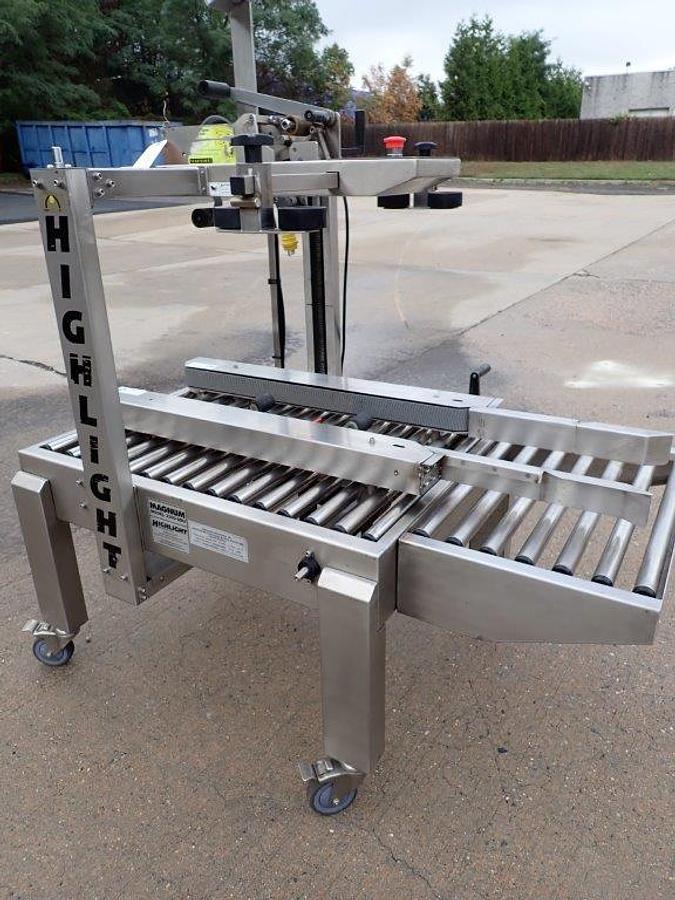
Highlight Industries is a US-based manufacturer headquartered in Grand Rapids, Michigan, and their product line centers primarily on stretch wrapping systems and packaging automation equipment. Their catalog includes turntable stretch wrappers, rotary arm stretch wrappers, orbital wrappers, conveyorized stretch wrapping systems, and hand-held stretch wrap dispensers. They also produce case tapers and other packaging line equipment, such as the Magnum 2300-SDU stainless steel top and bottom case taper, which is designed for demanding production environments. The company is recognized for building heavy-duty steel machines suited to high-volume industrial applications.
Highlight Industries offers both semi-automatic and fully automatic configurations across much of their product range, which gives buyers the ability to match a machine to their actual production volume and staffing setup rather than over-buying or under-buying capacity. Their equipment is particularly well regarded in industries like food and beverage, building materials, automotive parts, printing, and general manufacturing, where consistent, high-throughput packaging is a daily requirement. Because of this broad applicability, used Highlight Industries machines appear regularly on the secondary market and tend to hold their value reasonably well compared to lesser-known brands.
What should buyers know about purchasing used Highlight Industries equipment versus buying from the manufacturer?
Buying a used Highlight Industries machine through the secondary market is a common approach for operations that need proven, industrial-grade packaging equipment without the lead times or price points associated with ordering directly from a manufacturer. Used machines are sold as-is, meaning the buyer takes on the responsibility of evaluating the equipment's condition before committing to a purchase. This makes the inspection process critical. Reputable used equipment dealers who specialize in packaging machinery will typically offer in-person inspections, video walkthroughs, or photo documentation so buyers can assess the machine's current working condition before any money changes hands.
One practical step buyers often overlook is contacting Highlight Industries directly to ask about parts availability and technical support for the specific model they are considering. The age of a machine can affect whether replacement parts are still stocked and whether the manufacturer's service team is familiar with that model's configuration. A dealer with a long track record in packaging equipment is better positioned to give honest guidance on which models have strong parts ecosystems versus those that may present sourcing challenges down the road. Taking both steps, a thorough inspection and a manufacturer consultation, gives buyers a much clearer picture of the total cost of ownership before the purchase is finalized.
What industries are Highlight Industries packaging machines best suited for?
Highlight Industries equipment is built around the demands of high-volume industrial packaging, and the machines show up most frequently in food and beverage production, building materials distribution, automotive parts manufacturing, printing and paper, and general manufacturing. The heavy-duty steel construction that defines most of their product line is a deliberate design choice for environments where machines run multiple shifts and handle heavy or irregularly shaped loads. A turntable or rotary arm stretch wrapper from Highlight Industries, for example, is engineered to wrap pallets consistently at high cycle rates, which is exactly what a busy distribution center or production floor needs.
That said, the semi-automatic models in their lineup are also a reasonable fit for mid-sized operations that do not need a fully automated line but still want a durable, reliable machine that will hold up over years of daily use. Buyers in industries like agriculture, consumer goods, and hardware distribution have also adopted Highlight Industries equipment for similar reasons. The variety of machine types they produce, from orbital wrappers for long or oddly shaped products to conveyorized systems for continuous throughput, means that a single manufacturer's product family can often address several different packaging challenges within one facility.
How does a turntable stretch wrapper differ from a rotary arm stretch wrapper?
The core difference between these two machine types comes down to which component moves during the wrapping cycle. On a turntable stretch wrapper, the pallet load sits on a rotating platform that spins while the film carriage travels up and down a fixed mast. This design is cost-effective and mechanically straightforward, which is why turntable wrappers are the most common type found in packaging operations. They work well for stable, uniformly stacked loads that can tolerate the rotational force of the spinning platform without shifting or toppling.
A rotary arm stretch wrapper takes the opposite approach: the pallet stays stationary on the floor while a film carriage arm rotates around it. This configuration is the right choice for light, unstable, or very heavy loads that should not be spun. A tall stack of empty bottles, a load of loose bagged product, or an extremely heavy pallet are all cases where a rotary arm machine makes more practical sense than a turntable. Rotary arm wrappers are generally more expensive, both to purchase and to maintain, but they solve problems that turntable designs simply cannot. When evaluating used stretch wrapping equipment, understanding which type matches the actual load profile in a facility is one of the most important decisions a buyer can make before settling on a specific machine.
Are used Highlight Industries stretch wrappers compatible with standard stretch film rolls?
Most Highlight Industries stretch wrappers are designed to work with standard pre-stretch film rolls, which are widely available from packaging supply distributors. The machines use a film carriage system that accepts rolls within a defined core diameter and width range, and those specifications are typically published in the machine's documentation or can be confirmed with the dealer selling the equipment. Pre-stretch film carriages, which are a standard feature on most Highlight Industries models, mechanically elongate the film before it contacts the load, which reduces film consumption and lowers per-pallet material costs compared to machines without this feature.
When buying a used machine, it is worth confirming the film carriage type and the compatible roll specifications before assuming any standard film will work. Some older models may use a different carriage configuration than what a buyer's current film supplier stocks. This is a straightforward question to ask during the inspection process, and most experienced packaging equipment dealers can answer it or point buyers to the right documentation. Verifying film compatibility upfront prevents the frustration of receiving a machine that requires sourcing a different film product than what is already used elsewhere in a facility.
What does the inspection process look like when buying used packaging equipment?
Inspections for used packaging machinery generally fall into three categories: in-person visits, live or recorded video inspections, and photo documentation packages. In-person inspections are the most thorough option and are typically accommodated by dealers, sometimes at the dealer's facility and sometimes at the plant where the equipment is still in service or has recently been decommissioned. If a machine is still running in a production environment, a buyer may be able to observe it operating under real conditions, which is about as much information as anyone could ask for before a purchase.
It is important to understand that most used equipment dealers are not set up to run full production tests with actual product, since that level of operation requires different facility permitting and resources than a typical dealer maintains. The inspection is focused on confirming the machine's mechanical condition, checking for visible wear or damage, reviewing electrical components, and verifying that the machine matches the listed specifications. Buyers who cannot travel for an in-person visit should ask for a detailed video that covers the machine from multiple angles, shows all major mechanical assemblies, and ideally demonstrates the machine cycling through its basic functions. A dealer who is reluctant to provide this level of documentation is a red flag worth taking seriously.
What should buyers understand about shipping costs for used packaging machinery?
Shipping costs for used packaging equipment can vary significantly depending on the size and weight of the machine, the distance between the seller and the buyer, and the level of packaging or crating required to protect the equipment in transit. Smaller machines like hand-held stretch wrap dispensers or compact case tapers may ship on standard pallets with minimal preparation, while a large rotary arm stretch wrapper or a conveyorized system will require custom crating, heavy-duty rigging for loading, and specialized freight arrangements. Rigging costs for loading at the origin and unloading at the destination are often separate line items that buyers do not always anticipate when they first request a shipping quote.
The right approach is to ask the dealer for a fully itemized breakdown of all costs involved in getting the machine from its current location to the buyer's facility. This should include palletization or crating fees, rigging and loading costs, freight charges, and any fees associated with liftgate service or inside delivery at the destination. Understanding the total landed cost before agreeing to a purchase prevents surprises and allows for a more accurate comparison between machines listed at different price points by different sellers. A machine listed at a lower price but located across the country may end up costing more in total than a higher-priced machine closer to home.
What payment terms are typical when buying used packaging equipment from a dealer?
The standard practice among used equipment dealers is to require full payment before a machine is released for shipping. This applies to most transactions, particularly with buyers who have not previously purchased from a given dealer. The reasoning is straightforward: once a machine leaves the dealer's facility, the transaction is effectively complete, and collecting payment after the fact introduces risk that dealers are generally not willing to accept. Buyers should plan accordingly and have financing or funds arranged before finalizing a purchase agreement.
Some dealers extend payment terms to repeat customers or for larger transactions where an established business relationship already exists, but this is the exception rather than the rule. Buyers who need financing to acquire equipment should explore options through their own banking relationships or equipment financing companies before approaching a dealer, since most used equipment dealers do not function as lenders themselves. Confirming the accepted payment methods, whether wire transfer, check, or credit card, and understanding the exact timeline between payment and shipment are practical details worth clarifying with the dealer before signing anything.
How do semi-automatic and fully automatic stretch wrappers compare for packaging operations?
Semi-automatic stretch wrappers require an operator to attach the film to the load, initiate the wrap cycle, and cut and secure the film at the end. The machine handles the wrapping motion itself, but a person needs to be present at the start and finish of each cycle. This setup works well for operations that wrap a moderate number of pallets per shift and where labor is available to manage the process. Semi-automatic machines are generally less expensive to purchase and simpler to maintain, which makes them a practical choice for smaller facilities or for lines where wrapping is not the primary bottleneck.
Fully automatic stretch wrappers are designed to handle the entire wrapping cycle without operator intervention beyond loading the pallet onto the infeed conveyor. Film attachment, wrapping, cutting, and film tail wiping or tucking are all handled by the machine. This level of automation makes sense for high-volume distribution operations where pallets move through the system continuously and tying up a worker at the wrapper would reduce throughput elsewhere. The tradeoff is higher purchase cost, greater mechanical complexity, and more involved maintenance requirements. When evaluating used automatic wrappers, buyers should pay particular attention to the condition of the film clamping and cutting mechanisms, since these components see heavy use and are among the first to show wear on older machines.
What factors affect the price of used Highlight Industries packaging equipment?
Several variables drive the pricing of used Highlight Industries machines on the secondary market. Machine type is a major factor: a basic turntable stretch wrapper will typically be priced lower than a rotary arm or fully automatic conveyorized system simply because the latter involves more mechanical complexity and a higher replacement cost if purchased elsewhere. Age and hours of use matter as well, though a well-maintained older machine from a reputable manufacturer can still offer substantial value compared to a newer machine from a less established brand. The overall condition, including the state of electrical components, wear on the film carriage, and the integrity of the frame and mechanical assemblies, has a direct impact on price.
Market availability at any given time also plays a role. When a particular model is in high demand and few are available, prices tend to reflect that scarcity. Conversely, when a facility closes and multiple identical machines come to market simultaneously, buyers may find more favorable pricing. Optional features like remote diagnostics, load containment force feedback systems, or stainless steel construction for food-grade environments can push prices higher than a standard model of the same type. Buyers who have a clear understanding of their actual production requirements are better positioned to evaluate whether a higher-priced machine with additional features is worth the premium or whether a simpler configuration will do the job just as well.