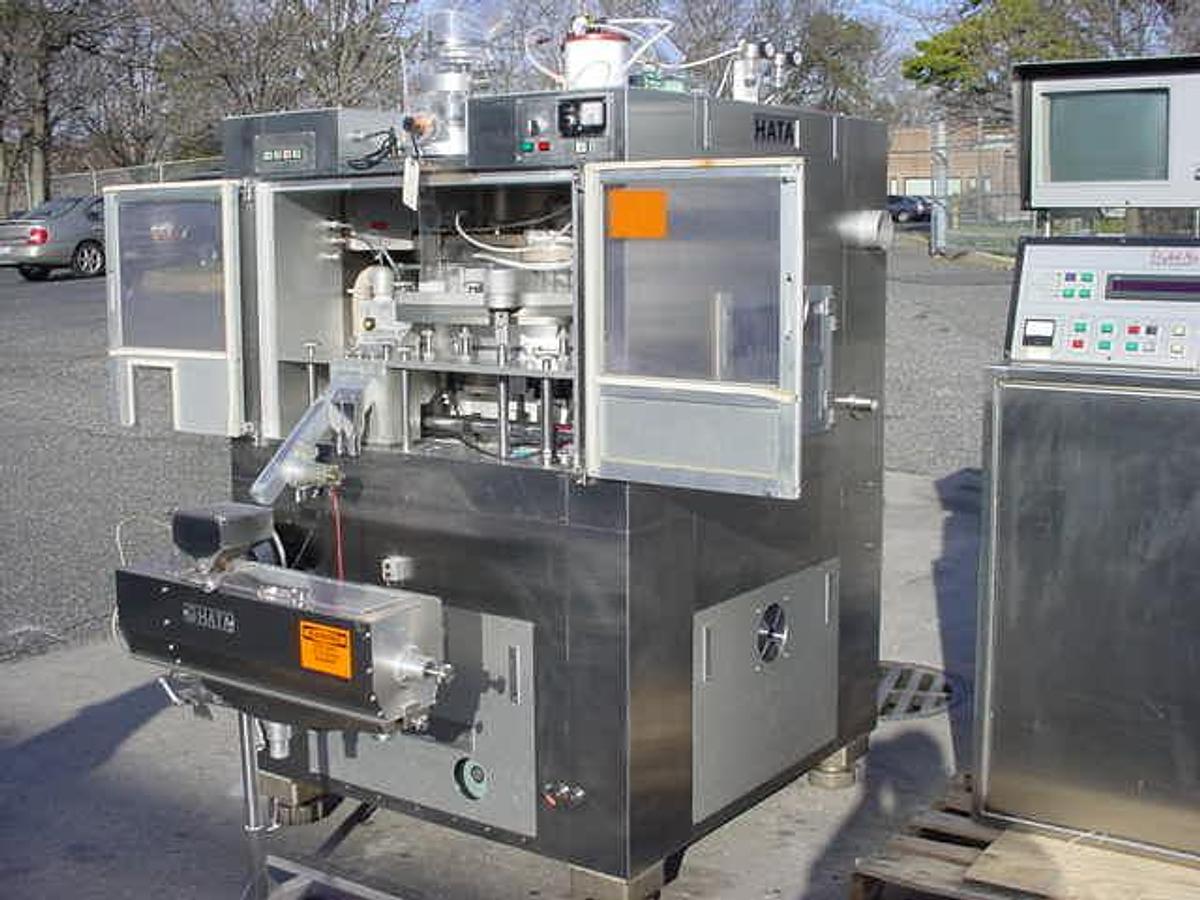
Category
Manufacturer
Model
FAQ:
What is a Hata tablet press and what industries use it?
Hata is a Japanese manufacturer with a long-standing reputation for producing rotary and single-punch tablet presses used across pharmaceutical, nutraceutical, dietary supplement, and food processing industries. The machines are built around precision engineering principles and are designed to meet international GMP (Good Manufacturing Practice) standards, which makes them a common choice in regulated production environments. Their presses are known for consistent tablet weight uniformity, low dust generation during compression, and minimal product waste, all of which matter considerably in pharmaceutical and nutraceutical applications where material costs and contamination control are serious concerns.
Hata presses are particularly well-regarded for their durability and the quality of their mechanical components. A used Hata press that has been properly maintained can continue to perform reliably for many years, which is one reason they retain strong resale value in the secondary market. Facilities ranging from small-scale R&D labs to high-volume commercial production lines have used Hata equipment, so the brand covers a fairly wide spectrum of production needs depending on the specific model.
What Hata tablet press models are commonly found on the used equipment market?
The Hata HT series rotary tablet presses appear most frequently in the used equipment market, with various configurations available to suit different production scales. One example is the Hata 55-station rotary tablet press, which is designed for higher-volume commercial production and typically includes a digital control panel for monitoring compression force, tablet weight, and other process parameters. The station count on a rotary press directly affects output capacity, so a 55-station machine is positioned toward the higher end of production throughput compared to smaller R&D or pilot-scale models.
Beyond the HT series, buyers occasionally find older Hata models with fewer stations that are better suited to small-batch production or formulation development work. When evaluating any used Hata press, it is worth confirming the tooling format the machine accepts, since Hata presses are generally compatible with standard TSM (Tablet Specification Manual) and EU tooling. This compatibility is practically important because it means replacement punches and dies are widely available from multiple tooling suppliers rather than being proprietary to a single source.
What production output can you expect from a Hata rotary tablet press?
Output capacity on a rotary tablet press depends on three main variables: the number of tooling stations, the rotational speed of the turret, and the tablet size being produced. A 55-station Hata rotary press running at moderate speed can produce tens of thousands of tablets per hour, with maximum theoretical output potentially reaching several hundred thousand tablets per hour at full speed depending on the specific model and configuration. In practice, actual production rates tend to be lower than theoretical maximums because operators balance speed against tablet quality parameters like hardness, friability, and weight variation.
For buyers evaluating a used Hata press, it is useful to understand that the machine's age and maintenance history can influence sustainable operating speeds. A well-maintained press may run close to its rated capacity, while one that has seen heavy use without regular servicing may require mechanical attention before achieving peak output. Inspecting the turret, compression rollers, and cam tracks during any pre-purchase evaluation gives a clearer picture of what the machine can realistically deliver in its current condition.
What tablet sizes and shapes can a Hata tablet press produce?
The range of tablet sizes and shapes a Hata press can produce is largely determined by the tooling installed in the machine rather than the press itself. Since Hata presses are compatible with standard TSM and EU tooling formats, they can accommodate a wide variety of punch and die sets that produce round, oval, capsule-shaped, oblong, and custom-embossed tablets. Tablet diameters typically range from a few millimeters for small pharmaceutical doses up to around 25mm or more for larger nutritional supplement tablets, depending on the tooling and the press's maximum punch size capacity.
Buyers should confirm the specific punch size range (B-tooling, D-tooling, or BB-tooling) that a particular used Hata model accepts, as this determines the maximum tablet diameter and the compression force available per station. The tooling compatibility information is usually available in the machine's technical specifications or can be verified by consulting the manufacturer's documentation for that model. Because TSM and EU tooling is manufactured by many independent suppliers globally, sourcing replacement or additional punch sets for a Hata press is generally straightforward.
Is a used Hata tablet press suitable for small-scale or laboratory use?
It depends heavily on the specific model. Hata has produced presses across a wide range of scales, from compact machines intended for R&D and pilot batches to large commercial rotary presses with 50 or more stations. A smaller Hata model with 10 to 20 stations would be a reasonable fit for a laboratory or small-batch production setting, offering enough output for formulation development and scale-up trials without the footprint or operational complexity of a full production machine. Larger models like a 55-station press are generally better suited to commercial production environments where throughput is a priority.
For buyers with limited floor space or lower volume requirements, it is worth carefully reviewing the physical dimensions and electrical requirements of any used Hata press before purchasing. Larger rotary presses require three-phase power, substantial floor space, and sometimes dedicated HVAC or dust collection systems to operate properly. A reputable used equipment dealer should be able to provide detailed specifications and, in many cases, arrange a video or in-person inspection so buyers can assess whether the machine fits their facility and production needs before committing to a purchase.
What should you inspect when buying a used Hata tablet press?
A thorough inspection of a used Hata tablet press should focus on the mechanical components that experience the most wear during normal operation. The turret, compression rollers, cam tracks, and punch guides are the areas most likely to show signs of wear or damage. Visible scoring, pitting, or uneven wear on the turret bores or cam tracks can indicate that the machine has had heavy use or that maintenance was deferred. The condition of the feeder system, including the feed frame and any forced feeder components, is also worth examining closely since these parts directly affect tablet weight consistency.
Beyond mechanical condition, buyers should verify that the control panel and any electronic systems are functional. Modern Hata presses with digital control panels allow operators to monitor and adjust compression force and other parameters in real time, so confirming that these systems respond correctly is important. Reputable used equipment dealers typically accommodate in-person inspections at their facility or at the plant where the equipment is currently located. Video inspections are also commonly available for buyers who cannot travel, and some dealers can provide video footage of the machine running under power, which gives a reasonable indication of its current operating condition even if actual product cannot be run due to facility permitting limitations.
Are replacement parts and tooling readily available for used Hata tablet presses?
Tooling availability for Hata presses is generally not a concern because the machines accept standard TSM and EU format punches and dies, which are manufactured and stocked by numerous independent tooling suppliers worldwide. This means buyers are not dependent on a single source for replacement punch sets, and competitive pricing is available from multiple vendors. Custom tooling for specialized tablet shapes or embossing is also widely available from these suppliers since the tooling format is an industry standard rather than proprietary to Hata.
For mechanical spare parts specific to the Hata press itself, availability can vary depending on the model's age. Buyers considering a used Hata press should contact the manufacturer or an authorized service representative to understand what parts are currently stocked or can be manufactured for the specific model they are evaluating. Older or discontinued models may have limited factory support, which makes it worthwhile to assess the machine's overall condition carefully before purchasing. A machine in good mechanical condition with minimal wear on critical components reduces the short-term risk of needing hard-to-source parts.
What does a digital control panel on a Hata rotary tablet press do?
A digital control panel on a rotary tablet press serves as the operator interface for monitoring and adjusting the machine's key process parameters during production. On a Hata press equipped with digital controls, operators can typically monitor compression force in real time, set upper and lower rejection limits for out-of-spec tablets, control turret speed, and track production counts. Some configurations also include automatic weight control systems that make minor adjustments to the fill depth to maintain consistent tablet weight without requiring constant manual intervention. These features reduce the likelihood of producing off-spec batches and are particularly valuable in pharmaceutical manufacturing where documentation and process consistency are regulatory requirements.
For buyers evaluating a used Hata press with a digital control panel, it is worth verifying that the control system is fully functional and that any associated software or firmware is intact. Control system components, including touchscreens and programmable logic controllers, can be expensive to repair or replace if they have been damaged or have degraded over time. During an inspection, asking the dealer to power up the machine and demonstrate the control panel's basic functions is a reasonable request that most reputable dealers will accommodate.
What are typical payment and shipping considerations when buying a used Hata tablet press?
Most used equipment dealers require payment in full before a machine is released for shipping. Some dealers extend payment terms to established repeat customers, but buyers purchasing from a dealer for the first time should generally plan for full prepayment. It is worth clarifying accepted payment methods early in the process, as wire transfers are the most common arrangement for equipment transactions of this size.
Shipping a tablet press involves more logistical complexity than shipping smaller equipment. Rotary tablet presses are heavy, precision machines that require careful palletization or crating to prevent damage to the turret, compression rollers, and control panel during transit. Larger machines may need professional rigging for loading and unloading, which adds to the total landed cost. Buyers should ask the dealer for a detailed breakdown of packaging, rigging, and freight charges before finalizing a purchase so there are no surprises in the total cost. International shipments add customs clearance and import duty considerations that should also be factored into the budget.
How does buying a used Hata tablet press compare to buying a new one?
The most obvious difference is cost. A used Hata rotary tablet press can be acquired at a significantly lower price than a comparable machine purchased through a manufacturer's sales channel, which makes used equipment an attractive option for facilities that need production capability without the capital outlay of buying new. For organizations running GMP-compliant operations, a used press that has been well-maintained and can be properly qualified and validated serves essentially the same function as a new one, provided it meets the facility's technical requirements.
The trade-offs are primarily around condition uncertainty and support. A used machine comes without a manufacturer's warranty, and its history may not be fully documented. This places more responsibility on the buyer to conduct a thorough inspection and assess the machine's condition before purchasing. Selecting a used equipment dealer with a solid track record in pharmaceutical or nutraceutical machinery, and taking advantage of any inspection opportunities offered, goes a long way toward reducing that risk. Buyers should also factor in the potential cost of refurbishment, tooling, and any compliance-related qualification work when comparing the total cost of a used press against a new purchase.