Category
Manufacturer
Model
Glatt
Glatt is a global leader in the field of process technology, particularly in the pharmaceutical and food industries. They are renowned for their fluid bed granulation and coating systems, which are essential for producing high-quality granules and powders.
FAQ:
What is a Glatt fluid bed dryer and how does it work?
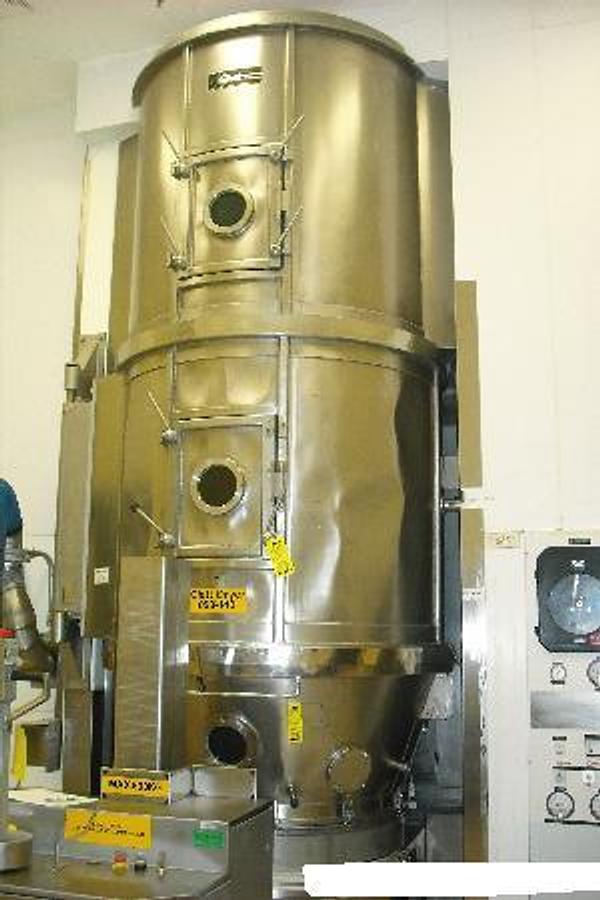
A Glatt fluid bed dryer is a process equipment unit that suspends wet granules, powders, or particles in a controlled stream of heated air, allowing moisture to evaporate rapidly and uniformly. The fluidization effect keeps particles in constant motion, which dramatically increases the surface area exposed to the drying air and results in faster, more consistent drying compared to tray or rotary dryers. Glatt has built its reputation over decades by engineering fluid bed systems with precise airflow control, temperature management, and containment features that meet the demanding standards of pharmaceutical and food manufacturing.
The basic operating principle involves a product container where material is loaded, an air handling unit that conditions and heats the incoming air, and a filter system that captures fine particles before exhaust air is released. Operators can control inlet air temperature, airflow volume, and exhaust humidity to dial in the exact drying conditions a particular product requires. Because the process is gentle and the heat exposure is brief for any individual particle, Glatt fluid bed dryers are well suited for heat-sensitive materials like active pharmaceutical ingredients, nutraceuticals, and certain food ingredients. The combination of speed, gentleness, and repeatability is why these machines have become a standard in high-volume production environments worldwide.
What is the difference between the Glatt GPCG and WSG/WST fluid bed dryer models?
The Glatt GPCG (Granulation and Coating) series is designed as a multi-function platform that can handle fluid bed drying, top-spray granulation, bottom-spray coating (Wurster process), and tangential spray applications, all within a single unit by swapping out product containers and spray inserts. This flexibility makes the GPCG a popular choice for pharmaceutical manufacturers who need one machine to handle multiple process steps, reducing capital investment and floor space requirements. GPCG units are available in a wide range of batch sizes, from small development-scale units to full production models, and they are frequently sought on the used equipment market because of their versatility.
The WSG and WST series, including models like the WSG-300, are more focused on fluid bed granulation and drying at larger production scales. The WSG designation typically refers to fluid bed granulators, while WST models are oriented toward spray granulation with top-spray nozzle configurations. These units tend to be built for high-throughput batch production and are common in both pharmaceutical solid dosage manufacturing and food processing applications such as instant beverage powders and seasoning blends. When evaluating used Glatt equipment, understanding which series a machine belongs to helps buyers confirm that the unit's capabilities align with their intended process, since a pure dryer configuration may require additional components or retrofitting to perform granulation or coating tasks.
What batch sizes and capacities are available for Glatt fluid bed dryers?
Glatt fluid bed dryers span an extremely wide range of batch capacities, which is one reason they appear in settings from R&D laboratories to full-scale commercial production facilities. Laboratory and pilot-scale models typically handle batches from as little as 1 kg up to around 30 kg, giving formulation scientists the ability to develop and optimize processes before scaling up. Mid-range production units commonly handle batches in the 60 kg to 300 kg range, and large-scale production models can process batches of 600 kg, 1,200 kg, or more depending on the specific model and product density.
When shopping for a used Glatt fluid bed dryer, matching the machine's rated capacity to actual production needs is critical. Oversized equipment can lead to poor fluidization at low fill levels, uneven drying, and unnecessary energy consumption. Undersized equipment creates production bottlenecks. Buyers should also be aware that the rated capacity listed on a machine typically reflects a bulk density reference, so actual batch weights will vary depending on the specific material being processed. Consulting with a process engineer or the equipment manufacturer to confirm that a particular used unit suits the intended product and batch size is a worthwhile step before finalizing a purchase.
What industries use Glatt fluid bed dryers?
Pharmaceutical manufacturing is the primary industry associated with Glatt fluid bed dryers. These machines are used extensively in solid dosage form production, specifically for drying wet granules before tablet compression, granulating active pharmaceutical ingredients with excipients, and applying functional coatings to pellets or granules. The precision and repeatability of Glatt systems, combined with their design features that support GMP compliance, make them a preferred choice at pharmaceutical plants producing tablets, capsules, and granular dosage forms.
Beyond pharmaceuticals, Glatt fluid bed dryers see significant use in the food and nutraceutical industries. Applications include drying and instantizing soluble coffee and tea, producing free-flowing seasoning and flavoring blends, processing dairy-based powders, and manufacturing vitamin and mineral premixes. Chemical and agrochemical producers also use fluid bed drying for fertilizers, detergent powders, and specialty chemicals where controlled particle size and moisture content are important to product performance. The machine's ability to handle a wide range of particle sizes and moisture levels, combined with flexible process control, is what drives its adoption across these diverse sectors.
Does the Glatt fluid bed dryer comply with GMP, FDA, and cGMP regulations?
Glatt fluid bed dryers are engineered with pharmaceutical GMP (Good Manufacturing Practice) compliance as a core design consideration. Features that support compliance include smooth, crevice-free product contact surfaces finished to pharmaceutical standards, contained product handling to minimize cross-contamination risk, validated cleaning procedures, and documentation packages that support equipment qualification (IQ/OQ/PQ). Many units are also designed to meet FDA 21 CFR Part 11 requirements for electronic records and signatures, which is relevant for facilities subject to FDA oversight.
When buying a used Glatt fluid bed dryer, the compliance picture becomes more nuanced. The machine itself may have been built to GMP standards, but buyers need to assess whether the unit has been maintained to those standards throughout its service life and whether documentation such as maintenance logs, calibration records, and prior validation packages are available. Gaps in documentation can add significant time and cost to the requalification process at a new facility. Buyers in regulated industries should ask the seller specifically about available documentation and should factor in the cost of requalification when comparing the total investment in a used machine versus other options. Consulting with a validation specialist before purchase is a practical way to understand the scope of work required to bring a used unit into compliance at a new site.
Can a Glatt fluid bed dryer handle granulation and coating in addition to drying?
Many Glatt fluid bed systems are designed to perform granulation and coating in the same equipment used for drying, which is one of the features that makes them highly valued in pharmaceutical and food processing operations. Top-spray granulation involves spraying a binder solution onto a fluidized powder bed, causing particles to agglomerate into granules of controlled size. This process is commonly used in pharmaceutical tablet manufacturing to improve powder flowability and compressibility. The same machine, with the same product container, can then dry the wet granules to the target moisture specification without transferring material to separate equipment.
Coating applications require additional configuration. The Wurster process, which uses a bottom-spray insert and a partition cylinder inside the product container, applies thin film coatings to pellets or granules for purposes like taste masking, modified drug release, or moisture protection. Tangential spray systems are used for building up layered pellets from a seed core. Whether a specific used Glatt unit can perform these additional processes depends on the model and the components included with the machine. Buyers should confirm exactly which spray inserts, nozzle assemblies, and product containers are included in a sale, since these components are essential to multi-function capability and can be costly to source separately for older models.
What should buyers inspect when evaluating a used Glatt fluid bed dryer?
A thorough inspection of a used Glatt fluid bed dryer should cover both mechanical condition and process-critical components. On the mechanical side, buyers should examine the condition of the air handling unit, including filters, heating coils, and blower components, since these directly affect drying performance. The product container and expansion chamber should be inspected for dents, welds, or surface finish degradation that could compromise cleanability or create contamination risk. Seals, gaskets, and finger bag filters are wear items that will likely need replacement and should be factored into the cost estimate. The control system, including any PLC or SCADA components, should be evaluated for functionality and software version compatibility.
For pharmaceutical applications specifically, buyers should request whatever documentation is available, including prior validation records, maintenance logs, and calibration certificates. Inspections can typically be arranged in person at the seller's location or through video walkthroughs for buyers who cannot travel. Some equipment may still be installed and operational at the facility where it was last used, which can allow for a live demonstration of basic functions. Keep in mind that most used equipment dealers are not set up to run actual production batches during an inspection, so functional testing is generally limited to verifying that motors, controls, and air systems operate as expected. Engaging a qualified engineer or process specialist to participate in the inspection is a practical way to assess a machine's condition more thoroughly before committing to a purchase.
What is the typical price range for a used Glatt fluid bed dryer?
Pricing for used Glatt fluid bed dryers varies considerably based on model, capacity, age, configuration, and overall condition. Small laboratory or pilot-scale units can be found at price points starting in the low tens of thousands of dollars, while mid-range production units in the 60 to 300 kg class typically trade in a range from roughly $30,000 to $150,000 or more depending on included components and condition. Large-scale production units with full GMP documentation packages and multi-function capability can command significantly higher prices, sometimes exceeding $300,000 for well-maintained machines with complete accessory sets.
Beyond the purchase price, buyers should account for the full landed cost of the equipment. Rigging, crating, and freight can add thousands of dollars depending on machine size and shipping distance. Reconditioning costs, replacement of wear parts, and requalification expenses for pharmaceutical use can also be substantial. Machines sold with complete documentation, all original accessories, and a well-documented service history will generally cost more upfront but often represent better overall value because they reduce the time and money required to put the machine back into validated production. Getting detailed quotes on all ancillary costs before finalizing a purchase helps avoid surprises and allows for an accurate comparison between available units.
Are spare parts and technical support available for used Glatt fluid bed dryers?
Spare parts availability for used Glatt fluid bed dryers depends significantly on the age and model of the machine. Glatt maintains support for many of its product lines, and for relatively recent models, consumable and wear parts such as filter bags, gaskets, seals, spray nozzle components, and inlet air filters are generally available through the manufacturer or authorized distributors. For older or discontinued models, parts availability can become more limited, and buyers may need to rely on aftermarket suppliers or fabricated replacement parts for certain components.
Before purchasing a used Glatt fluid bed dryer, it is worth contacting Glatt directly to ask about parts availability and technical support for the specific model and serial number under consideration. The manufacturer can provide a realistic picture of what support to expect, which parts are stocked, and whether software or controls updates are still available for the unit's control system. This step is particularly important for pharmaceutical buyers who depend on validated spare parts with appropriate documentation. Dealers who specialize in pharmaceutical process equipment will often have familiarity with parts sourcing for the models they sell and can provide guidance on what a buyer should plan for in terms of ongoing maintenance costs.
What should buyers know about shipping and payment when purchasing a used Glatt fluid bed dryer?
Glatt fluid bed dryers are large, complex pieces of industrial equipment, and shipping logistics require careful planning. The machine must be properly prepared for transport, which typically involves draining any fluids, securing or removing fragile components, and crating or palletizing to a standard appropriate for the size and weight of the unit. Larger production-scale dryers may require specialized rigging equipment for loading at the seller's facility and unloading at the buyer's site, which adds to the overall cost. Buyers should request detailed information from the seller about how the machine will be packaged and what rigging arrangements are required, so that the full landed cost can be calculated accurately before committing to a purchase.
Payment terms in the used equipment market are fairly standard. Most dealers require full payment prior to releasing equipment for shipment. Some dealers may offer extended terms to established customers with a prior purchase history, but this is not the norm for first-time buyers. Wire transfer is the most common payment method for transactions of this size. Buyers should also clarify the timeline between payment and shipment, since some machines may require preparation time before they are ready to load. Understanding all of these logistics upfront, including estimated transit time to the destination facility, helps buyers plan installation schedules and avoid production delays.