Category
Manufacturer
Model
FAQ:
What types of caps and closures can Geninox capping machines handle?
Geninox capping machines are built to handle a fairly wide range of closure types, which is one of the reasons they show up across so many different production environments. Common cap types include screw caps, snap-on closures, ROPP (Roll-On Pilfer-Proof) aluminum caps, pump dispensers, and trigger sprayers. The specific cap compatibility depends on the model and the tooling installed, so buyers should confirm which chuck heads or spindle configurations are present on any particular used machine before purchasing.
When buying a used Geninox capper, it is worth asking the seller whether the original tooling and change parts are included with the machine. Change parts allow operators to switch between different cap sizes and styles without replacing the entire capping head assembly. If those parts are missing, sourcing them separately can add to the total cost of getting the machine production-ready. Contacting Geninox or an authorized parts supplier to confirm availability for the specific model and age of the machine is a smart step before finalizing any purchase.
What industries use Geninox capping machines?
Geninox capping equipment is used across a broad range of industries where consistent, reliable closure application is critical to product quality and shelf life. The most common sectors include food and beverage, pharmaceuticals, nutraceuticals, cosmetics and personal care, and household chemicals. Each of these industries has its own regulatory and quality requirements, but they share a common need for accurate torque application and repeatable cap seating to prevent leaks, contamination, and product spoilage.
In pharmaceutical and nutraceutical applications, capping machines must apply closures with precise torque to meet tamper-evidence standards and maintain product integrity. In food and beverage, speed and hygiene are often the top priorities. Cosmetics and personal care producers frequently run a wide variety of bottle and cap combinations, which makes versatile, adjustable capping equipment especially valuable. A used Geninox machine that has been running in one of these industries may already be configured with tooling suited to that application, which can save setup time for a buyer in the same sector.
What is a 6-spindle automatic capping machine and how does it work?
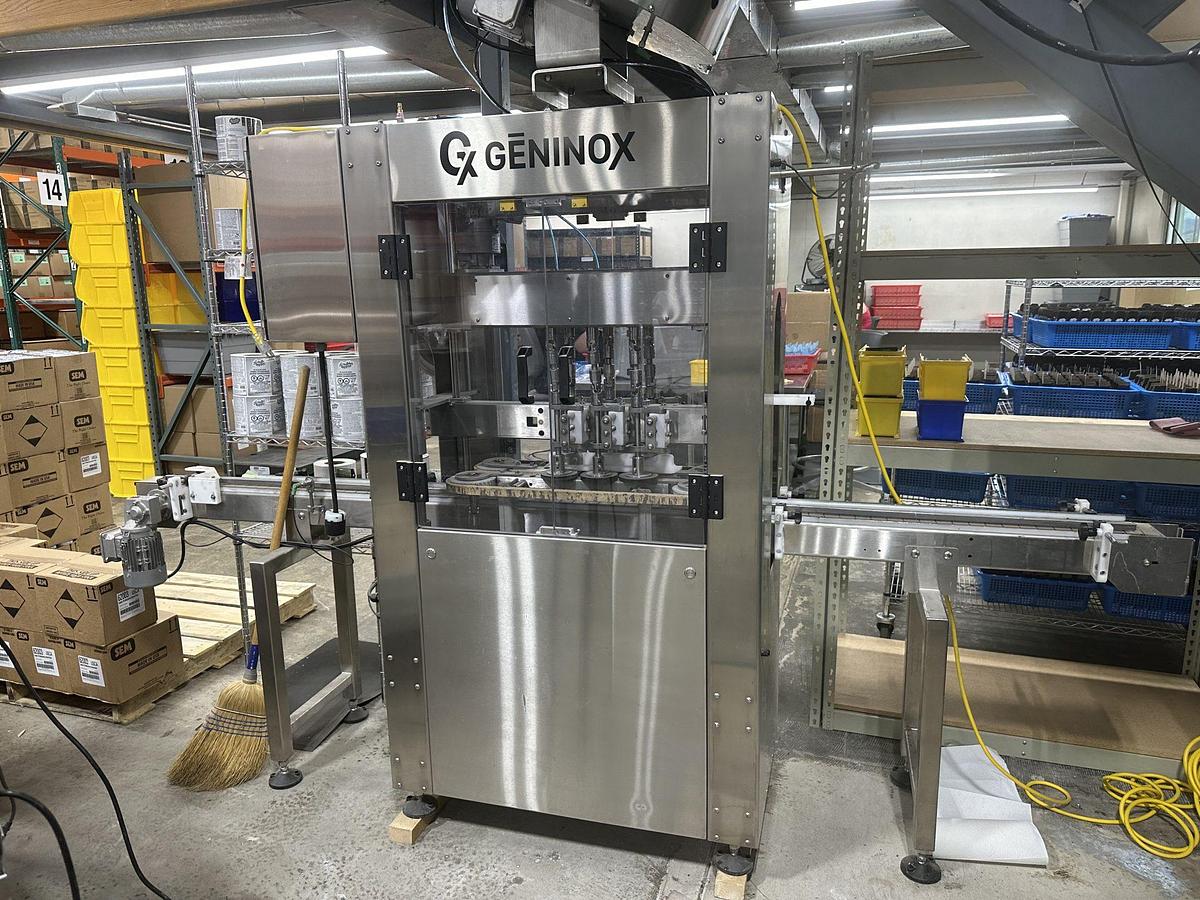
A 6-spindle automatic capping machine uses six rotating spindles arranged around a central drive to apply screw caps to containers as they move along a conveyor. As each bottle passes through the capping zone, the spindles grip the cap and rotate it onto the container neck at a controlled torque setting. Having six spindles rather than two or four means the machine can engage the cap more gradually and evenly, which reduces the chance of cross-threading and improves torque consistency across a production run. This design is common in mid-to-high volume production lines where both speed and accuracy matter.
The automatic nature of the machine means it does not require an operator to place caps individually. Caps are typically fed from a vibratory bowl or cap elevator that orients and delivers them to the capping head in sequence. The conveyor, cap feed, and spindle drive are all synchronized so the machine can run continuously without manual intervention during normal operation. For buyers evaluating a used 6-spindle Geninox capper, it is important to inspect the spindle discs and belts for wear, check the cap chute and feed system for damage, and verify that the torque settings can still be adjusted accurately.
What should buyers inspect when evaluating a used Geninox capping machine?
A thorough inspection of a used Geninox capper should cover both mechanical and electrical components. On the mechanical side, buyers should look closely at the spindle discs or chuck jaws for wear, check the conveyor belts and guides for damage or excessive play, and examine the cap feed system including the bowl, chute, and sorter for cracks or missing parts. Torque adjustment mechanisms should move freely and hold their settings without slipping. Any signs of corrosion, especially on machines that ran in wet or washdown environments, deserve careful attention since corrosion can affect both function and longevity.
Electrically, buyers should verify that the control panel powers up correctly, that all sensors and proximity switches are functional, and that the motor runs smoothly without unusual noise or vibration. Most reputable used equipment dealers will accommodate in-person inspections or provide detailed video walkthroughs of the machine in its current state. Some machines may still be installed at the facility where they were last used, allowing buyers to see them in a production context. Keep in mind that used equipment dealers typically do not have the permits or facilities to run actual production tests, so the inspection will focus on mechanical condition and operational readiness rather than live capping output.
How does buying a used Geninox capping machine differ from buying one directly from a manufacturer?
Buying a used Geninox capping machine through a secondary market dealer is a fundamentally different transaction than purchasing directly from a manufacturer. Used machines are sold as-is, meaning the buyer takes on responsibility for verifying the machine's condition rather than relying on factory quality controls or production testing. There is no manufacturer backing the transaction, and the machine's history, including how many hours it ran, what products it handled, and how well it was maintained, becomes a key part of the evaluation. This is why selecting a dealer with a long track record in packaging machinery specifically is so important.
The trade-off for that added diligence is typically a significantly lower purchase price compared to buying new equipment. For businesses that have the technical staff to inspect, install, and maintain the machine, a used Geninox capper can represent strong value. Buyers should also contact Geninox directly to understand what level of technical support and parts availability they can expect for the specific model and age of machine they are considering, since older models may have limited parts availability through the manufacturer's current supply chain.
What is the typical price range for used Geninox capping machines?
Pricing for used Geninox capping machines varies considerably depending on the model, age, configuration, and overall condition of the equipment. Simpler semi-automatic bench-top cappers tend to be available at lower price points, while fully automatic inline machines with integrated cap feeding systems and multi-spindle heads command higher prices. The presence or absence of change parts, tooling, and ancillary components like cap elevators and conveyors also affects the final price significantly.
Buyers should factor in more than just the listed machine price when calculating total acquisition cost. Shipping, rigging, crating, and any refurbishment or spare parts needed to bring the machine into production-ready condition all add to the real cost of ownership. Requesting a detailed quote from the dealer that breaks out packaging, freight, and any applicable rigging charges is a practical step before committing to a purchase. Getting the machine inspected before finalizing the deal is the best way to avoid unexpected costs after delivery.
Can a used Geninox capping machine be integrated into an existing production line?
Used Geninox automatic capping machines are generally designed for inline integration, meaning they are built to accept containers from an upstream conveyor, apply closures, and discharge capped bottles to a downstream process such as labeling or case packing. Most models use standard conveyor heights and can be adjusted to accommodate different bottle heights and diameters through guide rail and starwheel changes. Whether a specific used machine will integrate cleanly into an existing line depends on the conveyor height, bottle geometry, cap type, and line speed of the buyer's current setup.
Before purchasing, buyers should gather the key specifications of their existing line, including conveyor height, bottle dimensions, cap style and diameter, and target output speed, and compare those against the specifications of the used machine. A dealer familiar with packaging equipment should be able to help assess compatibility. In some cases, additional change parts or minor modifications may be needed to match the machine to a specific application, and the cost and availability of those parts should be confirmed before the sale is finalized.
Are used Geninox capping machines a good fit for small or mid-sized production operations?
The answer depends largely on the specific model. Geninox produces both semi-automatic and fully automatic capping equipment, and the used market reflects that range. Semi-automatic models, where an operator places the cap on the bottle and the machine applies torque, are well-suited to smaller operations with lower volume requirements and tighter budgets. They also tend to be easier to set up and maintain, which matters when dedicated maintenance staff are limited. Fully automatic inline models, like the 6-spindle automatic capper, are designed for continuous high-volume output and are better matched to mid-to-large scale production environments.
For a small business considering a used automatic Geninox capper, the key questions are whether the machine's minimum efficient run speed aligns with actual production needs, and whether the operation has the technical resources to keep the machine running. Automatic inline cappers involve more moving parts, more sensors, and more complex setup than semi-automatic alternatives. A machine that is well-matched to the production volume and the team's capabilities will deliver much better value than one that is oversized or too complex for the environment it is placed in.
What are the most important performance specifications to review when comparing used capping machines?
Throughput speed is usually the first number buyers look at, and it matters, but it should not be the only factor. Capping speed is typically expressed in bottles per minute and reflects the machine's rated capacity under ideal conditions. For a used machine, actual achievable speed may differ from the nameplate rating depending on the condition of the drive components, cap feed system, and sensors. Torque range and torque consistency are equally important, especially for pharmaceutical, food, and personal care applications where under-torqued caps cause leaks and over-torqued caps cause consumer complaints or damaged closures.
Other specifications worth examining include the range of bottle diameters and heights the machine can handle, the cap size range it accommodates, the type of cap feed system it uses, and the power requirements. For used machines specifically, the age of the electrical components and control system is relevant since older programmable logic controllers (PLCs) or proprietary control boards can be difficult and expensive to repair or replace if they fail. Asking the dealer for any available documentation, including manuals or maintenance records, gives buyers a clearer picture of what they are getting.
How are used capping machines typically shipped, and what should buyers expect for shipping costs?
Shipping costs for used capping machines depend on the size and weight of the equipment, the origin and destination, and the level of packaging required to protect the machine in transit. Smaller bench-top or semi-automatic cappers may ship on a standard pallet with appropriate blocking and strapping. Larger automatic inline machines typically require custom crating or heavy-duty skidding to prevent damage during handling. The cost of that packaging is usually passed on to the buyer, so it is important to ask the dealer specifically what packaging method will be used and what that adds to the total cost.
Larger machines may also require specialized rigging equipment for loading at the origin and unloading at the destination. Forklift access is standard for most industrial facilities, but machines that are particularly heavy or awkwardly configured may need a crane or rigger, which adds to the landed cost. Buyers should request a complete breakdown of packaging, freight, and rigging charges before confirming the purchase so there are no surprises when the invoice arrives. Full payment prior to shipment is standard practice among used equipment dealers, though some may offer terms to established repeat customers.