Category
Manufacturer
Model
FAQ:
What is a Furex rotary unscrambling accumulating table and what does it do in a packaging line?
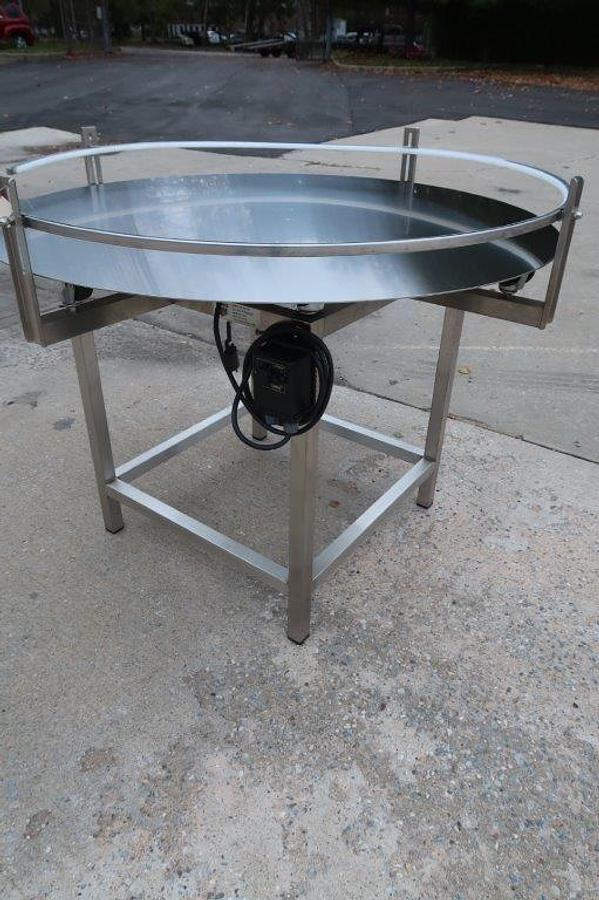
A Furex rotary unscrambling accumulating table is a piece of packaging machinery designed to take randomly oriented containers and prepare them for orderly, single-file feeding into downstream equipment. Containers are loaded onto the rotating turntable surface, and the centrifugal motion of the table gently pushes them outward toward a discharge conveyor or guide rail. From there, they move upright and in sequence to fillers, cappers, labelers, or other line equipment. The rotary design is intentional: it handles containers with significantly less force than linear alternatives, reducing the risk of tipping, scuffing, or damaging containers during the unscrambling process.
Furex is a well-regarded name in packaging machinery, particularly known for accumulation and conveying equipment used across pharmaceutical, food and beverage, cosmetic, and chemical manufacturing environments. Their rotary accumulating tables are built to handle sustained production demands while maintaining the gentle handling characteristics that regulated industries require. The machine essentially acts as a buffer and orientor at the very start of a packaging line, smoothing out the flow of containers so that downstream equipment can run at consistent speeds without interruptions caused by container jams or gaps in supply.
What industries are Furex rotary accumulating tables most commonly used in?
Furex rotary accumulating tables are used across a broad range of industries, but they are most heavily concentrated in pharmaceutical manufacturing, food and beverage production, cosmetics, and chemical processing. In pharmaceutical environments, the machines must meet strict sanitation and validation standards, which is why stainless steel construction and smooth, cleanable surfaces are standard. In food and beverage facilities, the same sanitation logic applies, and the gentle handling characteristics of the rotary design are valued for preventing label damage or container deformation on lighter packaging materials like PET bottles.
Cosmetics manufacturers rely on these tables for handling a wide variety of container shapes, including round, oval, and irregular profiles that would be difficult to manage on linear equipment. Chemical packaging operations use them for heavier containers like HDPE jugs and industrial bottles. The common thread across all these industries is the need to take bulk containers and feed them smoothly and reliably into automated filling and capping lines. Any facility running a moderate to high-volume packaging operation with multiple container formats will find this type of equipment useful for maintaining consistent line efficiency.
What container types and sizes can a rotary unscrambling accumulating table handle?
Rotary accumulating tables are designed to handle a wide range of container types, including round bottles, oval bottles, jars, jugs, and various irregular-profile containers. The key variables that determine compatibility are the diameter of the turntable, the height and base dimensions of the container, and the speed at which the table operates. Larger turntables, such as 48-inch diameter models, can accommodate bigger containers or higher volumes of smaller containers simultaneously, giving operators more flexibility across different product runs.
Changeovers between container sizes are typically managed through guide rail adjustments and, in some cases, speed adjustments on the variable frequency drive. Very tall, narrow containers require more careful speed calibration to prevent tipping during the outward centrifugal movement toward the discharge conveyor. Flat-bottomed containers generally perform best on rotary tables, while containers with unusual base geometries may require custom guide work. When evaluating a used rotary accumulating table for a specific application, it is worth confirming the turntable diameter and the range of guide rail adjustability to ensure the machine can handle the container formats in your production line.
What are the typical throughput speeds of a Furex rotary accumulating table?
Throughput capacity on a rotary accumulating table is expressed in containers per minute and depends on several factors: the diameter of the turntable, the size and weight of the containers being handled, the speed setting on the variable frequency drive, and the discharge configuration feeding into downstream equipment. Smaller, lighter containers can typically be processed at higher speeds, while larger or heavier containers require slower rotation to prevent tipping or jamming at the discharge point. Most commercial rotary accumulating tables used in mid-to-high-volume packaging lines are capable of handling anywhere from several hundred to over a thousand containers per minute under the right conditions.
Variable speed drives are a critical feature on these machines because they allow operators to dial in the table speed to match the throughput of the downstream filler or capper. Running the accumulating table too fast relative to downstream equipment causes containers to pile up at the discharge; running it too slow creates gaps that interrupt line flow. When purchasing a used rotary accumulating table, it is worth asking about the drive configuration and speed range to confirm the machine can be calibrated to match your specific line requirements. A dealer should be able to provide model specifications or connect you with the manufacturer to verify the rated speed range for the specific unit being sold.
What materials are Furex rotary accumulating tables constructed from, and are they suitable for food or pharmaceutical use?
Furex rotary accumulating tables are typically constructed with stainless steel frames, turntable surfaces, and guide components. Stainless steel is the standard material of choice for packaging equipment used in regulated industries because it resists corrosion, tolerates repeated washdowns with cleaning agents, and does not harbor bacteria in the way that painted mild steel or aluminum can over time. The use of stainless steel also supports compliance with FDA regulations, GMP (Good Manufacturing Practice) standards, and other industry-specific sanitation requirements that pharmaceutical and food manufacturers must meet.
Beyond the material itself, the design of the turntable surface and the smoothness of all contact points matter for sanitation compliance. Surfaces should be free of crevices, exposed threads, or rough welds that could trap product residue. When evaluating a used stainless steel accumulating table, it is reasonable to inspect the condition of the turntable surface, the undercarriage, and any drive components for signs of corrosion, pitting, or damage that could compromise sanitation performance. A visual inspection, either in person or via video, can reveal a great deal about how well the machine was maintained in its previous production environment.
Does a rotary unscrambling accumulating table integrate with existing bottling or packaging lines?
Yes, rotary accumulating tables are designed to function as a component within a larger packaging line rather than as standalone machines. They sit at the infeed end of the line, receiving bulk containers from a hopper or manual loading, and discharge them in single file onto a conveyor that leads to the next piece of equipment, typically a filler or rinser. The discharge conveyor height, guide rail width, and discharge angle can usually be adjusted to match the infeed requirements of the downstream equipment. Most machines of this type are also equipped with variable speed drives, which allow operators to synchronize the table's output speed with the speed of the rest of the line.
Integration considerations for a used machine include verifying that the discharge height and conveyor width are compatible with the existing line layout, and confirming that the electrical supply requirements match the facility's available power. Some older machines may use different control systems or drive configurations than what a modern line expects, which can require additional engineering work during installation. It is a good idea to share the specifications of the accumulating table with your line integrator or maintenance team before purchasing, so any adaptation costs can be factored into the total project budget alongside the equipment price, shipping, and installation.
What are the typical power requirements and footprint dimensions of a Furex rotary accumulating table?
Power requirements for rotary accumulating tables vary by model and turntable size, but most industrial units in the 48-inch diameter range operate on three-phase electrical power, commonly at 208-230V or 460V, 60Hz configurations standard to North American manufacturing facilities. The drive motor powering the turntable is typically a fractional to low-horsepower motor paired with a variable frequency drive (VFD) for speed control. Exact electrical specifications should always be confirmed from the machine's nameplate data or the manufacturer's documentation, particularly for used equipment where the original configuration may have been modified.
Footprint dimensions depend on the turntable diameter and the length of any integrated discharge conveyor section. A 48-inch turntable, for example, requires at minimum a floor space slightly larger than the turntable itself, plus clearance for operator access, guide rail adjustments, and the discharge conveyor run. In practice, a 48-inch rotary table with a standard discharge conveyor section might occupy a floor area of roughly 6 to 8 feet in one dimension depending on the discharge configuration. Ceiling height is generally not a constraint for this type of equipment. Before purchasing, it is worth requesting the machine's overall dimensional drawing to confirm it fits within the planned floor space in your facility.
How easy is it to clean a rotary accumulating table, and does it support quick changeovers between different container sizes?
Stainless steel rotary accumulating tables are designed with sanitation in mind, and the open turntable surface is generally straightforward to wipe down or rinse between production runs. The undercarriage and drive components require more careful attention, as standing liquid around bearings and motors can cause damage over time. In facilities with strict cleaning protocols, the machine's design should be evaluated for the presence of crevices, horizontal surfaces that collect debris, and the accessibility of all contact surfaces to cleaning tools. Well-maintained used equipment in good condition should retain its cleanability, but a thorough inspection is worthwhile to identify any areas where corrosion or damage could complicate sanitation.
Changeovers between container sizes are handled primarily through guide rail width adjustments and turntable speed changes via the VFD. Most machines use tool-free or simple tool-assisted guide rail adjustments that an experienced operator can complete in a matter of minutes. Switching between dramatically different container profiles, such as moving from a small round bottle to a wide-mouth jar, may also require repositioning the discharge conveyor guides. For high-mix production environments where changeovers happen frequently, it is worth asking the dealer for details on the specific adjustment mechanisms on the unit being sold, as guide rail systems can vary between models and may have worn or missing components on older used machines.
What should buyers consider when purchasing a used Furex rotary accumulating table?
Buying used packaging machinery requires more due diligence than purchasing from a manufacturer, because the condition of the equipment depends entirely on how it was maintained and operated in its previous production environment. Key things to evaluate on a used rotary accumulating table include the condition of the turntable surface (look for scratches, pitting, or corrosion on stainless surfaces), the state of the drive motor and VFD, the condition of the guide rails and discharge conveyor components, and whether all electrical components are present and intact. Reputable used equipment dealers will accommodate in-person inspections or provide detailed video walkthroughs of the machine so buyers can assess its current condition before committing to a purchase.
It is also worth contacting Furex directly to understand what level of support, parts availability, and documentation exists for the specific model and age of the unit you are considering. Older models may have limited parts availability, which affects long-term maintenance costs. Keep in mind that used equipment dealers typically sell machinery as-is, so the buyer carries the responsibility of inspection and evaluation. Choosing a dealer with a long track record in the packaging machinery industry, and one who specializes in this type of equipment, significantly reduces the risk of purchasing a machine with undisclosed problems. Factor in the full landed cost, including shipping, rigging, and any refurbishment needed, when comparing prices.
What are the shipping and logistics considerations for a used rotary accumulating table?
Rotary accumulating tables are heavy, rigid machines that require careful packaging and handling to arrive without damage. Depending on the size of the unit, shipping typically involves palletizing or crating the machine to protect it during freight transit. A 48-inch rotary table is a substantial piece of equipment, and heavier units may require professional rigging services for loading at the seller's facility and unloading at the destination. Rigging costs are generally separate from freight charges and should be discussed with the dealer upfront so buyers understand the full landed cost before finalizing the purchase.
Shipping costs vary based on the weight and dimensions of the machine, the distance between origin and destination, and the level of packaging required. Buyers should ask the dealer specifically about how the machine will be packaged, what freight carrier or method will be used, and whether liftgate service or a loading dock is required at the delivery address. For international shipments, export crating and customs documentation add additional steps and costs. Most used equipment dealers require full payment before the machine ships, so it is important to have all logistics details confirmed and agreed upon before funds are transferred. Getting a clear picture of total acquisition cost, including the machine price, rigging, freight, and any installation expenses, is essential for accurate budgeting.