Category
Manufacturer
Model
FAQ:
What materials can a Franklin hot stamp imprint machine work on?
Franklin hot stamp imprint machines are designed to work across a surprisingly wide range of substrates. Common applications include ribbons, leather goods, paper products, cardboard packaging, vinyl, certain plastics, and fabric. The key variable is how the material responds to heat and pressure, since the hot stamping process transfers metallic foil by pressing a heated die against the surface. Materials that are too heat-sensitive may scorch, while surfaces that are too hard or uneven can result in incomplete foil transfer.
For businesses in gift retail, trophy and awards, stationery, or promotional products, this versatility is a big part of what makes hot stamping attractive. A single machine can handle personalized ribbon for gift wrapping, imprinted leather journals, and branded packaging inserts. That said, buyers evaluating a used Franklin machine should test the specific substrates they plan to run, since die condition, platen flatness, and heating element performance on a used unit can all affect how cleanly it stamps on different materials.
What is hot stamping and how does a Franklin hot stamp imprint machine work?
Hot stamping is a dry printing process that uses heat, pressure, and metallic (or pigmented) foil to transfer a design or text onto a surface. A metal die carrying the desired image or type is mounted to a heated platen. When the operator brings the platen down onto the foil and substrate, the heat activates the foil's release coating, bonding the metallic layer to the material and leaving a sharp, permanent impression. The result is a high-end, professional finish that ink-based printing methods cannot easily replicate.
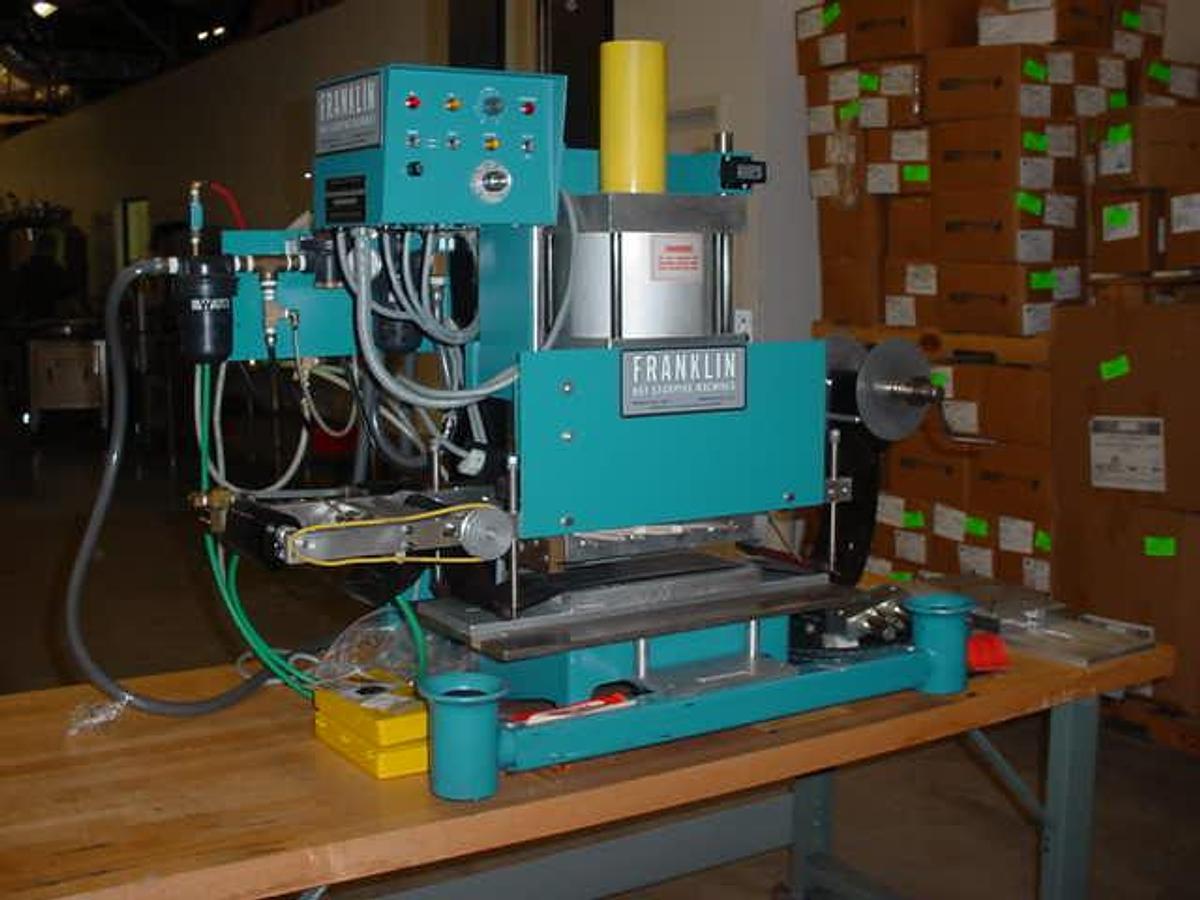
Franklin machines follow this same fundamental process and are built around a table-top form factor, making them practical for shop environments where counter or bench space is at a premium. The operator controls temperature and, on most models, dwell time and pressure to dial in the right settings for the material being imprinted. The machines use interchangeable type slugs or custom-cut dies, so the same unit can be reconfigured for different jobs, whether that means monogramming leather wallets one day or imprinting event ribbons the next.
What types of foil are compatible with Franklin hot stamp imprint machines?
Franklin hot stamp machines are generally compatible with standard hot stamp foil rolls, which are widely available from imprinting supply companies. Foil comes in a range of finishes including gold, silver, holographic, matte, and pigmented colors. The critical compatibility factors are roll width and core diameter, since the machine's foil feed mechanism is designed around specific dimensions. Buyers should confirm the foil width range their machine accepts before purchasing supplies, as using foil that is too wide or wound on the wrong core size can create feeding problems.
For used Franklin machines, it is worth checking whether the foil advance mechanism is functioning correctly, since worn or sticky advance rollers are one of the more common maintenance issues on older units. Foil from reputable imprinting supply vendors is typically sold in standard roll widths (commonly 1 inch, 1.5 inch, 2 inch, and wider), so sourcing ongoing supplies is generally straightforward once the machine's specifications are confirmed. Some specialty foils, such as those designed for plastics or leather, may require slightly higher temperatures than standard metallic foils, so having a machine with a reliable, adjustable temperature control is important.
Does a Franklin hot stamp machine have adjustable temperature and pressure settings?
Yes, adjustable temperature control is a standard feature on Franklin hot stamp imprint machines. Temperature adjustment is essential because different materials require different heat levels to achieve a clean transfer. Paper and ribbon typically stamp at lower temperatures, while leather and certain plastics need more heat. Running the wrong temperature for a given substrate results in either foil that won't adhere or material that scorches, so having precise, reliable temperature control is not optional, it is fundamental to getting consistent results.
Pressure adjustment is also typically available, either through a mechanical stop or a spring-tension system that controls how firmly the die contacts the substrate. On a used machine, buyers should pay particular attention to whether the temperature control system holds a stable set point and whether the heating element reaches and maintains operating temperature consistently. These are areas where older machines can show wear, and they directly affect output quality. During any inspection of a used Franklin machine, asking to see the machine cycle through a range of temperatures and observing how quickly it stabilizes is a reasonable and recommended step.
How long does a Franklin hot stamp machine take to reach operating temperature?
Most table-top hot stamp imprint machines, including Franklin models, reach operating temperature within roughly 5 to 15 minutes from a cold start, depending on the target temperature and the condition of the heating element. Lower temperature settings for paper or ribbon imprinting are reached faster, while higher temperatures needed for leather or plastic substrates take a bit longer. In a production shop environment, operators typically power the machine on at the start of the day and let it stabilize before beginning a run.
On used machines, warm-up time and temperature stability are worth evaluating during inspection. A heating element that is aging or a thermostat that has drifted out of calibration may take longer to reach set temperature or may fluctuate during operation, which shows up as inconsistent foil transfer quality across a production run. Asking the seller to demonstrate a cold start and observing how the machine behaves as it comes up to temperature gives buyers a practical data point on the condition of the heating system before committing to a purchase.
How are dies and type slugs changed on a Franklin hot stamp imprint machine?
Franklin hot stamp machines use interchangeable metal type slugs and custom dies that mount to the heated platen. Changing type typically involves loosening a retaining mechanism, swapping out the slugs or die, and re-securing them before the next run. The system is designed to allow relatively quick changeovers, which is part of what makes these machines practical for shops that handle a variety of personalization jobs throughout the day. Type slugs are usually available in multiple fonts and sizes, allowing operators to set up custom text combinations for names, dates, or short messages.
Custom dies for logos or decorative artwork are fabricated separately, usually from brass or magnesium, and mount to the platen in the same way as type. On a used machine, buyers should inspect the platen's die-mounting area for wear, damage, or stripped threads, since a compromised mounting surface can make it difficult to secure dies properly and can affect impression quality. It is also worth confirming that any type or dies included with the machine are in usable condition, as worn or damaged type will produce soft or incomplete impressions regardless of how well the machine itself is functioning.
What industries and businesses typically use Franklin hot stamp imprint machines?
Franklin hot stamp machines have historically been popular in gift shops, trophy and awards stores, stationery retailers, florists, bookbinders, and promotional products businesses. Any operation that offers personalization or on-demand imprinting as part of its service can find a use for this type of equipment. Hot stamping produces a metallic, embossed-looking finish that customers associate with quality and craftsmanship, which is why it remains the standard for applications like award ribbons, personalized leather goods, gift packaging, and embossed stationery.
Smaller print shops and craft-oriented businesses also use table-top hot stamp machines for short-run specialty work that would be impractical to outsource. Because the machines are compact and designed for bench-top operation, they fit into retail back rooms, small workshops, and production floors without requiring significant floor space. Used Franklin machines appeal particularly to businesses that want the capability without the cost of purchasing a higher-end industrial unit, and they are a practical choice for operations where hot stamping is one service among several rather than the primary production focus.
What should buyers look for when inspecting a used Franklin hot stamp imprint machine?
A thorough inspection of a used Franklin hot stamp machine should cover several key areas. The heating element and temperature control system are the most critical, since these directly affect whether the machine can produce consistent, quality impressions. Buyers should verify that the machine reaches and holds set temperature without significant fluctuation. The platen surface should be flat and free of deep scratches or pitting, as surface irregularities translate directly into uneven impressions. The die-mounting mechanism should hold type securely without play or wobble, and the pressure adjustment system should move smoothly through its range.
Used equipment dealers will generally accommodate in-person inspections or virtual walkthroughs via video for buyers who cannot travel to the machine's location. Because most dealers do not have the permits or setup to run full production tests with actual product, buyers should focus the inspection on the mechanical and electrical condition of the machine rather than expecting a live production demonstration. Consulting with Franklin or an imprinting equipment technician about parts availability for the specific model being considered is also a smart step, since the age of the machine can affect how readily replacement components can be sourced.
What is the typical lifespan of a Franklin hot stamp imprint machine?
Hot stamp imprint machines are generally built for long service lives, and Franklin units have a reputation for durability in shop environments. A well-maintained machine can remain in productive use for several decades. The mechanical components, including the platen arm, pressure adjustment, and die-mounting hardware, are relatively simple and not subject to rapid wear under normal operating conditions. The parts most likely to require attention over time are the heating element, the thermostat or temperature controller, and any foil advance mechanism, since these see the most thermal and mechanical cycling.
The condition of a specific used machine depends heavily on how it was used and maintained during its working life. A machine that was run lightly in a gift shop setting and serviced regularly will be in significantly better shape than one that ran high-volume production with deferred maintenance. Buyers should ask sellers about the machine's service history and prior application when that information is available. Since these machines are sold used and as-is, getting as complete a picture as possible of the unit's history during the inspection process is the most reliable way to assess remaining useful life.
What are the typical shipping and handling considerations for a used Franklin hot stamp imprint machine?
Franklin table-top hot stamp machines are relatively compact compared to floor-standing industrial imprinting equipment, but they still require careful packaging to prevent damage in transit. Proper palletization with adequate blocking and bracing is standard for this type of equipment. Depending on the seller's packaging capabilities and the distance being shipped, costs can vary, and buyers should ask for a detailed breakdown of palletization, crating (if required), and freight charges to understand the full landed cost before committing to a purchase.
For heavier or awkwardly configured machines, loading at the origin point may require a forklift or pallet jack, and unloading at the destination should be planned in advance. If a buyer does not have a loading dock or lift gate at their facility, arranging for lift gate service at delivery is an added cost to factor in. Used equipment dealers typically require full payment prior to shipping, and buyers should confirm all logistics details, including carrier, packaging method, and any additional handling fees, before the machine ships. Getting clarity on these points upfront avoids surprises and helps ensure the machine arrives in the condition it was sold.