Category
Manufacturer
Model
FAQ:
What is a Twin Shell V-Blender and how does it work?
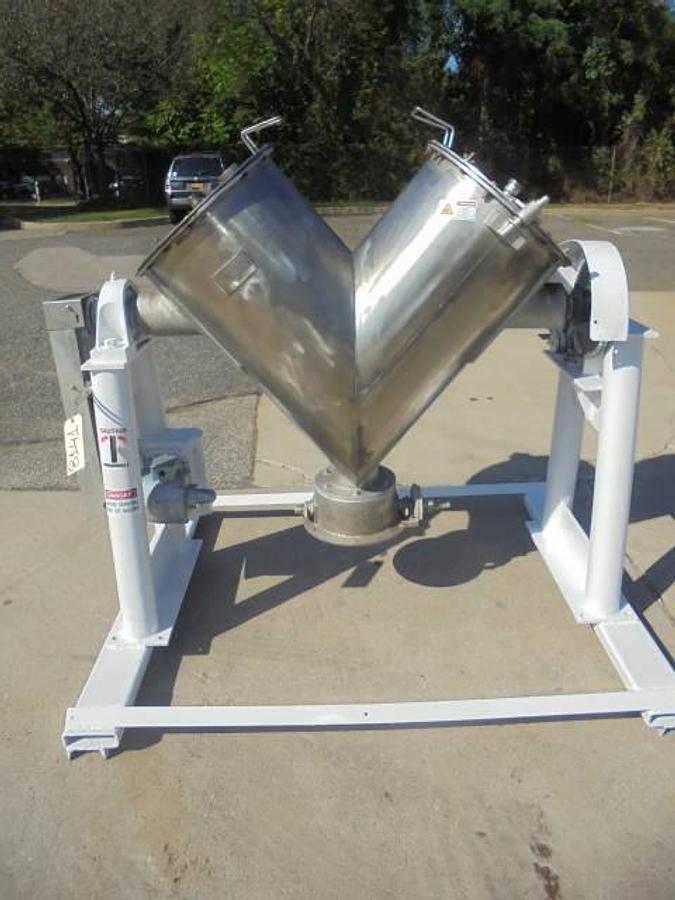
A Twin Shell V-Blender, sometimes called a V-cone blender or double cone blender, is an industrial dry blending machine designed for mixing free-flowing powders and granules. The defining feature is its V-shaped shell, which consists of two cylindrical legs joined at an angle. As the shell rotates on a horizontal axis, the material inside is repeatedly split and recombined as it moves between the two legs. This tumbling, splitting, and recombining action produces a highly uniform blend without generating significant heat or mechanically stressing the material, which makes it well suited for fragile granules, pharmaceutical powders, food ingredients, and chemical compounds.
The process is gentle compared to high-shear mixers, which is an important distinction when working with materials that could degrade under aggressive mechanical action. Twin Shell V-Blenders are widely used in pharmaceutical manufacturing, food processing, nutraceutical production, and specialty chemical blending. The 5 cubic foot capacity size, such as the Expert Hass unit commonly found on the used equipment market, is considered a pilot-to-production scale machine, capable of handling meaningful batch volumes while still fitting within smaller processing facilities. Cycle times typically range from 15 to 30 minutes depending on the material properties and the desired blend uniformity.
What is an intensifier bar on a Twin Shell V-Blender and why does it matter?
An intensifier bar is a high-speed rotating bar mounted inside the shell of a Twin Shell V-Blender. While the outer shell tumbles at a relatively slow speed to gently fold and recombine the bulk material, the intensifier bar spins at a much higher RPM and acts as a dispersion tool. Its primary purpose is to break apart agglomerates, which are clumps of fine powder particles that have stuck together due to moisture, electrostatic charge, or cohesive properties. Without an intensifier bar, these clumps would simply tumble through the blending cycle intact, resulting in a non-uniform final blend.
For processors working with fine powders, pigments, pharmaceutical actives, or any material prone to clumping, the intensifier bar is essentially a necessity rather than an optional add-on. It significantly expands the range of materials a V-Blender can handle effectively. When evaluating a used Twin Shell V-Blender with an intensifier bar, buyers should pay close attention to the condition of the bar itself, including the integrity of the blades or pins, the seals around the bar's shaft penetration points, and the drive motor. These components see considerable mechanical stress over the life of the machine and are important inspection points before purchase.
What should I inspect when buying a used Expert Hass Twin Shell V-Blender?
Buying a used industrial blender requires a more thorough evaluation than purchasing standard off-the-shelf equipment. For a Twin Shell V-Blender like the Expert Hass 5 cubic foot model, the inspection should start with the shell itself. Look carefully at the interior surface finish, welds, and any polishing. Scratches, pitting, or corrosion inside the shell can be problematic for sanitary applications and may indicate the machine was used with abrasive or corrosive materials. Check that the shell halves seal properly at the split line and that discharge valve seats and seals are intact and undamaged.
Beyond the shell, the drive system deserves close attention. Examine the gearbox, drive chain or belt, and motor for signs of wear, leaks, or unusual noise during operation. If the unit includes an intensifier bar, inspect the bar's seals and shaft bearings, as these are wear components that can be costly to replace. Reputable used equipment dealers will typically accommodate in-person inspections or provide detailed video walkthroughs of the machine. Some units may still be in production at a facility, allowing buyers to observe the machine running under real conditions. Keep in mind that most dealers do not have the permitting or setup to run actual product through the machine during a dealer-site inspection, so understanding the machine's history and requesting documentation of its last use can be very helpful in assessing overall condition.
What industries commonly use a 5 cubic foot Twin Shell V-Blender?
The 5 cubic foot Twin Shell V-Blender occupies a practical middle ground between small laboratory units and large production-scale machines. This size is particularly common in pharmaceutical manufacturing, where it is used for blending active pharmaceutical ingredients with excipients prior to tablet compression or capsule filling. The gentle tumbling action of the V-Blender is well suited to pharmaceutical work because it avoids heat buildup and minimizes particle degradation, both of which are critical when working with sensitive active ingredients.
Outside of pharma, this capacity blender is regularly used in nutraceutical and dietary supplement production, specialty food ingredient blending, cosmetic powder mixing, and fine chemical processing. Contract manufacturers who handle multiple product lines often favor this size because it offers meaningful batch output without requiring the floor space or infrastructure of a larger machine. The 5 cubic foot designation refers to the total shell volume, with working capacity typically around 50 to 60 percent of total volume to allow proper material movement during blending. For a used unit like the Expert Hass model, understanding the specific industry it was previously used in can help a buyer assess cleaning history, material residue concerns, and whether the machine's configuration is compatible with their intended application.
How is the capacity of a Twin Shell V-Blender measured and what does 5 cubic feet mean in practice?
The rated capacity of a Twin Shell V-Blender refers to the total internal volume of the shell, measured in cubic feet or liters. However, the actual working or loading capacity is typically 50 to 60 percent of the total shell volume. This is not a limitation of the machine design but rather a deliberate operational requirement. The blending action depends on the material moving freely between the two legs of the V during each rotation. If the shell is overfilled, the material cannot split and recombine properly, and blend uniformity suffers significantly.
For a 5 cubic foot unit, this translates to a practical working volume of roughly 2.5 to 3 cubic feet of material per batch. Converted to weight, the actual batch size depends entirely on the bulk density of the material being processed. A light, fluffy powder might yield a batch of only a few kilograms, while a dense granular material could yield substantially more. Buyers should calculate their target batch weight against the bulk density of their specific material to confirm that a 5 cubic foot machine meets their throughput requirements. This calculation is especially important when purchasing used equipment, since resizing after purchase is not an option and the machine's capacity is fixed by its physical dimensions.
What are the typical material compatibility considerations for a stainless steel V-Blender?
Twin Shell V-Blenders intended for pharmaceutical, food, or nutraceutical applications are almost always constructed from stainless steel, typically 304 or 316L grades. The interior contact surfaces are polished to a specified finish, often measured in Ra (roughness average) values, to meet sanitary standards and prevent material from adhering to the shell walls. The grade and surface finish of the stainless steel directly affects which materials the machine can process and how thoroughly it can be cleaned between batches.
For a used machine, material compatibility history is an important due diligence point. A blender previously used with highly abrasive materials may show interior surface wear that could compromise its suitability for pharmaceutical or food-grade use. Similarly, a unit used with corrosive compounds may have surface damage that is not immediately visible without close inspection. Buyers should ask the seller about the machine's prior application and request any available documentation on the materials it processed. When inspecting the unit, pay attention to discoloration, etching, or roughness on the interior shell surfaces, as these can indicate exposure to chemicals or cleaning agents that may have degraded the surface finish over time.
How does shipping and rigging work for a used industrial blender like a Twin Shell V-Blender?
Industrial blenders of this type are heavy, precision-fabricated machines that require careful handling throughout the shipping process. The shell, drive frame, and motor assembly must be properly secured to prevent movement during transit. Depending on the machine's size and weight, shipping typically involves palletizing or custom crating, and the level of packaging directly affects both the cost and the safety of the shipment. Buyers should ask the seller specifically what packaging will be used and whether the cost of crating is included in the quoted price or billed separately.
For machines of this scale, loading and unloading at each end of the shipment often requires a forklift or crane, and rigging costs can add meaningfully to the total landed price of the equipment. Buyers should request a full breakdown of all costs involved, including rigging at the seller's facility, freight charges, and any unloading requirements at the destination. It is also worth confirming the dimensions and weight of the machine in its shipping configuration to ensure the receiving facility has the equipment needed to unload it safely. Freight damage claims on industrial equipment can be difficult to resolve, so proper packaging upfront is far more practical than dealing with a damaged machine after delivery.
What payment terms are typical when purchasing used industrial mixing equipment?
Used industrial equipment transactions generally follow straightforward payment terms, though the specifics can vary by dealer. In most cases, full payment is required before the machine is released for shipment. This is standard practice in the used equipment industry and reflects the nature of the transaction, since the seller is transferring ownership of a physical asset that cannot be easily returned once shipped. Buyers purchasing from a dealer for the first time should expect to pay in full prior to shipping.
For buyers who have an established relationship with a particular dealer and a track record of repeat purchases, some dealers may extend payment terms on a case-by-case basis. Acceptable payment methods vary by dealer but commonly include wire transfer, ACH, and in some cases credit cards, though card payments may carry a processing fee. Before committing to a purchase, buyers should clarify the accepted payment methods and confirm the exact timing of when payment is due relative to the shipping schedule. Understanding the full payment and shipping timeline upfront prevents delays and ensures the transaction proceeds smoothly for both parties.
How can I verify the condition of a used Twin Shell V-Blender before buying?
Verifying the condition of used industrial equipment before purchase is a critical step that buyers should not skip. Reputable used equipment dealers typically offer several inspection options. In-person inspections allow a buyer or their representative to physically examine the machine, check surface conditions, review the drive components, and assess overall mechanical condition firsthand. This is the most thorough option and is especially worthwhile for higher-value equipment or when the buyer has specific technical requirements the machine must meet.
For buyers who cannot travel to inspect in person, video inspections have become a widely accepted alternative. A dealer can walk through the machine on a live video call, showing specific components the buyer wants to examine, or provide a pre-recorded detailed video of the machine. Some units are still installed and operating at a production facility at the time of sale, which can allow for observation of the machine running under real conditions, though actual product testing is generally not feasible at a dealer's location due to permitting and operational constraints. Buyers should also ask about the machine's service history, the reason it is being sold, and how long it has been out of service if it is decommissioned. All of this context helps build a clearer picture of what to expect and informs a more confident purchasing decision.
What should buyers know about parts availability and manufacturer support for used industrial blending equipment?
Parts availability is one of the most practical considerations when purchasing any used industrial machine, and it deserves careful attention before committing to a purchase. The age and model of the machine directly influence what level of support a buyer can expect from the manufacturer. For some models, manufacturers continue to stock replacement parts and offer technical support regardless of machine age. For older or discontinued models, parts may need to be sourced from third-party suppliers, fabricated custom, or salvaged from other machines of the same type.
Buyers should contact the manufacturer directly before finalizing a purchase to ask specifically about parts availability for the model and serial number in question. This conversation can reveal whether critical wear components like seals, gaskets, shaft bearings, and drive parts are still stocked, and what the typical lead times and costs look like. For a machine with an intensifier bar, the seals around the bar's shaft penetration are particularly important to ask about, as these are wear items that will eventually need replacement. Understanding the parts landscape ahead of time allows buyers to budget appropriately and avoid surprises after the machine is installed and in production.