Category
Manufacturer
Model
FAQ:
What is a rotary bottle filler and how does it differ from a linear filler?
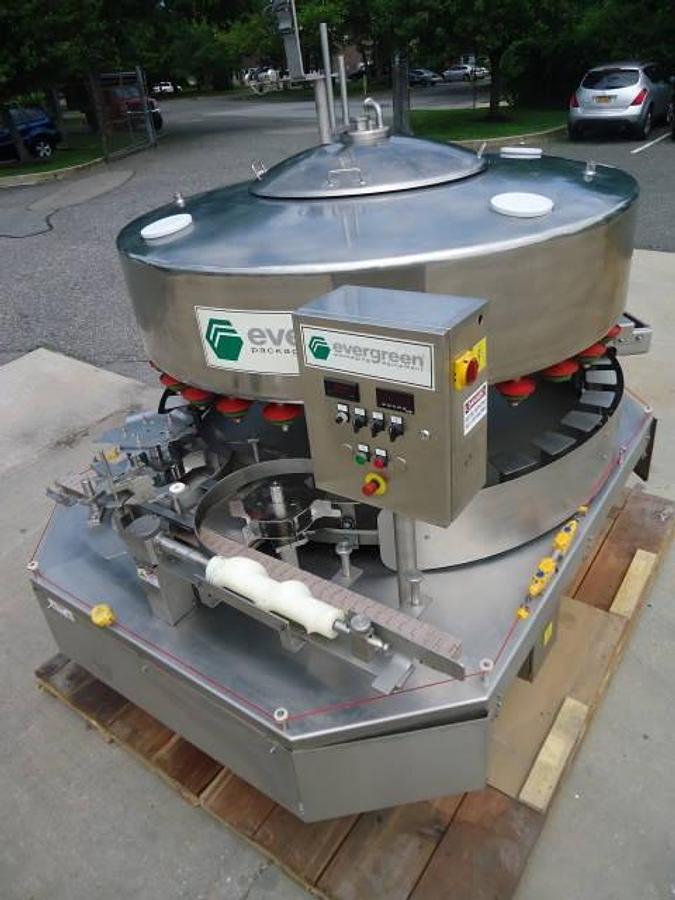
A rotary bottle filler uses a continuously rotating carousel to move bottles through the filling process, allowing multiple bottles to be filled simultaneously at different stations around the wheel. Because the machine never stops moving, it can achieve significantly higher throughput than a linear filler, which fills bottles in a stop-and-go sequence along a straight conveyor path. For medium to high-volume production environments, the rotary design is generally the preferred choice because it reduces cycle time and keeps output consistent even at high speeds.
Linear fillers have their place in smaller operations or when running very short production runs with frequent changeovers, but they typically top out at lower bottles-per-minute rates. Rotary fillers, by contrast, are built for sustained, high-speed production and are commonly found in beverage, food, pharmaceutical, and cosmetic bottling lines where throughput and consistency are critical. The Evergreen rotary bottle filler follows this same design principle, making it well suited for operations that need reliable, continuous output.
What does the 30-valve configuration on the Evergreen rotary bottle filler mean for production output?
The number of valves on a rotary filler directly determines how many bottles can be filled per revolution of the carousel. A 30-valve machine means 30 filling heads are active simultaneously, which translates into very high bottles-per-minute capacity compared to machines with fewer valves. For high-volume bottling operations, this is a significant advantage because output scales with the number of fill heads rather than requiring the machine to run at extreme speeds to hit production targets. Running at moderate speeds with 30 valves active typically reduces mechanical wear and helps maintain fill accuracy.
In practical terms, a 30-valve rotary filler can handle production volumes that would require multiple smaller machines to match, reducing the overall floor space and labor needed. This makes the Evergreen 30-valve configuration a strong candidate for beverage, water, juice, or other liquid bottling lines where throughput demands are high and downtime is costly. Buyers evaluating this machine should confirm the actual RPM range and target bottle size with the seller to get a realistic bottles-per-hour estimate for their specific application.
What types of liquids can a rotary bottle filler like the Evergreen handle?
Rotary bottle fillers are designed to handle a wide range of liquid products, but the specific fill valve type and machine configuration determine what product characteristics are compatible. Thin, free-flowing liquids such as water, juice, spirits, and carbonated beverages are the most common applications. Many rotary fillers can also handle mildly viscous products like oils, syrups, and sauces, provided the fill valves and pump systems are configured appropriately for those viscosities. Foamy or carbonated products typically require counter-pressure filling technology, so buyers should verify whether the specific machine is set up for that.
For pharmaceutical, cosmetic, or chemical applications, the same rotary filling principle applies, but the fill valve materials, seals, and cleaning systems need to meet the relevant regulatory or sanitary standards for those industries. When evaluating a used rotary filler, it is worth asking about the machine's production history, what products it was previously used for, and whether the existing valve and pump configuration matches the intended application. Retrofitting fill heads or valves is possible but adds cost, so confirming compatibility upfront saves time and money.
Is stainless steel construction important in a rotary bottle filler, and what should buyers look for?
Stainless steel construction is a core requirement for any bottling equipment used in food, beverage, pharmaceutical, or cosmetic production. The material resists corrosion from cleaning chemicals and acidic or alkaline products, does not harbor bacteria in the same way that painted or mild steel surfaces can, and meets the sanitary standards required by regulatory bodies in most of these industries. The Evergreen 30-valve rotary filler is described as stainless steel construction, which is a key factor for buyers who need equipment that can be cleaned and sanitized to food-grade or pharmaceutical-grade standards.
Beyond the basic frame and housing, buyers should pay attention to the grade of stainless steel used in product-contact parts such as fill valves, tanks, and tubing. 316L stainless steel is generally preferred for product-contact surfaces in sanitary applications because of its higher resistance to pitting and corrosion compared to 304 stainless. When inspecting a used machine, checking the condition of welds, surface finishes, and seals is important, as worn seals or pitted surfaces on product-contact parts can create sanitation challenges that affect compliance and product quality.
What bottle sizes and container types are typically compatible with an Evergreen rotary bottle filler?
Rotary bottle fillers are generally designed to handle a range of bottle heights, diameters, and neck sizes, but the actual range depends on the specific machine's adjustable components, including the star wheels, guide rails, and filling head height adjustment. Most commercial rotary fillers in the Evergreen class are built for round containers, which are the standard format for high-speed rotary systems. Square or irregularly shaped bottles can sometimes be run but may require custom tooling or slower speeds to maintain stability through the rotary carousel.
Changeover between bottle sizes on a rotary filler typically involves adjusting or swapping the star wheels, infeed and outfeed guides, and fill head heights. The time and complexity of that changeover varies by machine design. Buyers should ask the seller for the documented bottle size range and whether the changeover parts for their target bottle formats are included with the machine. For used equipment, confirming that all changeover components are present and in good condition is an important part of the inspection process, since missing or worn tooling can add unexpected costs after purchase.
How accurate is the fill volume on a rotary bottle filler, and how does it control overfill or underfill?
Fill accuracy on a rotary bottle filler depends on the filling principle the machine uses. Gravity fillers rely on filling to a set level in the bottle, which compensates for minor bottle volume variations but can be affected by product temperature and viscosity changes. Volumetric fillers use a measured chamber or flow meter to dispense a precise volume regardless of bottle geometry. Piston fillers offer very high repeatability and are commonly used for thick or semi-viscous products. The Evergreen rotary filler's specific fill mechanism should be confirmed with the seller, as this directly affects the accuracy achievable in production.
In well-maintained machines, modern rotary fillers can achieve fill accuracy within plus or minus 0.5 to 1 percent of the target fill volume, which is sufficient for most beverage and food applications. Overfill wastes product and increases cost per unit, while underfill creates regulatory and customer satisfaction problems. When evaluating a used rotary filler, asking about the fill accuracy the machine was achieving in its prior production environment gives a useful baseline, though actual performance after installation will depend on proper setup, calibration, and the specific product being run.
What should buyers expect when inspecting a used Evergreen rotary bottle filler before purchase?
Inspecting a used rotary bottle filler requires looking beyond the general appearance of the machine. Key areas to evaluate include the condition of the fill valves and seals, the state of the stainless steel surfaces (checking for pitting, corrosion, or damage to product-contact areas), the mechanical condition of the rotating carousel and drive components, and whether all changeover parts and tooling are present. Electrical components, control panels, and sensors should also be checked for functionality. Most reputable used equipment dealers will accommodate in-person inspections or provide detailed video walkthroughs of the machine so buyers can assess its condition before committing.
One important limitation to keep in mind is that most used equipment dealers do not have the production permits or facilities to run actual product through the machine during an inspection. This means testing is generally limited to dry cycling or running water, rather than a full production trial with the buyer's actual product. Buyers should factor this into their evaluation and, where possible, review any available maintenance records or production history. Consulting with the manufacturer about parts availability and technical support for the specific model and age of the machine is also a smart step, since older models may have limited support or discontinued components.
How difficult is it to clean and maintain a rotary bottle filler between production runs?
Clean-in-place (CIP) capability is one of the most important maintenance features on a rotary bottle filler used in food, beverage, or pharmaceutical production. Machines with CIP systems allow cleaning solutions to be circulated through the product pathways without full disassembly, which significantly reduces downtime between production runs. Not all rotary fillers include a CIP system, and the level of automation in the cleaning process varies by model and configuration. Buyers should confirm whether the machine they are evaluating has CIP capability and what the recommended cleaning procedure is for the products they intend to run.
Beyond cleaning, routine maintenance on a rotary filler includes inspecting and replacing fill valve seals and O-rings, lubricating drive components, checking and calibrating fill levels or volumes, and inspecting the infeed and outfeed star wheels and guides for wear. On a used machine, it is reasonable to budget for seal and gasket replacement as part of the commissioning process, since rubber and elastomer components degrade over time regardless of how well the machine was maintained. Having a service technician familiar with the Evergreen brand perform an initial inspection and tune-up after installation is a practical way to establish a reliable maintenance baseline.
What are the typical power requirements for a commercial rotary bottle filler?
Commercial rotary bottle fillers are industrial machines that typically require three-phase electrical power, most commonly at 480V/60Hz in North American markets or 380-400V/50Hz for European configurations. The exact power draw depends on the size of the machine, the number of fill heads, the drive motor specifications, and what ancillary systems (such as conveyors, cap tighteners, or CIP pumps) are integrated into the unit. A 30-valve rotary filler is a substantial piece of equipment, and buyers should obtain the full electrical specifications from the seller before purchase to confirm compatibility with their facility's power supply.
Beyond voltage and phase requirements, buyers should also consider the amperage draw and whether their facility's electrical panel has sufficient capacity to support the machine. If the machine was originally configured for a different voltage standard, rewiring or transformer installation may be needed, which adds to the total installation cost. Confirming the electrical specifications during the inspection phase, rather than after the machine arrives, avoids costly surprises. The seller should be able to provide the machine's nameplate data or original documentation to clarify the power requirements.
What are the key factors to consider when buying a used rotary bottle filler?
Buying a used rotary bottle filler involves evaluating several factors that go beyond the purchase price. The machine's production history, the types of products it was previously used for, its age, and the overall mechanical and electrical condition are all important starting points. Stainless steel construction, the number and type of fill valves, the bottle size range, and the availability of changeover parts are all specifications that need to match the buyer's production requirements. A machine that looks good on paper but lacks the tooling for the buyer's bottle formats, or has fill heads designed for a different product type, may require significant additional investment to put into production.
Working with a reputable used equipment dealer who specializes in packaging and bottling machinery is one of the most effective ways to reduce risk in this process. Dealers who focus on this category of equipment are more likely to have accurate technical information about the machines they sell, can facilitate proper inspections, and understand the nuances of rotary filler configurations. Buyers should also factor in shipping, rigging, installation, and any refurbishment costs when calculating the total landed cost of the equipment, since these can add meaningfully to the initial purchase price. Reaching out to the manufacturer about parts availability and technical support for the specific model is a useful step before finalizing any purchase decision.