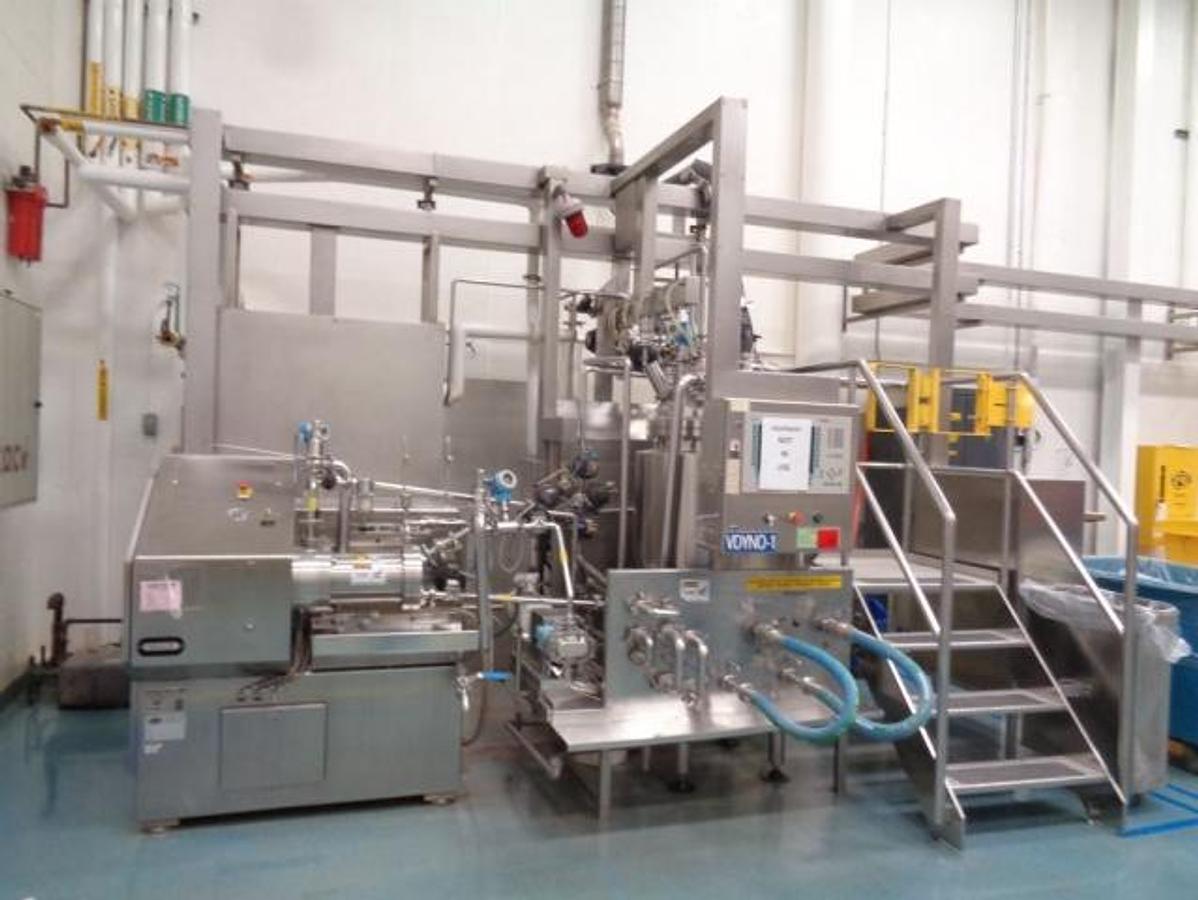
Category
Manufacturer
Model
FAQ:
What is a Dyno-Mill and what is it used for?
A Dyno-Mill is a wet grinding and dispersing mill manufactured by WAB Group (formerly Willy A. Bachofen AG), a Swiss company that has been a recognized pioneer in bead milling technology since the 1950s. The machine works by agitating grinding media, typically glass, zirconium oxide, or ceramic beads, inside a grinding chamber to break down suspended particles in a liquid medium. This process is called agitated bead milling, and it allows operators to achieve extremely fine particle sizes, including results down into the nanometer range, which is under 100nm in some applications. That level of fineness makes Dyno-Mills suitable for demanding work that standard milling equipment simply cannot achieve.
Dyno-Mills are used across a wide range of industries. In pharmaceuticals, they are used for drug nanoparticle formulation, where particle size directly affects bioavailability and dosing consistency. In cosmetics, they help produce stable pigment dispersions and creams. Chemical manufacturers use them for coatings, inks, and adhesives. Food processors rely on them for grinding and refining ingredients that require tight particle size control. Electronics manufacturers use them in the production of materials like battery slurries and conductive pastes. Because the machines can operate in both continuous and batch modes, they fit into a variety of production setups, from small laboratory runs to large-scale continuous manufacturing lines.
What are the main Dyno-Mill models and how do they differ?
WAB Group has developed several distinct Dyno-Mill product lines, each designed for a different scale of operation or application requirement. The Dyno-Mill MULTI LAB is the laboratory-scale model, built for research, formulation development, and small batch testing. It allows scientists and engineers to develop and optimize grinding processes before scaling up to production. The Dyno-Mill KD is a production-scale model designed for high-throughput industrial use, and it is one of the more commonly encountered models on the used equipment market. The Dyno-Mill ECO is engineered with energy efficiency in mind, making it a practical choice for operations looking to reduce power consumption during continuous production runs.
For regulated industries, WAB also produces the Dyno-Mill PHARMA, which is built to GMP (Good Manufacturing Practice) standards. This model includes design features that meet the documentation, cleaning validation, and material contact requirements typical of pharmaceutical and biotech manufacturing environments. Each model shares the core agitated bead milling principle but differs in chamber volume, throughput capacity, construction materials, and compliance certifications. When evaluating a used Dyno-Mill, identifying the specific model is an important first step, as it determines what applications the machine is suited for, what parts and support may be available from the manufacturer, and how the machine fits into an existing production line.
What industries commonly use Dyno-Mill grinding mills?
Dyno-Mill grinding mills are used across a broad range of industries, largely because of their ability to achieve very fine and consistent particle sizes in wet grinding applications. The pharmaceutical industry is one of the most significant users, relying on Dyno-Mills for producing drug nanoparticles, active pharmaceutical ingredient (API) dispersions, and topical formulations. Achieving particle sizes in the sub-micron and nanometer range can directly impact how a drug is absorbed by the body, so precision milling equipment like the Dyno-Mill is considered essential in advanced drug development and manufacturing.
Beyond pharmaceuticals, the cosmetics and personal care industry uses Dyno-Mills to produce pigment dispersions for makeup and skin care products, where color consistency and texture depend on uniform particle size. The coatings, inks, and adhesives sectors use them to grind pigments and fillers to the fineness required for high-performance products. Food manufacturers use Dyno-Mills for applications like chocolate refining and flavor dispersion. The electronics industry has also adopted bead milling for materials like battery electrode slurries and conductive pastes used in circuit board manufacturing. This cross-industry versatility is one reason used Dyno-Mill units remain in demand on the secondary equipment market, as a machine that served one industry can often be redeployed in another with appropriate cleaning and validation.
What particle sizes can a Dyno-Mill achieve?
Dyno-Mills are capable of producing some of the finest particle sizes achievable with milling equipment. Under the right operating conditions, including appropriate bead size, bead material, mill speed, and pass rate, Dyno-Mills can grind particles down into the nanometer range, specifically below 100nm. This makes them suitable for applications where sub-micron particle size is not just desirable but required, such as drug nanoparticle formulation, high-performance pigment dispersions, and advanced electronics materials. Most industrial wet grinding applications fall somewhere in the range of a few hundred nanometers to a few microns, and Dyno-Mills handle this range with consistency.
The actual particle size achieved in any specific application depends on several variables beyond the machine itself. Feed material hardness, the viscosity of the suspension, the size and density of the grinding beads, the number of passes through the mill, and the temperature of the process all influence the final result. Continuous flow configurations generally allow for tighter particle size distributions compared to single-pass batch processing. When purchasing a used Dyno-Mill, it is worth confirming the model's grinding chamber volume and maximum bead size capacity, as these specifications directly affect what particle fineness is achievable. Consulting with the manufacturer about the specific model can help clarify performance expectations based on the machine's age and configuration.
What grinding media is used in a Dyno-Mill?
Dyno-Mills use small spherical beads as the grinding media, and the choice of bead material has a significant effect on milling performance, contamination risk, and the types of materials that can be processed. The most common bead materials are glass, zirconium oxide (also called zirconia), and various ceramic compounds. Glass beads are the most economical option and work well for less abrasive materials and applications where trace contamination from the media is not a concern. Zirconium oxide beads are harder and denser, which makes them more effective for fine grinding and for processing harder feed materials. They also produce less wear debris, which is important in pharmaceutical and food applications.
Bead size is another critical variable. Smaller beads, sometimes as small as 0.1mm in diameter, are used when the goal is to achieve very fine particle sizes or to work with nanoscale materials. Larger beads are better suited for coarser grinding or for breaking down larger feed particles in earlier stages of processing. The grinding chamber design of a specific Dyno-Mill model determines the usable bead size range, so it is important to match the bead selection to the machine's specifications. When buying a used Dyno-Mill, checking whether the machine comes with its grinding chamber and any existing bead inventory can affect the total cost and readiness for production. Replacement beads are generally available through specialty suppliers, but costs vary depending on bead material and size.
Are used Dyno-Mill grinding mills a reliable option?
Used Dyno-Mill machines can be a practical and cost-effective alternative to purchasing equipment directly from a manufacturer, particularly for buyers who need production-capable milling equipment without the lead times and pricing associated with buying new machinery. Dyno-Mills are built to demanding industrial standards, and many units have long service lives when properly maintained. That said, reliability on the used market depends heavily on the condition of the specific machine, its service history, and the reputation of the dealer selling it. Buyers should approach used equipment purchases with appropriate diligence rather than assuming all units are in comparable condition.
Used equipment is sold as-is, which places the responsibility of evaluating condition on the buyer. Reputable dealers with a long track record in industrial and process equipment will typically accommodate in-person inspections, video walkthroughs, or photo documentation of the machine's current state. Some units may still be in active production at a facility, which allows for observation of the machine running. Others may be decommissioned. Keep in mind that dealers generally do not have the permitting or infrastructure to run actual product through a mill for testing purposes, so inspection tends to focus on mechanical condition, completeness of components, and visible wear. Consulting with the manufacturer about parts availability and support for the specific model and serial number is also a smart step before committing to a purchase.
What should buyers look for when inspecting a used Dyno-Mill?
A thorough inspection of a used Dyno-Mill should cover both the mechanical and process-specific components of the machine. On the mechanical side, buyers should examine the condition of the motor, drive system, and shaft seals. Seal wear is a common maintenance point on bead mills, and worn or leaking seals can indicate deferred maintenance or heavy use. The grinding chamber itself should be inspected for wear, pitting, or damage to the interior surface, as this affects both performance and contamination risk. For stainless steel units like the Dyno-Mill KD6, checking for corrosion, weld integrity, and surface finish quality is important, particularly if the machine will be used in food or pharmaceutical applications.
Beyond the machine body, buyers should verify that all key components are present and accounted for. This includes the grinding chamber, the bead separator (which retains grinding media while allowing product to exit), the cooling jacket connections, and any associated pumps or control panels that came with the unit. Missing components can add significant cost and sourcing time after purchase. Asking the dealer for any available service records, prior application history, or documentation of the machine's last use helps establish context for the machine's condition. If an in-person visit is not possible, requesting a detailed video inspection covering all major components is a reasonable alternative. Age and model information should also be shared with the manufacturer to understand what level of parts support and technical assistance is still available.
What maintenance does a Dyno-Mill require?
Regular maintenance on a Dyno-Mill centers on a few key wear components that are subject to the abrasive conditions inside the grinding chamber. Mechanical seals are among the most frequently serviced parts, as they prevent the liquid suspension from leaking out around the agitator shaft. Seal condition should be monitored regularly, and replacement intervals depend on the abrasiveness of the material being processed and the operating hours of the machine. Bearings in the drive assembly also require periodic inspection and lubrication according to the manufacturer's specifications. Neglecting bearing maintenance is one of the more common causes of unexpected downtime on bead mills.
The grinding chamber and agitator discs or pins should be inspected periodically for wear, as surface erosion inside the chamber can affect milling efficiency and potentially introduce wear particles into the product stream. Bead separator screens or gaps should also be checked, since a damaged separator can allow beads to pass into the product. Cooling systems, which regulate temperature inside the grinding chamber during operation, require standard fluid maintenance and inspection of connections and seals. For anyone purchasing a used Dyno-Mill, it is worth budgeting for a baseline maintenance review before putting the machine into production, including replacing seals and inspecting wear parts regardless of how the machine looks externally. Contacting the manufacturer with the model and serial number can help identify which replacement parts are still in production and what the current lead times are.
What should buyers know about shipping a used Dyno-Mill?
Shipping a used Dyno-Mill involves more logistical planning than shipping standard freight, largely because of the machine's weight, precision components, and sensitivity to impact during transit. Proper packaging is essential. Depending on the size and weight of the unit, this may involve custom wooden crating, foam padding around precision components, and securing the machine to a pallet with appropriate strapping. Smaller laboratory models like the MULTI LAB can often be crated with standard methods, while larger production-scale units like the KD series may require more substantial crating or even custom skidding. The level of packaging required directly affects shipping costs, and buyers should ask the dealer for a specific breakdown of crating and freight charges before finalizing a purchase.
Larger Dyno-Mill units may also require specialized rigging for loading at the dealer's location and unloading at the destination. Forklift access, crane services, or other heavy equipment may be necessary depending on the machine's weight and the layout of the receiving facility. These rigging costs are typically separate from freight charges and can add meaningfully to the total landed cost of the equipment. Buyers should account for all of these costs, including crating, freight, rigging at origin, and rigging at destination, when calculating the true cost of acquiring a used Dyno-Mill. Asking the dealer to provide a complete landed cost estimate before purchase helps avoid unexpected expenses after the sale is finalized.
What payment terms are typical when purchasing a used Dyno-Mill?
Payment practices in the used industrial equipment market are fairly consistent across reputable dealers. In most cases, full payment is required before a machine is released for shipping. This is standard practice in the industry and reflects the nature of used equipment transactions, where machines are often one-of-a-kind units and dealers need to confirm payment before committing to packaging, rigging, and freight logistics. Wire transfer is the most common payment method for higher-value equipment purchases, though some dealers may accept other forms of payment depending on the transaction size and buyer relationship.
For buyers who have an established purchasing history with a particular dealer, some flexibility on payment terms may be available, though this varies by dealer and is not the norm for first-time transactions. Before making any payment, buyers should confirm the full scope of what is included in the purchase price, specifically whether the price covers only the machine or also includes the grinding chamber, control panel, associated pumps, and any tooling or spare parts. Understanding exactly what is and is not included prevents misunderstandings at the time of shipment. Buyers should also clarify the timeline between payment and shipment, as crating and rigging preparation can take several days to a few weeks depending on the dealer's workload and the machine's location.