Category
Manufacturer
Model
FAQ:
What types of Donaldson equipment are commonly available on the used market?
Donaldson produces a wide range of industrial filtration and fluid management equipment, and many of these product lines circulate regularly on the used market. The most commonly available categories include Torit dust collectors, compressed air and gas filtration systems, hydraulic and lube filters, engine filtration units, and industrial chillers such as the Donaldson Ultracool Chiller. Buyers will also encounter PowerCore filtration systems and equipment built around Synteq filter media technology, which Donaldson developed for high-efficiency particulate capture in demanding environments.
Used Donaldson equipment tends to be well-represented on the secondary market because the brand is so widely deployed across manufacturing, agriculture, construction, mining, and aerospace facilities. When large plants decommission a production line or upgrade their filtration infrastructure, Donaldson units are frequently among the equipment released for resale. This makes it realistic for buyers to find specific models and configurations that suit their application without purchasing brand-new machinery.
What is the Donaldson Ultracool Chiller and what is it used for?
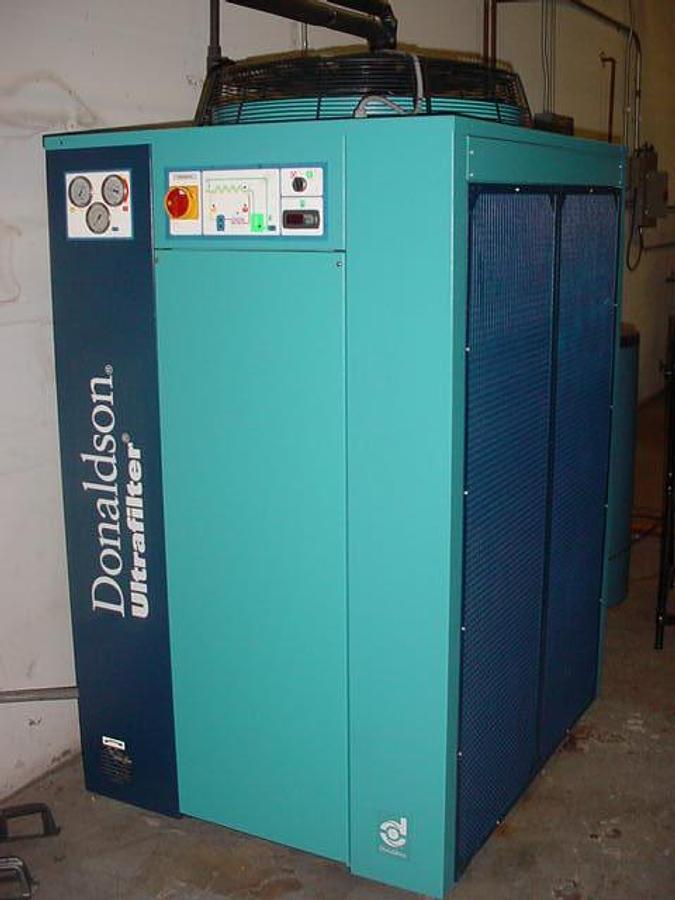
The Donaldson Ultracool Chiller is an industrial cooling unit designed to regulate the temperature of fluids used in machining, manufacturing, and other process-intensive applications. It works by removing heat from coolant or process fluid and recirculating it at a controlled temperature, which helps protect equipment, maintain dimensional accuracy in machining operations, and extend the service life of cutting tools and machine components. These chillers are particularly common in facilities running CNC machining centers, grinding operations, and other precision manufacturing processes where thermal stability is critical.
On the used equipment market, the Ultracool Chiller is a sought-after unit because Donaldson built it with industrial-grade components intended for continuous-duty operation. Buyers considering a used Ultracool Chiller should pay close attention to the cooling capacity (measured in kilowatts or BTUs), the flow rate, and the condition of the refrigeration circuit and pump assembly. An in-person or video inspection is strongly recommended before purchase to assess wear on seals, hoses, and the compressor, since these are the components most likely to show age-related deterioration in a used machine.
Are used Donaldson dust collectors a reliable purchase for industrial facilities?
Donaldson dust collectors, particularly the Torit product line, have a strong reputation for durability and engineering quality, which is one reason they hold their value well on the secondary market. These units are built for continuous industrial use in environments with high particulate loads, and many of them have service lives that extend well beyond a decade when properly maintained. For a buyer willing to do due diligence on a used unit, a Donaldson Torit dust collector can represent significant value compared to the cost of equivalent new equipment.
That said, buyers should approach any used dust collector purchase carefully. Key inspection points include the condition of the filter cartridges or bags, the integrity of the pulse-jet cleaning system (if equipped), the blower motor and housing, and the hopper or discharge mechanism. Because used equipment is sold as-is, it is the buyer's responsibility to assess current working condition. Requesting a video walkthrough or arranging an in-person inspection before committing to a purchase is the most reliable way to understand what you are actually getting. Consulting with Donaldson directly about parts availability for a specific model and serial number is also a smart step, since older models may have limited support.
What industries typically use Donaldson filtration equipment?
Donaldson filtration equipment serves an unusually broad range of industries, which is part of why the brand is so widely recognized among industrial buyers. Core markets include manufacturing (particularly metalworking, woodworking, and plastics), agriculture, construction, mining, oil and gas, food and beverage processing, pharmaceutical production, and aerospace. Each of these sectors relies on filtration for different reasons, whether that is protecting workers from airborne particulate, maintaining hydraulic system performance, managing compressed air quality, or controlling process fluid contamination.
In practical terms, this means used Donaldson equipment shows up across a wide variety of facility types. A dust collector decommissioned from a furniture plant might be perfectly suited for a metal fabrication shop. A hydraulic filtration unit from a mining operation could find a second life in a heavy equipment maintenance facility. Buyers shopping the used market benefit from this cross-industry applicability because it expands the pool of available equipment and often allows them to find a unit that meets their specifications without waiting for a same-industry seller.
How do I identify the right used Donaldson model for my application?
Matching a used Donaldson unit to a specific application requires knowing a few key parameters upfront. For dust collection, the most important variables are airflow capacity (measured in CFM), the type and concentration of particulate being captured, and whether the application requires explosion-proof construction or specific filtration efficiency ratings. For fluid filtration, buyers need to know flow rate, operating pressure, fluid viscosity, and the contamination class required by the downstream equipment. Having these numbers in hand before you start shopping makes it much easier to evaluate whether a specific used unit is actually appropriate.
Once you have a candidate machine, cross-referencing the model number with Donaldson's published specifications is straightforward. Donaldson maintains detailed product documentation, and many dealers who specialize in used industrial equipment can help interpret spec sheets for specific models. It is also worth contacting Donaldson directly to confirm parts availability and ask whether the model is still supported, since the answer can vary significantly depending on how old the unit is. Dealers who specialize in filtration equipment are generally better positioned to help buyers match equipment to applications than general-purpose machinery resellers.
What should I inspect before buying used Donaldson filtration equipment?
Used filtration equipment requires a more focused inspection than many other categories of industrial machinery because the internal components, particularly filter media, housings, and sealing surfaces, are subject to both mechanical wear and chemical degradation depending on what they were filtering. For a used Donaldson dust collector, the inspection checklist should include the condition of the filter cartridges or bags (which may need replacement), the pulse-jet solenoids and diaphragm valves, the fan and motor assembly, the ductwork connections, and the hopper or discharge valve. Any signs of corrosion, patching, or improvised repairs on the housing should be noted and factored into the purchase decision.
For fluid filtration equipment like hydraulic filter assemblies or compressed air systems, focus on the condition of the filter housings, pressure differential indicators, bypass valves, and any instrumentation. Ask the seller whether the unit was in active service recently or has been sitting idle, since long storage periods can affect seals and internal components. Most reputable used equipment dealers will accommodate video inspections or in-person visits, and some equipment may still be installed and running at the original facility, which gives buyers the best possible view of actual operating condition. Keep in mind that dealers typically do not have the permitting or infrastructure to run production processes, so live product testing is rarely an option.
What is the typical price range for used Donaldson dust collectors and filtration systems?
Pricing for used Donaldson equipment varies considerably based on model, size, age, and condition. A smaller benchtop or portable Donaldson filtration unit might sell in the range of a few hundred to a couple of thousand dollars, while a large Torit industrial dust collector with high CFM capacity and pulse-jet cleaning can range from several thousand dollars into the tens of thousands. Industrial chillers like the Ultracool line tend to fall in the mid-to-upper range of that spectrum depending on cooling capacity and configuration. The used market typically offers meaningful savings compared to buying equivalent equipment through standard supply channels.
Buyers should factor in more than just the purchase price when evaluating total cost. Shipping and rigging for large dust collectors or chillers can add substantially to the landed cost, particularly if the unit requires a crane or specialized freight handling. Filter media replacement, any necessary reconditioning, and local installation costs should also be estimated before finalizing a budget. Getting a clear picture of the machine's current condition through inspection, and confirming parts availability with Donaldson for the specific model, will help avoid surprises after the purchase.
How does shipping work for large used Donaldson equipment?
Shipping large industrial filtration equipment like Donaldson dust collectors or chillers is a logistics process that goes well beyond standard freight. Units of this size typically need to be properly prepared for transport, which can involve palletizing, crating, or custom packaging depending on the dimensions and fragility of the components. The cost of that preparation varies and is usually the buyer's responsibility to clarify with the seller before finalizing the purchase. Inadequate packaging is one of the most common causes of transit damage, so it is worth asking specifically how the unit will be secured and protected.
For heavier or more awkwardly sized machines, rigging is often required at both the origin and destination. This means using a forklift, crane, or specialized rigging crew to load and unload the equipment safely, and those services carry their own costs. Buyers should ask the seller for a detailed breakdown of packaging, rigging, and freight charges so they understand the full landed cost of the machine before committing. Lead times for freight shipping of industrial equipment can range from a few days to several weeks depending on distance, carrier availability, and whether the origin facility requires advance scheduling for equipment removal.
What payment terms should I expect when buying used Donaldson equipment from a dealer?
Most used industrial equipment dealers require full payment before a machine ships. This is standard practice in the industry and reflects the logistical reality that once a large piece of equipment is loaded and in transit, reversing the transaction becomes complicated and costly for both parties. Buyers who are purchasing from a dealer for the first time should expect to pay in full upfront, typically by wire transfer, though some dealers accept other forms of payment depending on transaction size.
For buyers with an established relationship with a particular dealer, some sellers will offer payment terms or other arrangements, but this is the exception rather than the rule and is generally extended only to repeat customers with a track record. If you are making a significant purchase and have concerns about the transaction, focusing on dealers with a long history in the industry and a verifiable track record of selling filtration and industrial equipment is the most practical way to reduce risk. Requesting an inspection before payment is also a reasonable and widely accepted practice that reputable dealers will accommodate.
Can I get replacement filters and parts for used Donaldson equipment?
Parts and filter media availability is one of the most important factors to research before committing to a used Donaldson machine, and the answer varies significantly by model and age. Donaldson is a large, well-established manufacturer with a broad distribution network, and for many of its product lines, replacement cartridges, bags, and service parts remain available for years after the equipment leaves active production. However, older or discontinued models can present challenges, and in some cases the specific filter media or a proprietary component may no longer be stocked through standard channels.
The most reliable way to check is to contact Donaldson directly with the model number and serial number of the unit you are considering. Their support team can confirm what parts are currently available and give you a sense of expected lead times. Third-party filter manufacturers also produce compatible media for many Donaldson platforms, which can expand your options and sometimes reduce ongoing operating costs. Dealers who specialize in filtration equipment are often a useful resource here as well, since they tend to have practical knowledge about which models are easy to support and which ones present sourcing challenges.