Category
Manufacturer
Model
Daniels
FAQ:
What types of industrial mixers does Daniels manufacture?
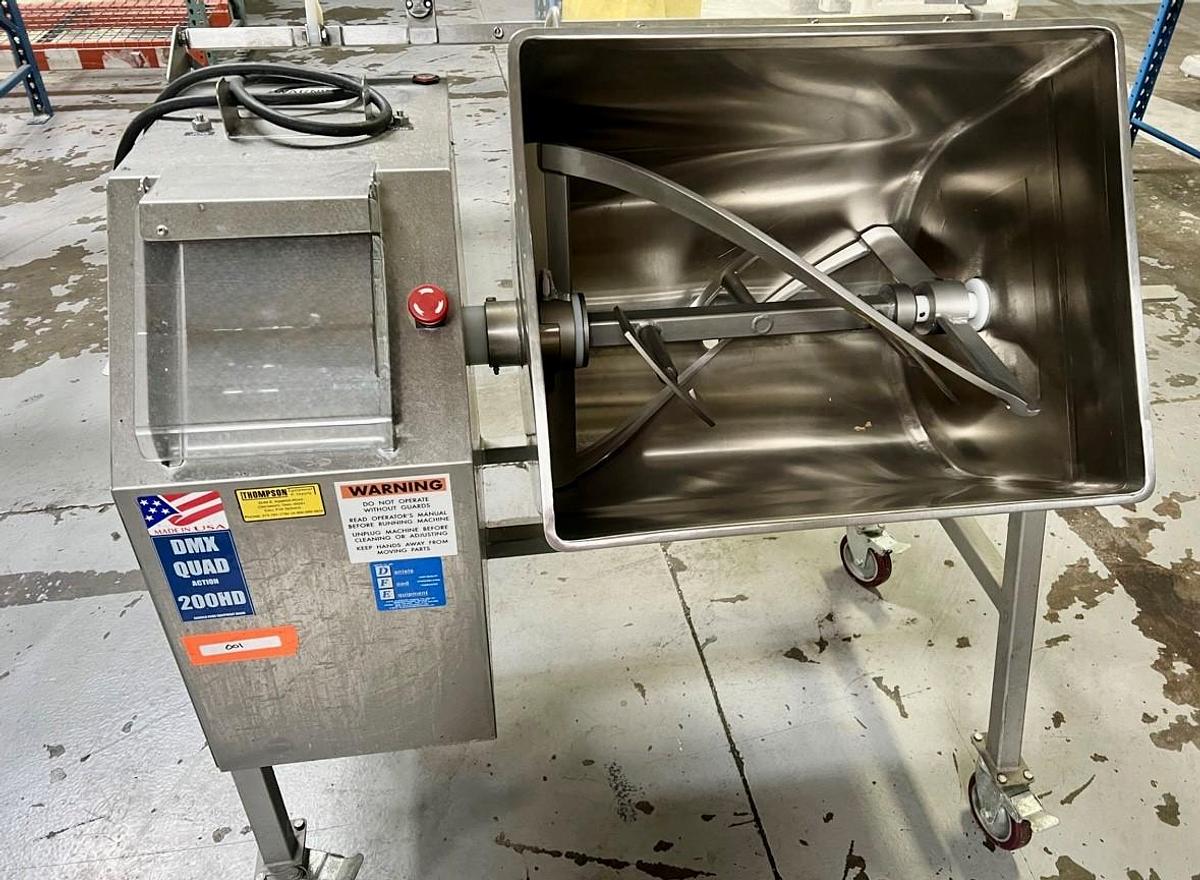
Daniels produces heavy-duty industrial mixing equipment designed for demanding production environments. One of their well-known models is the 200HD, a stainless steel heavy-duty double acting mixer with a tilt feature. The double acting design means the mixing action works in two directions, which improves blending consistency and reduces cycle times compared to single-direction mixers. The tilt function allows operators to discharge product efficiently without manual scooping or repositioning, which is a significant practical advantage in high-volume processing environments.
Beyond the 200HD, Daniels mixers are generally recognized in the industrial equipment market for their durability and suitability across multiple production settings. Buyers evaluating used Daniels equipment should pay close attention to the specific model designation, as mixing geometry, motor configuration, and bowl or vessel capacity can vary considerably between models. Consulting the manufacturer's published specifications for a given model number is a good way to verify that a particular machine matches the intended application before committing to a purchase.
What industries commonly use Daniels industrial mixers?
Daniels industrial mixers are used across a range of production industries where consistent, high-volume blending is required. Food processing operations are among the most common users, particularly facilities producing doughs, batters, sauces, confections, and other viscous or semi-solid products. The stainless steel construction found on models like the 200HD is especially relevant in food-grade environments because stainless steel resists corrosion, does not absorb odors or flavors, and can withstand the rigorous cleaning and sanitation protocols that food facilities must follow to meet FDA and NSF compliance standards.
Beyond food processing, heavy-duty industrial mixers of this type are also used in chemical compounding, pharmaceutical manufacturing, cosmetics production, and certain construction-related applications such as mixing adhesives, sealants, or specialty coatings. The specific suitability of a Daniels mixer for any of these industries depends on the model's construction materials, motor capacity, and mixing mechanism. Buyers should evaluate whether the machine's contact surfaces and seals are appropriate for the chemical properties of their product, particularly in pharmaceutical or chemical applications where material compatibility is a regulatory concern.
Why is stainless steel construction important in an industrial mixer?
Stainless steel is the preferred material for industrial mixer contact surfaces in food, pharmaceutical, and chemical applications for several interconnected reasons. First, it is highly resistant to corrosion from both the products being mixed and the cleaning agents used during sanitation. In food processing environments, mixers are often washed down with caustic cleaners, acidic rinses, or high-pressure hot water, and lesser materials can degrade quickly under those conditions. Stainless steel, particularly grades like 304 or 316, holds up well over years of repeated sanitation cycles.
Second, stainless steel is a non-porous material, which means it does not harbor bacteria in microscopic surface cavities the way that carbon steel or painted surfaces can. This makes it far easier to achieve and verify a sanitary clean, which is a requirement in FDA-regulated food and pharmaceutical facilities. For buyers purchasing a used stainless steel mixer, it is worth inspecting the interior surfaces, welds, and seals closely, either in person or through a detailed video inspection, to confirm that the stainless has not been compromised by pitting, cracking, or improper repairs over the machine's service life.
What should buyers look for when evaluating a used Daniels industrial mixer?
Evaluating a used industrial mixer requires a systematic approach because the machine's condition directly affects how it will perform once installed. The most important areas to inspect are the mixing mechanism itself (paddles, agitators, or blades), the motor and gearbox, the seals and gaskets, and the structural integrity of the vessel or bowl. Wear on mixing elements affects blending efficiency and can introduce metal contamination into product if the wear is advanced enough to cause flaking or cracking. The motor and gearbox should be checked for unusual noise, excessive heat, or visible oil leaks, all of which can indicate deferred maintenance or impending failure.
Reputable used equipment dealers will typically offer buyers the option to inspect machinery in person, through a live video call, or through detailed video documentation of the machine's current condition. Some machines may still be in active production at the facility where they are being sold, which can allow a buyer to observe the equipment running under real operating conditions. Keep in mind that most used equipment dealers do not have the permitting required to run actual product through a machine for testing purposes, so the inspection will generally focus on mechanical condition, visual assessment, and operational cycling rather than a full production trial. Buyers should ask specific questions about the machine's maintenance history, hours of use, and any known repairs before making a purchase decision.
What is the typical price range for used Daniels industrial mixers?
Pricing for used Daniels industrial mixers varies considerably depending on the model, mixing capacity, age, mechanical condition, and included accessories. Smaller or older units in average condition may be priced in the lower thousands of dollars, while larger, more recent, or well-maintained heavy-duty models like the 200HD can command significantly higher prices reflecting their original manufacturing cost and remaining service life. As a general reference point, heavy-duty commercial and industrial mixers in good condition from recognized manufacturers tend to sell in the range of several thousand to tens of thousands of dollars on the used market, depending on capacity and configuration.
Buyers should factor in more than just the purchase price when budgeting for a used industrial mixer. Shipping, rigging, and crating costs can add a meaningful amount to the total landed cost, particularly for heavier machines that require specialized freight handling. If the machine needs any reconditioning, replacement seals, or parts upon arrival, those costs should also be estimated in advance. Contacting the Daniels manufacturer directly to ask about parts availability and support for a specific model number is a practical step that can help buyers gauge the long-term cost of ownership before committing to a purchase.
How does a double acting mixer differ from a standard single-action mixer?
A double acting mixer uses an agitation mechanism that works in two directions simultaneously or in alternating directions, as opposed to a single-action mixer that moves in only one direction. In practice, this means the mixing elements are engaging the product from multiple angles during each cycle, which produces a more thorough and uniform blend in less time. For products that are viscous, have a tendency to stratify, or include ingredients with significantly different densities or particle sizes, a double acting design typically delivers better results than a single-direction unit of comparable capacity.
The double acting configuration is particularly valuable in food processing and chemical compounding applications where consistency across batches is critical for product quality and regulatory compliance. A single-action mixer may leave unmixed zones at the edges of the vessel or require longer cycle times to achieve the same level of homogeneity. When evaluating a used double acting mixer, buyers should verify that both directions of the mixing action are functioning correctly during inspection, since a failure in one direction of movement may not be immediately obvious but will noticeably affect batch quality in production.
What are the power requirements for industrial mixers like those made by Daniels?
Industrial mixers in the heavy-duty category typically require three-phase electrical power, which is standard in most manufacturing and food processing facilities but is generally not available in smaller commercial kitchens or light industrial spaces. Motor horsepower ratings for heavy-duty units can range from a few horsepower for smaller models to 20 horsepower or more for large-capacity machines designed to handle dense or highly viscous materials. The specific voltage and phase requirements for a given Daniels model will be listed on the machine's motor nameplate and in the manufacturer's published specifications.
Buyers purchasing used equipment should confirm that their facility's electrical infrastructure can support the machine's power requirements before finalizing a purchase. Upgrading electrical service to accommodate a high-horsepower three-phase motor can be a significant added cost if the infrastructure is not already in place. It is also worth noting that used machines may have been wired for a specific voltage configuration (such as 208V, 230V, or 460V three-phase) that may differ from what is available at the buyer's facility, and rewiring or transformer costs should be factored into the overall budget.
Do used industrial mixers come with a warranty?
Used industrial mixing equipment is typically sold on an as-is basis, which is standard practice across the used machinery industry. Warranties are generally offered by original equipment manufacturers on machines sold directly from the factory, not by used equipment dealers who are reselling machinery that has already been in service. This places the responsibility of assessing the machine's condition squarely on the buyer, which is why thorough inspection before purchase is so important.
To protect their interests, buyers should work with used equipment dealers who have a long, verifiable track record of selling industrial machinery and who specialize in the relevant equipment category. A reputable dealer will be transparent about a machine's known condition, facilitate inspection opportunities, and provide accurate documentation. Buyers should also contact the Daniels manufacturer directly to understand what level of technical support, parts availability, and service documentation they can expect for the specific model being considered, since older or discontinued models may have limited manufacturer support regardless of where the machine is purchased.
What should buyers understand about shipping and rigging costs for industrial mixers?
Shipping a heavy industrial mixer involves more logistical complexity than standard freight, and the associated costs can be substantial depending on the machine's size and weight. Most heavy-duty industrial mixers require specialized packaging, including custom crating or palletization, to prevent damage during transit. The level of packaging required will affect the shipping cost, and buyers should ask the dealer specifically what packaging will be provided and whether that cost is included in the quoted price or billed separately. Larger machines may also require flatbed freight or other specialized transport arrangements rather than standard LTL shipping.
Rigging is another cost that buyers sometimes overlook. Loading a heavy mixer onto a truck at the seller's location and unloading it at the buyer's facility often requires a forklift, crane, or other lifting equipment, and the cost of that service is typically the buyer's responsibility at the destination. Buyers should get a clear breakdown of all costs, including rigging at origin, freight, and destination unloading, before finalizing a purchase so that the full landed cost of the machine is understood. Unexpected logistics costs can significantly change the economics of a used equipment purchase, particularly for buyers who are comparing the cost of a used machine against other capital equipment options.
What mixing capacity considerations matter most when selecting an industrial mixer?
Capacity selection is one of the most consequential decisions in choosing an industrial mixer, and getting it wrong in either direction creates production problems. A mixer that is too small for the intended batch size forces operators to run multiple batches where one would suffice, reducing throughput and increasing labor costs. A mixer that is significantly oversized for the typical batch may not mix effectively, since many mixing mechanisms require a minimum fill level to function correctly. The general guidance in the industry is to select a mixer whose rated capacity is somewhat larger than the maximum batch size, typically by a margin of 20 to 30 percent, to allow for product expansion and to avoid overfilling.
For used equipment purchases, buyers should verify the rated working capacity of the specific machine being considered, not just the gross vessel volume, since these figures are not the same. The working capacity accounts for the practical fill limits of the mixing mechanism and the headspace needed to prevent spillage or inefficient mixing. Mixing capacity requirements should also be evaluated alongside the product's viscosity and density, since a mixer rated for a given volume of a light, free-flowing material may handle a significantly smaller volume of a dense or highly viscous product effectively. Discussing these parameters with the dealer and, if possible, with the Daniels manufacturer's technical team can help buyers confirm that a specific used machine is appropriate for their application.