Category
Manufacturer
Model
FAQ:
What types of equipment does Cora Industrial Stainless Corporation manufacture?
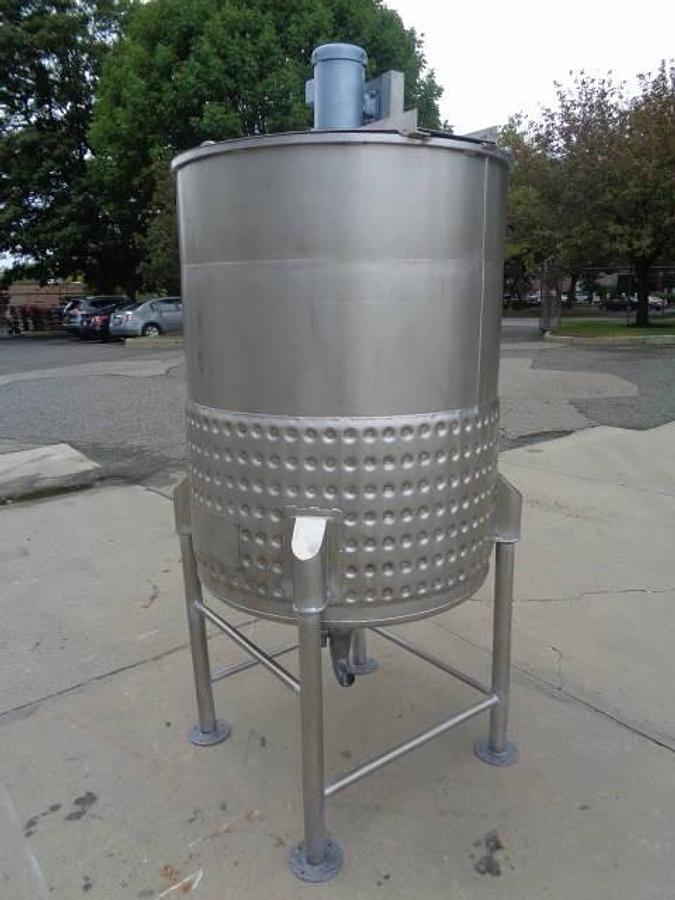
Cora Industrial Stainless Corporation specializes in stainless steel processing equipment designed for sanitary and industrial applications. Their product line includes mix tanks, jacketed vessels, dimple jacketed tanks, and related processing equipment built to handle food-grade, pharmaceutical, dairy, beverage, and chemical applications. The dimple jacketed design on their mix tanks, for example, allows for precise temperature control by circulating heating or cooling media through the jacket without the bulk of a full conventional jacket.
Because this equipment is built from stainless steel and designed around sanitary standards, it tends to hold up well over many years of production use. That durability is a big part of why used Cora stainless equipment remains in demand on the secondary market. Buyers looking at used units should pay close attention to the condition of welds, interior surfaces, and any fittings or agitator components, as these areas reflect how well the equipment was maintained during its service life.
What grades of stainless steel are typically used in industrial mix tanks and jacketed vessels?
The two most common grades found in sanitary industrial equipment are 304 and 316 stainless steel. Type 304 is the workhorse of the industry, offering good corrosion resistance, ease of cleaning, and compatibility with a wide range of food and beverage applications. Type 316 adds molybdenum to the alloy, which significantly improves resistance to chlorides and aggressive cleaning chemicals, making it the preferred choice for pharmaceutical processing, marine environments, and any application involving frequent CIP (clean-in-place) cycles with chlorine-based sanitizers.
When evaluating used stainless equipment, confirming the actual grade is important. Reputable used equipment dealers can often provide material certifications or mill test reports if the original documentation was retained. If paperwork is unavailable, a qualified technician can perform a basic PMI (positive material identification) test on-site to verify the alloy. Buyers should ask about this upfront, particularly for pharmaceutical or FDA-regulated applications where material traceability may be required.
What industries commonly use Cora Industrial Stainless Corporation equipment?
Stainless jacketed mix tanks and processing vessels from manufacturers like Cora Industrial Stainless are used across a broad range of industries where hygiene, temperature control, and corrosion resistance are non-negotiable. Food and beverage processing, dairy, pharmaceutical manufacturing, nutraceuticals, cosmetics, and specialty chemical production are the most common end markets. The combination of a sanitary interior finish and a dimple or conventional jacket makes this type of equipment particularly well-suited for batch processing operations that require heating or cooling during mixing.
On the secondary market, used Cora stainless tanks frequently find new homes in craft beverage operations, contract manufacturers scaling up production, and startups that need production-ready equipment without the lead times and costs associated with ordering fabricated-to-spec vessels. A 225-gallon jacketed mix tank, for instance, is a practical size for pilot-scale production or smaller batch operations across all of these sectors.
What does 'dimple jacketed' mean on a stainless mix tank?
A dimple jacket is a type of heat transfer jacket applied to the exterior of a tank wall. Instead of a full conventional jacket that surrounds the tank with a large annular space, a dimple jacket uses a pattern of embossed dimples welded to the tank shell, creating small channels through which a heating or cooling medium (steam, hot water, glycol, or chilled water) circulates. This design provides efficient heat transfer across a large surface area while keeping the overall weight of the tank lower than a full jacket would.
Dimple jackets are popular in food, dairy, and pharmaceutical applications because they allow precise temperature control, handle higher pressures than many half-pipe or full-jacket designs, and are relatively easy to inspect and maintain. On a used tank, the condition of the jacket connections, inlet and outlet ports, and any pressure rating documentation are important things to verify before purchase. Buyers should ask the seller whether the jacket has been pressure-tested or if any repairs have been made to the jacket welds.
Does used stainless processing equipment meet FDA and sanitary industry standards?
Whether a used stainless tank or vessel meets FDA, 3-A Sanitary Standards, or USDA requirements depends on how it was originally fabricated and how it has been maintained. Equipment built to these standards originally will have features like crevice-free interior welds, polished contact surfaces (typically a minimum 150-grit or Ra 32 microfinish for food-grade), sanitary clamp fittings, and drain-capable designs. The standards themselves apply to the design and finish of the equipment, not to whether it is used or recently fabricated.
Buyers purchasing used sanitary equipment for regulated applications should request any available documentation, including original fabrication drawings, surface finish records, and inspection certifications. If documentation is missing, a qualified sanitary equipment inspector or your quality assurance team should physically assess the interior surface condition, weld quality, and fitting types before the equipment is placed into service. Re-polishing or re-passivating a used stainless vessel is sometimes done to restore it to a compliant surface condition.
What should buyers inspect when evaluating used stainless steel tanks and mix vessels?
A thorough inspection of a used stainless tank should cover both the structural and functional aspects of the vessel. On the structural side, look closely at interior welds for pitting, crevices, or repairs that could harbor bacteria or compromise the vessel's integrity. Check the interior surface finish for scratches, gouging, or corrosion, particularly around agitator shaft seals, bottom outlets, and any nozzle penetrations. On jacketed tanks, inspect the jacket connections and ask whether the jacket has been pressure-tested recently.
Functionally, if the tank includes an agitator, mixer drive, or any mechanical components, those should be assessed for wear, noise, and shaft runout. Seals and gaskets are consumable items that will likely need replacement regardless of overall condition, so factor that into the total cost. Most reputable used equipment dealers offer in-person inspections, virtual walkthroughs, or video documentation of the equipment so buyers can assess condition before committing. For high-value vessels, arranging a third-party inspection by a qualified equipment appraiser or process engineer is a reasonable step.
How is used industrial stainless equipment typically priced compared to fabricating new vessels?
Used stainless processing equipment is generally priced at a significant discount to the cost of having equivalent vessels fabricated to order. The exact discount varies based on age, condition, configuration, and market demand for that particular size and type, but buyers often find used equipment priced at 30 to 70 percent below current fabrication costs for comparable units. Highly sought-after sizes, sanitary-grade vessels in good condition, and equipment with desirable features like agitators or insulation tend to hold their value better on the secondary market.
The cost advantage of used equipment goes beyond the purchase price. Fabrication lead times for custom stainless vessels can run from several weeks to several months depending on the fabricator's backlog and material availability. Purchasing a used unit that is already built and available for immediate inspection and shipment can dramatically compress the timeline for getting a production line operational. Buyers should account for any reconditioning, re-passivation, seal replacement, or compliance documentation costs when comparing the total landed cost of used equipment against a fabricated alternative.
What are typical payment terms when purchasing used industrial equipment from a dealer?
Most used industrial equipment dealers require payment in full prior to releasing equipment for shipment. This is standard practice in the industry and applies to the majority of transactions, particularly for first-time buyers. Some dealers extend payment terms or financing arrangements to repeat customers or buyers with established credit relationships, but these are handled on a case-by-case basis and are not the norm for one-time purchases.
Buyers should clarify payment expectations early in the purchasing process, including the accepted payment methods (wire transfer is most common for large equipment purchases), any deposit requirements to hold equipment while financing or logistics are arranged, and the timeline between payment confirmation and equipment release. Understanding the full payment schedule upfront, alongside shipping and rigging costs, helps buyers accurately plan the total capital outlay for acquiring the equipment.
How is used stainless industrial equipment typically packaged and shipped?
Shipping used industrial stainless equipment requires careful planning to prevent damage in transit. Smaller tanks and vessels are typically palletized and banded, with protective wrapping applied to finished surfaces, fittings, and any protruding components. Larger or heavier vessels may require custom crating to provide adequate protection, particularly for equipment with agitators, legs, or external components that could be damaged during handling. The level of packaging directly affects shipping costs, and buyers should ask the dealer for specifics on how their equipment will be prepared.
For heavy equipment, rigging costs for loading at the dealer's facility and unloading at the buyer's site are typically separate from freight charges and should be factored into the total landed cost. Large tanks may require a forklift, crane, or specialized rigging crew depending on the weight and configuration. Buyers should confirm the equipment's weight and footprint in advance so they can arrange appropriate unloading equipment on their end. Getting a detailed quote that breaks out packaging, rigging, and freight separately helps avoid surprises when the invoice arrives.
How can buyers verify the condition of used stainless equipment before purchasing?
Used equipment dealers typically offer several options for pre-purchase inspection. In-person visits allow the buyer or their representative to physically examine the equipment, check surface conditions, operate any mechanical components, and take measurements. Virtual inspections via video call are a practical alternative for buyers who cannot travel, and many dealers can also provide detailed video walkthroughs or photo documentation of the equipment on request. For equipment that is still installed and in production at a facility, the dealer can often coordinate access between the buyer and the plant owner.
It is worth noting that most used equipment dealers are not set up to run full production trials, as operating processing equipment commercially requires different permitting and facility infrastructure than a dealer typically maintains. The inspection is therefore focused on the mechanical and physical condition of the equipment rather than a live production run. Buyers with specific process requirements should bring in their own process engineers or equipment specialists to assess whether the unit's configuration, capacity, and condition match their intended application before finalizing the purchase.