Category
Manufacturer
Model
FAQ:
What is a Cook King continuous fryer and how does it differ from a standard commercial fryer?
A Cook King continuous fryer is an industrial-grade frying system designed to process product in an uninterrupted flow rather than in discrete batches. The machine accepts product at one end, moves it through a heated oil bath via a conveyor or similar transport mechanism, and discharges finished product at the other end. This design is built for high-volume food production environments where throughput and consistency matter far more than the flexibility of batch cooking. A standard commercial fryer, by contrast, loads a basket, fries a batch, and then requires the operator to unload before the next cycle begins.
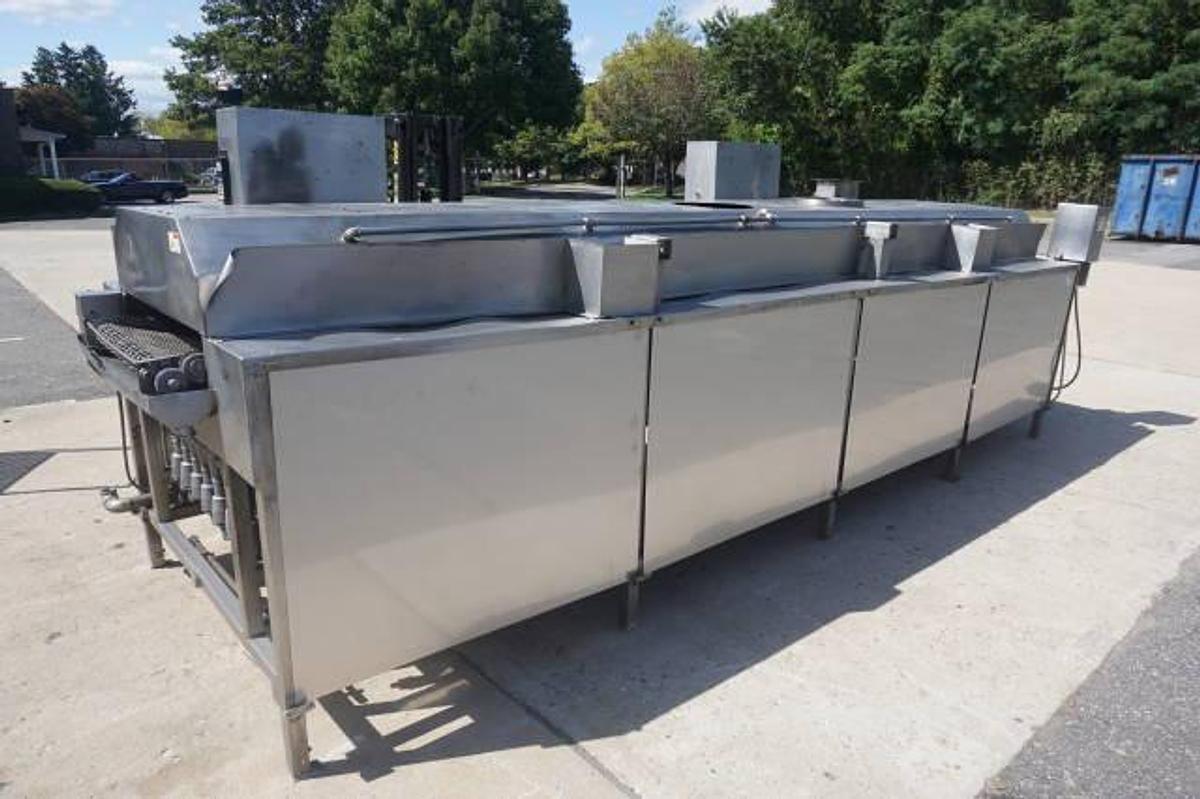
The Cook King unit currently available on the used equipment market is a 30-inch wide by 18-foot long gas-fired continuous fryer, which gives a clear sense of the scale involved. That 18-foot length is typical of production-line fryers used in snack food, poultry processing, seafood, and similar high-output applications. The 30-inch belt or conveyor width allows for significant product volume per pass. Buyers coming from a batch-fryer background should understand that continuous fryers require more floor space, more supporting infrastructure, and typically more experienced operators, but the payoff is a dramatically higher production rate and more uniform frying results across large volumes.
What types of food production facilities commonly use Cook King continuous gas fryers?
Cook King continuous gas fryers are found in facilities that need to fry large quantities of product with consistent results and minimal downtime between cycles. Common applications include snack food manufacturing (potato chips, tortilla chips, pork rinds), poultry processing plants frying breaded chicken products, seafood processors handling battered fish portions, and prepared foods manufacturers producing items like donuts, croutons, or fried appetizers. The continuous design is essentially a requirement once production volumes exceed what any batch fryer can realistically handle during a single shift.
The 18-foot length of the Cook King unit referenced in the used market suggests it was built for a serious production environment, not a small commissary or test kitchen. Facilities evaluating this type of equipment should consider whether their current production line layout can accommodate the machine's footprint, and whether their gas supply and ventilation systems are rated for the BTU demands of a continuous gas-fired fryer of this size. Consulting with a process engineer or the equipment dealer before purchase is a practical step, particularly for buyers who are scaling up from smaller batch equipment.
What should buyers inspect when purchasing a used Cook King continuous fryer?
Buying used industrial frying equipment requires a more thorough pre-purchase evaluation than buying smaller tabletop units. For a continuous fryer like the Cook King, the most critical areas to inspect are the oil pan or trough for pitting, corrosion, or weld failures, the conveyor or transport system for wear on belts, chains, and drive components, and the burner assembly for proper flame pattern and signs of heat damage. The control system, including thermostats, temperature sensors, and any programmable logic controllers, should also be reviewed to confirm all components are present and functional. A fryer that looks clean externally can still have significant internal wear.
Reputable used equipment dealers will typically accommodate in-person inspections or arrange video walkthroughs so buyers can assess the machine's condition before committing. Some equipment may still be installed in an active production facility, in which case the dealer can coordinate access between the buyer and the facility. Keep in mind that most used equipment dealers do not have the permitting or infrastructure to run actual product through the fryer during an inspection, so the evaluation will focus on mechanical and electrical condition rather than live production testing. Buyers who cannot inspect in person should request detailed photos, video of any moving components being operated, and documentation of the machine's service history if available.
What fuel type does the Cook King continuous fryer use, and what are the installation requirements?
The Cook King continuous fryer available on the used market is a gas-fired unit, meaning it relies on a natural gas or propane supply to heat the frying oil. Gas-fired continuous fryers are preferred in high-volume production settings because they deliver rapid heat recovery, which is essential when cold product is continuously entering the oil bath and dropping the oil temperature. Electric continuous fryers exist but are less common at this scale because the energy costs and infrastructure demands of electric heating at high BTU equivalents can be prohibitive.
Installation requirements for a used gas-fired continuous fryer of this size are substantial. Buyers need to confirm that their facility has adequate gas line capacity and pressure to feed the burner system, proper exhaust and ventilation rated for the fryer's output, a level and structurally sound floor capable of supporting the machine's weight (filled with oil, these units are extremely heavy), and appropriate electrical service for any control panels, motors, or sensors. Local fire codes and health department regulations governing commercial frying operations will also apply. It is strongly advisable to have a qualified industrial equipment installer or millwright assess the installation site before the machine arrives, so any infrastructure gaps can be addressed without delaying startup.
How is a used Cook King fryer typically shipped, and what should buyers expect for freight costs?
An 18-foot continuous fryer is a large, heavy piece of industrial equipment, and shipping it requires significantly more planning than standard freight. The machine will typically need to be properly disassembled if necessary, then palletized or crated to prevent damage in transit. The level of packaging directly affects freight cost, and buyers should ask the dealer specifically what packaging is included in the quoted price versus what is an additional charge. Rigging, which refers to the use of forklifts, cranes, or other heavy lifting equipment to load the machine at the origin and unload it at the destination, is almost always an added cost for equipment of this size and weight.
Buyers should request a full landed cost breakdown from the dealer before finalizing a purchase. This means getting clarity on the machine price, packaging and crating fees, rigging at origin, freight to destination, and rigging at the receiving facility. Overlooking any one of these line items can result in a significantly higher total cost than the purchase price alone suggests. It is also worth confirming whether the buyer's facility has a loading dock, forklift, or crane access, since lacking the right unloading equipment can create delays and additional expense on delivery day.
What are the typical payment terms for purchasing used industrial frying equipment?
Used industrial equipment dealers generally require full payment before a machine is released for shipping. This is standard practice in the industry and applies to most transactions regardless of the purchase price. The reasoning is straightforward: once a large piece of equipment is loaded and shipped, the dealer has very limited recourse if payment is not completed. Some dealers may extend payment terms to buyers with whom they have an established relationship and a history of completed transactions, but first-time buyers should expect to pay in full upfront.
Accepted payment methods vary by dealer but commonly include wire transfer, ACH, and in some cases business checks (though checks may require clearance before shipping is authorized). Buyers financing the purchase through a third-party equipment lender should communicate that early in the process, as it can affect the timeline between purchase agreement and actual shipment. Getting a written purchase agreement that clearly outlines the machine description, condition, price, payment terms, and shipping responsibilities is a basic but important step that protects both parties in any used equipment transaction.
What does the 30-inch width and 18-foot length of a continuous fryer mean for production capacity?
The dimensions of a continuous fryer directly determine how much product can be processed per hour. The 30-inch belt width on the Cook King unit means there is roughly 2.5 feet of usable frying surface across the machine, which allows for multiple rows of product to travel through simultaneously. The 18-foot length determines how long any given piece of product spends in the oil, which controls cook time. Operators can adjust conveyor speed to increase or decrease dwell time in the fryer, giving them control over the degree of frying without stopping the line.
To put this in practical terms, a continuous fryer with these dimensions can process a substantial volume of product per shift, far exceeding what any batch fryer could achieve. Exact throughput figures depend on the product being fried, its density, starting temperature, and the target fry time, but facilities using equipment of this size are typically running production volumes measured in hundreds or thousands of pounds per hour. Buyers evaluating this machine should calculate their own required throughput and confirm that the fryer's capacity aligns with their production goals, taking into account factors like oil turnover rate, heat recovery speed, and the capacity of upstream and downstream equipment on the line.
How should buyers assess the condition of a used continuous fryer's oil system and heat components?
The oil system is the heart of any continuous fryer, and its condition is one of the most important factors in evaluating a used unit. Buyers should look closely at the oil pan or trough for signs of corrosion, pitting, or previous repairs, since the constant presence of hot oil accelerates metal degradation over time. Welds along the bottom and sides of the oil trough are stress points that can develop cracks, especially in older equipment that has seen heavy use. Any visible repairs or patches in the oil containment area warrant careful scrutiny and possibly a pressure or leak test before purchase.
The heat exchanger or burner tubes (depending on the fryer's design) should be inspected for scale buildup, warping from thermal stress, and any signs of combustion issues like soot deposits or uneven heat patterns. The oil filtration system, if included, should be checked for filter media condition, pump function, and any leaks in the filtration circuit. Buyers who are not experienced with industrial frying equipment may benefit from bringing in a qualified technician or process equipment specialist to assist with the inspection. A thorough evaluation at this stage can reveal issues that would require costly repairs after purchase, giving the buyer either negotiating leverage on price or the information needed to walk away from a problematic machine.
Are used Cook King fryers a practical option for smaller food businesses looking to scale production?
A used Cook King continuous fryer of the size currently available on the market (30 inches wide, 18 feet long) is not typically a practical fit for a small food business in its early stages. Continuous fryers of this scale are designed for sustained, high-volume production and come with corresponding demands in terms of facility space, gas infrastructure, staffing, and supporting equipment. A small operation that does not yet have consistent order volume to justify running an 18-foot fryer would likely find the machine underutilized, difficult to maintain at optimal oil quality, and expensive to operate relative to output.
That said, a growing food business that is transitioning from a commercial kitchen or co-packer arrangement into its own production facility may find that purchasing a used continuous fryer is a cost-effective way to acquire industrial-scale capacity at a fraction of the cost of buying comparable equipment new from a manufacturer. The key is honest self-assessment of current and near-term production volume, facility readiness, and operational expertise. Buyers in this position should also factor in the cost of installation, any necessary refurbishment, and operator training when calculating the total investment required to bring a used continuous fryer into production.
What support can buyers expect from manufacturers for older used Cook King fryer models?
Before purchasing any used piece of industrial equipment, it is worth contacting the manufacturer directly to understand what level of support is available for the specific model and age of the machine. Manufacturers vary considerably in how long they continue to supply replacement parts and technical documentation for discontinued or older models. For some brands and models, parts remain readily available for decades. For others, key components may be sourced only from third-party suppliers or fabricated custom, which can significantly affect repair costs and downtime when something needs to be replaced.
For a used continuous fryer, the components most likely to need eventual replacement include conveyor drive motors, chain or belt assemblies, burner components, thermocouples and temperature sensors, and control panel parts. Buyers should ask the manufacturer whether these components are still stocked or if they can be sourced through approved suppliers. It is also worth asking whether the manufacturer offers any technical support or service documentation for the model in question, since having access to wiring diagrams, parts lists, and maintenance manuals can make a significant difference in the long-term operability of the equipment. A dealer who specializes in food processing equipment can often provide guidance on parts availability and point buyers toward reliable service resources.