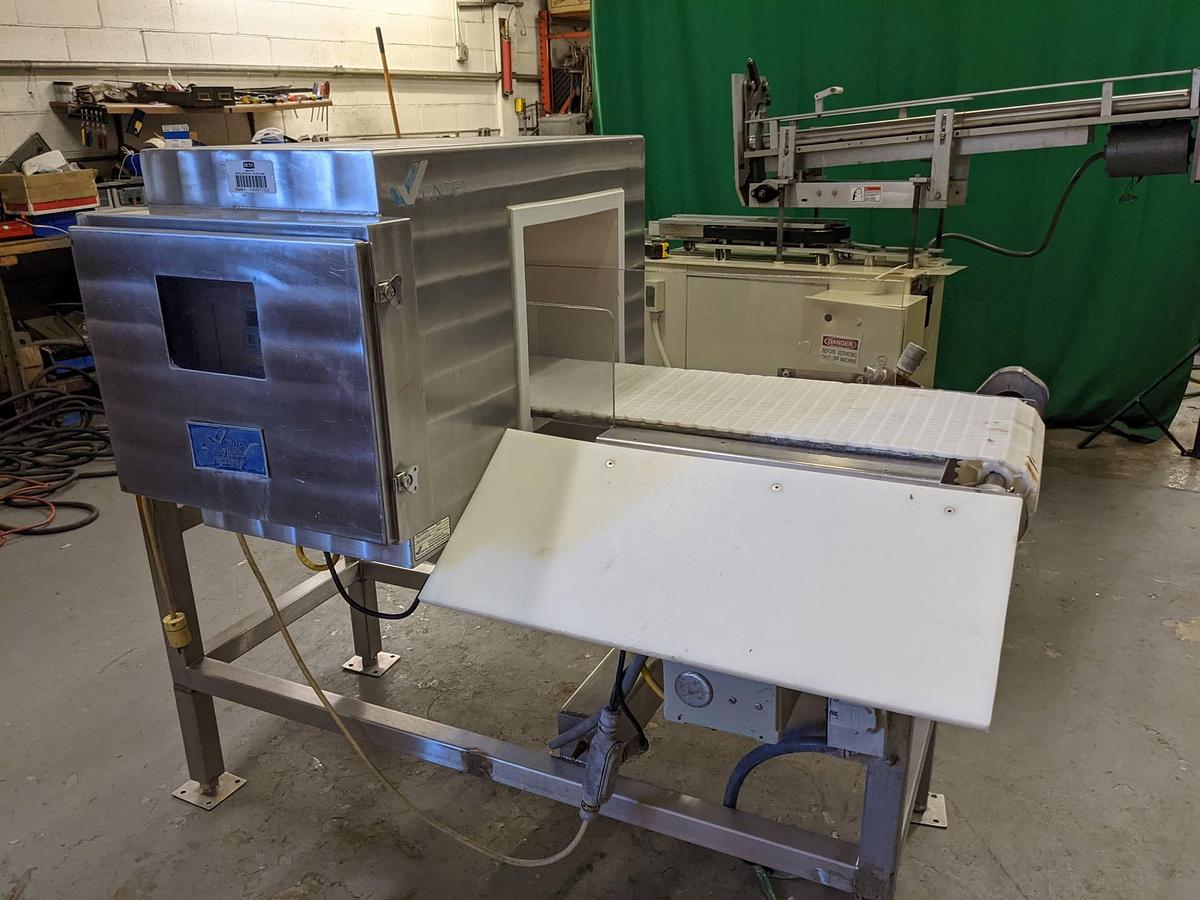
Category
Manufacturer
Model
Cintex
Cintex offers state-of-the-art detection systems for the packaging industry, specializing in metal detection and x-ray inspection systems. Their products are highly valued for ensuring quality and safety in food and pharmaceutical production environments.
FAQ:
What are Cintex metal detectors used for?
Cintex metal detectors are industrial-grade inspection systems designed for use in food processing, pharmaceutical manufacturing, and packaging production environments. Unlike consumer-grade hobbyist detectors, Cintex machines are built to run inline on production lines, scanning products as they move along a conveyor belt to identify metal contaminants before products reach consumers. Their core purpose is quality control and product safety, helping manufacturers catch ferrous, non-ferrous, and stainless steel contaminants that could pose a risk to end users or damage downstream equipment.
The brand is particularly well-regarded in food safety contexts, where regulatory compliance is critical. Cintex detection systems are engineered to meet standards such as HACCP and BRC, which are required by many food retailers and regulatory bodies. Because of this focus, Cintex machines are a poor fit for hobbyist treasure hunting or ground-search applications. Buyers searching for a Cintex detector should understand they are looking at an industrial inspection tool, not a handheld consumer device.
What types of metals can a Cintex industrial metal detector identify?
Cintex industrial metal detectors are capable of detecting all three primary categories of metal contaminants: ferrous metals (such as iron and steel), non-ferrous metals (such as aluminum, copper, and brass), and stainless steel. Stainless steel is generally the most challenging contaminant to detect because it has lower electrical conductivity and magnetic permeability than other metals. Cintex systems are specifically engineered to maintain sensitivity across all three categories simultaneously, which is a key requirement in food and pharmaceutical production where stainless steel equipment fragments are a common contamination risk.
Many Cintex detectors include multi-frequency or self-learning calibration technology that allows the system to distinguish between the product's own signal and that of a metal contaminant, a process sometimes called product effect compensation. This is especially important when inspecting wet, conductive, or high-salt food products that can generate their own electromagnetic signal. The ability to fine-tune detection thresholds for specific products makes Cintex machines adaptable across a wide range of production applications.
How does a Cintex conveyor metal detector work on a production line?
A Cintex conveyor metal detector operates by generating an electromagnetic field through a search head, which is the aperture or tunnel through which products pass on a conveyor belt. When a metal contaminant passes through this field, it disturbs the electromagnetic balance and triggers an alarm signal. The system then activates a reject mechanism, such as an air blast, pusher arm, or diverter, to remove the contaminated product from the line automatically, without stopping production. This inline, automated approach is what makes industrial metal detectors fundamentally different from handheld or ground-search units.
The aperture size of the search head directly affects sensitivity. A smaller aperture provides greater detection sensitivity because the metal contaminant occupies a larger proportion of the electromagnetic field. The Cintex Autosearch SS, for example, features an aperture of approximately 13 3/4 inches by 10 7/8 inches, which is sized for mid-range conveyor applications. Buyers should match aperture dimensions to their specific conveyor belt width and product height to ensure accurate detection without unnecessary false rejects.
What should buyers look for when purchasing a used Cintex metal detector?
Buying a used Cintex metal detector requires a more thorough evaluation process than purchasing new equipment, since used machines are typically sold as-is without manufacturer backing. The most important step is arranging an inspection, either in person or via video, to assess the machine's current working condition. Key things to examine include the state of the conveyor belt and drive system, the condition of the search head and its housing (especially for signs of moisture ingress or physical damage), and whether the control panel powers up and responds correctly. If the machine is still installed at a production facility, a live demonstration with product running through the aperture is the most reliable way to verify detection performance.
Buyers should also contact Cintex directly to ask about parts availability and technical support for the specific model and age of the machine they are considering. Older models may have limited spare parts availability, which can affect long-term serviceability. Choosing a used equipment dealer who specializes in food processing or packaging machinery, rather than a general industrial auction, is also advisable because those dealers are more likely to understand the machine's calibration history and have experience evaluating detection equipment specifically.
How sensitive are Cintex metal detectors, and what affects detection accuracy?
Detection sensitivity in a Cintex industrial metal detector is expressed in terms of the smallest sphere diameter of a given metal type that the system can reliably detect. Typical industrial metal detectors in this class can detect ferrous contaminants as small as 0.5 to 1.0 mm in diameter, non-ferrous contaminants in the range of 0.8 to 1.5 mm, and stainless steel contaminants between 1.0 and 2.5 mm, though exact figures vary by model, aperture size, and product type. Smaller apertures generally yield higher sensitivity, so a machine with a narrow tunnel will outperform a wider-aperture machine when detecting the same size contaminant.
Several factors can reduce detection accuracy in practice. Product effect, where the product itself generates a signal that masks or mimics a contaminant signal, is the most common challenge in food applications. High-moisture products, heavily salted foods, and products containing minerals can all create significant product effect. Cintex systems with auto-learn or phase adjustment features help compensate for this. Mechanical vibration from nearby equipment, improper grounding, and worn conveyor belts can also introduce noise that degrades sensitivity. When evaluating a used unit, it is worth asking whether the machine has been calibrated recently and whether calibration records are available.
Are Cintex metal detectors compliant with food safety regulations?
Cintex metal detectors are designed with food and pharmaceutical safety compliance in mind. Their systems are built to support HACCP (Hazard Analysis and Critical Control Points) programs, which require manufacturers to identify and control physical contamination hazards at critical control points in the production process. Many food retailers and certification bodies, including those administering BRC Global Standards and IFS Food, require that production lines include validated metal detection or x-ray inspection at appropriate stages. A properly installed and validated Cintex system can serve as the critical control point for metal contamination in these programs.
For a used Cintex machine to satisfy compliance requirements at a new facility, it will typically need to be re-validated in its installed configuration. Validation involves running test pieces of known size through the detector at production speed and confirming that the machine reliably detects and rejects them. Buyers should plan for this validation process as part of the installation cost and timeline. Consulting with a food safety auditor or equipment technician familiar with the specific regulatory requirements in their market is advisable before purchasing a used detector for compliance-critical applications.
What is the difference between a Cintex metal detector and a Cintex x-ray inspection system?
Cintex produces both metal detection systems and x-ray inspection systems, and while both are used for quality control in food and pharmaceutical production, they work on different principles and catch different types of defects. Metal detectors generate an electromagnetic field and detect disturbances caused by conductive materials, meaning they are specifically suited to identifying metal contaminants. X-ray systems, by contrast, pass ionizing radiation through a product and measure density variations, allowing them to detect not only metals but also glass, dense plastics, bone fragments, stones, and other high-density foreign objects that a metal detector would miss entirely.
For many production environments, metal detection is sufficient and more cost-effective, particularly when the primary contamination risk is from metal equipment wear or packaging materials. X-ray inspection is typically chosen when a broader range of contaminants needs to be addressed, or when the product itself (such as a metallized film package) interferes with electromagnetic detection. Used Cintex metal detectors are generally more accessible in price than x-ray systems and are a practical starting point for facilities establishing a contamination control program. The right choice depends on the specific contamination risks, product types, and regulatory expectations for a given production environment.
What does the aperture size on a Cintex metal detector mean, and why does it matter?
The aperture on a Cintex conveyor metal detector refers to the opening in the search head through which products pass on the conveyor belt. It is measured in width and height, and the dimensions directly determine what products the machine can inspect. A machine with an aperture of 13 3/4 inches wide by 10 7/8 inches tall, for example, can accommodate products and packaging up to those dimensions as they travel through the detector. If a product is taller or wider than the aperture, it physically cannot pass through, making aperture size a critical specification to match against actual production requirements.
Aperture size also has a direct inverse relationship with detection sensitivity. As the aperture gets larger, the electromagnetic field is spread across a greater area, which reduces the relative signal strength of a small metal contaminant. This means a machine with a large aperture will have a higher minimum detectable contaminant size compared to a machine with a smaller aperture, all else being equal. Buyers should always verify that the aperture of a used Cintex machine matches their conveyor width and maximum product height before purchasing, and should request sensitivity specifications for their specific product type to confirm the machine meets their contamination control requirements.
How is a used Cintex metal detector typically shipped, and what should buyers expect for costs?
Shipping a used Cintex industrial metal detector involves more logistical planning than shipping typical machinery because these systems include sensitive electronic components alongside mechanical conveyor assemblies. The machine will need to be properly palletized or crated before transport to prevent damage in transit. Depending on the size and weight of the specific unit, a standard pallet may be sufficient, or a custom wooden crate may be required to protect the search head and control panel. The level of packaging required will affect shipping costs, and buyers should ask the dealer specifically how the machine will be prepared for freight.
For larger or heavier Cintex systems, loading at the origin and unloading at the destination may require a forklift or other rigging equipment, which adds to the total landed cost. Freight charges for industrial equipment of this type are typically quoted based on weight, dimensions, and distance, and can vary significantly. Most used equipment dealers require full payment prior to releasing equipment for shipment. Buyers should request a complete breakdown of packaging, rigging, and freight costs upfront so they can accurately calculate the total cost of acquiring the machine, not just the listed sale price.
How should buyers inspect a used Cintex metal detector before purchasing?
Inspecting a used Cintex metal detector before purchase is one of the most important steps a buyer can take to protect their investment. Reputable used equipment dealers will accommodate in-person inspections, video walkthroughs, or detailed photo documentation of the machine. During an inspection, buyers should look at the physical condition of the conveyor belt and frame, check for corrosion or damage to the search head housing, and verify that the control panel powers on and displays correctly. If the machine is still installed at a production facility, it may be possible to observe it running in an active production environment, which provides the clearest picture of its current operating condition.
It is worth noting that most used equipment dealers do not have the permits or production infrastructure to run actual food or pharmaceutical products through a detector for a live test, so buyers should not expect a full production simulation at a dealer's warehouse. Instead, buyers can ask for test piece runs using calibrated metal spheres to verify basic detection function. Beyond the physical inspection, buyers should also gather whatever documentation is available, including past calibration records, service history, and the original operating manual if it exists. Contacting Cintex directly with the model and serial number is also a practical step to confirm parts availability and understand what level of manufacturer support, if any, is available for that specific unit.