Category
Manufacturer
Model
FAQ:
What is a ribbon blender and what is it used for?
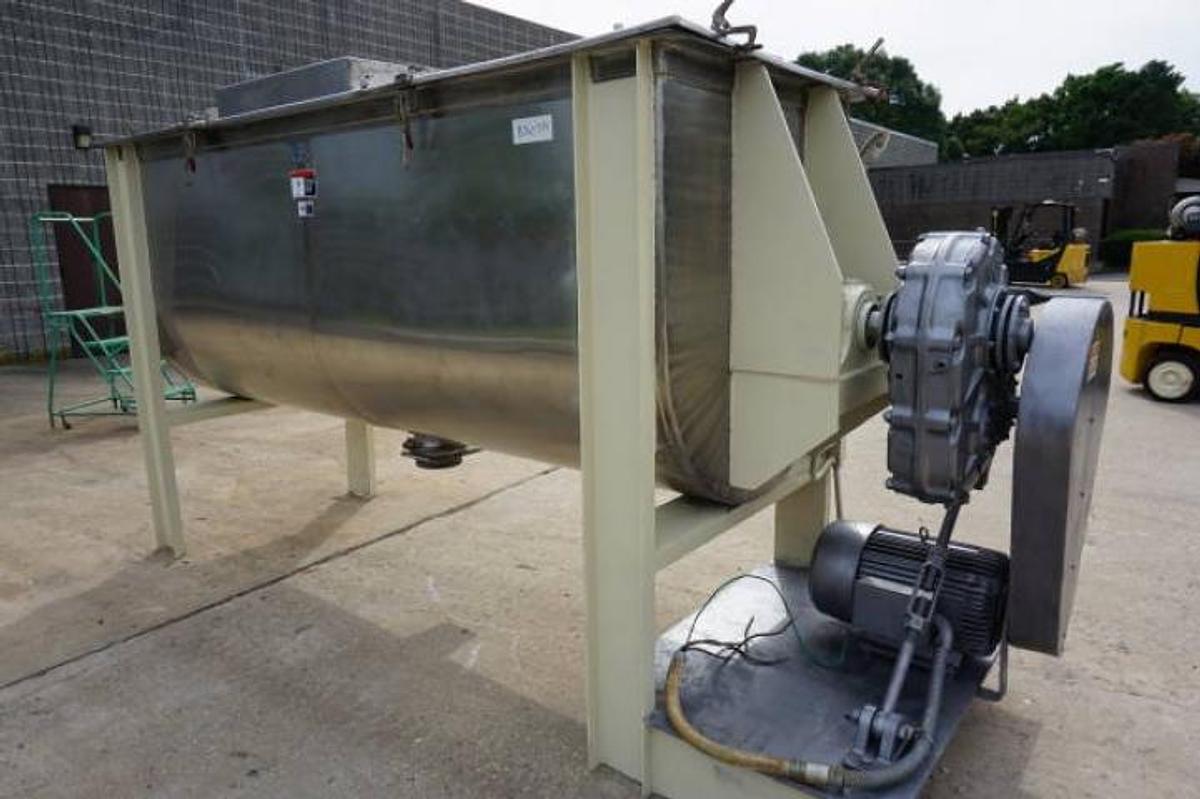
A ribbon blender is a horizontal mixing machine that uses a double helical ribbon agitator mounted inside a U-shaped trough to blend dry, semi-dry, and granular materials. The inner ribbon moves material in one direction while the outer ribbon moves it in the opposite direction, creating a continuous counter-current flow that produces thorough, uniform mixing across the entire batch. This design makes ribbon blenders one of the most effective and widely used mixing solutions in industrial processing.
Ribbon blenders handle a broad range of applications including dry powder blending, granule mixing, coating of particles, and light paste mixing. They are used to combine ingredients that need consistent distribution throughout a batch, such as spice blends, powdered pharmaceuticals, chemical compounds, plastic resins, and cosmetic powders. The enclosed trough design also makes them suitable for materials that need to be kept from contamination or that generate dust during processing. Capacities typically range from small lab-scale units of just a few cubic feet up to large industrial models exceeding 500 cubic feet.
What industries commonly use ribbon blenders?
Ribbon blenders are found across a wide range of industries because of their ability to handle dry and semi-dry materials efficiently. Food processing is one of the largest applications, covering everything from seasoning and spice blends to baking mixes, protein powders, and dry soup bases. Pharmaceutical manufacturers rely on ribbon blenders for blending active ingredients with excipients before tablet compression or capsule filling. The chemical industry uses them for fertilizers, detergents, pigments, and specialty compounds that require consistent particle distribution.
Cosmetics and personal care manufacturers use ribbon blenders for face powders, bath salts, and dry shampoo formulations. Plastics compounders blend resins, colorants, and additives in ribbon blenders before extrusion or molding. Animal feed producers blend nutritional supplements and feed ingredients in large-capacity units. The common thread across all these industries is the need to combine multiple dry or slightly moist ingredients into a homogeneous mixture without damaging particle structure, and ribbon blenders accomplish this with relatively low energy input compared to more aggressive mixing technologies.
What are the key specifications to evaluate on a used ribbon blender?
When evaluating a used ribbon blender, trough capacity is the starting point. Capacity is measured in cubic feet or gallons, and buyers should confirm that the listed capacity matches their batch size requirements, keeping in mind that ribbon blenders are typically loaded to 40 to 60 percent of total trough volume for optimal mixing performance. Motor horsepower is the next critical spec, as it determines whether the machine can handle the bulk density of the materials being processed. A 120 cubic foot unit with a 25 HP motor, for example, is well-suited for moderate-density powders and granules but may be undersized for very heavy or dense materials.
Material of construction is equally important. Stainless steel troughs and ribbons are required for food, pharmaceutical, and many chemical applications due to sanitation standards and corrosion resistance. Carbon steel units are acceptable for non-food industrial applications but should be carefully inspected for rust, pitting, or wear. Buyers should also examine the ribbon agitator for bent flights, worn welds, or clearance issues between the ribbon and trough wall, as tight clearance is essential for thorough mixing and preventing dead zones. The discharge valve type, shaft seals, drive components, and overall structural integrity of the trough should all be assessed before purchase.
Why is stainless steel construction important in a ribbon blender?
Stainless steel is the preferred material of construction for ribbon blenders used in food, pharmaceutical, nutraceutical, and many chemical processing applications for several practical reasons. It resists corrosion from moisture, acids, and cleaning agents, which is critical when the blender needs to be washed down between product runs or sanitized to meet regulatory standards. Stainless steel also does not impart taste, odor, or contamination to sensitive products, which is a requirement in food-grade and pharmaceutical environments. The smooth surface finish possible with stainless steel reduces product adhesion and makes cleaning more thorough and efficient.
From a regulatory standpoint, facilities operating under FDA, cGMP, or food safety certifications are often required to use stainless steel contact surfaces on processing equipment. This makes a stainless steel ribbon blender a long-term asset that can be validated and qualified within a regulated production environment. Carbon steel units, while less expensive, are generally limited to non-food industrial applications such as fertilizers, certain chemicals, and plastics. When purchasing a used stainless steel ribbon blender, buyers should verify the grade of stainless (304 and 316 are most common, with 316 offering better corrosion resistance for chloride-containing environments) and inspect weld quality and surface condition for any pitting or crevice corrosion that could harbor contamination.
What should buyers inspect when purchasing a used ribbon blender?
A thorough inspection of a used ribbon blender should cover both mechanical and structural components. The ribbon agitator itself deserves close attention: check for bent or cracked flights, worn welds at the ribbon-to-shaft connections, and the clearance between the outer ribbon and the trough wall. Tight clearance, typically around 3 to 6 millimeters, is important for efficient mixing and preventing unmixed material from accumulating at the trough bottom. Excessive clearance usually indicates ribbon wear or past damage. The trough interior should be inspected for pitting, cracks, dents, or signs of corrosion, particularly at welds and around the discharge valve opening.
The drive system, including the gearbox, motor, belts or couplings, and bearings, should be examined for wear, leaks, and overall condition. Shaft seals at the trough end plates are another common wear point and can be expensive to replace if damaged. The discharge valve, whether a slide gate, butterfly valve, or flush-bottom design, should open and close smoothly without binding or leaking. Reputable used equipment dealers will typically accommodate in-person or video inspections so buyers can assess the machine's actual condition. Keep in mind that most dealers do not have the permitting or production capabilities to run a full product test, so visual and mechanical inspection combined with a review of the machine's history is the standard due diligence process for used equipment purchases.
Are replacement parts and manufacturer support available for used ribbon blenders?
Parts availability for a used ribbon blender depends heavily on the age of the machine, the manufacturer, and whether the brand is still active in the market. For well-established equipment brands, many wear components such as shaft seals, discharge valves, belts, and bearings are either still available directly from the manufacturer or can be sourced through industrial parts suppliers as standard off-the-shelf components. Ribbon agitators and troughs, being fabricated parts, can often be reproduced by local fabrication shops if exact replacements are not available from the original source.
Before purchasing a used ribbon blender, it is worth contacting the manufacturer directly to ask about parts availability, technical support, and documentation for that specific model and approximate age. Manufacturers vary significantly in how much support they extend to older machines, and some may have limited availability of certain proprietary components. For buyers in regulated industries, the ability to obtain OEM documentation and spare parts is particularly important for equipment qualification purposes. Consulting the manufacturer early in the buying process helps set realistic expectations and can inform whether a particular used machine is a practical long-term investment for a specific application.
What capacity ribbon blender is right for a given production need?
Selecting the right ribbon blender capacity starts with understanding batch size requirements and how the blender fits into the broader production workflow. Ribbon blenders are typically filled to 40 to 60 percent of their total trough volume to allow proper material movement and ribbon action. A 120 cubic foot blender, for instance, would be practically loaded with 48 to 72 cubic feet of material per batch. Buyers need to account for the bulk density of their materials when converting between cubic feet and pounds or kilograms, since a cubic foot of a light powder weighs far less than a cubic foot of a dense granule.
Production throughput requirements should also factor in cycle time, which includes fill time, blend time, and discharge time. A larger blender running fewer cycles per shift may be more efficient than a smaller unit running many cycles, depending on the operation. It is generally better to have some headroom in capacity rather than running a blender at maximum fill, as overfilling reduces mixing efficiency and can strain the drive system. Used ribbon blenders are available across a wide range of capacities, from small units under 10 cubic feet suited for pilot-scale work up to large production units of 200 cubic feet or more, giving buyers flexibility to match equipment to their actual production volumes.
What materials can be processed in a ribbon blender?
Ribbon blenders are well-suited for free-flowing dry powders, granules, flakes, pellets, and crumbles, as well as materials with some moisture content that still maintain a semi-dry, non-sticky consistency. Common examples include flour, sugar, salt, protein powders, spice blends, detergent powders, fertilizer granules, plastic resin pellets, pigment powders, pharmaceutical excipients, and dry chemical compounds. The counter-current ribbon action is gentle enough to preserve fragile particles while still achieving thorough blending, which makes it preferable to more aggressive mixers for friable or shear-sensitive materials.
Ribbon blenders can also handle light pastes and slurries in some configurations, though they are not ideal for high-viscosity or very wet materials, which are better suited to paddle mixers or sigma blade mixers. Materials that are highly abrasive will cause accelerated wear on the ribbon flights and trough, so buyers processing such materials should factor in higher maintenance and replacement costs. Sticky or hygroscopic materials that tend to clump or adhere to surfaces can be challenging in a ribbon blender and may require special coatings, heated troughs, or frequent cleaning cycles to maintain performance. Understanding the physical properties of the target material is essential when evaluating whether a used ribbon blender is the right fit for a specific application.
How does buying a used ribbon blender compare to purchasing new equipment?
Purchasing a used ribbon blender can offer substantial cost savings compared to buying new equipment, often ranging from 40 to 70 percent less than the price of a comparable new machine depending on age, condition, and market demand. For operations that need to add capacity quickly, used equipment is also typically available for faster delivery than new machines, which often carry lead times of several months due to fabrication and custom build requirements. This makes used ribbon blenders particularly attractive for startups, pilot operations, or facilities scaling up production without large capital budgets.
The trade-off is that used equipment comes without the assurances that accompany a new purchase. Used machines are sold as-is, meaning the buyer takes on responsibility for assessing condition, understanding wear, and planning for any refurbishment or parts replacement that may be needed. There is no manufacturer warranty coverage on used equipment, so thorough pre-purchase inspection is critical. Buyers should work with reputable used equipment dealers who have a long track record in the industry and who can provide detailed information about the machine's history, condition, and specifications. Selecting a dealer who specializes in processing and mixing equipment, rather than a generalist, increases the likelihood of accurate technical representation and a smoother transaction.
What should buyers know about shipping and payment for a used ribbon blender?
Ribbon blenders are heavy industrial machines, and shipping costs can be a significant portion of the total landed cost. A 120 cubic foot stainless steel ribbon blender with motor and drive components can weigh several thousand pounds, requiring professional rigging for loading at the origin and unloading at the destination. Buyers should ask the dealer specifically about how the machine will be packaged or crated, what rigging services are included or available, and whether freight is quoted as a flat rate or based on actual carrier charges. Skimping on packaging or rigging to save money upfront can result in transit damage that costs far more to repair.
On payment terms, most used equipment dealers require payment in full before the machine is released for shipment. Some dealers may offer extended terms to repeat customers or established buyers, but this is the exception rather than the rule. Buyers should clarify payment expectations early in the process and factor in the full landed cost, including the machine price, rigging, freight, and any applicable taxes or import duties, before committing to a purchase. Getting a clear, itemized quote that covers all of these costs prevents surprises and makes for a smoother transaction from purchase through delivery.