Category
Manufacturer
Model
FAQ:
What is a CFS continuous fryer and how does it work?
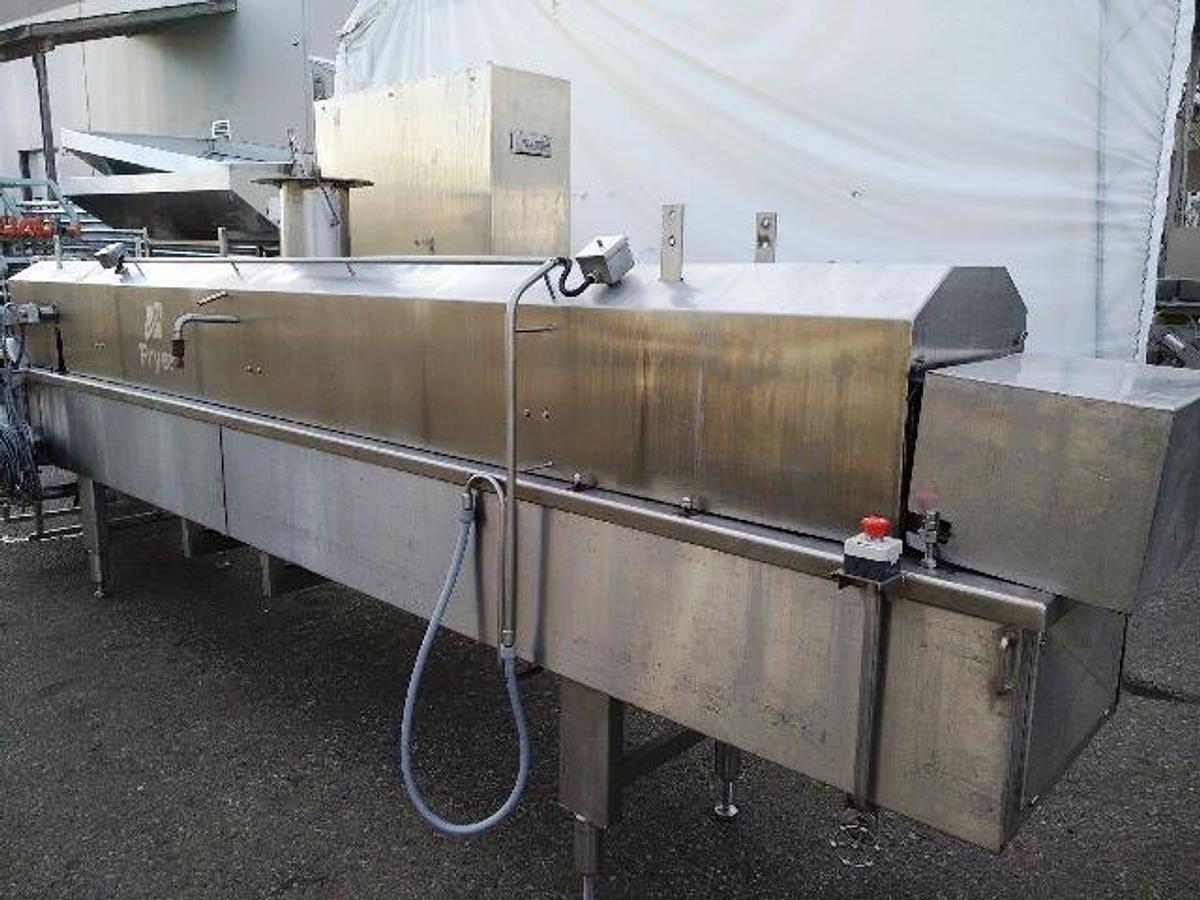
CFS continuous fryers are industrial frying systems designed for high-volume, uninterrupted food production. Unlike batch fryers that process a fixed load of product at a time, a continuous fryer moves product through a heated oil bath on a conveyor belt, allowing operators to feed product in at one end and receive finished, fried product at the other end without stopping the line. CFS, which traces its brand lineage through FMC FoodTech and Frigoscandia/JBT, became a well-recognized name in industrial frying equipment largely because of the precision and throughput these machines deliver.
The core mechanics involve a stainless steel belt conveyor that carries product through a temperature-controlled oil bath at a set speed. Operators can adjust belt speed and immersion depth to control fry time and texture, which makes the equipment flexible enough to handle a wide range of breaded, battered, or uncoated products. Temperature control on CFS fryers is typically precise to within ±1°C, which is critical for consistent product quality at scale. Many units also incorporate oil filtration systems that reduce oil degradation and extend oil life, which directly affects both product quality and operating costs. The all-stainless construction on most CFS fryer models meets USDA and international food safety standards, making them suitable for regulated food processing environments.
What types of food products can be processed in a CFS continuous fryer?
CFS continuous fryers are used across a broad range of food categories, but they are especially common in processing facilities that produce breaded and battered proteins. Chicken nuggets, chicken strips, fish fillets, schnitzel, and tempura products are among the most frequently processed items. The consistent oil temperature and controlled belt speed make these machines well suited to any product where uniform color, texture, and internal cook temperature are critical quality factors.
Beyond proteins, CFS continuous fryers are also used for french fries, onion rings, snack foods, and various par-fried or fully fried vegetable products. The adjustable belt speed and immersion depth settings give operators the ability to dial in fry time and oil exposure for different product profiles without major mechanical changes. This flexibility is one reason CFS fryers are found in facilities that run multiple SKUs on the same line. Processors handling high-volume output, whether for retail, foodservice, or institutional supply chains, typically favor continuous fryers over batch equipment because the throughput and consistency advantages compound significantly at scale.
How does a continuous fryer compare to a batch fryer for industrial food production?
The fundamental difference between a continuous fryer and a batch fryer comes down to throughput and consistency. In a batch fryer, a set quantity of product is loaded, fried for a fixed time, and then unloaded before the next batch goes in. This creates natural pauses in production, limits output capacity, and introduces variability because oil temperature can fluctuate between loads. For small-scale or artisan production, batch fryers are often sufficient, but for industrial food processing operations running hundreds or thousands of pounds per hour, they become a bottleneck.
A continuous fryer eliminates those pauses entirely. Product flows through the oil bath on a moving belt at a controlled rate, so the frying process never stops as long as product is being fed into the machine. Oil temperature stays more stable because the thermal load is spread evenly over time rather than spiking with each new batch. This stability directly translates to more consistent finished product color, texture, and moisture content. CFS continuous fryers specifically are built with precise temperature controls and oil filtration systems that further support consistent output over long production runs. For high-volume processors, the labor efficiency gains alone, since one operator can manage a running continuous fryer rather than repeatedly loading and unloading a batch unit, often justify the capital investment in continuous frying equipment.
What belt widths and capacity configurations are common for CFS continuous fryers?
CFS continuous fryers are available in a range of belt widths to accommodate different production volumes and facility layouts. A 16-inch wide belt model is a commonly encountered configuration and represents a mid-range option that works well for moderate-volume processing lines. Wider belt configurations, such as 24-inch or 36-inch belts, are found in higher-capacity installations where throughput demands are greater. Belt width is one of the primary factors that determines how much product can move through the fryer per hour, alongside belt speed and oil bath length.
Beyond belt width, the overall length of the oil bath zone also affects capacity. Longer fryers allow for slower belt speeds while still achieving full cook times, which can be advantageous for thicker or denser products that need more time in the oil. When evaluating a used CFS continuous fryer, buyers should consider both belt width and bath length together rather than relying on a single dimension to estimate capacity. It is also worth confirming the condition of the belt itself, since conveyor belts on continuous fryers are a wear component and replacement costs can vary depending on the material and configuration. Consulting with a used equipment dealer who specializes in food processing machinery can help buyers match the right fryer size to their specific production requirements.
What should buyers look for when inspecting a used CFS continuous fryer before purchasing?
Buying a used CFS continuous fryer requires a more thorough evaluation than purchasing simpler equipment, because these machines have multiple interconnected systems that all need to be in serviceable condition. The most important areas to inspect include the conveyor belt and drive system, the oil filtration components, the heating elements or heat exchanger, and the temperature control instrumentation. Belt wear is a common issue on used fryers, so buyers should look closely at belt integrity, chain tension, and the condition of the belt support structure. Corrosion or buildup in the oil pan and drain systems is also worth examining, since heavy carbonization can indicate deferred maintenance.
Reputable used equipment dealers will typically offer in-person inspections, video walkthroughs, or photo documentation to give buyers an accurate picture of the machine's current condition. Some machines may still be installed at a production facility where the equipment is either actively running or recently decommissioned, which can allow for a more complete operational assessment. Keep in mind that most used equipment dealers do not have the permitting required to run actual food production, so live product testing at a dealer's facility is generally not possible. Buyers should also contact the manufacturer directly to understand what level of technical support, spare parts availability, and service documentation exists for the specific model and age of the fryer they are considering, since older models may have more limited parts support than more recent ones.
Are used CFS continuous fryers reliable, and what factors affect their longevity?
Used CFS continuous fryers can be highly reliable pieces of equipment when they have been properly maintained and are purchased through a dealer who specializes in food processing machinery. CFS built its fryers with heavy-gauge stainless steel construction and food-grade components designed to handle continuous, high-temperature operation over many years. The core structure of these machines tends to hold up well, and the mechanical simplicity of the conveyor and oil bath design means there are relatively few failure points compared to more complex processing equipment.
That said, longevity and reliability on a used machine depend heavily on maintenance history and how hard the equipment was run in its previous application. Key wear items include the conveyor belt, bearings, seals, and heating elements, all of which have finite service lives. Oil filtration systems and temperature control components are also worth evaluating carefully, since neglected filtration can accelerate wear throughout the machine. Buyers who select a used equipment dealer with a long track record in the food processing sector and who take advantage of available inspection options are in a much better position to assess actual machine condition before committing to a purchase. Choosing a dealer who specializes in food processing equipment rather than a generalist machinery broker also tends to result in more accurate condition descriptions and better post-sale support for sourcing replacement parts or technical documentation.
What oil types and volumes are typically used with CFS continuous fryers?
CFS continuous fryers are designed to operate with a range of cooking oils, and the choice of oil depends on the product being fried, the desired flavor profile, and the smoke point requirements of the application. Soybean oil, canola oil, palm oil, sunflower oil, and various partially or fully hydrogenated shortenings have all been used in continuous fryer applications. High-smoke-point oils are generally preferred for industrial continuous frying because the oil is held at elevated temperatures for extended periods, and oils that degrade quickly at high heat will break down faster, affecting both product quality and oil change frequency.
The oil volume required for a CFS continuous fryer varies based on the size of the unit, but these are industrial machines and oil capacity is measured in hundreds of gallons rather than the small quantities associated with commercial kitchen equipment. A mid-sized continuous fryer might hold anywhere from 200 to 600 gallons of oil, and larger units can require even more. This oil volume has meaningful implications for operating costs, since oil represents one of the largest variable expenses in continuous frying operations. CFS fryers typically include oil filtration systems that remove food particles and slow oil degradation, which extends oil life and reduces the frequency and cost of oil changes. When evaluating a used CFS fryer, buyers should confirm that the filtration system is intact and functional, as this directly affects both product quality and ongoing operating economics.
What automation and temperature control features are found on CFS continuous fryers?
CFS continuous fryers are built for precision, and temperature control is one of the areas where these machines distinguish themselves from simpler frying equipment. Most CFS fryer models include automated temperature regulation systems that maintain oil temperature within tight tolerances, often within ±1°C of the setpoint. This level of control is essential in industrial food production where regulatory requirements and quality standards demand consistent internal product temperatures and uniform finished product characteristics across every unit produced. Temperature sensors are typically positioned at multiple points in the oil bath to account for thermal variation across the belt width and along the length of the fry zone.
Beyond temperature control, CFS continuous fryers generally offer adjustable belt speed, which gives operators direct control over residence time in the oil. Some models include programmable logic controllers (PLCs) that allow operators to store and recall product-specific frying parameters, reducing setup time when switching between product types. Oil level monitoring, automatic oil top-off systems, and integrated filtration controls are also found on many CFS fryer configurations. When purchasing a used CFS fryer, buyers should verify the condition of the control panel and any electronic components, since these are often the parts most affected by age and can be the most expensive to repair or replace. Asking the seller for documentation on the control system and confirming parts availability with the manufacturer before purchase is a practical step that can prevent surprises after delivery.
What are the typical maintenance requirements for a CFS continuous fryer?
CFS continuous fryers require regular, systematic maintenance to operate reliably and produce consistent product quality. Daily maintenance tasks typically include cleaning the oil pan and drain systems to remove food debris and carbonized particles, inspecting the conveyor belt for wear or damage, and checking oil filtration components. Oil filtration should be run continuously or at regular intervals during production, and the filter media needs to be changed or cleaned based on production volume and oil condition. Allowing food particles to accumulate in the oil accelerates oil degradation and can affect product flavor and color.
Periodic maintenance intervals, typically weekly to monthly depending on production volume, involve more thorough inspection of the drive system, bearings, chain tension, and seals. Heating elements or heat exchanger surfaces should be inspected for scale buildup or damage, since fouled heating surfaces reduce thermal efficiency and can cause hot spots. Belt replacement is a scheduled maintenance item rather than a breakdown repair on well-maintained machines, and keeping spare belts on hand is common practice in production facilities running continuous fryers. For buyers considering a used CFS fryer, understanding the maintenance history of the machine is valuable information. Machines that were maintained on a documented schedule by the previous owner are generally in better condition than those where maintenance records are unavailable. Reputable used equipment dealers who specialize in food processing machinery can often provide context on a machine's service history and help buyers assess what maintenance or refurbishment work may be needed before putting the equipment back into production.
What should buyers expect regarding shipping, payment, and inspection when purchasing a used CFS continuous fryer?
Used CFS continuous fryers are large, heavy pieces of industrial equipment, and the logistics of purchasing one involve several steps that buyers should understand before committing. Inspections are a standard part of the process and can be arranged in person, through video, or via detailed photo documentation provided by the seller. Some machines are still installed at production facilities, either running or recently decommissioned, which may allow for a more thorough operational review. Most used equipment dealers do not have the permits required to run food production, so live frying tests at a dealer's location are generally not available, but a thorough mechanical inspection can still provide a reliable picture of the machine's condition.
Shipping a continuous fryer requires careful planning. These machines need to be properly palletized or crated to prevent damage in transit, and larger units often require specialized rigging equipment for loading and unloading, which adds to the total landed cost. Buyers should ask sellers for detailed breakdowns of packaging, rigging, and freight costs before finalizing a purchase so there are no surprises on delivery. Payment terms for used industrial equipment typically require full payment prior to shipment, though some dealers may offer alternative arrangements for established customers. Selecting a dealer with a long track record in food processing equipment sales is an important factor, since it reduces the risk associated with buying used machinery and increases the likelihood that the seller's description of the machine's condition accurately reflects reality.