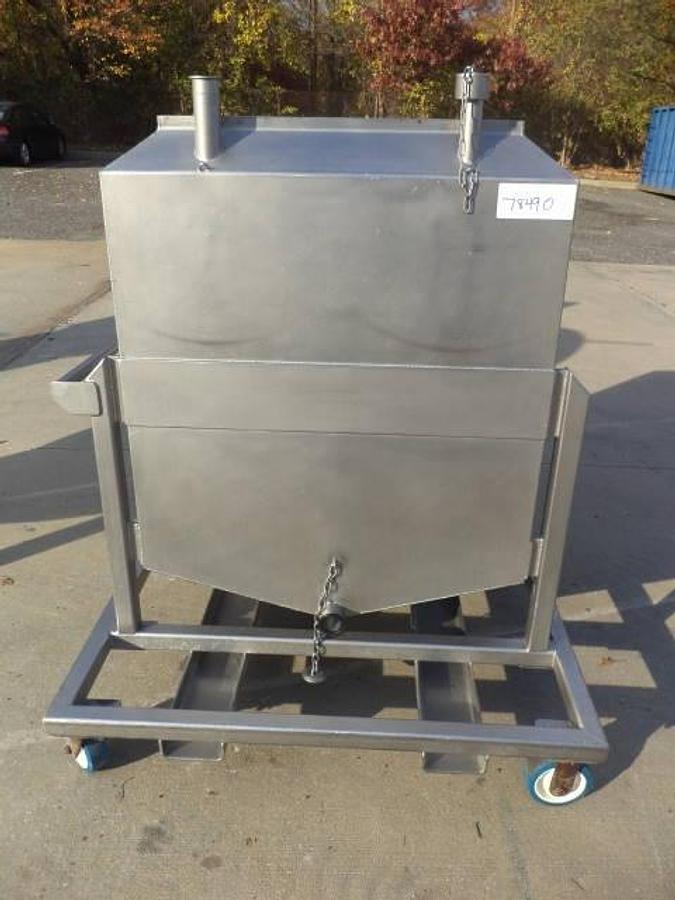
Category
Manufacturer
Model
FAQ:
What sizes do C-Mayo stainless steel totes typically come in?
C-Mayo stainless steel portable totes are available in various capacities, with 200-gallon units being among the most commonly found on the used equipment market. Stainless steel totes as a category generally range from around 100 gallons on the smaller end up to 350 gallons or more, depending on the specific model and fabrication. The 200-gallon size is a practical choice for many industrial, food processing, and chemical handling operations because it balances portability with meaningful storage or transfer volume.
When shopping for used C-Mayo totes specifically, available sizes will depend entirely on what has come off production floors and entered the secondary market at any given time. Buyers with specific volume requirements should contact the dealer directly to ask what capacities are currently in stock, since used equipment inventory turns over frequently and listings reflect what is physically on hand rather than a fixed product catalog.
What grade of stainless steel is used in C-Mayo totes, and does it matter?
The two grades most commonly used in industrial stainless steel totes are 304 and 316 stainless steel. Grade 304 is the more widely used option and handles most food-grade, dairy, and general liquid applications well. Grade 316 contains added molybdenum, which gives it significantly better resistance to chlorides, acids, and other corrosive substances, making it the preferred choice for pharmaceutical, chemical, and marine-adjacent applications. The difference in corrosion resistance between the two grades is meaningful in demanding environments, so knowing which grade a specific tote is made from matters before committing to a purchase.
For used C-Mayo totes, buyers should ask the dealer to confirm the steel grade of the specific unit being sold. This information is often stamped or labeled on the vessel itself. If the tote will be used in a regulated application such as food production or chemical transfer, verifying the grade upfront avoids costly compatibility issues down the line. A reputable used equipment dealer should be able to provide this specification or help facilitate an inspection where the unit can be examined directly.
Are C-Mayo stainless steel totes suitable for food-grade or pharmaceutical applications?
Stainless steel totes, as a general category, are widely used in food processing, beverage production, dairy operations, and pharmaceutical manufacturing precisely because stainless steel is non-porous, easy to sanitize, and does not impart flavors or contaminants to the product inside. For a tote to be compliant in these regulated environments, it typically needs to meet FDA material standards and, in many cases, be fabricated to sanitary specifications such as 3-A Dairy standards, which govern surface finish, weld quality, and drainage design.
For used C-Mayo totes specifically, buyers should verify the construction details of the individual unit before assuming food-grade or pharma suitability. A tote that was previously used in a non-food industrial application may have residues, surface conditions, or prior repairs that disqualify it from sanitary use without thorough inspection and cleaning validation. Buyers should request documentation on the tote's service history where available, and consider arranging an in-person or video inspection to assess interior surface condition, weld quality, and the integrity of any fittings or valves.
Can C-Mayo stainless steel totes be used to transport chemicals or hazardous materials?
Stainless steel totes are frequently used in chemical handling applications due to their durability and resistance to a wide range of substances, but transport of hazardous materials is governed by strict regulatory requirements. In the United States, containers used to ship hazardous liquids must carry UN/DOT certification, which involves testing for drop resistance, stacking loads, and leak integrity under defined conditions. A tote that is not certified to these standards cannot be legally used for regulated hazardous material transport on public roads, regardless of how well it is built.
When considering a used C-Mayo tote for chemical or hazardous material transport, buyers need to determine whether the specific unit carries the appropriate UN/DOT markings and whether those certifications are still valid given the tote's age and condition. Used totes may have been re-certified during their service life, or they may have been used only for in-plant transfer rather than regulated transport. The dealer should be consulted about any available documentation, and buyers may want to have the tote evaluated by a qualified inspector before putting it into service for hazardous applications.
What accessories typically come with a used stainless steel tote, such as lids, valves, or fittings?
Stainless steel totes in industrial use are typically equipped with a combination of top access ports or lids for filling and cleaning, bottom outlet valves for discharge, and various fittings depending on the application. Common configurations include butterfly valves or ball valves at the outlet, sanitary tri-clamp fittings for food or pharma use, and manway openings on top for interior access. Some totes also include agitators, heating jackets, or insulation depending on what process they were designed to support.
With used equipment, what is included with a specific tote varies considerably. A tote sold on the secondary market may come fully equipped with its original valves and fittings, or it may have had components removed during decommissioning. Buyers should ask the dealer to confirm exactly what is included with the unit being sold and to provide photos or video of all fittings, valve handles, lid hardware, and any other components. If specific sanitary fittings or valve types are required for the intended application, confirming compatibility before purchase saves time and avoids the cost of sourcing replacement components separately.
Why choose a stainless steel tote over a plastic IBC tote?
Plastic intermediate bulk containers (IBCs) are widely used because they are lightweight and relatively inexpensive, but they have real limitations in certain applications. Stainless steel totes handle high-temperature contents that would deform or leach chemicals from plastic, and they stand up to a broader range of corrosive substances without degradation. In food, beverage, dairy, and pharmaceutical production, stainless steel is often the required material because it can be cleaned and sanitized to a level that plastic cannot reliably achieve over repeated use cycles. Stainless steel totes also have a much longer service life under demanding conditions.
From a total cost standpoint, stainless steel totes carry a higher upfront price than plastic IBCs, but their durability often makes them more economical over a long service life. Buying used stainless steel totes is a practical way to access that durability at a significantly lower cost than purchasing comparable equipment direct from a fabricator. The key is to select used units that have been reasonably maintained and to inspect them carefully for dents, weld cracks, or valve wear before putting them into service.
What should buyers inspect when purchasing a used stainless steel tote?
A thorough inspection of a used stainless steel tote should cover several areas. The interior surface condition is critical, particularly for food-grade or pharmaceutical applications, since pitting, deep scratches, or contamination from prior contents can affect both cleanliness and product integrity. Welds should be examined for cracks, porosity, or signs of repair, since weld failures are a common point of concern in vessels that have been in heavy service. All valves and fittings should be operated through their full range of motion to check for leaks, corrosion, or mechanical wear, and any gaskets or seals should be assessed for condition.
Reputable used equipment dealers typically accommodate in-person inspections at their facility, or can arrange video walkthroughs and still photography of specific areas a buyer wants to examine. For totes that are still in active production at a plant, the dealer can sometimes coordinate an inspection at the facility where the equipment is operating. Buyers should take full advantage of these options rather than purchasing based on photos alone, since the actual condition of a used vessel can vary considerably from one unit to the next even within the same model.
How does shipping work for a used stainless steel tote, and what costs should buyers anticipate?
Shipping a stainless steel tote requires more planning than shipping standard freight because these vessels are heavy, often awkwardly shaped, and can be damaged if not properly secured for transit. Depending on the size and weight of the unit, it may need to be palletized, crated, or secured to a skid before loading. The level of packaging required directly affects the shipping cost, and buyers should ask the dealer specifically how the tote will be prepared for shipment and what that preparation adds to the total price.
For larger or heavier totes, rigging equipment may be needed to load the vessel onto a truck, and the buyer's receiving location may need a forklift or loading dock to unload it safely. These rigging and handling costs are typically separate from the freight charge itself. Buyers should request a detailed breakdown of all costs involved, including packaging, rigging, freight, and any fuel surcharges, to understand the full landed cost before agreeing to a purchase. Most used equipment dealers require full payment before the equipment ships.
What payment terms are typical when buying used industrial totes from an equipment dealer?
Used equipment dealers generally require full payment before a machine or vessel is released for shipping. This is standard practice in the industry and applies to stainless steel totes just as it does to other used industrial equipment. Payment is typically accepted by wire transfer, and some dealers may accept other forms depending on the transaction size and the buyer's history with that dealer. Buyers who have established a prior purchasing relationship with a dealer may occasionally be offered payment terms, but this is at the dealer's discretion and not the norm for first-time transactions.
Buyers should factor payment timing into their planning, particularly if the purchase requires internal purchase order approvals or financing arrangements. Confirming accepted payment methods and the dealer's required timeline before finalizing a purchase avoids delays that could result in the equipment being sold to another buyer. It is also reasonable to ask whether a deposit can hold a specific unit while the buyer completes their due diligence or arranges final payment.
What does 'sold as-is' mean when buying used stainless steel totes, and how should buyers protect themselves?
Used industrial equipment is almost universally sold on an as-is basis, meaning the seller makes no representations about the equipment's future performance and the buyer accepts the unit in its current condition. Unlike purchasing from an original manufacturer, there is no warranty coverage, and the responsibility for evaluating the equipment's suitability for the intended application falls on the buyer. This is the standard model across the used equipment industry, and it is why the inspection process carries so much weight in any used equipment transaction.
Buyers can protect themselves by working with dealers who have a demonstrated track record in their specific equipment category, asking detailed questions about the tote's service history and prior use, and taking full advantage of available inspection options before committing to a purchase. It is also worth consulting with the original manufacturer about parts availability and support for the specific model being considered, since older or less common models may have limited support infrastructure. Selecting a dealer who specializes in the relevant equipment category, rather than a generalist, tends to result in more accurate condition assessments and more useful pre-sale information.