Category
Manufacturer
Model
Buhler
Buhler is a global provider of industrial solutions, known for cutting-edge technology in grain and food processing machines, focusing on milling, sorting, and seed processing. Their equipment enhances processing efficiency and product quality across multiple food sectors, including baking and beverages. Buhler’s reputation is built on consistent innovation and adaptability to meet global food production challenges.
FAQ:
What types of Buhler industrial equipment are commonly available on the used market?
Buhler manufactures a wide range of industrial processing equipment, and many of these machines appear regularly on the used market as food processors, manufacturers, and industrial facilities upgrade or decommission their lines. Common categories include grain milling equipment such as roller mills, plansifters, and purifiers, as well as equipment for rice processing, pasta production, chocolate and confectionery manufacturing, animal feed processing, and optical sorting systems. Three roll mills, like the Buhler SDH-200, are a good example of the kind of precision processing equipment that surfaces through used machinery dealers. Buhler also produces die casting machines and equipment for advanced materials processing, which occasionally becomes available through industrial surplus sales.
Because Buhler machines are built to exacting standards and often have operational lifespans exceeding 20 to 30 years with proper maintenance, used units can still represent significant processing capability even after years of service. Buyers should pay attention to the specific model and generation of equipment, as Buhler has continuously updated its product lines over the decades. Older models may have limited parts availability compared to more recent generations, so it is worth researching the specific machine before committing to a purchase.
What industries use Buhler industrial equipment?
Buhler has built its reputation across a broad cross-section of industries, with the heaviest concentration in grain and food processing. Flour milling operations around the world rely on Buhler roller mills and sifting systems as core production equipment. Rice processing, pasta manufacturing, chocolate production, baking ingredient processing, and beverage ingredient milling are all sectors where Buhler machines play a central role. Animal feed manufacturers also use Buhler equipment extensively for grinding, mixing, and pelleting operations. Beyond food, Buhler is a major supplier to the die casting industry, serving automotive and other metal component manufacturers with high-pressure die casting cells.
The company has also expanded into optical sorting technology, with machines used in everything from grain cleaning to recycling and plastics sorting. This diversity means that used Buhler equipment turns up across a wide range of industrial auctions and surplus sales. A buyer from a flour mill and a buyer from an automotive die casting facility may both be searching for Buhler machinery, though the specific models and configurations they need will differ considerably. Understanding which product line a particular machine belongs to is an important first step in evaluating whether it fits a given application.
How do I verify the condition of used Buhler equipment before buying?
Condition verification is one of the most important steps in purchasing any used industrial machine, and Buhler equipment is no exception. Reputable used machinery dealers will typically offer buyers the option to inspect equipment in person, via live video call, or through detailed video documentation of the machine. An in-person inspection is generally the most thorough option, allowing a buyer or their technician to examine wear surfaces, check for cracks or corrosion, review electrical panels, and assess the overall mechanical condition. Some machines may still be installed and running at a facility, in which case the dealer can often arrange access to observe the equipment in operation.
Buyers should keep in mind that most used equipment dealers do not have the permits or production infrastructure to run full product trials, so testing under actual processing conditions is rarely possible at the dealer's location. This makes it especially important to bring a qualified technician familiar with Buhler equipment to any inspection. It is also worth contacting Buhler directly or an authorized service center to ask about the support and parts availability for the specific model being considered, since age and model generation can significantly affect what is available. Selecting a dealer with a long track record in industrial machinery and a specialization in food processing or the relevant industry adds another layer of confidence to the process.
What is the typical price range for used Buhler milling and processing equipment?
Pricing for used Buhler equipment varies considerably depending on the type of machine, its age, condition, configuration, and current market demand. Smaller bench-scale or laboratory-grade units may sell for a few thousand dollars, while large-scale flour milling systems, complete rice processing lines, or industrial die casting cells can run into hundreds of thousands of dollars. Three roll mills, optical sorters, and individual processing modules tend to fall somewhere in between, with prices shaped heavily by how recently the machine was serviced, whether documentation is available, and how much useful life remains in wear components.
Because used equipment is sold as-is, the purchase price is only one part of the total cost to consider. Buyers should factor in shipping and rigging costs, any refurbishment or parts replacement needed before commissioning, and the cost of installation and calibration by a qualified technician. In some cases, a lower-priced machine that requires significant reconditioning may end up costing more in total than a higher-priced unit in better condition. Getting a clear picture of the machine's history and current state during the inspection process is the best way to make an accurate cost comparison between available options.
Are spare parts readily available for used Buhler machines?
Buhler maintains a global spare parts network, and for many of its more widely deployed machine families, components are available through authorized service centers and distributors. However, parts availability is not uniform across all models and generations. Machines that are several decades old or that belong to discontinued product lines may have limited or no factory support, making sourcing replacement components more challenging. For these older units, buyers often rely on third-party machining, aftermarket suppliers, or cannibalized parts from other surplus machines of the same model.
Before purchasing a used Buhler machine, it is a good practice to contact Buhler or an authorized service center and ask specifically about parts availability and lead times for the model in question. Some components, particularly wear parts like sieve frames, roll surfaces, and sorting sensors, will need periodic replacement regardless of the machine's overall condition. Understanding the supply situation for these consumable parts upfront can prevent costly production downtime later. Buyers who are purchasing equipment for critical production processes should give parts availability equal weight alongside the machine's purchase price and physical condition.
What should buyers know about shipping used Buhler industrial equipment?
Shipping large industrial equipment requires more planning than standard freight, and Buhler machines are no exception. Depending on the size and weight of the unit, proper packaging can range from basic palletization with protective wrapping to full custom crating built around the machine's dimensions and fragile components. Larger machines such as complete milling systems or die casting cells may require specialized rigging equipment for loading and unloading, which adds to the overall cost. Buyers should ask the dealer specifically about how the machine will be prepared for transit and what rigging will be required at the destination.
Shipping costs for industrial machinery are not fixed and depend on distance, freight method, machine dimensions and weight, and the level of packaging required. The total landed cost of a machine, meaning the purchase price plus all shipping, rigging, and handling charges, can differ significantly from the listed sale price. Getting a detailed breakdown of these costs before finalizing a purchase is important for accurate budgeting. For international shipments, customs duties, import fees, and compliance with destination-country regulations add further complexity that buyers should research in advance.
What are the typical payment terms when purchasing used Buhler equipment from a dealer?
Used industrial equipment dealers generally require full payment before a machine is released for shipping. This is standard practice in the industry and reflects the as-is nature of used equipment transactions, where the dealer is not extending credit risk on a depreciating asset. Some dealers may offer payment terms to established customers with a purchasing history, but first-time buyers should expect to pay in full upfront. Wire transfer is the most common payment method for transactions of this size, though dealers may accept other forms depending on the amount and their individual policies.
Buyers who need financing for equipment purchases typically need to arrange it independently through a bank, equipment financing company, or leasing provider before approaching a dealer. Equipment financing is a well-established market, and lenders familiar with industrial machinery can often move quickly once they have details on the specific machine. Having financing in place before beginning serious negotiations puts a buyer in a stronger position and allows for faster transaction completion, which can matter when a desirable machine is available and other buyers may be interested.
How long do Buhler industrial machines typically last, and what affects their useful lifespan?
Buhler equipment is engineered for heavy industrial use, and well-maintained machines frequently remain in productive service for 20 to 30 years or more. The company's reputation in industries like flour milling and food processing is built partly on this durability, and it is one of the reasons used Buhler machines hold their value and remain sought after on the secondary market. That said, actual lifespan depends heavily on how the machine was operated and maintained during its service life. Equipment that ran in a clean, temperature-controlled environment with regular preventive maintenance will typically be in far better shape than a machine that ran continuously in harsh conditions with minimal upkeep.
Wear components such as rolls, screens, bearings, and seals have finite service lives and will need replacement regardless of the machine's overall condition. The availability of these parts for a specific model is therefore a key factor in how many more years of useful service a used machine can realistically provide. Buyers evaluating a used Buhler machine should try to obtain any available maintenance records, ask about the machine's operating history, and have a qualified technician assess the condition of critical wear parts during the inspection. This information, combined with a parts availability check, gives the clearest picture of the machine's remaining useful life.
What is Buhler's reputation in the grain milling and food processing industry?
Buhler Group is a Swiss-based company with over 160 years of history in industrial processing technology, and it is widely regarded as one of the leading equipment manufacturers in grain milling, food processing, and related sectors. The company's roller mills, plansifters, and complete milling systems are found in flour mills on every continent, and Buhler technology is considered a benchmark for precision and efficiency in the industry. Their equipment is also deeply embedded in rice processing, pasta production, chocolate manufacturing, and animal feed operations globally. This broad adoption across demanding industrial applications is a large part of why used Buhler machines retain strong interest in the secondary market.
Buhler's reputation is built on consistent engineering quality, energy efficiency improvements across successive product generations, and a long-standing commitment to supporting its installed base. For buyers of used equipment, this matters because it means there is generally a community of experienced technicians, a body of technical documentation, and in many cases some level of manufacturer support available, even for older machines. The depth of Buhler's presence in the food processing industry also means that used equipment dealers who specialize in this sector are more likely to have relevant expertise and a meaningful inventory of Buhler machines compared to generalist surplus dealers.
What is a Buhler three roll mill, and what is it used for?
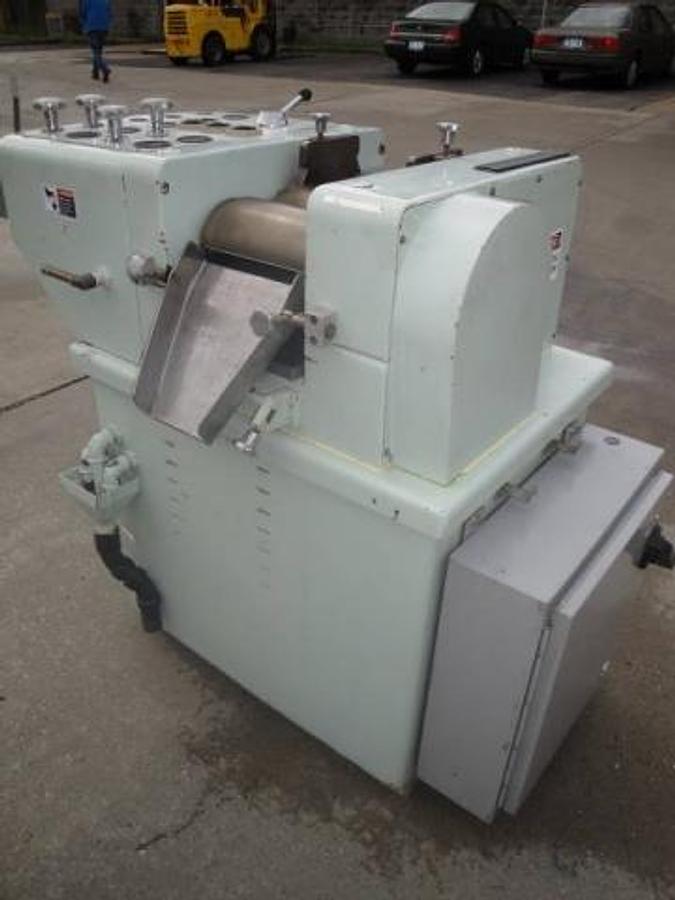
A three roll mill is a machine that uses three horizontally positioned rollers rotating in alternating directions to mix, refine, or disperse materials that pass through the gaps between them. The material is fed into the first nip, the gap between the first and second rolls, and then transferred to the second nip, where it is further processed before being collected from the surface of the final roll by an apron blade. The shear forces generated in these gaps break down agglomerates and produce very fine, uniform dispersions. The Buhler SDH-200 is one example of this type of equipment, representing the precision engineering approach Buhler applies across its product lines.
Three roll mills are used across a range of industries where fine dispersion and consistent particle size are critical. Applications include the production of inks, pigments, coatings, adhesives, cosmetics, and certain food products. In the electronics industry, they are used to process thick-film pastes and other materials requiring precise viscosity and particle distribution. Because these machines are built to tight tolerances and the roll surfaces wear over time, condition assessment during inspection should pay particular attention to roll surface quality and the adjustment mechanisms that control nip pressure. Used three roll mills from established manufacturers like Buhler can offer strong processing capability when properly maintained.