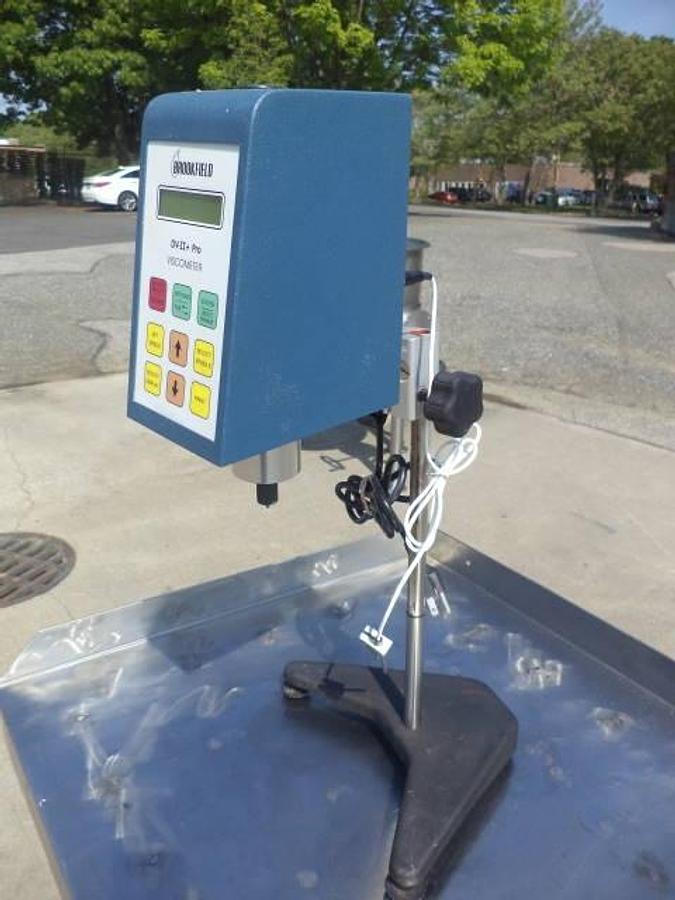
Category
Manufacturer
Model
Brookfield
Brookfield is a leading supplier of viscometers and rheometers that provide crucial measurement solutions for industries like food, pharmaceuticals, and cosmetics. Their instruments enable precise viscosity and flow analysis, essential for quality control and product development. Brookfield’s innovations support industries in optimizing formulations, ensuring consistent product performance and adherence to regulatory standards.
FAQ:
What is a Brookfield viscometer and what is it used for?
A Brookfield viscometer is a rotational viscometer used to measure the viscosity of liquids, meaning how thick or thin a fluid is and how it resists flow. The instrument works by rotating a spindle at a controlled speed inside a fluid sample and measuring the torque required to maintain that rotation. The higher the resistance, the higher the viscosity reading. Brookfield Engineering, now part of AMETEK, has been the dominant name in this category for decades and its instruments are considered the industry standard for rotational viscometry.
These instruments are used across a wide range of industries including food and beverage manufacturing, pharmaceuticals, cosmetics, paints and coatings, adhesives, and petrochemicals. In a food production environment, for example, a Brookfield viscometer might be used to confirm that a sauce or syrup maintains the right consistency batch after batch. In pharmaceutical manufacturing, viscosity measurements are critical for ensuring that suspensions, gels, and liquid dosage forms meet regulatory specifications. The instruments support both quality control on the production floor and formulation development in the laboratory.
What is the difference between the Brookfield DV-I, DV-II, and DV-III viscometer models?
The DV-I, DV-II, and DV-III represent three tiers of capability within Brookfield's digital viscometer lineup. The DV-I is the most straightforward model, designed for single-speed or basic multi-speed viscosity measurements. It displays viscosity and torque readings but has limited data output options, making it well suited for routine quality control tasks where simplicity and speed matter more than detailed analysis.
The DV-II adds programmable speed control and improved data logging features, making it a popular choice for laboratories that need more flexibility in test methods. The DV-III steps up further into rheometer territory, offering controlled stress and controlled rate testing modes that allow users to characterize non-Newtonian fluids, meaning fluids whose viscosity changes depending on shear rate. This capability is important for materials like gels, creams, polymer melts, and food products that do not behave like simple liquids. When evaluating used Brookfield instruments, understanding which model tier fits the application is essential, since buying a DV-I for work that requires rheological profiling would leave significant measurement capability gaps.
What are the main torque ranges available for Brookfield viscometers, and why does it matter?
Brookfield viscometers are manufactured in four primary torque ranges: LV (Low Viscosity), RV (Regular Viscosity), HA (High Viscosity), and HB (High Viscosity Brookfield). Each range is designed to handle a different span of fluid thicknesses. The LV range is suited for thin fluids like water-based solutions, light oils, and dilute suspensions, while the HB range handles very thick materials like heavy greases, pastes, and high-solids formulations. The RV and HA ranges cover the middle ground and are the most commonly used in general laboratory and production settings.
Choosing the wrong torque range is one of the most common mistakes buyers make. If the instrument's torque range is too high for the fluid being tested, the spindle will spin with very little resistance and the readings will fall in the low end of the meter's scale, producing inaccurate or unrepeatable results. Conversely, a torque range that is too low for a thick sample can overload the instrument. When purchasing a used Brookfield viscometer, buyers should confirm which torque range the unit is configured for and verify that it matches the viscosity range of their target materials before completing the transaction.
How do I choose the right Brookfield viscometer model for my specific application?
Selecting the right Brookfield viscometer depends on four main factors: the expected viscosity range of the fluid, whether the fluid is Newtonian or non-Newtonian, the level of data output needed, and any temperature control requirements. For straightforward quality control of a single product with a known viscosity, a basic digital model like the DV-I or DV-II in the appropriate torque range is usually sufficient. For research and development work involving complex fluids, a DV-III or a full rheometer configuration gives the ability to run flow curves and yield stress measurements.
Temperature control is another factor that often gets overlooked. Many fluids change viscosity significantly with temperature, so if measurements need to be taken at a controlled or elevated temperature, the instrument must be compatible with a circulating water bath or a Peltier temperature controller. Spindle compatibility is equally important. Brookfield's standard LV and RV spindle sets cover most common applications, but specialty spindles like the Helipath stand, small sample adapter, or cone and plate geometry are needed for certain materials. When buying a used instrument, it is worth asking whether any spindles or accessories are included with the unit, as sourcing them separately can add meaningful cost.
What viscosity ranges can Brookfield viscometers measure?
The measurable viscosity range depends on the torque range of the instrument and the spindle selected. In broad terms, Brookfield viscometers can measure fluids from roughly 1 centipoise (cP), which is close to the viscosity of water, up to several million centipoise for extremely thick pastes and gels. The LV torque range typically covers 1 to 2,000,000 cP depending on spindle choice, while the HB range is designed for high-end measurements that can exceed 8,000,000 cP with the right spindle configuration.
It is important to understand that no single spindle covers the entire range of a given instrument. The spindle geometry and rotational speed together determine the effective measurement window. A large-diameter spindle rotating slowly is appropriate for thin fluids, while a small-diameter spindle at higher speeds is used for thick materials. Brookfield publishes detailed spindle selection guides and range charts that help users identify the correct spindle and speed combination for a target viscosity. When evaluating a used Brookfield viscometer, buyers should confirm that the spindles included or available for the unit are appropriate for their specific fluid and viscosity range.
Are used Brookfield viscometers a reliable option compared to buying new instruments?
Used Brookfield viscometers can be a very practical choice, particularly for laboratories and production facilities working within a defined budget. Brookfield instruments are built to a high standard of mechanical durability, and many models have long service lives when properly maintained. The rotational measurement mechanism at the core of these instruments is not subject to the same wear patterns as heavy industrial machinery, so a well-kept used unit can still deliver accurate, repeatable readings. The key is sourcing from a reputable dealer who specializes in laboratory and analytical equipment and who can provide an accurate description of the instrument's condition.
Buyers should approach the purchase with appropriate diligence. Used equipment is typically sold as-is, which places the responsibility for evaluating condition on the buyer. Requesting a video inspection or an in-person visit to see the instrument operating is a reasonable step before committing to a purchase. Buyers should also contact Brookfield (AMETEK) directly to confirm whether the specific model and serial number they are considering is still supported with parts and service, since older or discontinued models may have limited manufacturer support. Calibration status is another consideration. A used viscometer may need to be recalibrated after purchase, which can be done through Brookfield's service network or a qualified third-party calibration laboratory.
What spindles and accessories are compatible with Brookfield viscometers?
Brookfield viscometers use a standardized spindle coupling system, and the accessories available for them are extensive. Standard spindle sets come in LV, RV, HA, and HB configurations, each consisting of multiple spindle geometries numbered by size. Beyond the standard sets, Brookfield offers a range of specialty accessories including the small sample adapter (useful when only a few milliliters of sample are available), the Helipath stand with T-bar spindles for non-flowing materials like gels and creams, the cone and plate geometry for precise absolute viscosity measurements, and the spiral adapter for paste-like materials.
Temperature control accessories include jacketed sample chambers that connect to a circulating water bath and Peltier-based temperature systems for precise automated control. On the data side, many Brookfield models support USB or RS-232 connectivity and are compatible with Brookfield's RHEOCALC or WINGATHER software for data logging and analysis. When purchasing a used Brookfield viscometer, it is worth clarifying exactly which spindles and accessories are included in the sale, since a complete spindle set in good condition adds meaningful value. Spindles that are bent, corroded, or damaged will produce inaccurate readings and should be replaced.
What should I inspect when evaluating a used Brookfield viscometer before buying?
A thorough inspection of a used Brookfield viscometer should cover both the mechanical and electronic components of the instrument. On the mechanical side, the most critical item is the pivot point and the torque spring mechanism inside the instrument head. Any sign of physical impact, dropping, or rough handling can affect the calibration of this mechanism and result in inaccurate readings. The spindle coupling (the female coupling at the bottom of the instrument head) should be inspected for wear or damage, and the drive motor should operate smoothly without unusual noise or vibration at all available speeds.
On the display and electronics side, buyers should verify that the digital display is fully functional, that all speed settings are selectable and stable, and that any data output ports (USB, RS-232) are intact. If the instrument includes a keypad or touchscreen interface, all controls should be tested. Spindles included with the unit should be inspected for straightness, since even slight bending will cause wobble during rotation and produce erratic readings. Dealers who specialize in laboratory equipment will typically accommodate video inspections or in-person visits so buyers can observe the instrument operating. Buyers should also ask whether the unit comes with its carrying case, power supply, and any documentation, as these add to the practical value of the purchase.
Do used Brookfield viscometers come with calibration certification?
Calibration status on used laboratory instruments varies depending on the dealer and the history of the specific unit. Some used Brookfield viscometers are sold with recent calibration documentation, particularly when they come directly from a production facility that maintained calibration records as part of a quality management system. In other cases, the unit may be sold without current calibration, in which case the buyer is responsible for having it calibrated after purchase.
For applications where measurement traceability is required, such as pharmaceutical manufacturing or regulated food production, calibration to NIST-traceable standards is typically necessary regardless of what documentation comes with a used instrument. Brookfield's service centers and a number of accredited third-party calibration laboratories can perform this service. The cost of calibration should be factored into the total acquisition cost when comparing used versus other options. Buyers should also be aware that calibration verifies the instrument's accuracy at the time of testing but does not address internal mechanical wear that might cause drift over time, which is another reason why sourcing from a reputable dealer with transparent condition descriptions matters.
What should buyers know about shipping and payment when purchasing a used Brookfield viscometer?
Brookfield viscometers are precision laboratory instruments, and proper packaging is essential to prevent damage during transit. The instrument head contains a delicate torque-sensing mechanism that can be affected by impact or rough handling, so adequate cushioning, foam inserts, and a sturdy outer carton or crate are important. Buyers should ask the dealer specifically how the unit will be packaged and whether a custom crate or special foam packaging will be used. Shipping costs will vary based on the destination, the weight of the unit, and the level of packaging required. Some units may ship with a spindle set and accessories that add to the overall package weight and dimensions.
On the payment side, most used equipment dealers require payment in full before the instrument ships. This is standard practice in the used equipment market. Buyers who are new to a particular dealer should expect to pay upfront, while repeat customers may occasionally be offered different terms depending on the dealer's policies. Before finalizing a purchase, it is worth asking the dealer for a complete breakdown of all costs including the instrument price, packaging, freight, and any applicable fees, so there are no surprises in the total landed cost of the equipment.